The Executive Secretary, Nigerian Shippers’ Council, NSC, Mr. Hassan Bello, has weighed the importance of National Fleet to the nation’s economy as something beneficial with exponential boost to the economy if implemented.
Speaking at an event in honor of the World Seafarers Day 2019, organized by Nigerian Maritime Administration and Safety Agency, NIMASA, with the theme: “On Board With Gender Equality”, recently held in Lagos, Bello said that the country having realized a total sum of $9 billion between foreign ship owners as freight on dry and wet cargoes in 2015 alone, can surpass the figure if the national fleet will be authorized.
According to Bello, “Nigeria for example in 2015, bring a total sum of $9 billion as freight on dry and wet cargoes between foreign ship owners, imagine what it could have been if we have the national fleet.”
He praised NIMASA’s effort in making sure that the pending project sees the light of the day through the collaboration with the National Committee on Fleeting.
“I am happy that NIMASA is collaborating with the national committee on fleeting to ensure that it is conformed.”
Also while speaking particularly on the theme of the event; Mr. Bello urged all Maritime sectors in Nigeria to acknowledge the importance of seafarers as over 60 percent are from 10 nations like Philippines, Indonesia, China, Turkey, Russia, India, United States, Ukraine, wales and Japan, while the remaining percent are from the rest of the world.
In his words, “Over 60% of the world seafarers are supplied by 10 nations, Philippines, Indonesia, China, Turkey, Russia, India, United States, Ukraine, wales and Japan.”
He agitated for the promotion of gender equality by eliminating all forms of discrimination and social vices which affects women in seafaring activities as their number is highly insignificant.
“According to International Transport Workers, ITW, only about 2% of the world’s 1.25 million seafarers are women. Seafaring is therefore a male dominating profession.
“Most of these women, 94% work under the titles of persons such as in boats and ferries, only about 6% of women work on cargoes
“According to International Maritime Organization, IMO, generally, women work as hotel staff or passing the ships, of this group, 5.1% of women are from The Organization for Economic Co-operation and Development, OECD, countries, 23% from Europe, 13.7% from America, and sadly, only 1.7% are coming from Africa.
“The reason for the low percentage of women in the seafaring is the harsh working environment from the sea to other issues such as harassment, gender disparity, violent harassment and inappropriate comments.
“For instance, over 18% of women seafarers globally have complained about sexual harassment by their male counterparts.
“And according to 2015 survey, jointly carried out by Women International Shipping and Trade Association, the International Maritime Organization and the International Seafarers on the fierce network has handed cognizance to the issue, this otherwise is pending on the profession”, he concluded.
Editor’s note: This post was shared by Amaka U (note: that could be a pseudonym)
I had just got into an Uber after standing for over two hours under the rain and sun to get a five minutes biometrics for my visa application to Australia. I have survived being shoved around, and a possible accidental discharge from roaming armed security, and noise from an angry crowd. Hmm, it’s either Nigerians love to travel or they are all gradually migrating to other countries. I can’t even reason it or google it. I am exhausted. My feet ache. I smell of sweat.
“Why do people not speak up?” I murmured to myself.
As I kept thinking about it, I picked up my MacBook and started to make this list.
Shame. As in the recent case of Pastor Biodun Fatoyinbo where the people who spoke up were ridiculed.
Stigma. What happens after I have been heard? Even if people sympathized with me, how will I cope now that the society knows and discriminate against me because I spoke up?
Loss. What happens if I lose my job, my relationships, my life, my money, my family, my visa, or anything that matters to me in the course of speaking up?
Judgement. What happens when people judge me based on my past mistakes or attack my person, as against focusing on the issue I am speaking up for; or question my motives for speaking up?
Intimidation. What if I get threats from the people I speak up against?
Acceptance. Maybe whatever happened isn’t worth speaking up for. Its okay; God dey. Wetin you want make I do? Na that wan I go chop? Abegi, leave it. Is it your issue?
I evaluated the consequences of speaking up. The experience was harrowing. I was harassed more than I have ever been in a while. I have heard friends and colleagues complain about the experience of getting their biometrics done or submitting their visa applications, but have never thought that it would be like this. Talk about wearing the shoes to see where it pinches!
I made some videos, listened to people volunteer suggestions on how to make the experience better, and made some enemies as well. I decided to record the experience. I thought seeing the video would be more reflective and bring life to my story. Making that video took some courage. It was the first time I would record a public discontent.
I am a corporate employee and not an activist, my friend and colleague told me when I recounted my experience.
“This could impact on your employer’s brand. And how would potential employers view this? You are not cut out for this,” he said, short of saying that this was beneath me.
“Social media activists who do this make a living out of this. You are not even on social media, so how would you share this?”
Well, I can find an evangelist. I just need someone passionate about social issues to read my story, visit the site to validate it, and then push it. From the “#metoo” movement, to the recent local “#stepdownbiodun”, we have seen the power of social media bring about change.
He had good intentions. I am an employee. My stance could impact negatively on the brand like the case of Nike’s employee on the HK protest . But at what point do I draw the line between expressing myself as an individual and maintaining silence as an employee? If a social issue impacts negatively on me and I want to speak up, do I have to do that anonymously so long as I have to put food on my table? Would a potential business with a vendor stop me from speaking up if I were directly involved in a social issue?
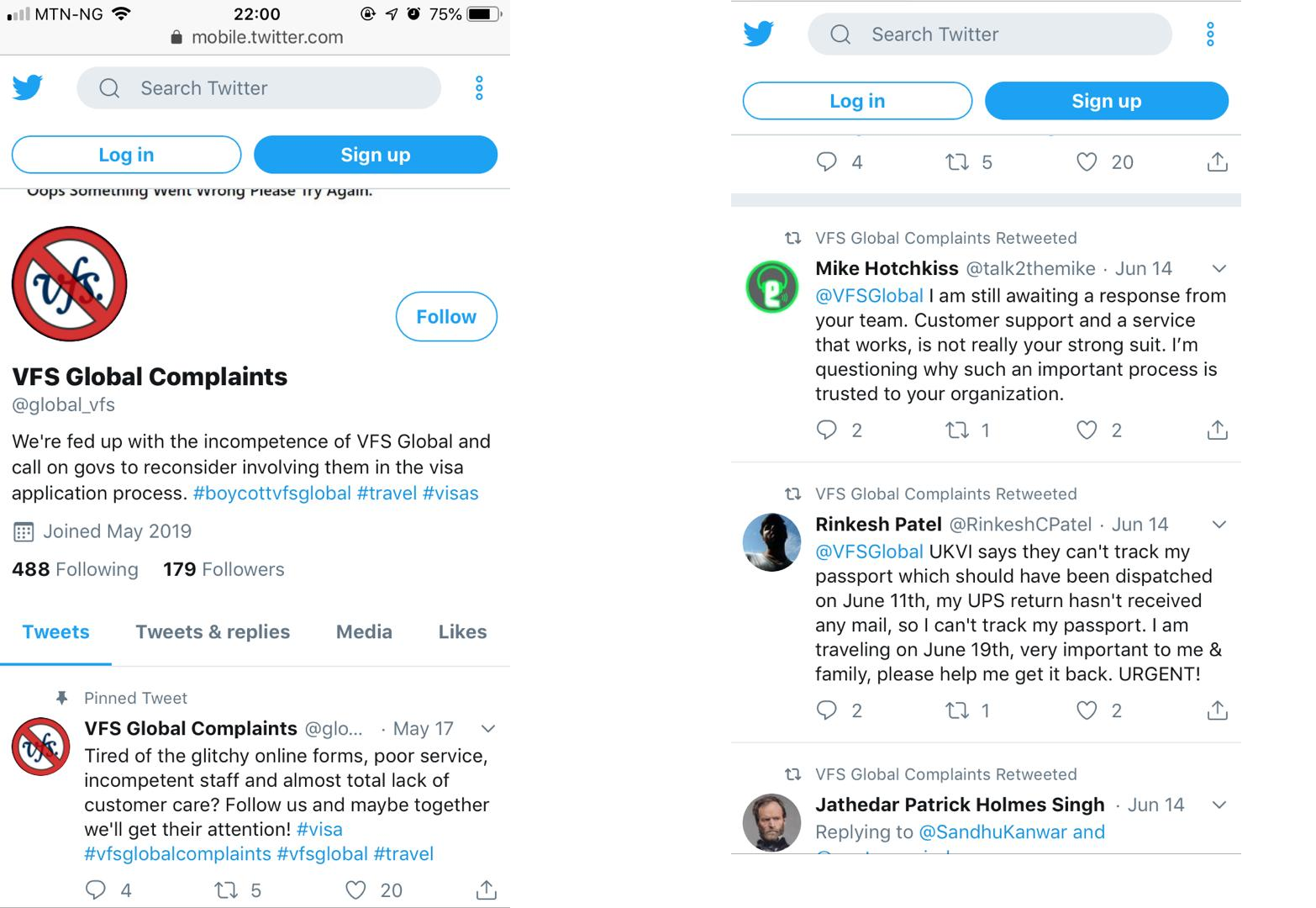
VFS Global has problems everywhere
“This is really hard,” I finally answered myself.
Maybe the legal people are already thinking about this, or who knows, they might have figured it out. But I have to google that another day. Today, I have to finish my story.
Endless evidences abound of changes that emanate when people damn the consequences and speak up. I have come to find out that in Nigeria, especially for social issues as against personal issues like rape/incest and political issues, people choose not to speak up because of reasons No. 5 and 6 above. We live in a society where the rich intimidates the poor, the military intimidates the civilians, the strong intimidates the weak, so I can relate.
While I was courageously making the video, a mobile policeman (MOPOL) approached me and asked why I was videoing him and other applicants. I looked at him boldly and smiled. I have learnt not to argue with any armed person. It’s only this life that I have. Australia can wait. Some people on the queue also attacked me. My phone would have probably been snatched from me or broken if I hadn’t held it firmly when one irate woman hit me on my hands and demanded that I stopped making the video. The person behind me casually asked to ignore her. He said it’s a misdirected anger. Her anger should be at the people who have exposed us to rain and sun and shoves and harassment over the past two hours with no end in sight.
“Their anger is justified,” he said. “It’s just misdirected at you.”
I smiled in agreement. I did not talk back at them. I only “munched up” and frowned back. Silence, sometimes, is a display of strength. No one got close to me again until I made another video.
I finally got in. I barely survived being squashed into the wall, holding tightly to my bags and standing strongly on my six-inches block heels as I pushed through the tiny space in the gate created by the MOPOL to allow people on the queue get into the compound while blocking applicants trying to jump the queue. I did make it inside in one piece.
I said a silent prayer and was looking forward to getting into the business of the day (getting my biometrics done) when two applicants started exchanging words. It was remaining just a little spite before they started to fight. There were already shoves and derogatory words like “prostitutes” and “criminal” being exchanged. The culprits were male and female. The female accused the male applicant of being a criminal because he jumped the queue and got in behind her. The male called her a prostitute for calling him a criminal. Then other applicants dared to intervene by asking the male not to call a female such a derogatory name.
Tempers were flaring just in time for an Indian VFS employee to intervene by requesting that they exit the building to continue their quarrel. What an intervention!
Then she saw that I was recording. And she turned to me. “You have to delete that video,” she said. “Or we won’t attend to you.”
I faced the camera on her and asked, “So you mean I won’t be attended to because I am capturing this experience?”
Before I knew it, the head of security came, introduced himself and asked me to follow him.
“So, he is the head of security,” I thought. I have watched in amazement as he threw orders around at MOPOL officers and the security guards as soon as he got in earlier in the morning.
“Who parked that G-Wagon in the compound?” he asked, with some air of importance.
I thought he owned the building. But even if he did, couldn’t other tenants drive their vehicles into the compound, I thought. He has to move the car immediately, he snapped. He gave more orders and then got in. That encounter was so consuming that I only remembered to record him after he had finished demonstrating.
“Where are we going?” I asked him as I found that we were about to climb the stairs.
“To my office,” he answered.
“I heard you have videos. You have to delete them,” he said with an intimidation that did not frighten me.
This time, I answered by daring him, “Oga, you have to get a gun and shoot me, then break into my phone and delete the videos that I already uploaded online. In fact, why am I even following you upstairs? Let us discuss here to the full glare of everyone. I don’t feel safe going upstairs with you.”
Now he looked at me again and saw that his plan of inflicting fear had failed. He asked me, “What is your name?”
I answered, and he said in my native dialect, *“Kedu ihe obu?”
I responded, “I refuse to be treated like this. I would not be subjected to this inhumane treatment because you have to take my biometrics. This is not right, I ended.”
This time, an Indian employee came out and offered me water, then he asked the head of security to leave as he would take it up from there. He pointed me to the direction of the Australia biometric center.
Long story short, it took less than five minutes to take my passport photograph and my thumbprint. Before that, the teller asked that I pay N8,500 with my card, then give him a copy of my passport data page.
“And in case you are not here with a copy of your passport data page, you can go into the hall to make a copy for N30,” he advised.
While I inserted my card in the POS terminal, I mentioned that it was not stated on the appointment portal that I had to pay so that I could plan for it.
“So, if I didn’t come with money, I will go back to get it, abi? Do you know what it took me to get in here?” I asked as I took my receipt and scribbled my name behind it at his request.
Then the security lady at the door came to me and said, “Madam, you are not supposed to enter the biometrics room with your bag. You have to go and drop it at the business centre.”
“Oh yeah,” I said blankly. “Did you people forget to state this on the appointment portal so that people can plan themselves?” I internalized.
Biometrics done, the lady took my passport to the teller point, copied it and gave me. They had a copier. I thanked her and left.
Outside, I met two Indian VFS employees waiting for me. One was the lady who wanted to intimidate me at the gate; the second was probably in charge of the Australian session. They apologized for my experience, the lady exited and the man asked if I made a video.
“Yes,” I said. “Because this has to stop. You see, my parents might come to apply to visit my sister who resides in Australia, and God forbid that they go through this. Nigeria is hard, I know. But I can’t lose my parents over biometrics. Imagine if in the course of squeezing us in, the MOPOL gun discharged bullets accidentally and a life/lives is/are lost? I saw a newborn baby being squeezed and suffocated. I couldn’t get in to get a video. This is not right. Could this be a capacity problem?” I asked.
He explained how the French Embassy wouldn’t let them create an appointment schedule for their applicants while mandating them to accept only 150 applicants daily. Applicants seeking French visa are more than 500 daily. How can we bring all these people in and then tell them we cannot accept more than 150? “Can this happen if it were TLScontact processing the visa application”? I asked.
I saw reasons with him yet I pushed him to explore an effective queuing system. “Push hard on France. See how it affected my Australian biometrics? Send them a video of this mess.”
Then he said, “Last week, applicants beat up our security. They also vandalized our gate.
I asked him, “Should we wait till they kill your security before we do something? I can see some shade here,” I pointed to the side of the compound that was not exposed to the sun.
“Mount a canopy, put some seats. Get people to come in order and sit according to the time of their arrival and then take it from there. Even when everyone can’t get in at once, there is a comfort for those outside that the system is fair and that it would get to their turn. This can be done. There should be a deliberate attempt to ensure that people are treated decently. You can allow the French visa applicant come in the morning and reschedule other applicants for afternoon or evening. Something has to give. My parents would faint in the condition that I was subjected to. I saw old people there. They might not be my parents, but has our culture of respecting the old died? Or does the respect end when they come to get their biometrics or drop off their passport for a visa?”
VFS executive or official driving into the compound through the whole chaos. With their windows wound up.
Then, the subtle threat, “Since you won’t delete your video, I would write to the Embassy to say that you contravened the policy of–”
“It’s fine,” I cut him short politely.
“It’s okay if I don’t get the visa,” I said.
“How do you see your sister then?” he asked.
“She will come back na. She is also a Nigerian citizen. Do your job,” I said. “There is also an online feedback portal, so I will give my feedback and upload my videos. Someone has to speak up,” I thought to myself as I bade him good-bye.
If I do not get an Australian visa but my story and video get VFS Global to modify their visa application processing, that’s a plus. My need for change is greater than my fear of not getting the Australian visa.
Back to the reason why people don’t speak up. Right now, I am not concerned about shame, stigmatization and judgement. I can’t be sure how all of this would play out; but who knows? They can wing it. Irrespective of how it all plays out, I refuse to be subjected to inhumane treatment because I need a visa.
Nigeria is hard, people are migrating in droves, but we can demand a decent treatment from vendors, especially when we have paid for it. Here is to social good!
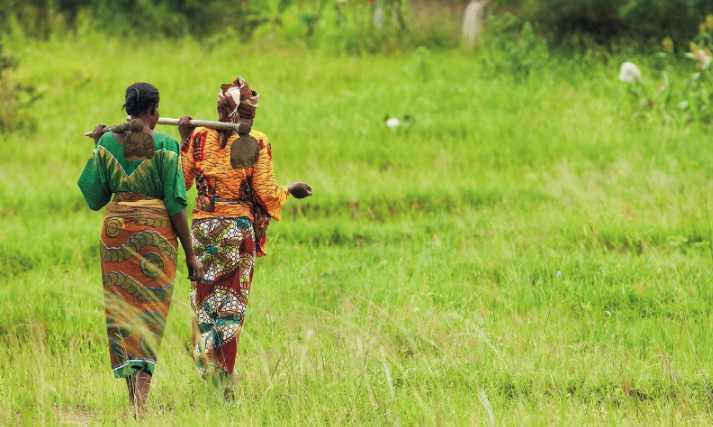
It’s no news that over 80% of the foods we eat in Africa are produced by smallholders in rural villages. These farmers are highly disadvantaged economically, as well as in formal education.
On the other hand, the food and agricultural experts from African Universities are trained to serve the large commercial farms, who are, in most cases, very few. The smallholders that constitute the majority of food producers can neither afford the services of the trained experts nor make a good business sense to do so. As a result, we are faced with the two-fold challenges of experts who do not have enough market for their services, and an existing market of smallholders who do not have trained experts to serve them.
They’ve got to be a way to make agribusiness sustainable and profitable in Africa, and especially for the smallholders. This is the center focus of the “Making Agribusiness Work” course organized by ICRA at the International Institute For Tropical Agriculture(IITA), Ibadan.
I was privileged to be part of this two-week, down-to-earth, practical and real-life oriented course as an Orange Knowledge Program (OKP) scholar. The course equips me with the necessary skills with which to build trust among the actors along the agribusiness value chain that can lead to a win-win situation for everyone.
One of the profound lessons that stood out for me in this course is the Agribusiness Cluster (ABC) approach, as against the conventional farmers corporation or producers association approaches. This model, according to our facilitator, is based on the ”eat, let’s eat” model. The model is built on the foundation that the pie can always be made large enough for everyone to take a bite if we can strike a balance between coordination and competition among the major stakeholders along the value chain.
From this course, I am better equipped not only to communicate, facilitate trust and negotiate a win-win situation for Agribusiness Clusters, but to also make agribusiness work for both smallholders and every other actor along the value chain.
I will love to appreciate the Orange Knowledge Programme (OKP) of the Netherlands for granting me the scholarship to be part of this course.
happy african male university graduate with classmates
By Adeshina Fadeyibi, PhD
The dream of every parent is to see their children secure a paid job after completing a course of study in the higher institution of learning. However, only very few are fortunate to secure the job of their dreams. Many take jobs without personal conviction, while others may never get the jobs. This last category of graduates is the one to eventually constitutes problems for our society.
Interesting, the fact that people do not easily get jobs has not stop our universities from turning up graduates every year. Thus, the number of young people looking for jobs is increasing with the future providing little or no hope. The best to offer is the National Youth Service which can only last one year.
Federal government social investment schemes such as the Npower have helped, but the schemes cannot provide ready jobs for everyone, and they are not sustainable. There is therefore the need for the government to think deeply on better, effective and sustainable ways of addressing this problem before it is too late.
This writer has an idea that can help address the growing unemployment in Nigeria. The broad idea is simple! Create Federal Farm in each state of the federation, and unemployment will reduce by 80%.
The highlights are worth sharing, and the writer has the following to say:
Nigeria has over 60% of its total land mass uncultivated, and that is an opportunity
Only a fraction of this is required by government to establish farm in every state.
Farming is robust! This means it encompasses all works of life. Hence, graduates of all disciplines can be engaged to earn a living from farming.
From cultivation of land to crop harvesting and processing, and from rearing of animals including birds or poultry to their processing, a lot could be done.
The processing of the raw materials will also be done right on the farms. This will involve equipment design, maintenance and management. Service of experts in these disciplines (Agric Engineer, Mechanical Engr, Electrical Engr etc) can be sought.
You will need the economists and the accountants to handle the area of budgeting viz a viz the income from the proceeds of farms.
Services of experts in Law will be required to give legal advice.
There are people who are into hide and skin business. Their services could be sought too.
Whether skilled (graduate of higher institution) and unskilled (those with little or no training or formal education), everyone is important here.
Here again, there is no need sweating for oil money to pay workers. There will be enough to feed the nation and to export. Government itself will make enough from the sale of the farm proceeds abroad.
The list is endless!
You can imagine if government can establish this in every state! This writer is confident it will help address unemployment among our dear graduates.
Should the indigenes of states have option to contract private experts to manage their common resources and needs or to allow their state government to continue to do the job? Our constitution is very silent on this. But, current realities make case for such a right.
There have been, in recent times, a recurring trend in Nigeria, characterized by persistent decline in the willingness of state leaders to exercise good initiatives and foresights in the duties owed the citizens. This is further exacerbated by disturbing administrative inefficiency, profligate and outrageous sharp practices in public ministries, in the state and local government levels. (The case of the central government is beyond the scope of this work).
The other side of the above observed trend is the fact that private individuals and firms, in turn, have increasingly come up with means to privately do tasks owed citizens by government. These tasks include but not limited to provision and maintenance of infrastructure, education, health care, water, and security as a result of which the only time one feels the presence of government (or rather government officials), in some states, is during election when politicians seeking reelection and their challengers come out to say things, promise things and do some fancy shows like rice sharing, money sharing, eating roasted corn on the road, moving heavy equipments to construction sites. Do they usually give specific order that the work must proceed as slow as possible, and be abandoned after election is over? That’s just what happens.
One may not be surprised if the younger generation knows nothing about the duties of government, in some states, beyond the things that they are taught in their schools about government. As such, little children may know the names of their states and local leaders, have book knowledge of what they do (or should be doing), which are in fact the formulated knowledge of yesteryears, based on what government represent, at that time.
But finding it hard to reconcile what the teacher says in school about governance and what is seen every day, these kids painfully live day by day in the reality that security is provided by family and the vigilante of the community, that parents provide water and light, that, if there were no private schools, he/she would prefer to stay at home, and be taught by family members, than go and waste talent in public schools.
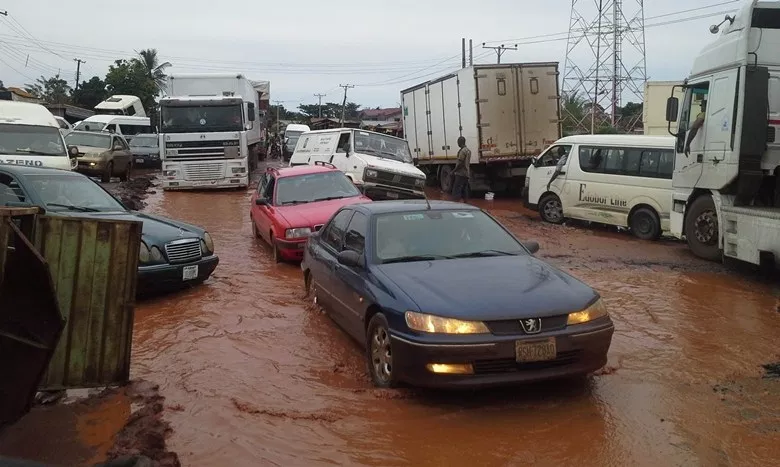
No one should be surprised if children in such states know of government existence, only when it is mentioned in parents’ radio or TV sets. No one should be surprised when a young fellow is confused after they hear that government has completed this or that road project awarded with alarming sums, and the child and his/her parent had to pay N50, for some footmen to carry them on the back, and cross the road during heavy downpour, which rendered the muddy road, that has been completed on radio, over-flooded and impassable. As it is with roads, so it is with other projects initiated by such state governments. The result of these states government’s alarming inefficiency, heart rending mismanagement of state resources and show of lack of vision, incapability in doing the job, has led citizens into the daily struggle of developing capacity to cope with both the shock of government’s inefficiencies and also the personal duty of meeting self daily need and challenges.
The nightmare associated with living daily to contain these two-faced problems, is the reason it is argued” why not give citizens the option to choose whether to still let government do the job or to use their common resources to contract experts to do the various jobs for them? These days, anything may be outsourced.
A case for reducing inefficiency (Outsourcing)
The confusion is straight. What is seen today, in state governance, is not the sort of thing we were told by the fathers and forefathers. Their stories tell us that government started because the people felt that they should form a body to manage their common needs, in order for them to enjoy efficient, excellent results. They formed this institution and empowered it with their tax and the right to exploit the resources of the land to achieve its mandate. That’s an instance of outsourcing. Outsourcing happens when an individual, or group of individuals, contract an expert, for a fee, to do a job or part of a job they had been doing themselves, when they feel that, better results will be achieved by giving out the task to the expert to do for them (this is not a technical definition). Monumental strides exist in history to show that the step taken by the forefathers, by forming government is a fantastic move. But, there are instances calling for a reexamination of how states citizens go about meeting common needs.
When individual citizens drill their own water, build roads (as it’s been witnessed in some states in Nigeria), provide own power supply, take up the task of securing their lives and properties, as well as proffering solutions to other social welfare problems that affect them, of which government is paid tax to do, (because citizens feel doing it collectively, rather than individually, will yield better outcome), that means that government is clandestinely outsourcing the job to the citizens, at a greater cost to citizens. In other words, government failure causes unofficial outsourcing of some sort. This secret, outsourcing of government jobs back to citizens is causing heavy friction and unimaginable burden on citizens, business and commerce, in the sense that, citizens pay tax to government to do these job so that they (citizens) will enjoy economic of scale, government fails to do it, or do it poorly, which makes citizens to bear the triple burden of:
(1) doing some of these jobs themselves (for which they paid tax),
(2) paying taxes to government, and
(3) Losing the enjoyment of economic of scale, which would have been gained, had government done the job well, and doing government’s job without being paid.
The chief reason for outsourcing is to enjoy better economic benefits. These economic benefits cannot be achieved if citizens go about meeting common social needs, individually, which is why government became necessary. Are the failures of government to meet these common needs of citizens satisfactorily and the unofficial relegation of the tasks back to citizens indication that government can no longer do the job well?
All Together
Citizens should not continue to suffer so much avoidable losses. If the government can no longer do the job well, the constitution should be immediately updated to that regard. It should give room for privatization of all public services and recognize that citizens have options of either paying local authorities tax to render public services or to pay experts to manage the various social needs for them. Constitution should not continue to support state governments to ill-use citizens and get away with it, through its limited choices provisions. If our lawmakers feel the system is not yet ripe for such a complex arrangements suggested, the constitution should be immediately reframed in such a way that no state administration will wreck the havoc being witnessed in some of our states and get away with it.