DD
MM
YYYY

PAGES

DD
MM
YYYY

spot_img

PAGES

Home Blog Page 6846

The Diversity of Law Practice: What Legal Trainees Agonize Over

0

By Kingsley Ugochukwu Ani, Esq.

Question: Is Law all about courtroom practice?

This question seems to be flying around, particularly in the minds and mouths of legal trainees still in school. As the years of schooling dwindle and the real life starts to beckon to them, these are questions that are the fore of many trained legal minds: is Law all about going to Courts?

It is a funny question, but a salient one, all the same. Why? Because understanding the different facets of Law practice will aid a young trainee or lawyer to make the informed decisions about their chosen career path down the line. By being thoroughly and rigorously informed about the different facets Law can take, a young trainee starts to perform their own mental calculations as to the type of Law they want to delve into, or if they even want to delve into “core” legal practice in the long run after their training.

When we were in School—at least me personally—all that was impressed upon us was that Law practice entailed long black robes, stiff white wig, then making a virtuoso performance in front of a Judge. Our lecturers took the time to regale us with their courtroom tales of dramatic cases they had been involved in at one point or other. Some often came hurrying late to classes, handkerchiefs mopping sweat from brows, armfuls of (Court) files clutched under an armpit covered in their thick suits. Without being told, we understood that they went to Court; that they had been involved in one legal “battle” with another lawyer on the “other side”. It seemed that it was The Life.

But strangely, we came out of the University and started to hear about Corporate Finance and the other strange areas that emanate from Corporate and Commercial Law. We struggled to fit it all into our heads, all the while racing against the ever ticking clocks that counted down to that Almighty Bar Part II. We passed that hurdle, thankfully, smiling when the results came out and we stared at phone screens that showed us our grades and dates for Clearance.  After that, Mergers & Acquisitions, Startup advisory, IT (fused with Law), Financial Derivatives, Islamic Finance, PPP and a slew of other practice areas came up—these probably sounds like weird music when heard for the first time.

Many tried to read a meaning into these esoteric areas but they failed. There was nothing in their curricula that prepared them for these. So they ignored them and embraced their Courtroom practice. Others tried to understand these new areas they are seeing for the first time and they realized that there was more to Law than merely going to Court. At least, we had all watched Suits, seen Harvey butting heads with opponents in esoteric contracts that left heads spinning.

An Interdisciplinary Approach

To add insult to injury, Lawyers are now adopting an interdisciplinary approach to Law: Law & Strategy, Law & Compliance, Law & Finance, Law & IT, Law & Business Advisory . . .the list is endless. Many lawyers are aghast at the thought of this notion: I mean, after all those grueling years of study, and we are still talking about mixing law with other disciplines? Many kick against it; others embrace it (I particularly love Strategy).

This interdisciplinary approach to Law has bred its own arguments. A senior was once interested in finding out more, and when he understood the bane of the Movement, he was furious. Law and Business Strategy? Seriously? Law and Information Technology? What about that other area that has set the Internet abuzz with conversation—Blockchain? How does that relate to Law? Blockchain and Law? Ha! The fury was unmitigated. Perhaps because this senior thought he had missed out on some inner joke amongst elite lawyers, or perhaps he couldn’t grasp this, but the fury was visceral. Why not leave the law as it is? Unfettered by other disciplines and esoteric leanings that leaves the average lawyer spinning around in utter confusion?

The Verein Structure

The Swiss Verein, or Swiss “Association”; legally operated from Swiss Law. And herein lies the laughing point: most lawyers—or at least the ones I have come in contact with and discussed these issues with at length—understand law practice from the purview of sole proprietorship, sole practitionership, and partnership. Anything else is unheard of.

And then enters the Swiss Verein structure. Baker & Mckenzie, Dentons, DLA Piper, Hogan Lovells, and other “global” law firms coming together under one umbrella.

Many lawyers don’t understand this structure because they have never heard of it. I am sure of at least eight lawyers who heard of the Swiss Verein for the first time ever in 2019, and only because I mentioned it to them. What sort of structure was that?

Conclusion

I am sure that I can spend countless thousands of words dissecting Law and the perception of lawyers to it, but there is no need. I can expend countless words talking about the large global firms that have successfully adopted the Swiss “Association” model, but there will be no need for that. We can also argue about interdisciplinary approaches to law, and even inter-jurisdictional approaches (yeah, lawyers getting qualified to practice in more than one jurisdiction like Nigeria and New York, for example). The point is, the arguments are diverse and the perspectives even more so.

Do what you can, but remember that Law isn’t just merely Law; a lot more is involved. Open your eyes, open your minds. Today’s global world calls for more than one approach. Choose your onions well.
Ndubuisi Ekekwe Will Speak in Society of Petroleum Engineers International Conference

4

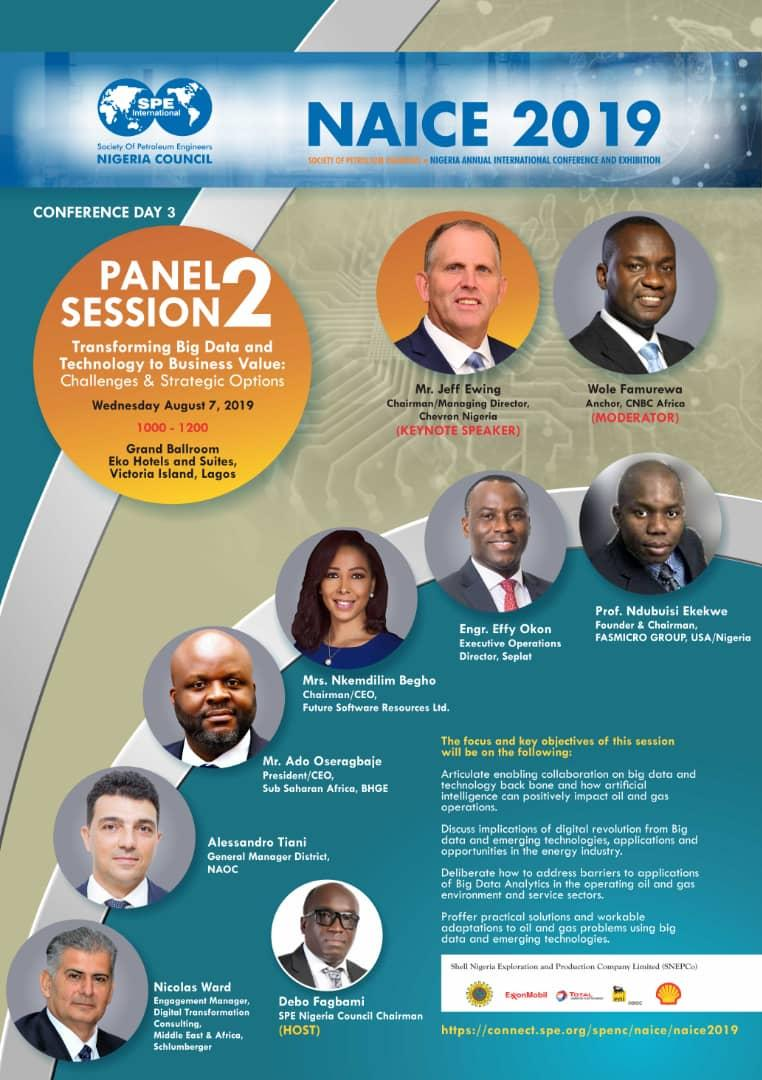
I am very excited to announce that I will be speaking in the Society of Petroleum Engineers’ international conference scheduled Aug 7th in Eko Hotels Lagos.  Many multinationals and over 1500 delegates will be attending.The mechanics of oil exploration and distribution has always been about data. In our age, the nexus has changed dramatically because it is not just about the availability of data but the capacity to refine data that matters. How can data improve fuel distribution in Nigeria, removing many elements of information asymmetry we continue to experience?

Yes, you are tracking the truck from Lagos depot to Bauchi when the liquid content has been diverted to Togo. You will get your empty truck to Bauchi and blindly tell Bauchi citizens that a truck has offloaded fuel for them! Sensors/data offer a promise to change all those in Nigeria.

Along with MD of Chevron Nigeria, leaders from Schlumberger, General Electric, etc, we will have deep conversations on how data will improve the utilization of the factors of production for the good of Nigeria in the energy sector. The banks have given us fintech; can the oil sector give us PetroTech with elements for startups to use to improve the sector, removing complexity and advance our nation. That possibility can happen even for the downstream sector, and Eket or Warri will become the PetroTech Valley.

Personally, I have Zenvus and will add a sensor to track fuel volume in trucks, push the numbers through GSM or satellite to cloud, every 10 mins, until it gets to destination. Fuel diversion solved! I am so excited about the promise of digitization and data transformation of the nation’s energy sector.

Lagos, here I come.

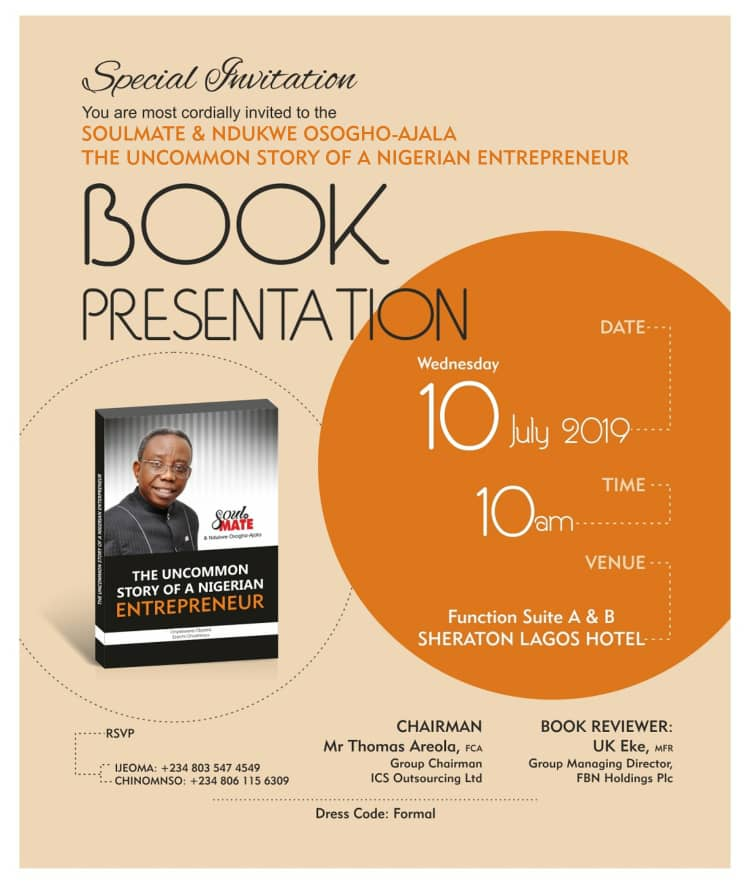
Sir Ndukwe Osogho-Ajala, a FUTO Legend and Founder of Soulmate Industries, Launches a Book “The Uncommon Story of a Nigerian Entrepreneur”

0

From our great university – Federal University of Technology, Owerri Nigeria (FUTO) – legends have emerged. In one bank IT department, we joked those days that if all the FUTO grads called off, operations would halt. The tenacity, the toughness and the excellence in FUTO have produced technical and business leaders, not just in Nigeria, but around the world.

In the business domain, one graduate is special. Chief Sir Ndukwe Osogho-Ajala is peerless. He is the Founder and CEO of Soulmate Industries Limited, the largest wholly-indigenous hair beauty brand in Africa. Before you think he worked for one of those foreign companies to begin, nothing like that; simply, he picked his FUTO class notes and built the largest indigenous beauty care brand in Africa.

With Sir Ndukwe Osogho-Ajala, (May 2019)

As babies in the business world after all the academic journeys, we always return to him for guidance. I did spend time in the colossal Soulmate campus to experience the quality and excellence in engineering and production. He explained the processes and the reasons why Soulmate continues to grow like the baobab tree.

Sir Osogho-Ajala is a visionary and a blessing not just to Nigeria but Africa in general. Some of us that have access to his personal email and phone are indeed lucky because he is an epitome of honor, values, and service.

For years, we have asked him to put the Sir Osogho-Ajala Process on paper. Yes, write something or approve for people to understand your process so that others will learn.

Good people, I am extremely honored to write that Sir has indeed given out the Sir Osogho-Ajala Process in a new book, The Uncommon Story of a Nigerian Entrepreneur. The book was launched last week in Lagos, and now available for sell. The Soulmate team is getting it ready for the ecommerce platforms but you can get it immediately via the contacts below.

Get this book to understand how to build a great business in Nigeria. All founders in my networks are getting copies because they need to understand how someone who did it DID IT in Nigeria.

Where to Get This Book

Contact number: 08061156309, 09080359876.
Email: chinweike.o@soulmateng.net, chinomnsojohn@mail.com

Selected Reviews

A detailed review of the book is here.

The book attempts to demonstrate the power of character, the essence of integrity, the end-product of purposeful leadership and most importantly, the irreducible centrality of God in fulfilling destiny. On the last point, it nullifies the relevance of god-father, except one comes prepared, with determination, honesty, hardwork, diligence and focus.

There is a lot of story-telling, which the authors deliberately employed to hypnotise the reader, drawing full attention to the challenges which adversity, lack, deprivation and denial can pose to advancement and self actualisation. Yet, we are reminded that every person is accountable for God-given talents.

Battling Nigerian Graduate’s Unemployment from the Foundation

4

By Ozioma J. Okey-Kalu

I have heard so much about how graduates burn midnight candles and end up unemployed or underemployed after graduation. Blames have been placed on the bad economic situation of the country, corruption, tribalism, favouritism and so on. I have also heard people blame our education system, which they said is the major reason Nigerian graduates are unemployable. Ok, so all these factors and more contribute to the increase in the number of unemployed graduates in Nigeria today, but is that all there is to it? Has anyone realised that most of these graduates don’t even know the profession they want. All they need is a job that will pay their bills. Now, let me share a little insight into my own career journey. Hopefully, that will tell us what most Nigerian graduates are facing today.

While I was in secondary school I didn’t know what I wanted to be in life. All I know is that I want to be rich and important (now, now, don’t laugh, this is serious). How I was going to achieve my dream I didn’t know. I only have a few ideas of what career is all about. But my school (St. John of God Secondary School, Awka) had a guidance and counseling unit. The Guidance Counsellors always organised Career Day once a year for the senior students. They usually invite resource persons from any of these five professions – medical, law, accountancy, education and engineering. This means that we always have lawyers, doctors, teachers, accountants and engineers (their areas never bothered us then) as our resource persons during the yearly career day. These resource persons will just tell us how wonderful and prestigious their professions are, how we need to work hard and then the subjects we need to pass, at the credit level, in our WAEC so we can study them in the university.

They never bothered telling us how we can start up private organisations based on these courses of study, nor the different sections in their professions. In fact, Career Day then was never interesting – there were nothing new, nothing invigorating and nothing captivating. To me it was just an event where some ‘big’ people speak ‘big grammar’ to us. Don’t get me wrong. The Guidance Counsellors gave their best shot, at least the much they can afford, but they couldn’t capture all the students, including me. Well, with the help of these Guidance Counsellors (my mother was one of them though), some students were able to choose the subjects they could comfortably write and make their grades in WAEC. So, here I was, busy studying for my WAEC without knowing what I will do with it except that I will go into the university to study…. I actually couldn’t say what I wanted to study.

I bought JAMB form and filled. I chose Law as first and second choice (Of course if you are in Arts, and you are not good in Maths, you should go for Law, right?). I wrote my JAMB and got a score that was 10 marks lower than UNIZIK ‘merit list’ cutoff mark for Law. Alright, so Law profession is out of the way because no one would do the ‘running around’ for the Supplementary List for me. Finally, the school offered me English. I took it (Do I even know what I wanted before other than going into the university?) and found out I love the course. By 200 level, a window was opened for students that would like to change over to Law. I was qualified to do that but I didn’t want to for personal reasons (I didn’t like their black and white ‘uniform’ – can you imagine this?). So, as far as I was concerned, Law profession has been buried. But then, another challenge came up – what will I do with the English certificate when I graduate? Nobody could supply me an answer to this question.

I graduated, did my one year NYSC in Zamfara State, came back home and met the monster called ‘Job Hunt’. I spent all my NYSC savings on jumping from one test or interview venue to another. I passed through a lot trying to land a job. I was literally applying to any job I see on the newspaper or job sites and writing most of their tests. I usually got invited for interviews after the written tests, but the story always ends there. One interviewer was kind enough to tell me that I was overqualified for the position I applied for and that I should be on the lookout for when there will be opening for people of my cadre.

Honestly, as I looked back to my journey in the job market, I found out I was going for jobs that I wasn’t qualified for; jobs not meant for people with my certificates; jobs I couldn’t even do well if they were offered to me. I found out where I truly belonged when I landed a job in a school – I actually love being in the midst of intellectuals, where I can bring up ideas and have them argued, analysed and appreciated. I discovered where my talents and interests fit in. And I have been developing and growing in this area.

Now, let’s look at what some Nigerian graduates are encountering in their career pursuit. If most of them are in the same situation I described above, then know it that JAMB, university authorities, parents, peers, relatives and society chose their courses of study for them. How many Nigerian graduates decided on their own to go into their current fields? How many studied their courses because of the occupation they targeted? How many Nigerians know what they wanted to be before they went into the university? How many of them even know what they wanted now? Ok, let’s stop speculating.

Make out time to visit a nearby primary or secondary school and ask the students questions on different occupations they know and the one they want to go into. The truth is, the problem of unemployed and underemployed graduates could be traced to the mismanagement of their talents and interests at the foundation level – that is nursery, primary and junior secondary schools. The only thing we tell our young ones is to go to school and study. Study for what, exactly? They need to know what they are going to school for. Therefore, we all have works to do.

There are needs for the interests, talents and aspirations of children to be discovered as early as possible – I will recommend from their nursery school days. Let us stop saying that these children are too young to know what they want. I know from experience that at this early stage, when these children are still free from the influence of the society, their talents can easily be discovered. For example, my first son loves cars, dancing and constructing toys from any materials he could lay his hands on. I noticed this about him before he was old enough to start school. He has not changed even though he is already 8 years old. At least I know what my first son wants but the second one is confusing me. He’s giving me the impression that he’s going to end up like me – you know, not knowing exactly what I wanted.

However, I am beginning to see some traces of public speaking in him, so maybe he will end up in academics like me. So I always ask myself – What if we capture these children on time and help them excel in their best areas, wouldn’t we be making them better adults? Wouldn’t the problem of unemployment be reduced? At least, among the graduates. I don’t want to call government into this because we know how that system works. Let us encourage private sectors to take up these tasks. I believe private school owners can look for experts that can do this. Individuals and organisations that are good in this should meet schools and sell their ideas to them.

Then, Entrepreneurship and Business Education should be introduced as subjects in primary schools. Pre-Vocational Studies (Agricultural Science and Home Economics combined) is not enough. Yes, the pupils will learn how to farm and all but then, they will not be taught how to set up agro businesses, manage them and expand them from the subject. They need to start early to learn about the business world – it is never too early to start that.

The students in secondary school should be conversant with the areas they want to go into if their nursery and primary schools prepared them well enough. Their interest this time should be how to perfect the basic skills in their desired profession. It is good that WAEC has introduced more vocational and technical subjects into the system, but this shouldn’t be just for senior secondary; let it be extended to junior classes as well. By so doing, these students will be going to higher institutions with a clear vision of what they need and not just to make good grades, then come out and hover around looking for employment.

As for students in the higher institutions, make good use of the resources at your disposal. Find out different job opportunities open to people in your field of study, and their basic required skills. This will enable you to focus and to plan ahead on how to acquire and develop these skills. Lecturers should also help out here. Nobody told us where we will drop our applications during our university days, so we came out of school lost. Let lecturers, and teachers too, be the guide these students need.

For unemployed and underemployed graduates, I will say, “Stop jumping into every test and interview centre you see. Take your time to find out what it is you truly want. Then ask yourself what it will take you to get there. Draw a road map of the way to your goal. By the time you have done these, pick up a job your see to act as a source for sponsoring your way towards your dream job or business.” As I always say, once you are looking for something, you will surely get it. When and how is what I can’t say. So, let’s keep searching, we will all get there. Remember, the hustle is real.

Nigerian’s Fintechs Biggest Challenge

0

The African Union had agreed on key aspects of AfCFTA such as tariffs, a monitoring system and a digital payment system. This means that AfCFTA is now effectively operational even though trading with the heavily reduced tariffs will begin a year from now, Fortune notes. Yes, next year! I have noted the implications on banking, and why Ecobank, UBA and Standard Bank are promising because of their geographical footprints.

AfCFTA’s digital payment system, Pan African Payment and Settlement Platform (PAPSP),  will be a great deal for Africa. Besides the “rule of origin” clause which remains largely non-conclusive, how the PAPSP works will be the game changer in this treaty.

And that will shape the new selling points for most African fintech startups. Nigerian fintech startups must look outwards over the next one year as AfCFTA evolves since geographical footprint will become a strategic advantage (I wrote few years ago in Harvard Business Review that locality is a competitive weapon). But these fintechs may not need to open new branches in new territories – they can form alliances (think of Ecobank Nedbank alliance). (Mergers and acquisitions are also options.)

The Ecobank Nedbank Alliance is the largest banking network in Africa, with more than 2,000 branches in 39 countries. As part of its commitment to offer a unique one-bank experience, the alliance provides tailored banking and LocalKnowledgeAfrica™ to Ecobank  and Nedbank  clients across the Africa continent.

Watch at this video.

Yes, PAPSP can solve the case in that video, and if it does, the most important friction in African trade and commerce will be gone. The things remaining will be marginal in value, diminishing the interests for huge investments by global investors! Do not take this construct for granted. We all know the key friction in the disparate African economies. If PAPSP does the fixing at scale, what again will be in the business plans for fintechs with continental roadmaps?