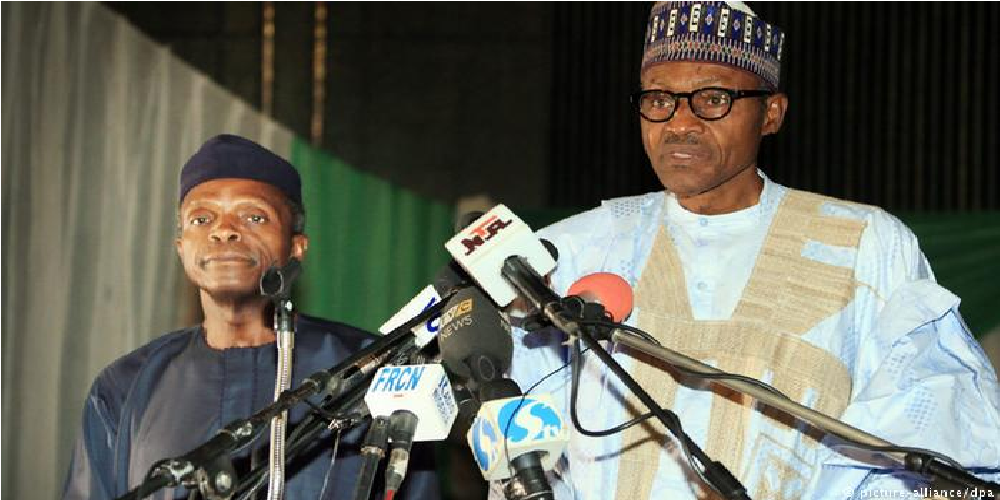
Nigeria’s President, Muhammadu Buhari, has received the report on impact of the African Continental Free Trade Area agreement (ACFTA). As you know, most African heads of states have adopted the phase 1 of the agreement. Nigeria’s president sees positives and negatives which ACFTA can bring to the nation. Then, he dropped the words:
“Our position is very simple, we support free trade as long as it is fair and conducted on an equitable basis…As Africa’s largest economy and most populous country, we cannot afford to rush into such agreements without full and proper consultation with all stakeholders. …Africa, therefore, needs not only a trade policy but also a continental manufacturing agenda. Our vision for intra-African trade is for the free movement of “made in Africa” goods. That is, goods and services made locally with dominant African content in terms of raw materials and value addition.”
If you are reading carefully, President Buhari was alluding to the “rule of origin” clause, making sure that the goods which will have low or zero tariffs are actually made in Africa. You do not want France to open factories in Morocco which has an agreement with it, to make things in Morocco, and then ship to Nigeria tariff-free.
Besides, the president hinted on the need to fix key frictions like logistics which will really make Africa thrive. African Development Bank had already concluded on that one also: tariff is useful but building infrastructures will deliver most impacts to Africa’s economic future.
ACFTA (African Continental Free Trade Agreement) has been heralded by many as a possible panacea to many trade frictions in Africa. Interestingly, the African Development Bank’s 2019 African Economic Outlook may have a clear insight on what really matters: “trade costs due to poorly functioning logistics markets may be a greater barrier to trade than tariffs and nontariff barriers”. Yes, logistics paralysis in Africa is more critical than tariffs.
We are studying Jumia and this is our prediction: Jumia will emerge as one of Africa’s most dynamic aggregators of digital commerce. Recently, Jumia is not building but rather partnering and aggregating others. That is a potent business model: Aggregation Construct. Max is handling packages in West Africa, So Fresh is dealing with the food domain, and so on across market domains.
In coming months, Jumia will add music, video and broad entertainment through aggregation. We are examining this company and Jumia has no plans to put huge CAPEX but rather orchestrate partnerships on its near 4.5 million users in Africa. Being public brings discipline; Jumia is a public company traded in U.S.
Jumia Prime will not have any value without those elements. And to make it useful, Jumia will aggregate many things around it: “Jumia launches Jumia Prime, mimicking Amazon Prime, on a brilliant double play strategy where it promises to offer free shipping to customers, in Lagos and Abuja, who pay subscriptions to use Jumia.”
Jumia Music, Jumia Video, Jumia Readers, etc are coming. Yes, I expect Jumia to bundle subscriptions of some important publications for its Prime members. Expect FT and HBR there. Jumia Video could be a potent competitor to iRokotv than Netflix or DStv in Nigeria as Jumia Prime will make price lower.
I have this mindset that every sector in Africa is still largely at infancy. Yes, I do not believe anyone has won anything except in areas Dangote operates in Nigeria! Our application and utilization of the factors of production are still extremely inefficient. This means that you can attack any sector and find your moments. Yet, the reason why most are at infancy levels could also be the reason why you need to examine the business battles you choose to fight.
I like to motivate and inspire young people to understand that despite everything they read, Nigeria offers opportunities. Let me take my blog, Tekedia.com, as an illustration.
When I began blogging about two years ago, I decided that it must be useful to people that visit Tekedia.com. We need to bring originality, predictability and authenticity. But it won’t cost me money since I am already spending resources via my time. I put 90 minutes of everyday on LinkedIn and Tekedia.com. But it is part of my business since Tekedia anchors most things we do. Without it, we cannot operate effectively on our works with startups and also our broad advisory services. Simply, Tekedia is our oasis in the One Oasis Strategy.
To be at that expense parity, my team added payment section for exclusive contents. I had told them that they must find a way to ensure we cover all costs. Then subscriptions took off. Most of the subscribers are actually corporations who pay for their staff. Largely, they like what we have here and want their staff to come and read, about Nigeria and Africa.
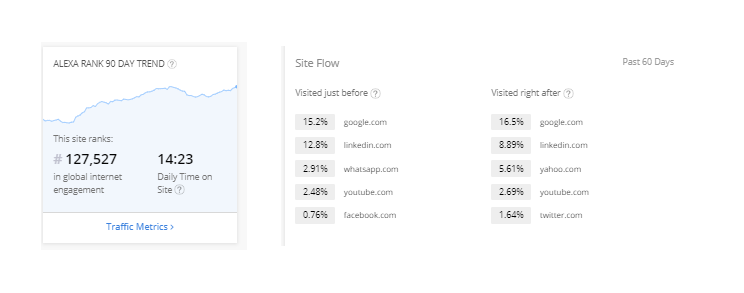
About 70% of Tekedia readers come from typing Tekedia.com, using Alexa. We do not pay attention to Twitter and Facebook. Rather, we focus only on LinkedIn where we think we have our audience. Yet, LinkedIn brings less than 10% of the traffic. What happens is that once people come from LinkedIn, they now begin coming directly. Tekedia enjoys average visit of 14 mins; yes, visitors spend at least 14 mins per visit on average.
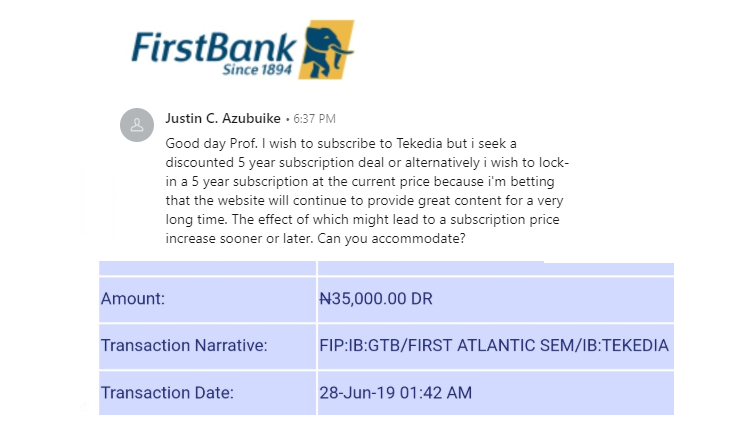
Today, I will use one customer that permitted us to share his transaction. He has paid for the next five years on Tekedia. Yes, he locked the subscription because he thinks we will raise price soon. Yes, someone is subscribing to a blog and paying for five years ahead. We have a Japanese company that paid for three years for its staff; the same for a Virginia company.
Why would they do that in the age when everyone thinks media cannot sell contents? Simply, being different! Yes, if you are different, the society will reward you. Do not go and copy Punch, Forbes, etc and hope you can create a product people will pay. But if you have your uniqueness, you will get that payment. We have thousands of subscribers in this blog and certainly do not care for those intruding Google ads everywhere.
Here is the link to subscribe. If you subscribe, we offer one more thing: I will personally respond to any professional question you send to my team.
I hope this is of value. This is a hobby but I have learnt these days that society can also pay for your hobbies if you do them well. Be unique and offer value in whatever you do, society will reward.
This is my comment to an analyst who wrote about Tekedia
Great insight but it seems you missed key parts of Tekedia. People spend 14 mins per visit on Tekedia according to Alexa you quoted. Techcabal for example is 2 mins. Nairametrics is 5 mins. If a site can retain people for 14 mins per visit, it means you can sell things to them. It is no more a news site but a mini-portal.
Also, you flipped and muddled the sources: 70% of users visit Tekedia directly through tekedia.com. For us, that is better than Google search. You are making it look like having a visit from Google search is better – that is not true. We do not even care if Google finds us because our business is not built on traffic but subscriptions.
Tekedia is not built for traffic – we have no Facebook, Twitter etc strategy; we want only quality visits which we found LinkedIn offers. Even LinkedIn where I am active contributes less than 13% of our traffic. Once people visit, they become fans and visit directly via typing tekedia. Google is 15%. FB is less than 1%. If you run it, 70% come to the site because they have paid and subscribed. Or want to read.
We are one of few blogs in Nigeria people pay to read exclusive contents. If you add ecommerce to Tekedia, you will make sales. I am hoping for a proposal in that space from people.
Jumia is firing on all cylinders these days. There is a new level of intensity that comes when you are a public company. If Amazon did it – yes, getting Whole Foods, a grocery chain in-house – we will explore our options. An option is here: Jumia is partnering with So Fresh, a Nigeria-based fresh food chain, to deepen its competitiveness in the restaurants service nexus.
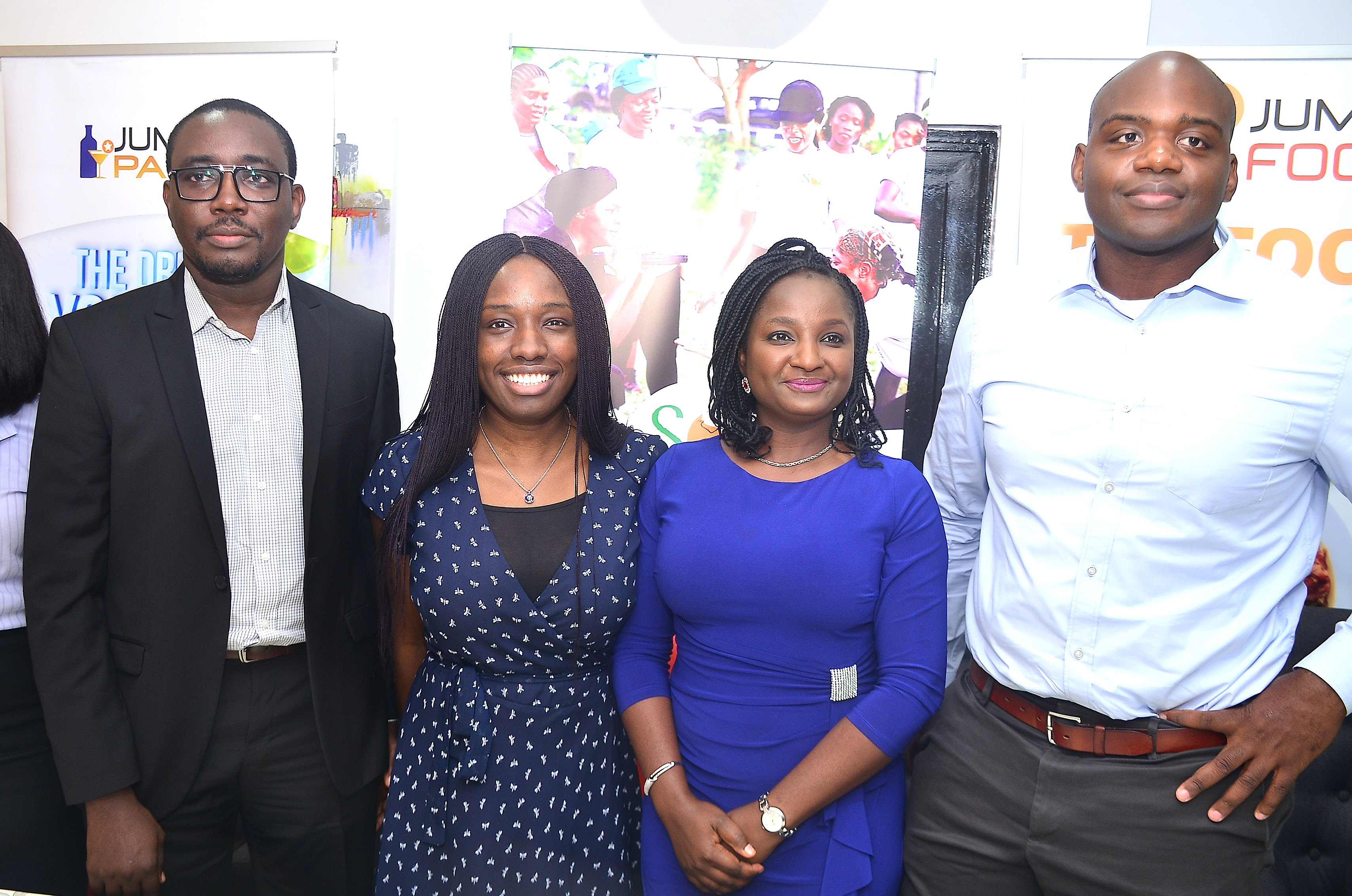
Jumia Food Nigeria has added So Fresh, Nigeria’s leading fresh food chain, to its ever-growing catalogue of restaurants on its platform. This is in a bid to promote healthy living among Nigerians.
Guy Futi, the Managing Director of Jumia Food said the company’s commitment to promoting and encouraging a healthy lifestyle among Nigerians necessitated the partnership.
“As a business, we are always looking for new ways to serve our customers, such as through a partnership like this. I am particularly excited with So Fresh because this is an opportunity for us to support and sustain healthy lifestyle among Nigerians through the consumption of fresh foods which customers can now order from So Fresh on Jumia Food.
If you look carefully, Jumia is using its brand equity and visibility to become an aggregator. That is a winning model any day. So Fresh is in, and the journey to flip Africa from atoms to bytes in commerce continues!
In the aggregation-integration construct, more values accrue to the entity that controls demand, not supply, since supply is largely unbounded and unconstrained. For example, the number of news sources (i.e. the suppliers) is large while the entities that host users and control their experiences like Twitter, Facebook, and Google (i.e. the aggregators) are limited. These aggregators accumulate most gains and also hold more power over the suppliers of news like newspapers.
What does it mean to be Nigerian? What is the Nigerian dream? As more of the best Nigerian minds continue to despise their country and seek greener pastures outside its shores, it’s time to get introspective and ask if being Nigerian is a blessing. Are you better off being born in Nigeria than say Ghana or Rwanda?
What is a Nigerian life worth? The life of an African Giant, borrowing the words of a famous Coachella rebel. Statistically, this type of thing is measured by GDP per capita, which is the Gross Domestic Product (GDP) of a Nation divided by the population of that country. GDP measures the total output of a country, so you can see why dividing total output by population, even if unevenly skewed, gives you an idea of how rich the citizens of that country are.
Let me add the caveat that I have a problem with using the GDP per Capita as a measure of the wealth of citizens because for very small countries with vast amount of natural resources like Oil, their GDP per capital numbers would be astronomically high, but this rarely translates into economic growth for its citizens given that the Oil would most likely be drilled by foreign companies who would pay royalties to the Government who, seeing as this is Africa, would most likely siphon most of that money into offshore accounts and personal pockets. Proponents of this metric however say that indirectly, a higher GDP always translates to better lives for citizens, this is true if you were dealing with countries not riddled with bad governance and crippling theft like we have in Africa.
Back to Nigeria, according to stats, a Nigerian would be the 13th richest person if all Africans were lined up in hall. That’s because Nigeria’s GDP per capita is ranked 13th (so much for being the richest African economy but this is offset by being the most populous Country as well, so way too many zeros to divide by). The stats say a Nigerian life is worth $1,968 (roughly N700,000). Let’s hold on on how laughable this figure is in a country where minimum wage is $50 (recently increased to $83). This presumes that in a year, a basic Nigerian would have earned (or accrue a GMV) of about N700,000. You’re laughing, I’m not.
Most Nigerians would tell you they don’t feel their life is worth almost $2,000. Mothers sell their babies for as low as $100 and even less, people commit heinous crimes for as little as $50, these people don’t think their life is worth anything more. This great disparity between what the Economists say and what the average Nigerian says is largely down to how poor and corrupt our Government is at the expense of the Nigerian life and not necessarily because the Economists are far off in their estimates. Even if we were to stick with the stats, is a Nigerian life worth that much? I sincerely doubt it because the power brokers do nothing to show that a Nigerian life is the 13th most expensive in Africa.
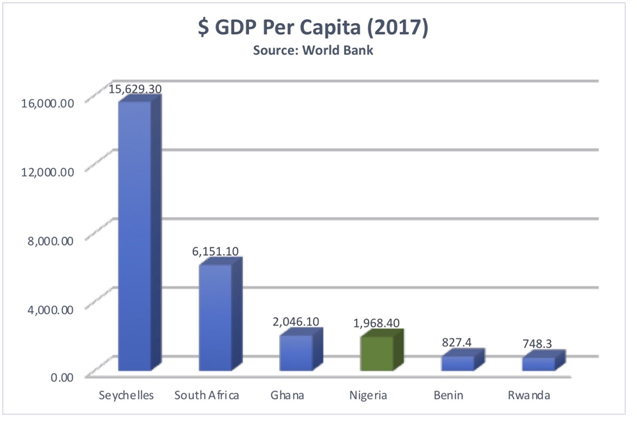
GDP per Capita hides the reality (Source: World Bank)
If you place Nigeria close to its peers, like the Graph above shows, they are no where near their contemporaries. Nigeria’s GDP figures just do not make sense, and that’s saying something given that most Nigerians already think this figure does not represent their current state. The much heralded benefits of macroeconomic growth that Economists like to tout has not happened in Nigeria yet, our Healthcare remains one of the poorest, road accidents are still high, police brutality and crackdown keeps rising. The supposed dividends of high GDP remains elusive.
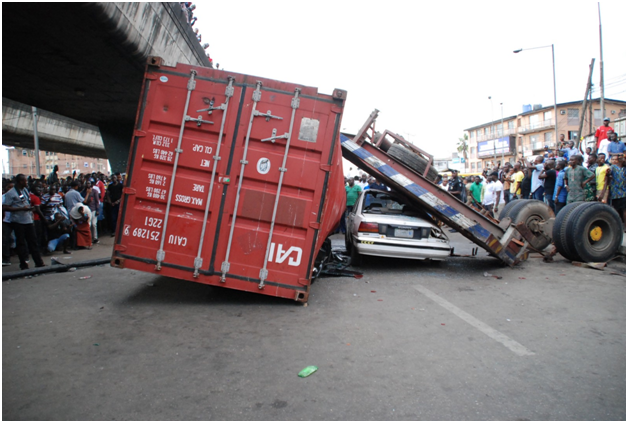
As a Nigerian, it’s tough looking at the Graph above, I have carefully selected the comparable Countries for good measure. A Nigerian life is supposedly worth 2x a Beninese but the Government of Benin Republic treats her citizens like they are worth 10x that of a Nigerian life. In Benin Republic, motorcycles have their separate lanes to reduce the risk of accidents on the main road, where having to share the road with cars could prove fatal. Trucks carrying containers out of the Port in Cotonou are well bound to reduce the risk human accidents. Remember, a Beninese is only worth about $800.
Source: Google
Compare this to Nigeria where trucks carrying containers out of ports are not well bound and regularly kill Nigerians and this has happened more than once, with no sufficient response from the Government. Remember, a Nigerian life is worth about $2,000. The action of the Nigerian Government towards the Nigerian people, if anything, is an indication that the Nigerian life is worth close to zero. Rwanda has become a beacon for how to deal with conflict resolution, Nigerians flock to Rwanda during the holiday season because RwandaAir (their National Carrier) offer discounted flight options, the Government issues Visa on Arrival and they have natural parks and well maintained tourist attractions, they even have a spot on Arsenal’s Jersey. Yes, the English football club. How much is a Rwanda life worth you ask? $748 or almost 3x a Nigerian life. Is that a heavy sigh you just heaved? It reverberates round Nigeria, if that makes you feel any better.
Little wonder, the current generation of Nigerians leaving the country are the ones who were promised the “future” but have grown to the realization of being governed by the very people who ruled their parents. Our best brains are leaving, the very best of them across key sectors and professions meant to herald the next phase of Economic growth. The services sector makes up more than 52% of Nigeria’s GDP, guess where those who are currently leaving the country come from? You guessed right, the Services sector. No Nation can become successful if it continues to pay zero attention to its future. The Countries embracing these smart young Nigerians understand the need to secure the future while Nigeria’s Government continue to despise its future with wanton killings orchestrated by the Nation’s Police Force.
The drivers of the Services sector, Power, infrastructure and security, remain poorly addressed. Just the other day, a British Aid worker was kidnapped and killed in the North, next, it was a young man killed by the Police. Every day, there’s sad news infiltrating our polity.
Where are the people meant to protect and govern us, you ask? They are jostling for juicy positions in both the Executive and legislative arms of Government.
Remember, a Nigerian life is worth almost $2,000 or N700,000 per annum if you please.