DD
MM
YYYY

PAGES

DD
MM
YYYY

spot_img

PAGES

Home Blog Page 6863

How To Get A Job – In Nigeria, Africa

9

By Ajayi Joel

So where do we begin? You are a graduate, an undergraduate on break, dropout, or you know someone who knows someone who falls in this category.

If you’ve searched for jobs and you don’t seem to get one. Yes, something is not connecting: I mean with all your degree, they said they would pay you N40,000 per month.

If it’s comfortable for you to the extent that you would have time to build yourself on a skill, then it’s worth considering, but if it would take all your day, and you would end up spending everything without saving, then forget it. There are some basic things you can do, and I would want you to be deliberate about them. I mean success is deliberate. It doesn’t jump on people.

More so, it would also come with pains, and discomfort, but it would help you a great deal and get you to become qualified for a job. There are phases to rise to that mountaintop. Here are things to consider.

First, Sit at Home

Sit your simple self down at home, and make a straight decision with your life. I mean your father’s house, your uncle’s house or any house that you would not be the one to cater for your feeding.

If your uncle’s house is the best place to go to accomplish this or your aunty, then go there. Sit down at home. You probably must have saved some money from NYSC.

If you are a dropout or you didn’t do NYSC, your path is going to be different – go get a job around. A menial job is not a demeaning job. Swallow your pride.

Now let’s analyze this for the straight path that did NYSC. You have a wide range of options while you sit at home.

  1. You can decide to learn a soft skill online for months or a year: 6 days per week of daily dedication to learning would take you somewhere. Entities like Udemy and Coursera are great ecosystems to learn things.
  2. You can decide to learn a skill outside, but it would cost you money. If you have saved from your NYSC, then you can use the money.

The fact is that you would definitely have not to worry about feeding, that one is covered. All you need to do at your uncle’s house is wash his car, wash the dishes, and clean the house.

Doesn’t make sense right? Then forget it! Do it your way.

But sitting at home saves you a whole lot of money and time. I mean learning actively DAILY for 6 days is something huge. But there is a friction somewhere!

Who would pay your data subscription expenses? Because there is definitely no way possible that you will not incur cost on data charges if you really want to learn. So who will pay for your data charges? This is where a good strategy on saving comes into play. Perhaps you had planned during your NYSC for the rainy days. Dip into the saving and spend on productive things. I mean things that would improve your ability to improve your capabilities.


Build a Network of Influential People

Connect to the people in the society who have influence and money. You can do this via the church or mosque or anywhere people can make themselves accessible to you.

This is the fact: schools do not emphasize networking, and that is unfortunate. Here are ways to connect to influential people.

  1. Try to get their social media handles. Facebook, twitter, Instagram, etc
  2. Be active on their posts, turn on the notification for the persons post. Once such person makes a post, quickly respond to it based on your knowledge. I mean respond if it’s something relating to what you have an idea about, and not something that would make you appear foolish.
  3. Send a direct message, send an email. I believe emails have more response rates. Mail them; they would respond if they are the ones handling their mails. In most cases they are. Let your message be around wanting to learn more, wanting to stay connected or you can offer your service for free to them.

Sounds crazy right? It has worked for me in many scenarios. Fine, they may have someone working for them in that field, or might not need your offer. Chances are that they would want to reply you to feed their ego or want to help you out.

Be deliberate about almost this. I have the WhatsApp contacts of some successful entrepreneurs and I chat with them via WhatsApp that they reply immediately. I have learned quite a lot from the chats. You can as well.

All Together

Getting a job in Nigeria and broad Africa is hard. Simply, to overcome the hurdles, you need a strategy. It may be better to pass over that poor job to have time to prepare yourself for a better opportunity. But even when you are preparing yourself, make sure you are connecting with the people that could offer you a hand to climb the ladder of careers. In a nutshell, you must have a plan on the points I’ve noted, as that plan and executing it are the critical elements to success. That success is a great job! Good luck.


Uber Plans UberBOAT in Nigeria, West Africa

2

Logistics is commerce. And whenever there is paralysis in logistics, supply chain struggles. Nigeria and indeed Africa have doses of supply chain paralyses at scale. Yes, while many just complain, some brilliant minds are out to fix the frictions and enjoy the glories. Gokada, Zido, Kobo360, Max and other transportation sector related startups have been in business to fix the frictions at different levels and domains: Kobo360 with trucks, Zido with tricycles and Gokada with motorcycles.

The big news today is that Uber is expanding operations in Nigeria and broad West Africa with UberBoat. (Uber is currently operating in the region; it is simply upping the game with new investments.) Yes, Gokada went for it, Max followed and now Uber has come for the moments. Just for saying that, Uber saw its stock onto the northstar, rising 5%. You know what? Markets like that Uber will swim in the Lagos waters to help Nigerians move faster. Game on – logistics; may the best solution win!

Uber is looking to expand into West Africa. Shares of the ride-hailing company rose as much as 5% on Thursday after an executive told Reuters that Uber was talking to regulators in the region about expanding its services in Senegal and the Ivory Coast.

Uber is also exploring the possibility of offering boat rides on waterways in Lagos, Nigeria, to alleviate street traffic, according to Reuters. The company started offering boat rides in Mumbai, India, earlier this year. Uber already launched a ride-hailing service in Lagos, a city with 20 million people, in July 2014.

Building A Start UP Culture

0

By Sani Nahuche

An organizational culture is difficult to characterize, yet it’s woven into everything an organization does. It’s the reason workers love or loathe their employments, or clients can feel esteemed or overlooked. Like notoriety, it takes a very long time to assemble a decent culture, yet just a couple of stumbles to destroy everything. That’s why smart founders focus on developing company culture from day one, and work like mad to protect it for the duration.

Start-up founders typically focus on improving their hard metrics that they think little of the organizational culture. They have outsourced that responsibility to someone in the firm. Yet, organizational culture isn’t just about office game rooms, free titbits or easy-going Friday. It’s about how your group cooperates. It’s what your group has confidence in, and what they esteem the most. For the staff to work together, a solid organizational culture is important.

Here are some pointers to build an authentic and engaging culture irrespective of the size of your firm – stat-up, ramp-up  or an established organization.

1.      Clarify the mission

With new businesses, the impulse is to promptly begin building items and visiting clients. In any case, the time spent characterizing the mission and culture is basic. Regardless of whether an organization is beginning sans preparation or from a current parent organization, the mission must be clear and moving. Rising up out of a bigger partnership implies you’ll have a blend of inheritance representatives and new abilities.

New workers will hold unexpected perspectives in comparison to prepared ones, making arrangement significantly increasingly basic. At the point when all representatives comprehend the organization’s central goal, they will feel engaged to work autonomously and effectively.

2.      Do team activities outside work

Organization retreats and outdoor activities are extraordinary approaches to encourage group building. These activities unite individuals who don’t more often than not work next to one another to construct companionships. Organizations get more grounded when individuals get along well.

3.      Value employee feedback

I view organizational culture as the manner in which representatives feel in light of the spot they work. Some state culture resembles the air you inhale; however, I trust it’s substantially more unmistakable than that. A working environment evokes genuine feelings that effect representatives’ lives. They may feel nervousness, stress or experience difficulty resting, however they likewise can and should feel cheerful, energized and persuaded by their work.

As founders, we must comprehend what representatives are feeling – both the great and the terrible. A decent culture is one of trust, criticism and energy instead of ping pong tables or free bites. It’s tied in with making a situation that enables representatives to convey on the organization’s central goal and objectives.

4.      Value Employee like customer

Similarly, as each organization should take course from its clients, associations should likewise request that representatives help control work environment culture. You can’t right issues that you don’t think about, so ordinary criticism is basic. You may find solutions you don’t care for; however, those are regularly the most important. I tune in to workers through occasional studies, group gatherings and one-on-ones that enable us to learn and change.

In our firm, one study uncovered that our parent organization’s fundamental beliefs – genuineness, honesty, decent variety, commitment and prevalent execution – were values that our workers overwhelmingly needed to proceed in our new pursuit. Without this criticism, while we were attempting to separate ourselves, we might’ve missed the solid culture that was ideal readily available

What Jumia, Konga Can Learn from Amazon on Merchant Ads

0

Merchant ads of the future favor ecommerce platforms where users are in active mindset of shopping. It is better to show a mother diapers from your Amazon-native estore, when she is browsing diapers, than on Facebook when she is posting baby photos, or on Google when she is searching how to use diapers effectively.

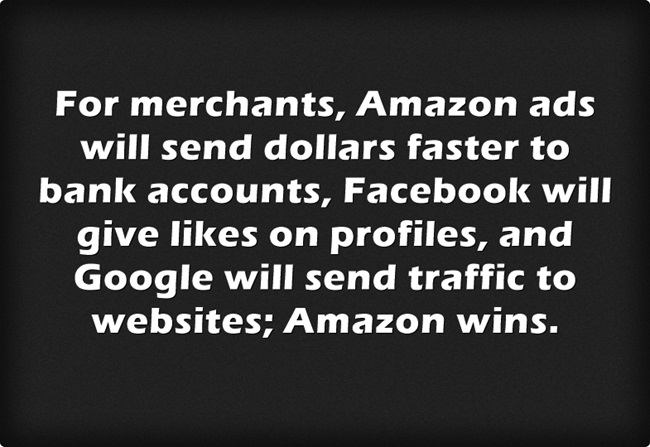
Amazon merchant ad conversion rate will be higher, ahead of whatever Facebook and Google offer. For merchants, Amazon ads will send dollars faster to bank accounts, Facebook will give likes on profiles, and Google will send traffic to websites; Amazon wins.Amazon wins because most merchants do not even bother having physical stores anymore in America; the stores are in Amazon.com and the fulfillments are handled by Amazon. Those merchants’ jobs are simply to get people to buy – from them! Jumia and Konga must learn lessons here.

Largely, depending on your priorities – I will vote for more money to bank accounts – I see a huge opportunity for Jumia and Konga as they deepen their platforms. Yes, the ecommerce companies can anchor something that will unlock local merchant advertising in countries they operate.

Simply, active shopping ads within ecommerce platforms look promising. Because merchants are big advertisers, there is disintermediation coming to that category in Facebook and Google businesses.

Amazon will be showing up more in this photo. As companies build estores in Amazon, they will put more ad budgets in Amazon.


Facebook Libra Will Aggregate Nigeria’s Financial Inclusion Journey

2
CBN Governor

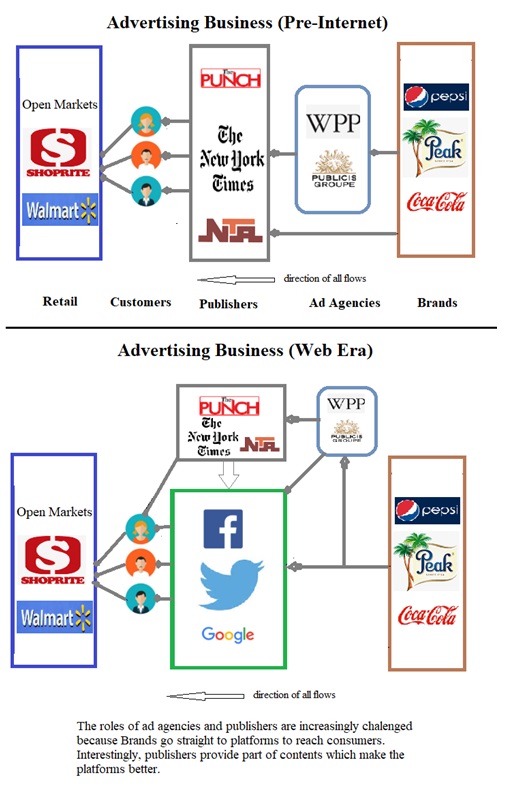
In the aggregation-integration construct, more values accrue to the entity that controls demand, not supply, since supply is largely unbounded and unconstrained. For example, the number of news sources (i.e. the suppliers) is large while the entities that host users and control their experiences like Twitter, Facebook, and Google (i.e. the aggregators) are limited. These aggregators accumulate most gains and also hold more power over the suppliers of news like newspapers.

The founding members of Facebook Libra which include Stripe, Visa, MasterCard, and Naspers will be suppliers. Facebook will be the only aggregator in the network and will enjoy the largest benefit in the Libra system. Why? Among all of them, Facebook is the only entity that actually has most control of the users through the Calibra, the Libra wallet.

Facebook Libra’s major competitor will be the credit card it will work to replace in the developed world. In developing world like Africa, the Libra competitor will be cash. I am close to saying that the friction on cash is higher, and Facebook could get traction if it works with networks of local agents across territories and domains. Replacing credit cards in places like America? I am not really sure about that. But who knows! WeChat has a different paradigm: attack cash since China was never a credit card nation to start with.

Nonetheless, Facebook Libra has a real chance of winning the peer to peer payment sector, challenging MoneyGram, Western Union and intra-nation platforms like Venmo.

So, the challenges for Libra are to win over credit card users in the developed world and make fans out of cash users in the developing world. Because it has WhatsApp and Messenger, I will vote for the win in the developing world. Fixing the cash challenges will be bringing the underbanked or unbanked into the fold through a global scale of financial inclusion. Possibly, with the help of Libra, the Central Bank of Nigeria will hit its financial inclusion target.

Put succinctly, our priorities at the CBN over the next five years are the following; First, preserve domestic macroeconomic and financial stability; Second, foster the development of a robust payments system infrastructure that will increase access to finance for all Nigerians thereby raising the financial inclusion rate in the country; Third, continue to work with the Deposit Money Banks to improve access to credit for not only small holder farmers and MSMEs but also consumer credit and mortgage facilities for bank customers.

We will be waiting how they will create that Libra initial money. If Facebook decides to give limited people equivalent of $50, I can assure you that many will become believers. Of course, getting Libra could be as simple as connecting your local Naira bank account to the Calibra wallet.

From the aggregation-integration construct, Facebook will control the users in Nigeria while the banks and some fintechs will become suppliers. Yes, Facebook Calibra stays at the edges of the smiling curve while others work at the center on the Libra project. In this world of blockchain, Libra is the genuine digital currency, Bitcoin and cousins will likely focus as store of values because if Libra takes off, the winner-takes-all effect will be normalized that even if Bitcoin wants to become a means of exchange later, it will not be accommodated.

Facebook Libra will use amalgam of suppliers like fintech and banks in Nigeria to architect a redesign, where as the super-aggregator controlling the users (i.e. demand, the Nigerians), will execute a framework that will possibly bring many people into quasi financial inclusion, where bank fees could be avoided, and stamp duty fees disintermediated. The Central Bank of Nigeria will win on its financial inclusion target but Nigeria Postal Service (NIPOST) may see its stamp duty fees disappear.

How Facebook Libra Cryptocurrency Will Affect Nigerian Naira, Inflation, Banking