Good People, I invite you to send your articles to Tekedia, my blog. We publish technology, business, economic, and policy related articles. When you publish on Tekedia, the article is there and can be discovered by even those not on social media. Also, the content is not de-ranked after few days!
A young man is starting as a legislative aide to a Nigerian Senator for a piece he published on my blog. The new Senator reached out to my team, and they made the connection. He has a job. Our works have shaped bills in the Nigeria’s National Assembly. The Bill debate on new JAMB fees acknowledged us.
And the good part – if you publish on Tekedia, I will share some on LinkedIn, increasing the chance of many people reading the piece.
The economy of the country is greatly influenced by the level and the structure of government spending. The government spending is an important tool for national governments to mitigate the uneven economic development and economic shocks across individual countries. Government spending plays important role in a fiscal policy of each country as a possible automatic stabilizer since from a Keynesian perspective, there is a view that government spending should act as a stabilizing force and move in a countercyclical direction. The impact of fiscal policy on economic growth is a complex and contradictory topic in finance debates. Government influences real economy through the impact of public revenues and expenditures on the quantity and quality of production factors, labor and capital. On the other hand, some of the public expenditures can stimulate growth. The aim of this report is to provoke thoughts among national budget setters by comparing national budget (government spending) with economic growth.
In early 2014 the Nigerian Bureau of Statics rebased the nominal GDP (Gross Domestic Product) of Nigeria representing the value of goods and services to $510b thereby overtaking South Africa to become the largest economy on the continent of Africa. Nominal GDP is the important benchmark that measures the economic output of a nation, respect and status is accorded to a country with particular reference to her position or ranking on the Global GDP table, in other word, the higher a country’s position, the more that country is respected.
In 1916 the economic output of the United States of America overtook that of the entire British Empire thereby making the United States the most important economic power in the world. A position it has retained to the present day. The United States of America is being challenged by China for the first position in the present day and this is the root of all the problems between the two countries, it may ultimately lead to conflict in the future as historically, no country has attained global dominance peacefully. As historians would like to assert that before the 1914 war, the great economic potential of the U.S. was suppressed by its ineffective political system, dysfunctional financial system, and uniquely violent racial and labor conflicts. “America at that time was a byword for urban graft, mismanagement and greed-fueled politics, as much as for growth, production, and profit,” a pattern that most Nigerian watchers have seen in Nigeria’s recent history.
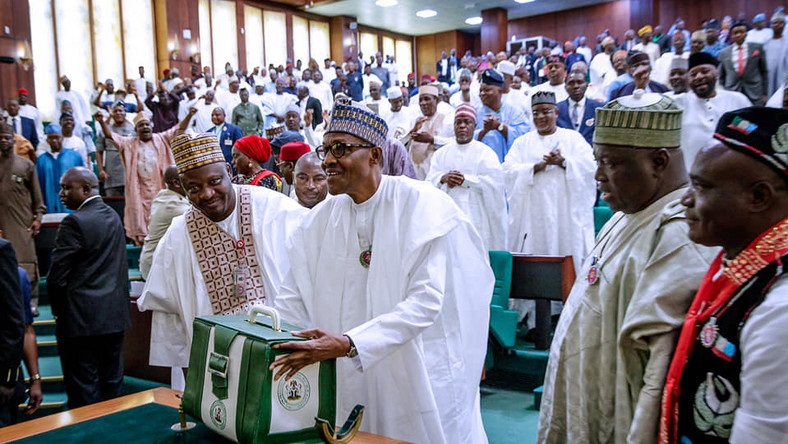
2019 Nigeria Budget (source: Deloitte)
The importance of GDP may not be immediately apparent to the majority of Nigerians as it only represent a statistical figure, however it makes sense to compare it to the mindset of a voter in an election, whilst the single vote may not influence a presidential election, the individual will invariably be affected by the outcome of a presidential election whether their preferred candidate win or lose. As the GDP measures the size of the of a Country’s economic output, it is used as a key variable in the decision matrix for any foreign investor. The crucial question for any foreign direct investor is whether the foreign market is big enough. The GDP figure provides a snapshot answer to that question. The levels of the GDP ranking are the reason why the United States and European Union are putting pressure on China and India to open their domestic markets to foreign investors. India and China are very attractive markets for foreign direct investment.
The empirical formula by which many Countries have improved their overall economic outputs in the past was through massive government spending on defense and infrastructure. The United States of America used this method in the 1930s during the great depression. Germany used this method to rebuild her economy after the first and second world wars, Japan have used it to a great effect after the second world war and more recently China is using this method to propel herself towards global dominance.
According to the latest data provided by IMF, the United States of America is the greatest economic and the strongest military power because it has consistently spent a large proportion of its GDP on infrastructure and defence. The United States spent $700b or 3.42% of GDP on defence in 2018. It represents 10.28% of their total annual budget. The comparative figures for Nigeria in the same period was $1.56b or 0.38% of GDP on defence. It is by far cheaper to prevent war by spending big on the military than to prosecute war because a nation’s defence is weak, in medical parlance they say that ” prevention is better than cure”
THE G8 COUNTRIES
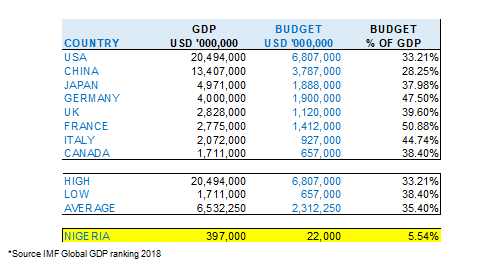
The Group of Eight (G8) comprise of eight countries whose economic outputs are closely aligned at the top of the global ranking. They meet regularly to formulate strategies and to reach agreement on tariffs and set rules for international trades. Membership of this exclusive club is highly prized, as decisions by this group invariably affect the citizens of all other countries. The table below shows the current members of the G8 countries, their position on the global GDP ranking and their annual budget in 2018.
As government spending is the key catalyst for economic growth, these group of countries appropriate a minimum level of their annual budget for defence and key infrastructure to maintain their economic and military powers.
The table showed that the United States budgeted $6,807b or 33.2% of GDP. China came a distant second at $3,787b which represent 28.25% of GDP. The average national budget for the G8 countries was $2,312b or 35.4% of GDP in 2018. As a point of interest, all the G8 countries were in budget deficit, except Germany who had a budget surplus of $300b. It is important to understand that budget deficit is not necessarily bad, it depends on the circumstances of the country. If the government spending is on defence and infrastructure projects that are essential to sustain peace and long-term prosperity of the country as in China and the USA, then short term deficit would be ambitious. However, if deficit is on recurrent expenditures, that would be reckless consumption.
The budget is a statement of intentions of the government as it provides a guide as to the direction of the economic well-being of the country. Governments can either budget for economic growth or austerity. The budgetary process and content are done with meticulous details as the budget is usually subjected to the highest levels of scrutiny in these countries. The competencies and integrity of the treasury secretary in the United States and Great Britain is usually second to none. Essentially.
AFRICAN POWERHOUSES
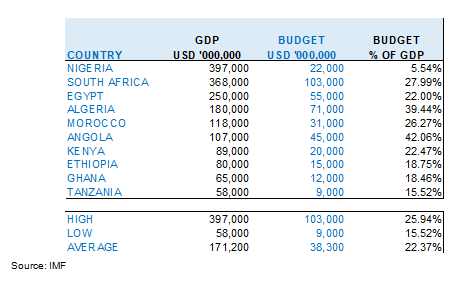
How are African Countries managing their economy, why are there more jobs in matured economies like the G8 countries whereas unemployment rates in African countries are high. The table below shows the top 10 largest economies in Africa by GDP.
Amongst the 10 largest economies in Africa, South Africa has the largest annual budget. It was $103b followed by Algeria at $71b while Egypt was in third place at $55b. The average budget of the top 10 largest economies in Africa was $38.3b or 22.4% of GDP.
Angola had the most ambitious and the highest national budget at $45b or 42.06% of GDP in the sub-Sahara Africa. Government spending on energy and infrastructure in Angola has seen rapid economic growth and vast improvement in the quality of life for the citizens of Angola in general in recent years. Angola GDP annual growth rate is averaged 8.68% and reaching all time high of 23.2% in 2007. Tanzania had the smallest annual budget of $9b but at 15.52% of GDP, the budget representing the government spending is providing enough stimulus to the economy such that Tanzania is experiencing sustained period of high economic growth whilst poverty rate is declining. Tanzania GDP Annual economic growth is projected to trend at 6.5% in 2020.
Nigeria had a budget of $22b which is 5.54% of its GDP in 2018. Nigeria’s budget is $16b lower than the average for the top 10 economies in Africa. The correlation between sustained government spending on defence and key infrastructures is reflected in quality of life, the security and general wellbeing of the citizens of that country. The quality of infrastructures is highest in South Africa, while the average life expectancy is highest in Morocco at 78 years. The average life expectancy in Nigeria is 56 years and the quality of infrastructures is lowest amongst the top 10 economies in Africa. This means that a child born in Morocco can expect to live 22 years longer than a child born in Nigeria.
THE NEXT ELEVEN
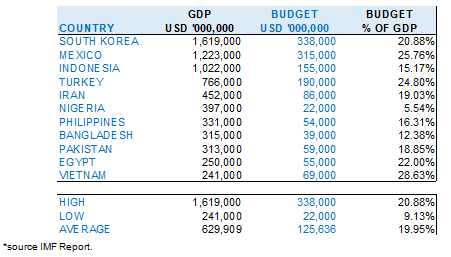
The next eleven is a group of 11 countries that are deemed by the global financial experts to have tremendous economic growth prospects within the next few years. The lives and wellbeing of the citizens of these countries are likely to change for the better if their respective governments make the right choices. The table below shows the government spending in 2018.
South Korea produced the largest USD budget at $338b followed closely by Mexico at $315b. The average annual budget for this group of countries was $126b or 20% of GDP. Vietnam recorded the highest budget to GDP ratio of 28.63%. Amongst this group, Nigeria with a budget of $22b is the lowest and it is roughly half of the budget of Bangladesh.
The average annual budget for this group of countries was $125.6b in 2018. This means that Nigeria’s government spending on defence, energy and infrastructures was estimated at $103b below the average amongst of comparable countries.
In a study by PWC, the international accountancy firm, the diaspora remittance to Nigeria was estimated to be worth $25b which surpassed the national budget for that year. Nigerians living and working overseas spent more money on their relatives than the government of the federation did for entire country.
MEAGRE BUDGET
The current and previous administration have been attempting the miracle of the Five Loaves and Two Small Fishes. Unfortunately, only Jesus Christ was able to feed 5,000 men with five loaves and two small fishes. By all indications the Nigerian government budget is bad attempt at performing the miracle of the five loaves and two small fishes.
It is pathetic and an outright embarrassment for the largest economy in Africa to have a budget so small, it cannot construct a standard gauge railway line across the two major Cities. It is impossible to build a bridge across the river Niger within a reasonable time by dropping five buckets of concrete into the river twice a year, nor can a reasonable person attempt to make a car journey by pouring kerosene into the fuel tank. You must use the right amount and type of fuel to get optimum performance of the motorised engine.
No developing country need to re-invent the template for economic performance and growth for that has already been created in the advanced economy and globally acceptable. An empirical model that has worked for many countries does exist and it is wise to adopt that model. In every comparable statistic, the Nigerian government has underperformed consistently since the mid-1970s. [examples of underperformance]
The Nigerian budget at 5% to GDP is not enough to inject any meaningful stimulus into a $500b economy. Simply put it this way, if you have $5,000 capital to use for business and someone adds $200 to you, your new capital at $5,200 is not substantially different from your initial capital, however if your finance is boosted by an additional $1,000 then your new capital at $6,000 can significantly do better. That is the type of effect that $100b budget would have on the Nigerian economy as opposed $22b.
The paltry budget is a testament to the lack of ambition, knowledge or complete dereliction of duties on the part of the economic advisers to the Nigerian government. Nigeria will not achieve any meaningful economic development by working outside of the framework by which other countries of the world are measured. There is an international benchmark and reasons why budgets are pegged to GDP. All the attractive things about the USA and every other country of the G8 that we admire are down to the fact that they religiously adhere to a spending plan which ensures that a minimum level of defence and infrastructural spending are maintained consistently.
It is simply not possible to accomplish any major infrastructure project of the type Nigerians see in other countries with meagre budget. The Nigerian government budget and the budgetary process that produce it is not fit for purpose. The Nigerian government budget is based on a template drawn by Lord Lugard to manage the colonial administration of Nigeria with the same government departments as in 1914. It is not a surprise that 80% of it is for recurrent expenditures on the administration of government.
Nigeria as a nation has always spoken eloquently about her resources and her potentials but at 60 years, it is time to realize her potentials by doing the right things. It is the sure path to the advancement of economic wellbeing of her citizens. The Nigerian government must show a radical and an ambitious budgetary planning & development that will inject enough stimulus into the private sector to create jobs and prosperity.
The minimum budget for Nigeria in 2020 should be $60b or 15% of GDP which would bring Nigeria to the same level as Tanzania the lowest country in the group of the top 10 economies in Africa. The Buhari administration should aim to raise the budget and annual government spending to $100b by 2023. This is by no means an advocacy for international borrowing but by raising domestic taxes on good and services produced within Nigeria. Also, to develop a mechanism to collect income and corporate taxes across the 36 States in the country. With digitalization in mind, there are several ways in which government can collect taxes with ease and transfer this revenue to capital investment. This basic practice is the very essence of GDP. The money that China lends to African countries is through the balance of trade surplus derived from taxes on GDP of China. Taxation on the economic output of 200 million Nigerians is the infinite supply of rocket fuel that will propel Nigeria to the position of economic superpower in Africa.
Economists hold two views on whether government spending is an effective way to stimulate the economy. The view presented in this article is that in the short-term government spending will enhance growth. For instance, purchases by the government cause a chain reaction of spending. That is, when the government buys $1 worth of goods and services, people who receive that $1 will save some of the money and spend the rest. This theory suggests that the “government spending multiplier” is greater than 1, meaning that the government’s spending of $1 leads to an increase in gross domestic product (GDP) of more than $1.
The report is co-authored by Ajibade Yusuf and Chris Odeh, Gradient Consulting Africa SARLS. Gradient Consulting Africa is a Luxembourg based company and provides specialist advisory service in corporate governance, project finance and economic intelligence to Corporate and Sovereign institutions. Gradient Consulting are advisors to Belgium-Luxembourg-Nigeria Chamber of Commerce. For more information please contact:ajibadeyusuf@gradientconafrica.com
You get the best from mentoring when you add value to the person mentoring you. The secret is this: to get a quality mentor, you must have something unique to offer that person. Though the value transfer is asymmetric, nonetheless, you are offering something. Yes, he or she must look forward to speaking or meeting you because you add value in a unique way.
In this video, towards the end, I shared some insights on mentoring after a question.
HYDERABAD, INDIA - DECEMBER 2010: Indian and American employees work out of the Facebook offices in Hyderabad, India, December 1, 2010. The offices were recently opened in September 2010, and are presently hiring new employees. (Photograph by Lynsey Addario/Getty Images)
Facebook has invested in India’s Meesho. Meesho is “an online reseller network of housewives and SMBs [small and medium scale businesses], who sell products within their network on social channels. The company is creating … e-commerce distribution channel via homepreneurs selling on WhatsApp, Facebook, and Instagram”. Simply, Meesho makes it possible for anyone to resell for brands through its networks on Facebook, WhatsApp and Instagram. The innovation here is making it possible for people to start their online stores via social channels, and earn income.
As Facebook explores ways to generate revenue from WhatsApp, the company is now turning to a startup that already has a lead. The social juggernaut said today it has invested in social-commerce startup Meesho in what is the first time the firm takes equity in an Indian startup.
Neither Facebook nor Meesho, which prior to this announcement had raised about $65 million from a number of investors, including DST Partners, RPS Ventures and Shunwei Capital, shared financial terms of the deal. A source familiar with the matter told TechCrunch that the capital was “very significant.”
Meesho, a Y Combinator alumnus, is an online marketplace that connects sellers with customers on social media platforms such as WhatsApp. The four-year-old startup claims to have a network of more than 2 million resellers who largely deal with apparel, home appliances and electronics items.
This business model is just simple and can be run nationwide in a place like Nigeria. Simply, the customer pays the shipping cost while Meesho or the supplier ships. A supplier is the person that owns the goods to be sold. This is how that supplier is brought into the platform.
Meesho supplier process
The Resellers – Those Selling for Suppliers
When suppliers post their wares, the resellers help them share across the social media. Then, buyers buy and pay. This is like turning everyone possible into a sales agent, online.
“Someone should get a Nigeria version”.. I know our guys are really working hard back at home and hopefully they can come up with something close or near.
Meesho, is an Indian-origin social commerce platform founded by IIT Delhi graduates Vidit Aatrey and Sanjeev Barnwal in December 2015.
What i want to take from here is ” Founded by IIT Delhi Graduates” There is a lot of motivation for people that go to this school due to its strategic location in Delhi, which is more quite close to one of indian’s Silicon Valley.
Notable people have graduated from Indian Institute of Technology Delhi is a public engineering institution located in Hauz Khas, Delhi, India, hence there is always some influence and preference in products that comes out from someone from this institution.. I can name top ten people in the industry what we use their product daily.
Lagos State University school of Engineering in Epe. With all the tech companies in Lagos Island and Lekki axis while we can also tag the location as Silicon valley replica, Why can’t they take LASU Engineering school as their Product innovating Hub?
Capital vs. Knowledge – which one rules? This is a chicken and egg debate which I thought was already settled until a debate began today. Follow below…
Background
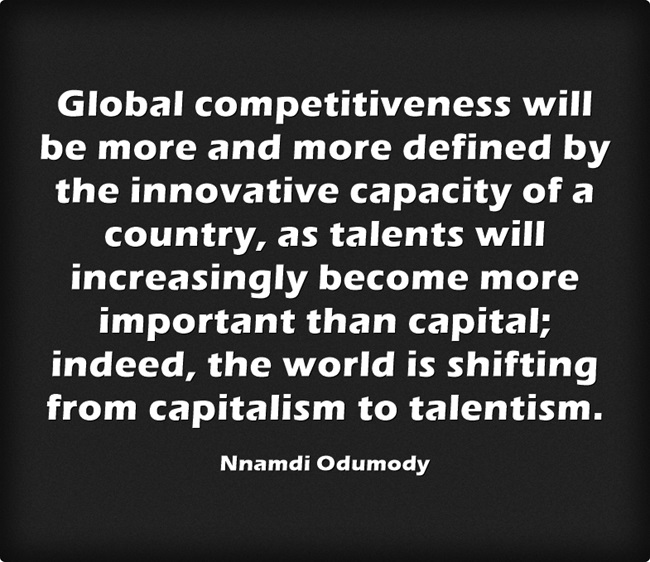
This is the article written by Nnamdi. Here is a quote from the article.
Nam: I have to respectfully disagree with my namesake Nnamdi Odumody. Capitalism has always depended on talent as talent has always been one of the distinguishing factors to establishing competitive advantages of nations. As such, the world has always been defined by talentism. Daily, however, talents are becoming easier to define. Which makes the world ever more capitalist because it remains challenging to protect and convert talent to results without capital. For this reason many with and of talents are daily exploited by those with capital. The larger the company the larger the cases. The bigger the country, the more frequent the cases.
Ndubuisi Ekekwe: You are reading it literally Nam. Today, we are in a knowledge economy where knowledge is seen as a factor of production beyond the old ones by classical economists. Capital remains as a factor of production; it will always be. But the reality is that unlike few decades ago, you do not need tons of capital to create value (no one said you do not need any, you still need). So, companies like Uber, Airbnb, Facebook etc even though they need capital are winning by talent (i.e. knowledge).
Check, most of the largest 10 companies in the world, they were built on knowledge, not just capital. Those heavy-asset companies are making way. So, if you want to change the world, while you need capital, the key is talent (knowledge) because capital does not give that old competitive advantage it used to offer. Yes, you need it but you still need knowledge.
Jumia is more valuable than GTBank despite having asset base that is a fraction of GTBank. GTbank is the most valued bank in Nigeria!
Nam: Ndubuisi Ekekwe, Nnamdi made two assertions: 1) talents will become more important than capital, 2) world is shifting from capitalism to talentism. I disagreed with both because both premises and conclusions are flawed.
If what he had said is that it now takes less capital to create more value, I would have agreed.
What is true, and has always been true, is that talent is required to put capital to good use. But both work hand in hand.
All the brands you mentioned required millions and, in all but one case, billions of dollars to be built into multi-billion dollar brands. So while it takes less capital to get started, it takes o’ so much more capital to scale, plateau and sustain. Talents alone cannot do that; nor can capital.
The fact is that talents and capital work hand in hand–always have, always will. Trying to shrink the relationship down to a quote is tough. So, while the story has merit, the quote requires work.
Ndubuisi Ekekwe: Nam – you actually made the point on this line “So while it takes less capital to get started”. In the old industrial economy, you need Capital to begin at huge level and that was a problem. Today, you just need to have an idea, and you can start with very low capital. So, because what can get you on the signpost is not HUGE capital but brilliant idea (powered by subscription cloud), the driver is idea. So, the importance of capital has shifted to idea – that does not mean capital is not important.
Facebook sold 10% to Thiel for $500k. FB was already a business then – he might have started with say $50k. If you want to build a seaport in Nigeria today, you need $1 billion to begin. For that age of seaport, CAPITAL was king since without it, no progress. In our time, capital remains important but is just part of the equation. That “age” is not time but sectoral evolution