DD
MM
YYYY

PAGES

DD
MM
YYYY

spot_img

PAGES

Home Blog Page 6879

The 5 (G) World War

0

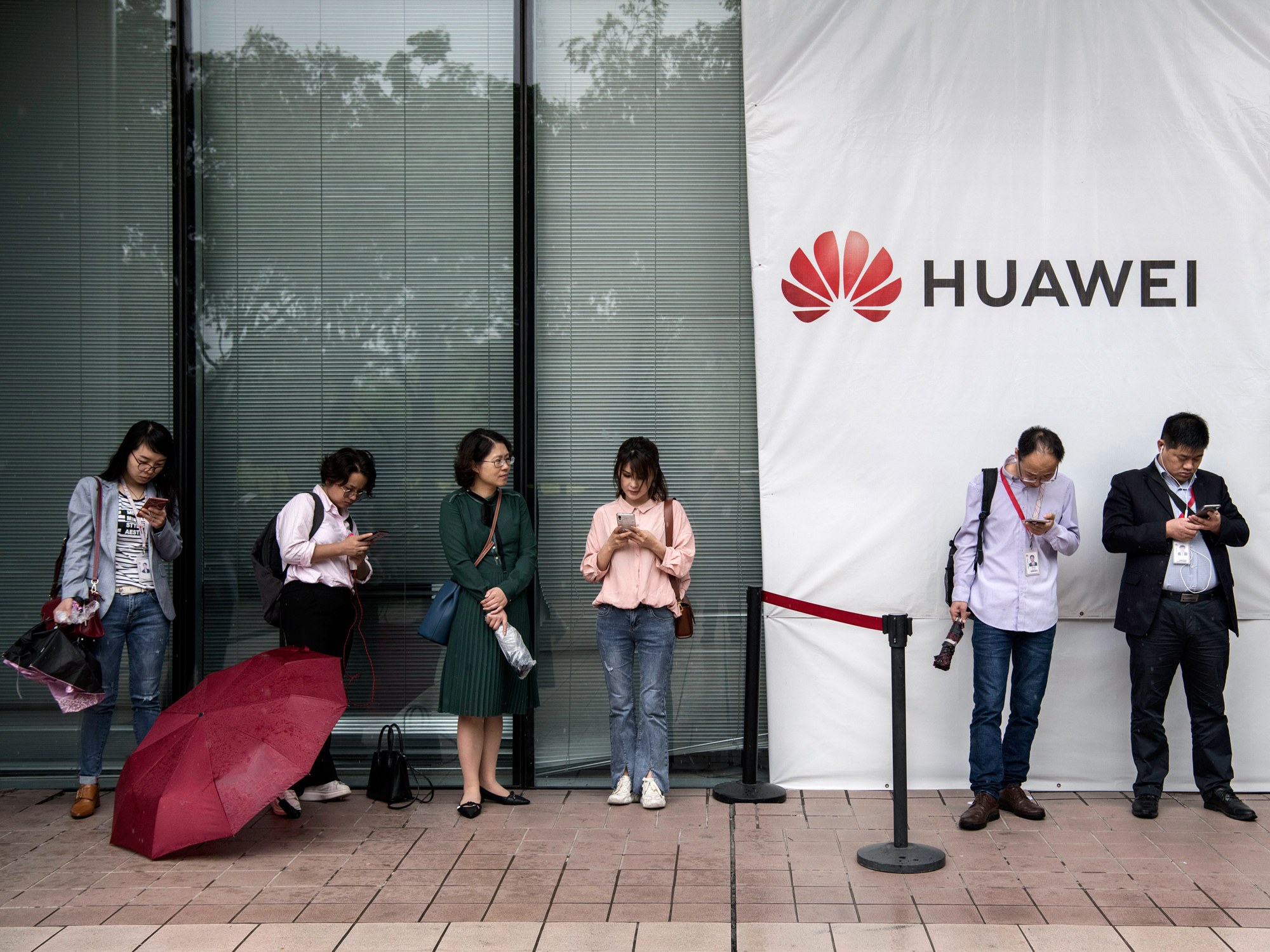
The Institute of Electrical and Electronics Engineers (IEEE), a major international U.S.-based professional association that publishes technical academic papers, has excluded Huawei staff from participating in the peer-review process. Last month, the U.S. government placed Huawei on its dreaded “entities list,” making it difficult for businesses to collaborate with the China-based telecom giant. IEEE is attempting to comply with the new regulations. In retaliation, the China Computer Federation has cut-off ties with the IEEE, reports Fortune newsletter.

IEEE, the Institute of Electrical and Electronics Engineers, is a professional association for technologists that publishes research, defines technology standards, and hosts conferences, among other activities. Huawei employees frequently contribute to the organization’s publications and present at its conferences. But this week the Chinese technology news publication Pandaily published an email sent by IEEE to the editors of its publications, instructing them to stop using Huawei employees as peer reviewers for articles they’re considering for publication. In other words, Huawei employees will no longer play a role in evaluating research before publication.

Meanwhile, Huawei has ” ordered employees to cancel technical meetings with US contacts, and has repatriated all U.S. employees working in the company’s Shenzhen research and development facilities.” The country has also created its own list to ban foreign entities or individuals who “do not follow market rules, violate the spirit of contracts, blockade and stop supplying Chinese companies for noncommercial reasons, and seriously damage the legitimate rights and interests of Chinese companies.”

The U.S.-China trade war may not end as just a trading conflict – we sincerely hope it ends with ‘G’ in this phrase: The 5 (G) World War. The escalation has crossed lines with military leaders using words usually reserved for politicians. People, this is entering a global paralysis with structural redesign of commerce and industry in ways never experienced in the last four decades.

LinkedIn Comment on Feed

The serious shaking of world order is needed, for too long, we seem to have different rules for some categories of people and players, while instructing the rest of us to remain in the line.

China has been wearing a globalist toga for a while now, but has equally refused to open itself up for the rest to scrutinize its internal workings; the world is not only made up of dumb people, there are wise and smart ones too.

You only consider negotiation as a viable option when you believe the other party has something to bring to the table, else you can easily bully them to submission.

We shouldn’t be afraid whether 5G evolution is slowing down or not, but it’s important governments and people across the globe use this US-China thing to reassess their own partnerships and alliances; many have been too timid to complain or raise objections, even when it’s clear that they have beaten on all sides in the treaties.

After all the noise and punches, let’s see if it can give the global community a wonderful opportunity to rewrite trade rules. At the moment, some countries are simply too dumb to understand what could hit them in the future, except we clearly define this ultra-ambiguous word called globalisation.

Game on…
Why Incumbents Struggle To Out-Compete Great Startups – Hangover and Incentive Paralysis

2

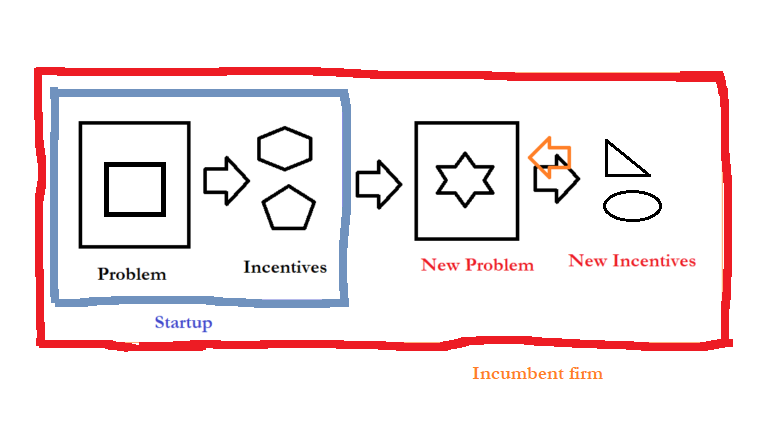
There is a clear market friction to be solved which a startup has identified, and is on the mission to make it happen, and create better demand-supply equilibrium. The Problem is obvious [square]. The Incentives are evident [pentagon and hexagon]. The startup is going to business to solve the problem with these clear incentives.

Then an incumbent firm sees the startup, and quickly creates a unit or division to attack the same problem. Unfortunately, there is a hangover effect (legacy), despite its apparent advantages on capital, experience and other systems for production. Due to the hangover, the incumbent will develop new incentives on the original problem.

Magically, the incentives become triangle and circle over the startup’s pentagon and hexagon. As a result of these incentives, the incumbent will go and modify the problem to fit into the evolved incentives. By the time it is done, the problem is no more a square but a star. Simply, it is now solving a different problem, and will likely fail.

This is why most incumbents never catch-up with startups on great missions. Google+ could not stop Facebook because Google+ had different incentives – connect people to support other Google’s properties which differed from Facebook’s original incentives. Due to those evolved incentives, Google+ was solving a different problem when compared with what Facebook was solving.

Of course this does not mean the incumbent cannot arrive at a better problem to solve by changing the incentives. My point is simple: if a startup is doing great in the market, it means its original problem was a friction that has existed in market unsolved. Changing that may not help the incumbents over time.

Sure – the startup must continue to execute to ensure it wins.

To Rise, Africa needs more Entrepreneurs than Small Business Owners

0

The weakest link in Africa’s economy is that it has more informal small business owners per capita than any part of the world. To rise, Africa needs more entrepreneurs than the largely un-scalable informal small business owners.

IF ANYTHING explains the poverty in many parts of sub-Saharan Africa, it is not an unwillingness to work hard—most of the continent’s people still sweat to survive tilling fields with medieval tools. Nor is it because of a lack of enterprise and optimism: on the permanently traffic-jammed streets of Lagos, Nigeria’s main commercial city, hawkers gingerly ease their way between cars trying to sell almost anything from snacks to books, pirated DVDs and even toilet seats. Africans are far more likely to be self-employed than people in richer parts of the world, for the simple reason that without social safety nets, many of them must hustle or starve

[…]

Yet for all Africans’ energy and ingenuity, the region struggles to produce enough of the productive and profitable small businesses it needs to lift hundreds of millions of people out of poverty. The World Bank reckons that sub-Saharan Africa has only a quarter as many small businesses as Asia, relative to its population. Members of the OECD, a club of mostly rich countries, have about eight times as many formal small businesses per person

Entrepreneurs build startups – A Startup in this content means going to create something of value with transformational impacts in the market. It is different from small business which could be “barbing salon” [Nigerian slang for barbershop], selling corn along the roads, etc that rarely scales. While a barbing salon [small business] could have competitors on a street, a barbing entrepreneur who runs many salons across Nigeria, will not collapse because of many salons, at the moment. Rather, the entrepreneur will likely go down because of poor execution. Nigeria has not attained parity on the number of barbing salons it needs at the moment; we have more rooms to grow nationwide, but that has to be done optimally and profitably. The competitive elements remain low.

Nigerian Government Gets Final Credit Alert on MTN ‘s N330 billion Negotiated Settlement

0

MTN Nigeria Plc has completed the payment of the N330 billion (about $1 billion) negotiated settlement agreed with the Nigerian government: “We are very pleased to have completed the payment of the N330 billon negotiated settlement with the NCC”. With this final payment, Nigerian government will not be getting more credit alerts and MTN should work hard to keep it that way. We do not want revenues via fines – let firms do the right things first.

MTN Nigeria Plc says it has paid the sixth and final instalment of N55 billion negotiated settlement to the Nigerian Communications Commission (NCC).

The Chief Corporate Relations Officer of MTN Nigeria, Tobechukwu Okigbo, made the disclosure in a statement on Friday in Lagos.

According to him, the amount completes MTN’s payment of the N330 billion negotiated settlement agreed between the NCC and the company in 2016.

“The successful resolution of the fine was the outcome of active collaboration between the NCC and MTN.

“We are very pleased to have completed the payment of the N330 billon negotiated settlement with the NCC.

“We are particularly gratified to be in a position to have fully met the terms of the settlement within the agreed time frames.


Seun Ayegbuzi’s Coverdor Wants To Fix Nigeria’s Insurance Friction with Technology

0

 By Nnamdi Odumody

According to a 2018 survey by the Chartered Insurance Institute of Nigeria, 86.6 million people out of Nigeria’s adult population of about 100 million are excluded from any form of insurance cover.

The penetration ratio of the Nigerian insurance industry is at 0.5 percent in 2018. That is among the least in Africa compared with South Africa’s 17 percent, Kenya’s 2.8 percent and Ghana’s 1.1 percent.

The National Insurance Commission which is the apex regulator for the insurance industry has a target for Nigeria to become one of the world’s top twenty insurance markets by 2020. In 2018, the industry generated a Gross Premium Income of 448.6 billion naira which is expected to record 10 percent growth to about 493.4 billion according to Augusto and Co’s data.

Currently, there are over 12 million registered vehicles for motor insurance, fire insurance for households and manufacturing companies, annuities for retirees and life assurance policies for individuals while opportunities abound in ‘’Takaful’’ i.e. insurance for Muslims and other large scale economic projects across the nation.

Lack of trust, awareness, affordability of insurance products and services, easy access to insurance products, dishonesty amongst insurance practitioners, late payment of claims, refusal to settle genuine claims, ambiguous description of product details, cultural and religious beliefs, low level of innovation in product development, limited take off of takaful, microinsurance and bancassurance. More so, weak distribution channels, financial incapacity, high incidence of insurance fraud, low level of disclosure, prevalent unethical practices and inadequate industry database are some of the reasons why Nigerians don’t purchase insurance products as well as the underperformance of the sector.

The Nigerian Insurance Industry includes the following sub-sectors: Composite, Non-life, Life and Reinsurance operators. Over the last five years, the Nigerian Insurance Industry has grown at a compound annual growth rate (CAGR) of 11%, buoyed by increased capitalization as well as the introduction of policies aimed at promoting the local market.

Nonetheless, the industry remains challenged with low apathy from the Nigerian populace and weak policy enforcement practices, resulting in a low penetration ratio. These challenges however present enormous opportunities when benchmarked with other African countries especially South Africa. The industry has room to grow, if it can innovate

Coverdor which is Nigeria’s first digital insurance platform wants to make tech-savvy Nigerians access insurance anywhere and anytime from their mobile devices, and also manage all aspects of insurance transactions in real time.

Its users can easily insure their electronic gadgets and home appliances individually against mechanical, accidental and liquid damages directly from Coverdor’s platform or through online and offline point of sale or partner’s e-commerce website or retail outlet in Nigeria.

Seun Ayegbuzi, founder of Coverdor

Using proprietary artificial intelligence technology, it completes a policy sales transaction and policy holder onboarding within 3 minutes and also processes customer claims in less than 3 minutes.

Coverdor needs to fix the friction and provide the last mile access to insurance services for millions of Nigerians without insurance cover. That is how the insurance sector will show a sustained promise.

The Nigerian Insurance Blurry Internet Vision