DD
MM
YYYY

PAGES

DD
MM
YYYY

spot_img

PAGES

Home Blog Page 6890

UBER Left Wall Street with $120 Billion; in Main Street, it has $64 Billion Left

0

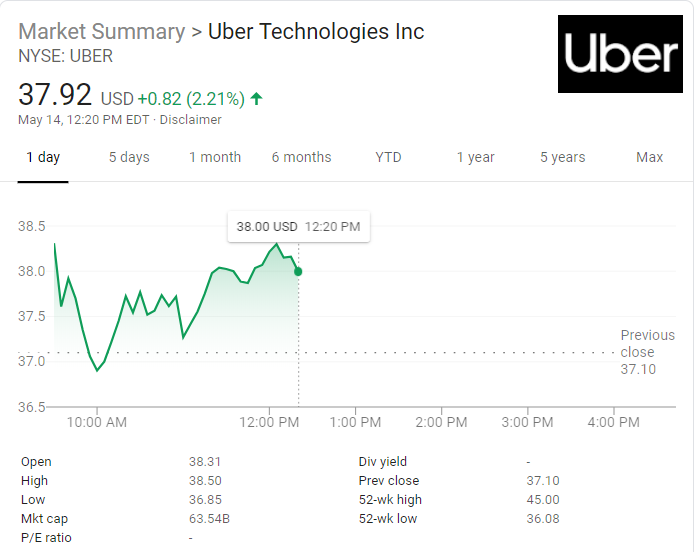
Uber was $120 billion with the exclusive Wall Streeters. Today, as it trades in public market, it is less than $64 billion. Uber – welcome to the Main Street. You will be fine, but you need to understand how to manage with cola and not just champagne. All those $120 billion virtual wealth have come home for reality checks!

Morgan Stanley nabbed the biggest U.S. initial public offering of the past five years. Now it gets to field the second-guessing after Uber Technologies Inc.tumbled 18% in its first two days of trading.

Across Wall Street, questions are flying: Why did bankers including Morgan Stanley’s suggest a $120 billion valuation last year that Uber couldn’t deliver? Did the syndicate led by the firm set the IPO’s price too aggressively? And did they steer too much stock to big investors who made hollow pledges to hold it long term?

Dara Khosrowshahi rings the opening bell during the Uber’s IPO on the floor of the NYSE in New York on May 10. Photographer: Michael Nagle/Bloomberg

Apple Response

Today’s decision means plaintiffs can proceed with their case in District court. We’re confident we will prevail when the facts are presented and that the App Store is not a monopoly by any metric.

We’re proud to have created the safest, most secure and trusted platform for customers and a great business opportunity for all developers around the world. Developers set the price they want to charge for their app and Apple has no role in that. The vast majority of apps on the App Store are free and Apple gets nothing from them. The only instance where Apple shares in revenue is if the developer chooses to sell digital services through the App Store.

Developers have a number of platforms to choose from to deliver their software — from other apps stores, to Smart TVs to gaming consoles — and we work hard every day to make our store the best, safest and most competitive in the world.

Platforms Are Digital Monopolies, Apple App Store is Modern Day Standard Oil – U.S. Supreme Court

0

Apple lost big yesterday – nothing to do with America-China trade war. The problem: the App Store is a modern day monopoly, says the United States Supreme Court.

A group of iPhone owners who accuse Apple of violating US antitrust rules can sue the company, the Supreme Court ruled Monday. They claim Apple’s App Store is a monopoly.

Justice Brett Kavanaugh, in the majority opinion, said that when “retailers engage in unlawful anticompetitive conduct that harms consumers,” people buying those companies’ products have the right to hold the businesses to account.
“That is why we have antitrust law,” Kavanaugh wrote. The court’s four liberal justices joined Kavanaugh in the 5-4 decision.
The Supreme Court opinion notably does not accuse Apple of violating antitrust law: It holds that consumers have the right to sue the company for monopolistic behavior, because they purchase apps directly from Apple.

Yes, consumers can sue Apple for antitrust violations because the App Store constitutes a monopoly. The claim by Apple that it was just an intermediary was thrown out.

People, this ruling doesn’t just affect only Apple. Everything we know of Facebook, Amazon, Google Play Store and the whole nexus of platforms with the positive continuum of network effect will change. Simply, you cannot attain pure competitive advantage in markets only on the power of platforms. Yes, if you build one, you must make it wholly fair for other players to use same to serve market frictions. The era of walled-off virtual technology storefronts is largely over. I can see the trial lawyers sharpening their spears and swords with the ruling.

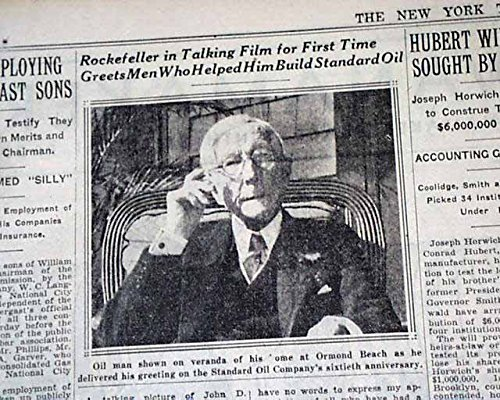
When you think of Apple App Store, you can refer to Standard Oil and how U.S. broke the empires of Rockefeller. I can tell you that the tech world has changed.

By 1880, Standard Oil owned or controlled 90 percent of the U.S. oil refining business, making it the first great industrial monopoly in the world. … Rockefeller and his associates decided to move Standard Oil from Cleveland to New York City and to form a new type of business organization called a “trust.”

Yet, the ruling is very narrow: this was a lawsuit from consumers to a company and not a company against a company. The way the justices looked at the issue may be different if a company had sued Apple. Of the three nexus in technology – making current use cases far improved, inventing new use cases, and pioneering new business models – platforms powers the last nexus, anchoring it on the unbounded distribution of the Internet, and in the process creating disruption through new basis of competition. Nothing has changed except that consumer rights are more enhanced now.

Jumia Will Not Provide Rebuttal to Citron Accusations; In Earnings, GMV Up 58%

0

Jumia had a fair outing yesterday in its first quarterly earnings call: GMV grew by 58%, leading to a 102% increase in Marketplace revenue, but the company made a surprising decision it will not provide direct rebuttal to the Citron’s accusation.

In the wake of the report, a slew of American law firms said they were investigating possible disclosure violations and invited investors who may have lost money on the stock to contact them. In response, Jumia brought forward its first-quarter earnings announcement that was scheduled for Thursday to today.

  • That release showed that Jumia’s first-quarter loss widened from a year earlier to $51m, and gave no indication of when it might become profitable.

That seems very strange as Citron has called it a “fraud“. We will see how it works for the business.

I agree with this summary by The Africa Report: Failure to provide a detailed rebuttal of Citron’s claims will do little to reassure Jumia’s investors, who deserve to hear management’s side of the story. Other African companies may end up paying the penalty.” The Citi reaction is certainly not good enough; investors will like to hear from Jumia directly.

Personally, I do think Jumia showed a promise in its first call; expect recovery from the paralysis of the accusation.

Shares of Jumia Technologies (NYSE: JMIA) were bouncing up and down today after the African e-commerce specialist posted its first quarterly earnings report as a publicly traded company, showing sluggish top-line growth and a widening loss despite some promising signs. Shares fell as much as 17.8% in morning trading but recovered most of those losses and were down just 3.2% as of 12:46 p.m. EDT as investors tried to make sense of the report.

Jumia showed off some impressive figures as gross merchandise volume (GMV) increased 58% to 240 million euros, which drove a 102% increase in marketplace revenue to 16 million euros. However, first-party revenue fell 21% to 15.6 million euros, which was in part due to a strategic shift to focus on higher-margin third-party marketplace revenue. Therefore, overall revenue rose just 12.3% to 31.8 million euros, or $35.6 million, which was short of estimates at $39.8 million.

Active customers grew to 4.3 million from 4 million in the fourth quarter and 3 million in the quarter a year ago. On the bottom line, the company’s net loss widened from 34.1 million euros to 45.8 million. Jumia did not report results on a per-share basis.

Just after the quarter ended, Jumia also entered into a partnership with Mastercard (NYSE: MA), which made a 50-million-euro private placement concurrent with the IPO, to focus on the e-commerce company’s JumiaPay payment platform as well as co-branded products like credit cards

JUMIA FULL Financial Report

GMV grew by 58%, leading to a 102% increase in Marketplace revenue

Jumia continued to deliver cost efficiency improvements

JumiaPay entered into a strategic partnership with Mastercard who also made a €50 million investment in Jumia

LAGOS, Nigeria–(BUSINESS WIRE)–Jumia Technologies AG (NYSE:JMIA) (“Jumia” or the Company) announced today its financial results for the quarter ended March 31, 2019.

“Jumia delivered excellent results during the first quarter of 2019: strong GMV growth of 58% leading to 102% growth in marketplace revenue, year-on-year improvement of 356 basis points of Operating loss as a percentage of GMV and further development of JumiaPay, highlighted by the investment by and partnership with Mastercard,” said Sacha Poignonnec and Jeremy Hodara, co-CEOs of Jumia. “We believe that Jumia is increasingly relevant for consumers and sellers in Africa. Looking ahead, we remain focused on our core operations, driving consumer adoption and engagement on our marketplace, increasing the penetration of JumiaPay, while continuing to improve our financial profile and making a sustainable impact on the continent.”

Business highlights

  • The €50 million investment by Mastercard into Jumia, in a concurrent private placement with our Initial Public Offering, marked another milestone in the development of JumiaPay and a validation of its potential. We are partnering with Mastercard on a number of initiatives, including the development and marketing of co-branded products (i.e., cards, virtual cards and quick response codes).
  • In the first quarter of 2019, our marketplace continued to gain depth and diversity as we focused on attracting quality sellers to our platform and providing our consumers with an expanding range of products and services. An example of this strategy is the partnership we announced this quarter with the technology leader Xiaomi. As part of this partnership, we are opening the Mi official store on our platform with the ability to offer a number of Xiaomi products on an exclusive basis. This demonstrates the attractiveness of Jumia as a destination of choice for high profile international brands, giving them access to millions of potential consumers in Africa with one partnership.

Financial highlights

  • Gross Merchandise Volume (“GMV”) grew this quarter by 58% on a yearly basis, on the back of strong marketplace growth, leading to a 102% increase this quarter in Marketplace revenue on a yearly basis. Our strong GMV growth combined with the attractive value proposition we offer both sellers and consumers are a key engine of monetization, which we derive from diversified revenue streams such as Commissions, Fulfillment, Value Added Services, Marketing and Advertising services.
  • Gross Profit margin as a percentage of GMV increased from 5.6% in the first quarter of 2018 to 6.5% this quarter, as a result of the increased GMV monetization rate. Our Gross Profit also exceeded Fulfillment expense this quarter.
  • We continue to have a strong focus on cost efficiency. Leveraging our strong brand awareness and highly localized marketing approach, we have been able to gain 205bps of marketing efficiency this quarter, bringing the Sales & Advertising expense from 7.2% of GMV in the first quarter of 2018 to 5.1% in the first quarter of 2019.
  • Adjusted EBITDA loss as a percentage of GMV improved from negative 19.8% in the first quarter of 2018 to negative 16.4% in the first quarter of 2019.

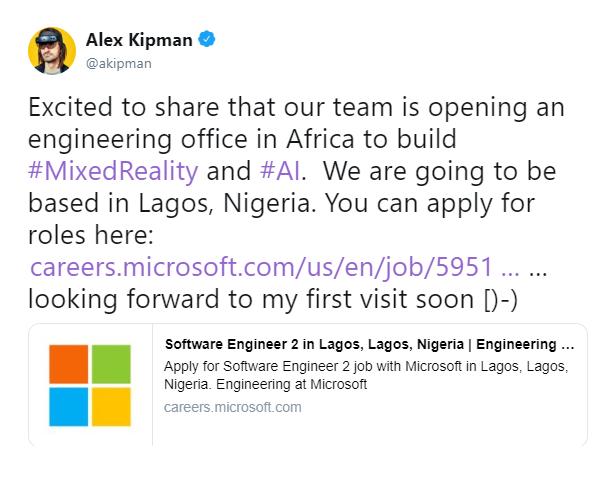
Finally, Microsoft Is Bringing Development Center to Lagos, Hiring Dozens

0

Microsoft seems to be putting deep focus on Nigeria. It reported weeks ago that it was opening an AI research unit in Lagos. Now, it is going to also build development centers in Africa with Lagos as one of the centers. The company plans to spend $100 million in the next five years to build the development centers in partnerships with local partners and governments. Microsoft also plans to hire in Lagos and Nairobi, another development center, about 100 full-time developers by the end of 2019, and expand the number to 500 by Q4 of 2023.

Microsoft Corp.  plans to spend more than $100 million over five years to open its first development centers in Africa to work with local partners and governments, as well as hire engineering talent.

Initial sites will be in Nairobi, Kenya’s capital, and Lagos, Nigeria’s commercial hub. The software giant plans to hire 100 full-time developers at the two sites by the end of this year and expand to 500 by the end of 2023, Microsoft said in a statement Tuesday.

The Redmond, Washington-based company plans to use the sites to recruit African engineers to work in areas such as cloud services, which use artificial intelligence and applications for mixed reality – where customers use goggles to project 3-D images onto the real world

This is looking better here – they used to send salespeople. Now, we are getting engineers and technical fellows that will build AI and Mixed Reality technologies in Lagos.

The current marginal GDP growth in Nigeria is largely due to technology – let us keep it going. Without telecoms and startups, Nigeria will possibly be on recession. So, technology is playing a major role, and as entities like Microsoft come onboard, we will see more growth in the economy.

Derq is Using AI to Prevent Road Accidents

0
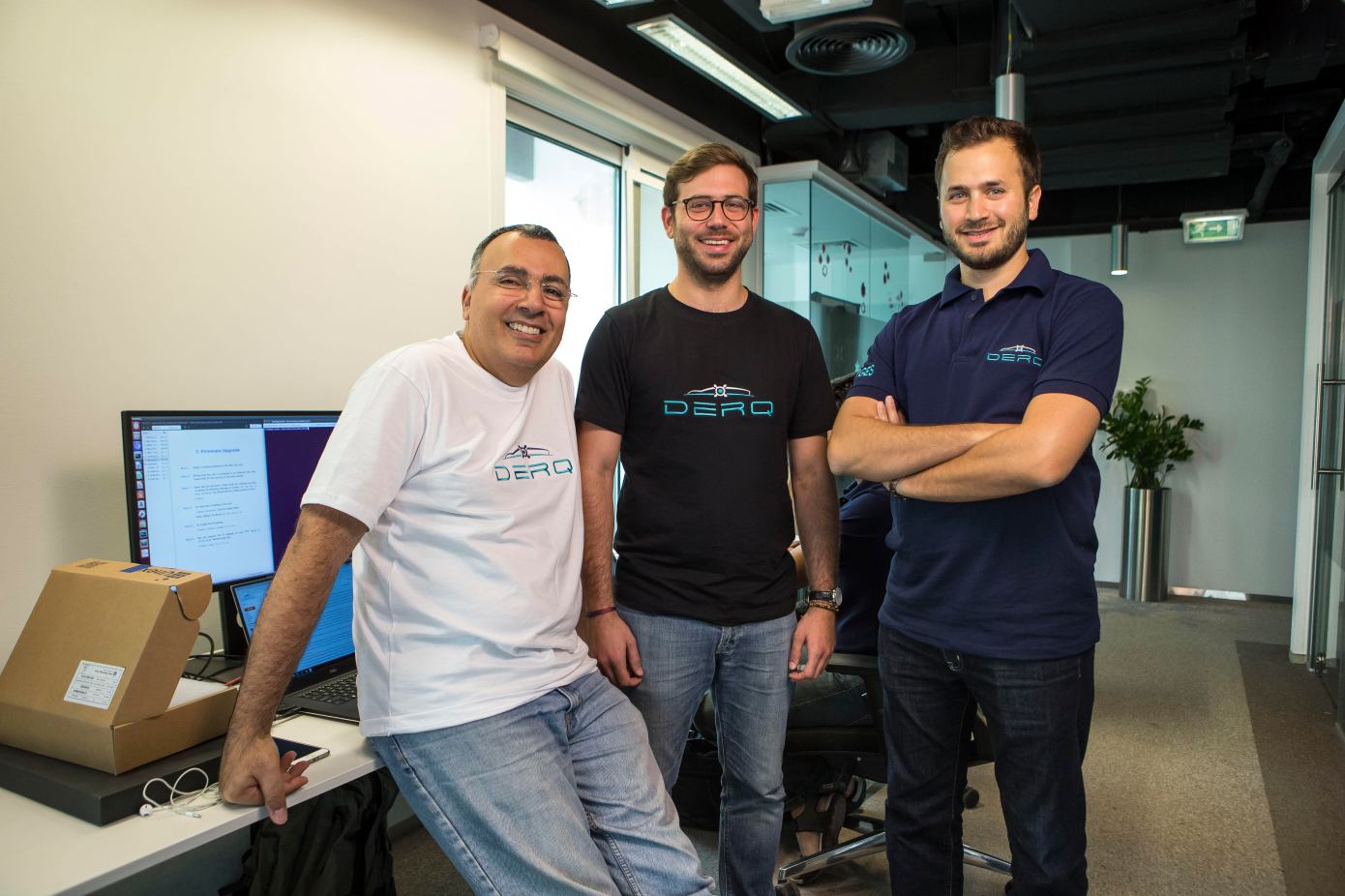
DUBAI. UNITED ARAB EMIRATES, 20 June 2017. DERQ Co-Founder and CEO Dr Georges Aoude and partners who's start-up has raised $1Million in Middle East Investment. (Photo: Antonie Robertson) Journalist: Nick Webster. Section: National.

By Nnamdi Odumody

According to the WHO Global Status Report on Road Safety 2017, there are 1.35 million fatalities from road accidents every year due to preventable crashes, and between 20 and 50 million sustain non fatal injuries.

The Nigeria’s National Bureau of Statistics (NBS) report shows that in the first quarter of 2018, about 1292 people died in 2,482 road accidents in Nigeria. Speed Violation was reported as the major cause of road accidents in Q1 and it accounted for 50.81 percent of the total road crashes reported. Between July and September 2018, no fewer than 126 lives were lost in road accidents.

From the data, a total of 28,195 lives were lost in 68 months i.e. 415 lives every month, 14 persons every day and two lives every four hours.

The Federal Road Safety Corps (FRSC) stated that in May 2017 there were 33.7 deaths per 100,000 people in Nigeria from road accidents which is one of the highest in Africa with Zimbabwe the worst in the world with 74.5 deaths per 100,000 inhabitants. The world average is 17.4 while Africa is 26.6. Norway has the least road fatality in the world with two deaths per 100,000 inhabitants, according to International Transport Forum Road Safety Annual Report for 2018.

Derq, a spin off from MIT based in Detroit and Dubai, wants to prevent these horrible tragedies from happening. It has a mission to eliminate road accidents and save lives by using proprietary artificial intelligence and V2X (Vehicle to Everything) technology. It can predict and prevent car accidents before anyone else on the road.

Its goal is to predict and prevent collisions at any time, independent of vehicle model, autonomy and surroundings. In Detroit and Dubai, Derq’s software monitors vehicles, pedestrians, bicycles, scooters and other vulnerable road user interactions to predict and prevent collisions, creating up to two additional seconds of warning time for drivers and vehicles.

Its V2X technology is designed to support improved automotive safety, automated driving and traffic efficiency and is based on globally recognized 3rd Generation Partnership Project (3GPP) specifications with ongoing evolution designed to offer forward compatibility with 5G. Its technology spans driver behavior modeling, deep learning methods, advanced driver assistance, perception and sensor fusion, V2I Communication and Embedded Systems Design.

Derq won the first prize for Artificial Intelligence pitch at the 2019 SXSW Pitch.

Nigeria will need this as we are losing many people on road accidents in the nation.