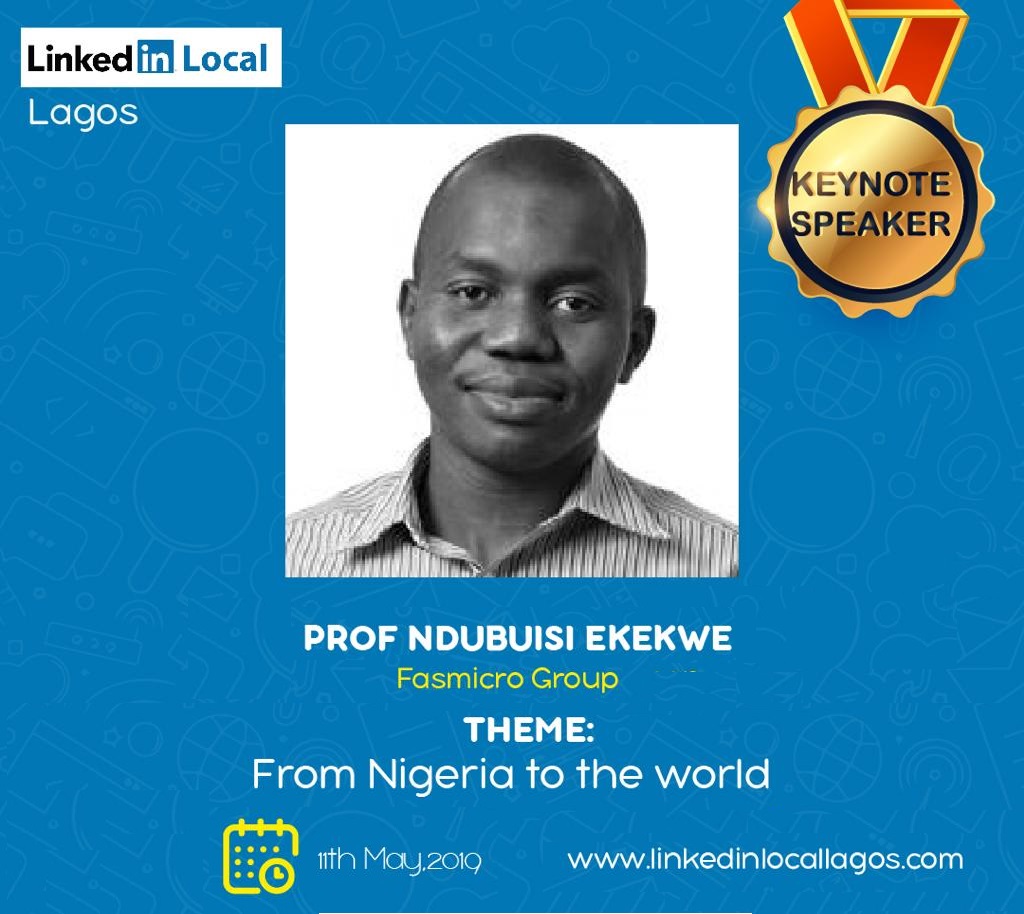
Greetings! Many came from all over the nation to connect at the Platform. But it was not possible. To make up, I have accepted to keynote LinkedIn Local Lagos on May 11. Let me say that my role is simply to come there, and speak, and possibly inspire some young people. Send all questions to Kayode and his team. There is a link to register to attend the event.I will arrive early with my team and will try to meet as many as possible.
Venue is now SATURDAY, MAY 11, 2019. 11AM |RADISSON BLU ANCHORAGE HOTEL, VICTORIAISLAND, LAGOS
LinkedIn Local is a global community by the users of LinkedIn, designed to take online relationships offline to get to know the person behind the profile.
LinkedIn Local Lagos is the biggest networking gathering in Nigeria, where business leaders, young and old professionals alike, can participate in discussions, learn and network.
LinkedIn is a platform for career development and planning. So, my talk will focus in that space. I will draw some experiences while in FUTO and my current journey. It is not physics but there are elemental constructs which can be picked from any experience.
Berlin, Germany - February 27: In this photo illustration the logo of transportation network company Uber is displayed on a smartphone on February 27, 2019 in Berlin, Germany. (Photo Illustration by Thomas Trutschel/Photothek via Getty Images)
It is here – Uber has started the unification of intra-city transportation. Yes, Uber now has the ability for people to use Uber, the ride-hailing solution, and also use the app to pay for public transportation systems. In other words, Uber lets you buy transit tickets besides all the current benefits. The integration is to provide seamless experience for users by making it easier for them to use Uber to get to train station, and jump right into the train, without a need of queuing for train tickets since they could buy tickets via Uber app.
“For the first time ever, taking an Uber trip can mean taking public transit,” Uber Head of Transit David Reich said in a statement. “We are excited to expand our collaboration with RTD and Masabi to make Denver the first city in the world where riders can purchase transit tickets and ride public transit seamlessly through the Uber app. With this step, we are moving closer to making Uber’s platform a one-stop shop for transportation access, from shared rides to buses and bikes.”
For transit, Uber is serving two sets of customers: agencies and riders. For both sets, Uber is aiming to increase efficiency, enhance the experience and increase equity and accessibility, Reich told TechCrunch earlier this year.
While Uber is only launching this in Denver today, Masabi handles ticketing for 30 transportation agencies worldwide, including Los Angeles’ Metrolink, New York’s MTA, London’s Thames Clippers and Boston’s MBTA. Uber also has relationships with a number of cities already.
Uber is expanding revenue base and will make life harder for Lyft to survive. I do believe that Lyft will give up soon by merging with Uber, or give itself up to a consortium of car companies which may need it to onboard users for the driverless future.
Apple settled with Qualcomm few weeks ago. Now, we are learning that it paid Qualcomm $4.5 billion. That is a lot of money for starting a fight and then paying to apologize because without the “enemy” your business has no future. Yes, for iPhone to have a 5G version within the next 12 months, Qualcomm must be in the equation since Intel Corp is not yet ready, and going to Huawei for the chips may not be optimal for a U.S. company when Huawei is under the crosshairs of the U.S. government.
How much is an apology worth? Well, if you’re Apple, it turns out the number is at least $4.5 billion, which is the amount that Qualcomm revealed in its Q2 earnings it will get from the settlement agreement between the companies, which had previously been embroiled in an ugly patent dispute for the past few years.
The Apple / Qualcomm settlement was an unexpected shift that came early in the trial between the two companies. According to a report from Bloomberg, Apple had decided that Intel’s modems (which Apple had been exclusively using in the interim due to its fight with Qualcomm) wouldn’t be ready in time for a 5G iPhone, leading Apple to pony up the newly revealed sum of between $4.5 to $4.7 billion to make up with Qualcomm. That amount of money is separate from any future royalties that Apple will pay for using Qualcomm chips in its devices going forward, too.
This is a total and complete victory for Qualcomm. Sure, Apple is well loaded that this is largely insignificant – Apple has a cash hoard totalling a reported $225.4 billion. Yet, it matters in case it wants to start fights next time.
Innovation enables a new basis of competition, offering firms and nations the opportunities to create a separation by anchoring new trajectories in markets and territories. Until ideas have been tested and the hypotheses validated in markets, within demand-supply frameworks, the term “innovation” cannot be used.
In my book – Africa’s Sankofa Innovation – I have explained different types of innovation [section reproduced below]: disruptive or breakthrough innovation, sustaining innovation, incremental innovation,discontinuous innovation, continuous innovation, open innovation, closed innovation, Hybrid innovation, grassroots innovation or “bottom of the pyramid” innovation, Sustainability innovation, inclusive innovation, social innovation, and user innovation. Then, there is Sankofa innovation.
Box 1.1: Different Forms of Innovation
Innovation is important in commerce and industry owing to its specific capacity to improve competitiveness and position institutions for success. There are many kinds and forms of it: disruptive or breakthrough innovation is one that changes the basis of competition in an industry — for example in watches, Swatch change the basis of competition from accuracy to fashion; sustaining innovation is one that perpetuates the current dimensions of performance —for example, Tesla making electric cars that can go further before recharging; and incremental innovation focuses on small improvements on existing products, services and processes.
Disruptive innovation is the most consequential as it redesigns markets through transformational impacts enabled by the technologies. The evolution of smartphones like iPhone has been termed disruptive. It brought new social systems like the sharing economy made possible by mobile apps. Also, the wealth created by Apple is well documented besides the economic and political consequences its impacts have exerted on the economies that hosted the industries its technologies have disrupted (think of job losses in Nokia home country Finland).
Innovation can also be examined within the direction of change: while discontinuous innovation breaks paths to move to significantly new directions, continuous innovation follows a sequence without deviating from the status quo. When innovation takes place in a form that it draws insights that lie outside the boundaries of the firm, it is called open innovation and when the system is highly internally controlled and sequestered from outside, it is said to be a closed innovation. Hybrid innovation where companies keep their internal R&Ds with controlled intellectual properties but open some R&Ds components to get insights from external stakeholders has become common.
Recently, innovations by the billions of global citizens living on less than $2 per day (the poor) and stakeholders of traditional form of knowledge mainly from the informal sector have been categorized as grassroots innovations or “bottom of the pyramid” innovations. Sustainability innovation combines sustainability — environmental preservation, protection through renewal, maintenance, and sustenance — with innovation. For inclusive innovation, the focus is reduction of inequality — poverty, disability, distance and others — and driving growth that considers every stakeholder. This is very close to social innovation which while considering owners/investors equities in enterprises also pushes for serving the society and improving the lot of the poor. And finally, when innovation is led by users — user firms, user communities, end users — and not by suppliers or manufacturers, it is user innovation.
Then, there is Sankofa innovation which is “reach back and get it” type of innovation that emphasizes continuous improvement by looking back and learning from past experiences.
Good People,
Thank you for the emails and InMails – we have them. I may be slow to get back but I want to use this medium to thank everyone ahead. To those that travelled from far to meet me which unfortunately did not happen, I will make time to speak with all. #Believe
Here is a cut-out of my presentation from the master content. The presentation is titled “The Growth of Nations”.