DD
MM
YYYY

PAGES

DD
MM
YYYY

spot_img

PAGES

Home Blog Page 6906

On Improving the Igbo Apprenticeship Venture Capital System

0

Great debate on scaling and institutionalizing the Igbo Apprenticeship Venture Capital System which I noted reduces inequality even though it makes it harder to build category-king winner-takes-all businesses. Yes, by constantly dividing your market share, and funding competitors, you may reduce inequality (a cultural desire) but you will never build global champions which work on absolute and complete market dominance where the trajectory is to own 100% of market share, if possible. That sharing principle is the heart of the success, and also the most deficient part of the Igbo Apprenticeship Venture Capital System within the context of modern free enterprise mechanisms.

Many have written and asked me why I noted in my Platform speech that the Igbo apprenticeship system is the best business framework in the world. Certainly, I did not have time to explain many elements of my hypothesis on stage.

Simply, under the Igbo apprenticeship system, you attain easily an efficient economic equilibrium where inequality is severely mitigated.  Everything the world is complaining about inequality and the rich getting richer, the Igbo apprenticeship system handles optimally.

[Notice that I woke up to decide that going forward, I will write the Igbo Apprenticeship System as Igbo Apprenticeship Venture Capital System. That is a better description of what is happening therein. It is not just providing apprenticeship in skills; it is also giving capital, which is important].

The key point is that the VENTURE CAPITAL ecosystem which the Igbo apprenticeship system enables drives more people to accumulate capabilities and wealth, not just one individual, in a community. Largely, the master is running a venture capital fund and accelerator, transferring skills and capitals to young people. Those young people then emerge. You can reduce poverty within that construct but the master may not be a dominant capitalist locally or regionally.

Venture capital is a type of private equity, a form of financing that is provided by firms or funds to small, early-stage, emerging firms that are deemed to have high growth potential, or which have demonstrated high growth.

For the modern form of capitalism, lack of capacity to grow big may affect the economies of scale, putting the players at the downstream side of markets. They will have lesser resources to fund innovation and advance the fixing of market frictions. A reform is needed in that space.

But in reality, this market is governed by a sharing principle. Every merchant, when you ask them, “How did you get started in global trade?” they say, “Well, when my master settled me.” And when I finally got it into my head to ask, “What is this ‘settling?’” it turns out that when you’ve done your apprenticeship with someone you work for, they are required — required — to set you up in business. That means paying your rent for two or three years and giving you a cash infusion so you can go out in the world and start trading. That’s locally generated venture capital. Right? And I can say with almost certainty that the Igbo apprenticeship system that governs Alaba International Market is the largest business incubator platform in the world.

Yes, that is why I want to see how it can be reformed to mirror the structure of FrieslandCampina (makers of Peak Milk – a Dutch cooperative-structured company) where many dairy farmers (in thousands) collectively own it, feed into the firm, and yet the firm is a global dairy powerhouse. Simply, there is an opportunity to have cooperatives within the Igbo apprenticeship venture capital system to help drive scale for innovating market efficiencies through scale.

LinkedIn Comment on Feed

A nice article. The Igbo Apprenticeship System is a unique and kind that deserves emulation. The advantages supersedes the demerits. What is needed is to institutionalised it with government/private sector participation for start-up capital. The use of local/PPP debt finance equity finance could be a profound achievement.  The system had already removed/reduced hooliganism and joblessness in Igbo land. The critics without alternative solution to create jobs and wealth can misdirect the minds. Nigeria does not seem to be a country with perspective seeking ideas for its citizens hence hoping on them is a waste of time and energy. It may evoke sentiments that Nigeria is a branded a country without perspective, but this could be a story for another day. Precisely, regarding the Igbo Apprenticeship Scheme, I have the opinion that it should be improved and not discard nor apply the winner-takes-all businesses because the later can only create servitudes without end void of tapping hidden potentials by all-inclusive to wealth creation model.

The Igbo Apprenticeship System can be modified where necessary. The system to isn’t that bad as perceived by some quarters. Why do we even need to build the king winner-takes-all businesses? Looking at the reality on ground now? We should scale this one we have first and then when the need arises we’d cross that bridge. The real beauty I see in the system is that, it closes a wealth gap which is highly responsible for one of the challenges we face as a nation and in the world today. I would love to ask this, when will Nigeria and Africa at large begin to look inward for the answers she had to most of the problems it has with objectivity? We’d get it right someday. Thank you for sharing your thoughts always Prof. Ndubuisi Ekekwe
Tyme is a Digital Bank Redesigning Retail Banking for the Future

1

By Nnamdi Odumody

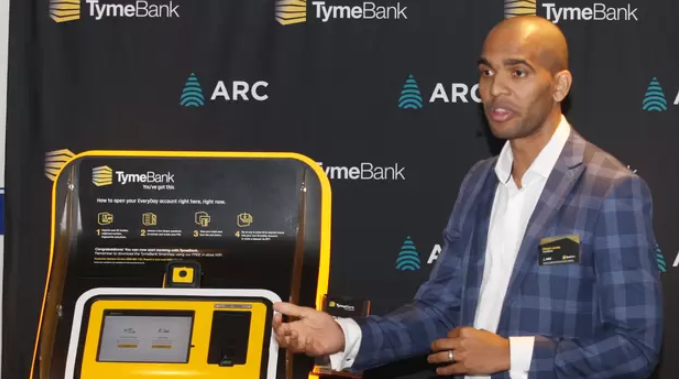
Tyme Bank is a South African digital bank which is redesigning retail bank of the future. It uses artificial intelligence to interact with its customers online, and ATM kiosks offline, as it has no physical branches, offering a low cost account, targeting the 11 million unbanked people in the rainbow nation.

The bank of the future will be a technology company, which will utilize data analytics to offer personalized real-time financial services, to its customers, no matter where they are located. It will likely operate mainly with limited physical branches, unbounded by locations – rural or urban, thereby promoting financial inclusion for all. Some banks in Nigeria are already redesigning their strategies to key into this redesign which has become evident to technology leaders. For these banks, technology does not just run them, technology is transforming them, and that is great.

Tyme charges no monthly administration fees, smart app subscription fees and it offers users free Wi-fi at its partners Pick N Pay & Boxer retail stores which have a Tyme Bank Kiosk. Customers can download the smart App from Google Play Store.

Its interest rates are competitive earning customers as much as 10 percent through its Goal Save which allows for cash deposits and withdrawals with no restrictions, fees or penalties. The Everyday Account opening process is simple, convenient with no filling paper forms, scanning, faxing or email service.

Tyme Bank charges for debit card use at other retailers, payment to other bank accounts, internal and external debt order, etc and it is automatically linked to the Pick N Pay Smart Shopper programme which means no need for multiple cards in your wallet.

Nigerian retail banks and other financial services providers which want to reach the over 20 million underbanked with a convenient retail banking experience should learn from Tyme, and create a local market fit solution which will disrupt their conventional brick and mortar approaches.

Youneek Studios is Creating African-themed Superheroes

1

By Nnamdi Odumody

YouNeek Studios is a creative hub which utilizes graphic novels, animation, video games, and other forms of media to tell extraordinary stories about African heroes, and heroines, that everyone can relate to.

Its goal is to put Africa on the global map in the graphic novels, animation and superhero stories.  Its Cofounder and CEO, Adewunmi Roye Okupe, a Bachelor and Master’s Degree holder in Computer Science from George Washington University, was inspired by the Marvel Superhero franchise which led him to found YouNeek Studios in 2012. Through this platform, Roye has written, produced and directed several animated productions, including but not limited to 2D|3D animated short films, TV commercials,  show openers, music videos and much more.

In August 2015, Roye released his debut graphic novel titled ‘’E.X.O: The Legend Of Wale Williams Part One –  a science fiction superhero series about redemption set in a futuristic 2025 Africa. It tells the story of Wale Williams, a young man who inherits a suit with superpowers after his father goes missing. After been tricked into returning back home to Lagoon City, Nigeria after a five year absence, Wale embarks on a journey to investigate his father’s mysterious disappearance.

One of Youneek superheroes

Learning the incredible powers of the suit, Wale realizes that he must restore hope to his city by preventing disastrous attacks from Oniku who leads a group of violent extremists known as THE CREED. It earned a 5 star rating on Amazon.com from reviewers, earning number one spot on the Amazon best seller chart in Science Fiction Comics category in May 2016, with features in CNN, Forbes, The New York Times, NBC, The Guardian, ABC7, BBC, The Huffington Post, Mashable, etc.

His sophomore novel, Malika Warrior Queen is about a Malika, a queen of Azzaz and amazon who struggles to keep peace in her ever expanding empire. As a young child, Malika inherited the crown from her father in unusual circumstances splinting their kingdom of Azzaz into two. After years of civil war, Malika united all of Azzaz and expanding it to become one of the greatest empires in all of West Africa. This created enemies within her inner circle and one of the leading superpowers in the world at that time Ming Dynasty of China took notice. Queen Malika now faces a huge task of fighting internal foes to prevent her empire from collapse and safeguarding it from a foreign force which will leave no stone at conquering and exterminating her people.

Windmaker the History of Atala, his third book, was inspired by African mythology. It is about a breathtaking kingdom called Atala. With dragons, mythical relics, a feuding royal family, and magical swords, this book brings suspense to its readers in an inspiring African set up.

The YouNeek African Heroes is an all age coloring and activity book for children aged 0-8 years old. They color the amazing superheroes in its library, enjoy learning about science, history, monuments and mythology linked to Africa while solving mazes,  crossword, solving puzzles, etc.

In 2019, YouNeek Studios plans to release Malika Warrior Queen Part 3, Iyanu Child of Wonder – a teenage girl who has no knowledge of her past but discovers that she has powers which rival the divine ones in ancient Yorubaland, E.X.O : The Legend Of Wale Williams Part 4, and Windmaker: Return of a King.

In less than three years, YouNeek Studios has sold over 100,000 books with Hollywood star Jamie Foxx publicly endorsing E.X.O on Facebook, and plans to adapt its YouNeekVerse range of superheroes into big budget movies for the African and global audience.

How Disruptive Technologies like Desert Control and Rewardn Can Solve Desertification in Northern Nigeria

2

By  Nnamdi Odumody

Desertification is a process by which the dry land ecosystem suffers continuous degradation by the removal of tree and plant cover as a result of human activity.

In Northern Nigeria, about 40 million people in eleven states are threatened with desertification as a result of poor land use, unsustainable cattle grazing  practices, and the consumption pressures which are associated with a booming population.

According to Prof Emmanuel Oladipo, an environmental consultant, the direct cause of desertification and arid land degradation, is as a result of drastic reduction or destruction of the perennial plant cover, particularly trees and simplification of the vegetation structure. The soil surface not protected by permanent vegetation becomes subject to erosion by water and wind, crusting by raindrop splash and trampling by animals. Consequently, there are salinization by evaporation and water logging in topographic depression since water is no longer extracted by permanent vegetation.

Farmers in the North are adopting measures such as tree planting to provide shade and windbreaks using diesel powered irrigation pumps, and sowing beans, but these are not enough to tackle the enormous scale of the crisis.

Nigeria has an annual deforestation rate of about 3.5 percent. The economic cost of deforestation, drought and desertification, is 10.5 billion naira. A National Strategic Action Plan for desertification and deforestation was developed in 2011 but lack of political will has hampered its progress.

Solutions On the Way

Desert Control is a startup which utilizes cutting edge nanotechnology to transform deserts to arable land using their proprietary ‘’Liquid Nano Clay’’. Through a patented mixing process, Liquid Nano Clay combines clay and water, and is then spread on to sandy soil, enabling the soil to retain water, turning desert into fertile soil. This process which normally takes 15-20 years is done within 7 hours with the technology, reducing the water needed for irrigation by 65 percent, and then enabling more robust soil and higher yield.

They tested it in Al Ain, an emirate in the United Arab Emirates, which imports about 80 percent of its food consumption due to loss of arable land, as a result of desertification, recording a huge success rate.

A Nigerian company called Rewardn has a similar technology.

The Northern Nigeria Governors Forum should engage Rewardn and Desert Control to help them fight desertification in their region on a large scale with the innovations.

In Sahara Desert which is also facing the threat of desertification, Shimizu Construction Corporation has come up with a disruptive solution tagged “Desert Aqua Net Plan’’ which will irrigate the Sahara with a network of interconnected canals and sea water lakes. These 30km wide man made oases linked to the sea and each other, via long canals, will ameliorate and cool the scorching desert, provide a source of food and host resort like cities on artificial islands.

Nigeria should learn and explore partnerships with these entities to fight desertification in the northern part of the nation.

The Platform – Why I Said the Igbo Apprenticeship System is the World’s Best Business Framework

9

Many have written and asked me why I noted in my Platform speech that the Igbo apprenticeship system is the best business framework in the world. Certainly, I did not have time to explain many elements of my hypothesis on stage.

Simply, under the Igbo apprenticeship system, you attain easily an efficient economic equilibrium where inequality is severely mitigated.  Everything the world is complaining about inequality and the rich getting richer, the Igbo apprenticeship system handles optimally.

See it this way, a man goes into a business sector, and wins market share. Then, one day, he decides voluntarily to give out market share and immediately creates competitors for himself. And as he does that, he includes huge obligations to ensure those competitors thrive. So, magically, a system evolves where everyone is just doing well with no distorted imbalance. No one is super-rich but everyone is just fine! And the players just like it that way because “onye aghara nwanne ya” [do not leave your brethren behind] is part of the culture!

The United Nations did confirm in its most recent report that Southeast Nigeria is the most balanced and economically stable part of Nigeria with the least hunger and economic stress on the citizens: “The report further highlights the existing gap in human security across the geo-political zones of the country; – the most human security secure geo-political zone is the South-East while the North-West and the North-East geopolitical zones..” The Igbo apprenticeship is the simple reason for that.

There is something that has worked in Nigeria. It is the Igbo apprenticeship system. It is the reason why the southeastern Nigeria is considered the region in Nigeria with the highest level of human wellbeing (not necessarily education attainment which is not exclusive) by the United Nations’  “Human Security and Human Development” report.

The report further highlights the existing gap in human security across the geo-political zones of the country; – the most human security secure geo-political zone is the South-East while the North-West and the North-East geopolitical zones are the least human security secured, with residents of the Federal Capital Territory being the worst in most realms of the Human Security Index. The North-East region of the country has been the most affected by the more than 5 yearlong military insurgency. It also remains among the least developed parts of the country.

What the world is expecting Amazon, Google and Facebook to do, under the Igbo apprenticeship system, business legends fund competitors and give out market share to build an economic system where everyone participates with no sole dominant player. I have not seen any better business framework in the world if the essence of capitalism is to improve the wellbeing of the citizens and the world through fixing frictions which exist in economies and markets.

Yes, I will prefer a community where everyone has enough to eat (like my Ovim village in Abia State) over one where few have excess with many severely poor. The American capitalism can make the latter happen, but Igbo apprenticeship framework ensures the former is maintained through empowering competitors – and by extension others, at scale.

LinkedIn Comment on Feed

Comment #1

That’s why anything that is not documented and properly archived is never appreciated. The West keep making us feel like lesser human beings, while many of the things their famed business schools are trying to figure out, we have resolved them with ease here; only that our storytelling skills are more or less abysmal.

What you see play out in the southeastern Nigeria is more ‘balanced capitalism’, far from socialism, because it still rewards those who put in the greatest efforts. The framework has worked magically well, without any super or suffocating legislation guiding its mechanisms. Something to teach others who do not know what to with the super rich, other than entertaining socialism, whose end result certainly leaves everyone poorer.

Amazon, Google or Apple aren’t slowing down anytime soon, neither is it a wise choice to dismantle them, just to ‘level’ the playing field. Now it’s a question of figuring out how these behemoths can cede some market share, without being forced to do so. And if the West wants to figure that out, now they have to come to us, we have a workable framework, which we are willing to share, with some good dollars in return…

As always, wisdom is not taught in the universities.

Comment #2

While I acknowledge the merits of the system, there are some issues to think about.

If businesses keep losing market share through this system, it’s hard to build big business brands that can take advantage of scale and scope economies. This is because market share and operations keep getting fragmented as each new apprentice becomes an “Oga”. Now that’s not quite an efficient system if we agree that cost savings from scale and scope economies are efficiency-enhancing.

The other issue is the link to inequality. It’s not readily the case that the apprenticeship system reduces inequality. Otherwise we could also simply say that education simply eradicates inequality by making everyone capable of earning the returns of education. What’s well known, however, is that inequality largely stems from accumulated wealth which goes on to earn the owner more and more return. Therefore settling an apprentice with, say, 0.01% of one’s wealth will probably help the recipient start a life not solve inequality.

My Response to #2 Comment

Your last sentence makes my point even though you pivoted. If you set anyone with Bill Gates 0.01%, I think he/she will be fine. And if that person sets another, that improves. The key point is that  the VENTURE CAPITAL ecosystem which the Igbo apprenticeship system enables drives more people to accumulate capabilities and wealth. You may not notice – Igbo apprenticeship system is a VC fund! As I noted, UN has data that SE does better on human wellbeing and security, I do believe it is this VC that ensures that people have opportunities over just begging.

On building big firms, you have a point. That is where I ask for reform. I do think there is a way out – think of makers of Peak Milk (Friesland Campinas). The company is owned by thousands of dairy farmers. Igbo traders can band together and own a conglomerate which they feed into. Yes, they can build bigger firms. There are ways to deal with that which I have no space to explain here.

LinkedIn Comment on Feed

The same apprenticeship and market system has ended up undermining improvements in quality and capability. Why do you think it’s very easy for a custom officer or agbero to mess a business owner up here? It’s because most of them lack the capacity to assert their rights, so it becomes convenient to ‘settle’ and move on.

To modernise this framework, I will propose super ownership framework, where every small trader must choose one of the big holding names to trade under. This way, you no longer see one Obi or Kunle importing one container, rather you now have Vector Conglomerate importing thousands of containers, within this conglomerate, the small guys are doing their thing, without molestation. The Vector Conglomerate has billions of naira for legal battle, in case any idiot or authority impedes its operations.

It’s a high level cooperatives, with massive capability to do big things. Now it will be easier to control fake products, pay single tax or duties to the government, and everyone will be happy.

Implement same for truck ownership, then we won’t have any truck without a known label on our roads. It will now be easier to bill the big owners on any reckless driving or negligence.

We can organise Nigeria, if we want!