DD
MM
YYYY

PAGES

DD
MM
YYYY

spot_img

PAGES

Home Blog Page 6912

Tech China Under Stress As Layoffs Accelerate

0

Something is wrong in tech China as many of the nation’s leading technology companies embark to cut jobs. Anyone that does not believe that China’s economy is under stress cannot deny the reality that these great technology firms cannot be massively retrenching if the economy is healthy. But this is also a wakeup call for everyone: if China enters into massive recession, the world will be dragged into that pit. So, startups in Africa must begin to watch these signals and plan accordingly because everything is not right. Now is the time to keep cash that will take a startup through recession when (not if) it happens.

China’s second-largest e-commerce company, JD. com, plans deep job cuts to staunch losses and reassure investors, according to a slew of recent media reports, highlighting the mounting challenges faced by Chinese tech firms as their nation’s economy loses steam.

The Information, citing investors, reported Tuesday that NASDAQ-listed JD.com is preparing to lay off as many as 12,000 people, or roughly 8% of its workforce. Bloomberg and Quartz also report the company is planning cuts and has rescinded some job offers.

Reports of layoffs at JD.com follow announcements of similar retrenchment at other Chinese tech companies. Tencent Holding, China’s mammoth social media and online games provider, said last month it would sack or demote up to 10% of senior and middle management. In February, ride-hailing giant Didi Chuxing said it would slash its workforce by 15%. (Fortune newsletter)

Yet, Alibaba continues to wax stronger. So, in the midst of the paralysis, there are exceptions. Looking at the stock performance over the last six months does show solid confidence on the company and the Chinese economy.

All Together

The big Chinese tech companies are experiencing massive layoffs. If you run a startup in Africa, it may be smart to start planning: keep some cash war chests in case recession arrives, and capital dries up.  Sure, some say the challenges are localized. Yet, I do not think there is anything about China that is local to China!
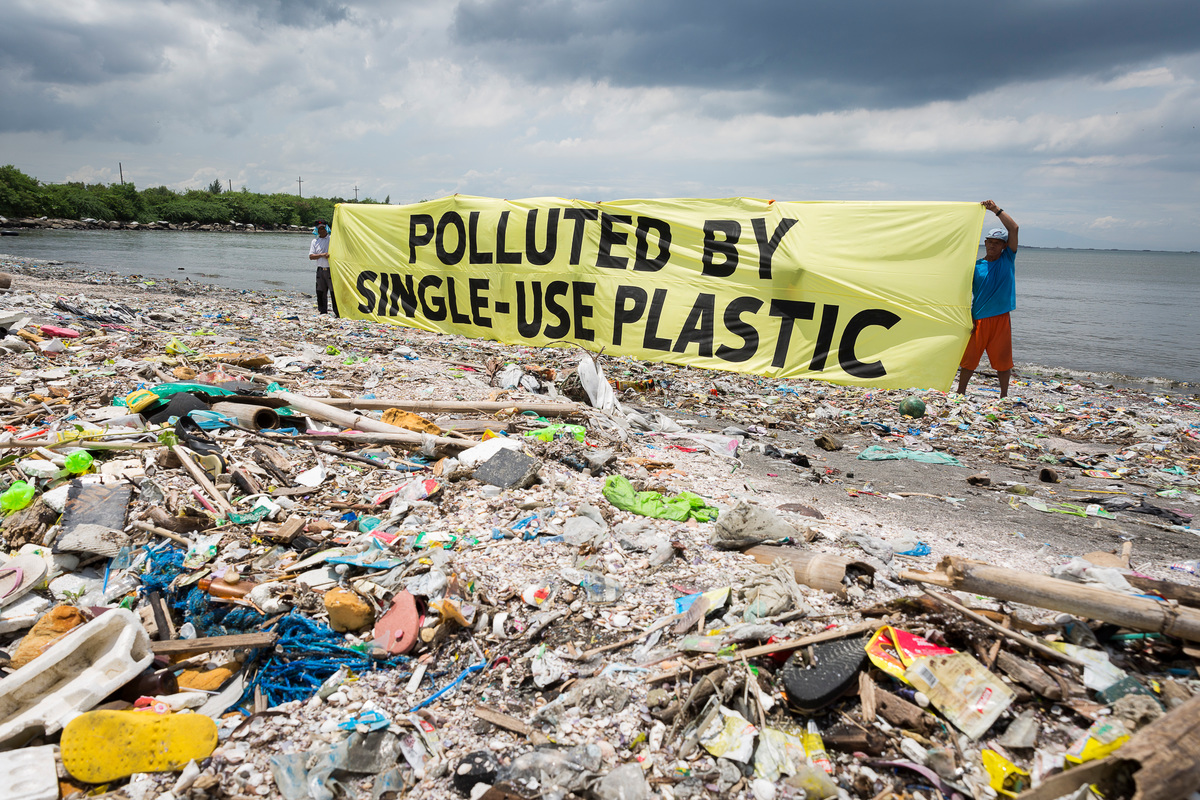

Nigeria Should Combat Plastic Waste for Sustainable Environment

0

By Nnamdi Odumody

According to the State of Plastics Report, only 9% of the nine billion tons of plastic in the world ever produced are recycled. More than 480 billion plastic drinking bottles were sold in 2016 across the world, up from about 300 billion a decade ago. By 2021, this figure will increase to 583.3 billion, according to Euromonitor International’s global packaging trends report.

An estimated 8.3 billion tons of plastic have been produced since the 1950s. About 91% of plastic waste isn’t recycled.  According to National Geographic Channel, 73% of all beach litter is plastic. 10 rivers across Asia and Africa carry 90% of the plastic which ends up in the oceans while it takes 10-1000 years for all types of plastic waste to decompose. Victor Igonoh, an Environmentalist, states that by 2050 plastic bottles will be more than fishes in the ocean.

Nela Duke, CEO of Obudu Conservation Centre, pegged the production of plastic bottles in Nigeria to about fifteen thousand tons per day (around 5.4 million annually) while Greenpeace stated that Coca Cola produces more than 100 billion PET bottles every year. It also said that the top six beverage companies in the world use a combined average of 6.6% of recycled PET bottles in their products.

The average person uses 70,000 microplastics every year while about 500 billion – 1 trillion plastic bags are used worldwide annually. Ingestion of plastic kills an estimated 1 million marine birds and 100,000 marine animals each year and by 2050 there will be 12 billion metric tons of plastic in landfills.

Being non-biodegradable, plastics remain where they are, without decomposing, for a long time and causes serious damage to its environment. Plastic leaches harmful chemicals like carcinogens, endocrine disruptions, phthalates, heavy metals, and more when kept for a long time.

Considering the harmful effects of plastic to the environment, a few countries have taken strict measure to ban or tax plastic bags. In August 2017, Kenya introduced penalties on plastic bags which range from a four year prison sentence, or a fine of $40,000 on anyone caught using polythene bags while neighboring Tanzania in April 2019 has announced a plan to ban, the importation, production, sale and consumption of all single use plastic bags by July 2019.

Kenya introduced one of the world’s toughest laws against plastic bags in 2017. Now, Kenyans who are caught producing, selling, or even using plastic bags will risk imprisonment of up to four years or fines of $40,000 (£31,000).

Other countries that have banned, partially banned, or taxed single-use plastic bags include China, France, Rwanda, and Italy.

To curb this menace in Nigeria, a nongovernmental organization, Developmental Association For Renewable Energy, and its technical partners in Kaduna State engaged youths on recycling disused plastic into interlocking tiles, roofing titles, blocks and other industrial purposes. This technology called Ecobricks was developed by a U.K based NGO Waste Aid to turn plastic wealth into eco-friendly products.

An ecobrick is a plastic bottle packed with plastic to a set density to create a reusable building block. Ecobricks are used to make modular furniture, garden spaces and full-scale buildings such as schools and houses.

The Federal Ministry of Environment and State Chapters should collaborate with the private sector in developing technology to track plastic used and discarded across the country, and come up with stiff penalties on producers and consumers of plastics in Nigeria while research and development to produce environmentally friendly alternatives to plastic should be done.

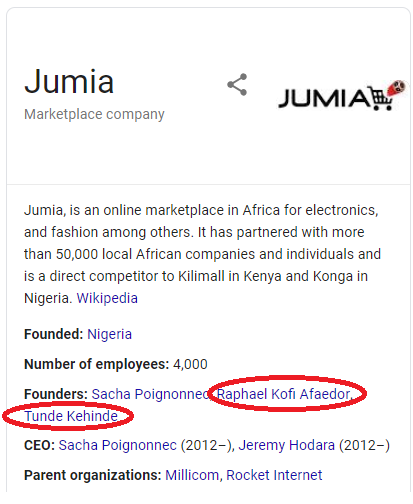
The Jumia Founders – Raphael Afaedor, Tunde Kehinde and Sacha Poignonnec

3

Like the Paypal mafia, Jumia could become something greater in Africa. These two Africans – Raphael Afaedor and Tunde Kehinde – the original co-founders of Jumia, left out in all the major stories, must NOT be forgotten. Along with Sacha Poignonnec, they created the first Jumia – but they left, surprisingly. That $3.9 billion happened because of Raphael Afaedor and Tunde Kehinde. I recall the day they followed Nigeria’s former minister of ICT to Silicon Valley and the world paid attention. They should inspire younger people in this story of Jumia. (Added from LinkedIn summary)

“Jumia was incorporated in Germany, its legal Headquarters is in Berlin, Germany, while its administrative Headquarters is in Dubai, UAE. Its global Technology centre is in Porto, Portugal. Its Top Executives aren’t African. The largest shareholder is MTN”, writes AfricaFactZone .

Yet, Jumia Nigeria was co-started with these two West Africans.  People need to see their faces to understand that without Jumia Nigeria, the mission of Jumia cannot thrive. Raphael Afaedor and Tunde Kehinde are key reasons why Jumia trades in NYSE today. They must inspire a new generation of Nigerian entrepreneurs!

Sure, the West Africans left in surprising ways, and today Sacha Poignonnec and the co-CEO run the show. Yet, Tunde and Raphael seeded, strategically, this company called Jumia. The money men have since changed the company. I just hope they will get something out of this major party in New York City with valuation hitting $3.9 billion. .

Comment on LinkedIn Feed

  1. Well said Prof. these two bosses had that foresight in bringing the business to limelight after their Harvard studies. I was opportuned to be part of the team not up to 50 staff who toil day and night to see the dream come true. They were true leaders with high energy and drive for success. They sit on the same table deliberating and calculating the way forward when average daily order rate was at 30. The impossible was made so easy with their strategic and continuous improvement process. I celebrate them.

  2. As they say, great things start small. I remember seeing Raphaels name on some sensitive data point when i recently joined the group, and I had always longed to speak with him and know what they were thinking when JUMIA all started seeing what it has become today……. Fastforward today I think lessons has been learnt, younger entrepreneurs would learn how to forecast properly, know when to sell off, or when to remain, how to sell off and what clauses to have. I also remembered a tech start up that was sold for over 1million USD and 2 years down the line, they are no where to be found. Good decision to sell off on the part of the co-founders! Good value for them at the end.

  3. Hi Ndubuisi, yes these guys are cited as the Jumia Group cofounders but I think that we need to insist on the lesson to learn at this stage: Building champion companies takes time and commitment. While I hope these guys will get part of the financial return they deserve (provided they still have shares in the company), I also think that we, African entrepreneurs, should start thinking long-term and Shen starting companies, make sure that we’re there to stay, no matter what. And that’s where enabling environments could come in, in order to make sure that basic needs are covered in the early years, backed by a vision to champion industries. Recall the Steve Wozniak case with Apple and late Steve Jobs!

  4. As an entrepreneur, you should be in it for the long time. There will always be challenges along the way. You also need to be ready to get other people involved in the business. If the other parties have not  invested in the business. Jumia could have been dead today. We have seen how greed and wanting to own it alone have killed good business that could grown in Nigeria. Congrats to them for let other people to be a part pf their business.

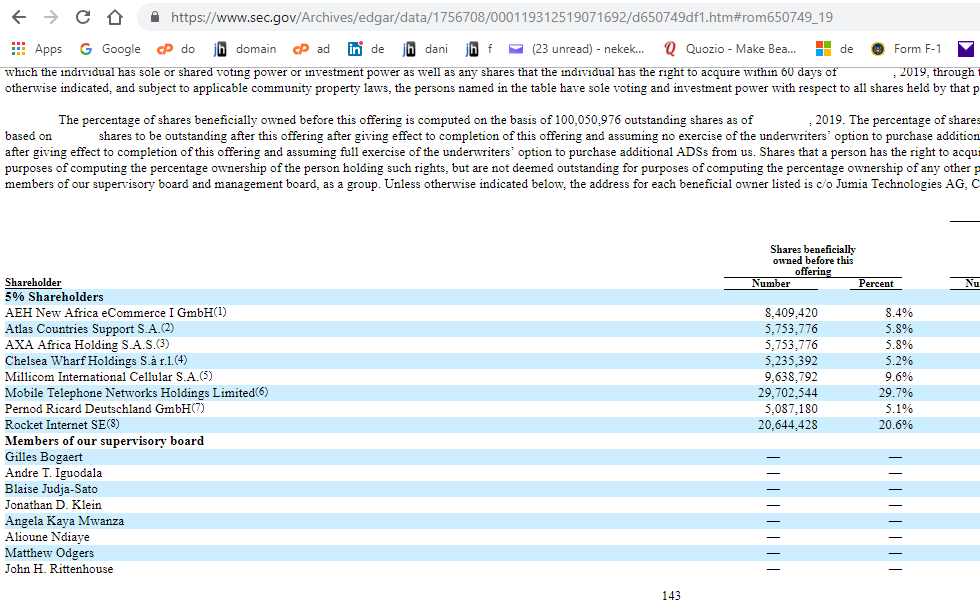
Jumia Principal Shareholders As Published in United States SEC Form F-1 Filing

0

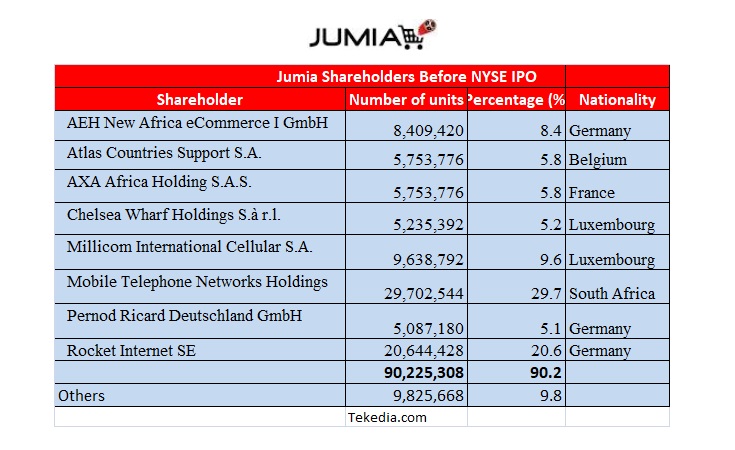
I have seen the other table where someone assigned the “original founders” of Jumia Nigeria double digit percentages of the listed Jumia. Sure, our brother (Nigerian) and our Ghanaian cousin were those, we knew, that started Jumia Nigeria. People did expect them to own huge pieces of the firm.

Evidently, the title “founder” does not mean you own a company. Today, people are paid to hold titles of ‘co-founder” and paid regular wages with no equity in companies. Legally, they award you 1 unit of stock when 50 million units are available! Yes, you are co-founder but we understand the size of your plate.

The table they are sharing is fake – disregard it. Mine is genuine. We extracted it from Jumia filed papers with the SEC/NYSE (Securities & Exchange Commission/New York Stock Exchange). Forget any alternative facts and trust that one. This is the link to the report and I am sharing the raw table below.

Source: Jumia, SEC.gov

There is no sentiment here – this is free enterprise. It is possible to hire a Nigerian in London, give him money to start a business in Nigeria, give him title of Founder when he does not even command 0.1% of the company! To understand why, go back to AO Lawal’s Economics where he explained Capital as a factor of production. It remains scarce and controls all other elements of production.

So, there is no need to argue over reality. Jumia filed in United States SEC its principal shareholders. Those are the shareholders, period. Any previous PowerPoint or document is irrelevant at this point. You can always trust anything I share as they are backed by above Google research.

To Deliver Disruption At Scale

0

ICT brought huge productivity gains across sectors and markets. The web is delivering disruption at scale. It will be nearly impossible for your ICT venture to disrupt without the web!

But with the advent of the Internet, many things are changing, owing to the unbounded and unconstrained nature of the web. The companies that relied on ICT to change their sectors are also now vulnerable. Indeed, ICT brought huge productivity gains, Internet is delivering disruption at scale.

The implication is that the way we run Internet companies must be different from the way we ran businesses pre-Internet and when ICT was the vehicle for productivity gain. There are key things to note: