I have seen the other table where someone assigned the “original founders” of Jumia Nigeria double digit percentages of the listed Jumia. Sure, our brother (Nigerian) and our Ghanaian cousin were those, we knew, that started Jumia Nigeria. People did expect them to own huge pieces of the firm.
Evidently, the title “founder” does not mean you own a company. Today, people are paid to hold titles of ‘co-founder” and paid regular wages with no equity in companies. Legally, they award you 1 unit of stock when 50 million units are available! Yes, you are co-founder but we understand the size of your plate.
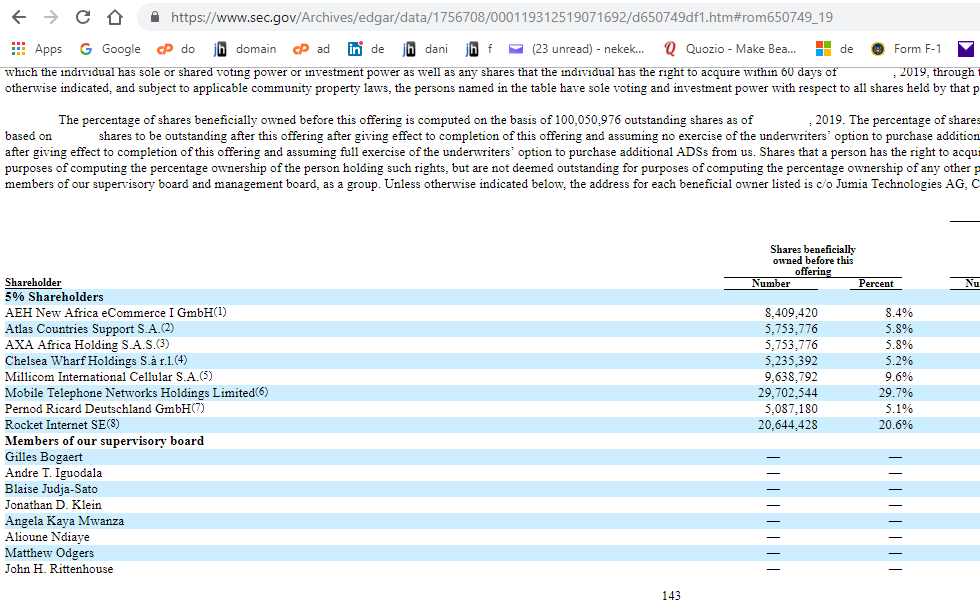
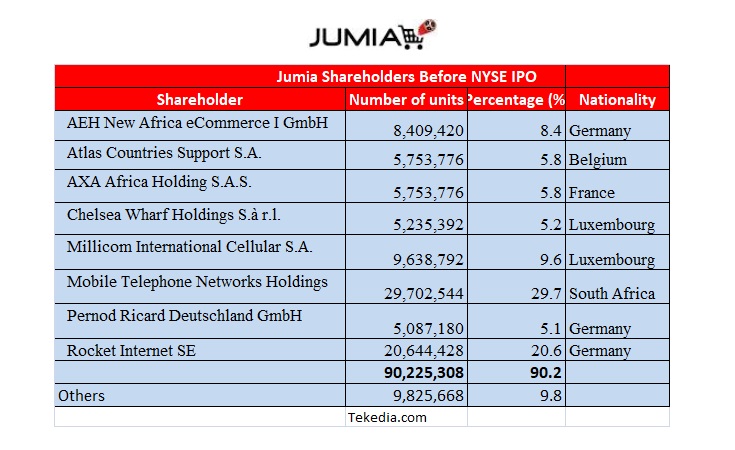
The table they are sharing is fake – disregard it. Mine is genuine. We extracted it from Jumia filed papers with the SEC/NYSE (Securities & Exchange Commission/New York Stock Exchange). Forget any alternative facts and trust that one. This is the link to the report and I am sharing the raw table below.
Source: Jumia, SEC.gov
There is no sentiment here – this is free enterprise. It is possible to hire a Nigerian in London, give him money to start a business in Nigeria, give him title of Founder when he does not even command 0.1% of the company! To understand why, go back to AO Lawal’s Economics where he explained Capital as a factor of production. It remains scarce and controls all other elements of production.
So, there is no need to argue over reality. Jumia filed in United States SEC its principal shareholders. Those are the shareholders, period. Any previous PowerPoint or document is irrelevant at this point. You can always trust anything I share as they are backed by above Google research.
ICT brought huge productivity gains across sectors and markets. The web is delivering disruption at scale. It will be nearly impossible for your ICT venture to disrupt without the web!
But with the advent of the Internet, many things are changing, owing to the unbounded and unconstrained nature of the web. The companies that relied on ICT to change their sectors are also now vulnerable. Indeed, ICT brought huge productivity gains, Internet is delivering disruption at scale.
The implication is that the way we run Internet companies must be different from the way we ran businesses pre-Internet and when ICT was the vehicle for productivity gain. There are key things to note:
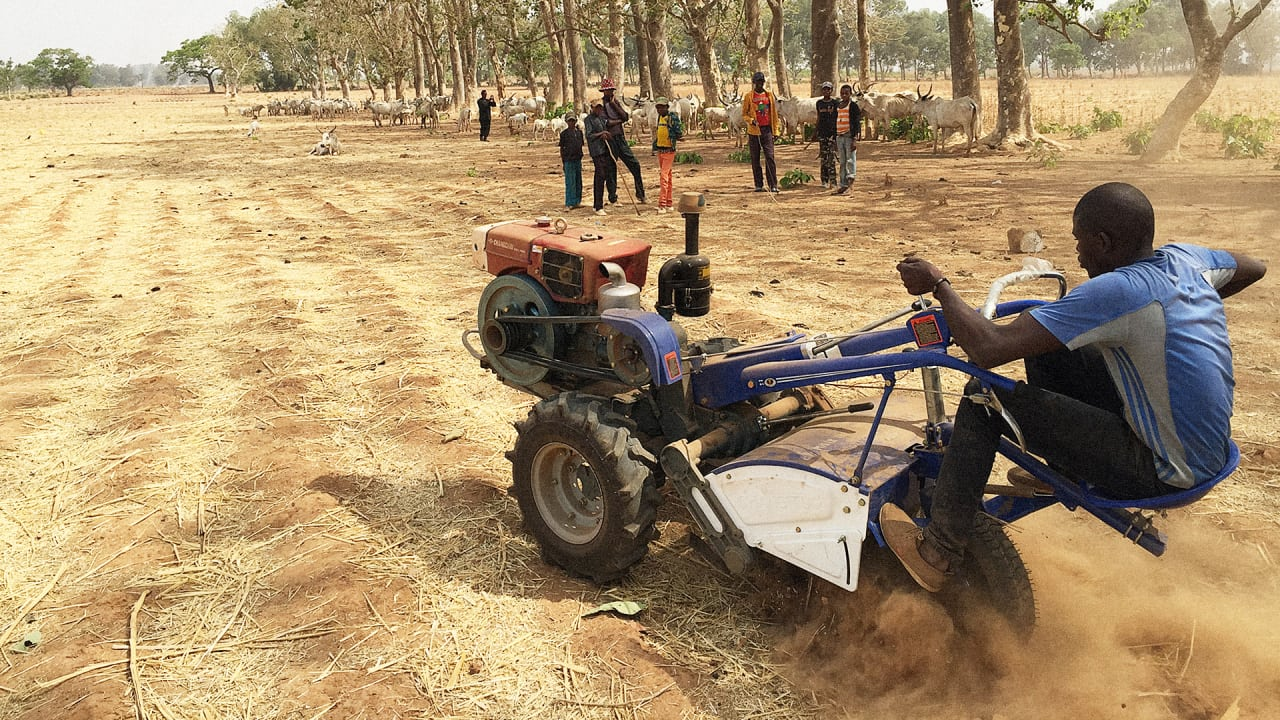
In Sub-Saharan Africa, more than 60 percent of farms are powered by humans with less than 20 percent provided by engines, a model which is not sustainable as food demand increases due to population growth, which is averaging 11 million per year.
According to the Food and Agriculture Organization, 35-50 percent post harvest losses for perishable agricultural products are lost annually in the region due to poor planting practices.
Jehiel Oliver, an African American investment banker, decided to do something about this. He founded Hello Tractor which in 2014 launched a mobile platform to enable farmers access tractor services on demand. Through the use of a mobile app and other technologies, it aggregates tractor service requests, and then pairs them with recommended tractors and operators, while simultaneously tracking how many hours each piece of equipment is on the field and areas serviced.
There are many opportunities in the Nigerian (and indeed African) agriculture sector for entrepreneurs to unlock, starting from the traditional agro-businesses to the evolving agricultural technology (agtech) businesses. We have listed some of the ideas in this piece where we noted that agriculture could be on its way to $1 trillion cumulative revenue in Africa within seven years. Agriculture employs more than 65% of Africa’s working population, making it a very important part of our economy. It presents immense opportunities because the sector is still at infancy, and can only grow looking at the renewed efforts by investors, entrepreneurs, farmers and governments to deepen African competitiveness through agricultural production and processing.
Hello Tractor underwent a strategic redesign after Jehiel discovered that it needed to add additional services which include predictive maintenance, operator and tractor scoring, financing and crop yield forecasting. It collaborated with IBM Research’s Nairobi Lab to develop IoT (internet of things), Blockchain and AI technologies which would run on its Watson Intelligent Cloud.
On 11th December 2018 at the Techcrunch Startup Battlefield Africa which held in Lagos, it unveiled an agriculture digital wallet and decision making tool which provides demand and supply visibility for farmers, tractor fleet providers and banks to give farmers the equipment and technology needed to build a sustainable farm. The new services will be tested in a pilot commencing in the first half of 2019.
For farmers, machine learning will help to predict crop yields, which combined with advanced analytics and blockchain can be mined to develop a credit score for loans. IoT Data from tractors will help smallholder farmers know when to cultivate, the quality of their farm cultivation, what to plant and the right type of fertilizer.
Tractor fleet owners will be able to view and manage fleet utilization, predictive maintenance and forecast future tractor utilizations based on history, real time weather and remote sensing satellite data. Using a five-star rating system, tractor operators will be ranked and utilized based on their training (e.g ploughing, deep ripping, harrow, fertilizing). Owners will also have financing opportunities for maintenance and buying tractors and implements using historical data.
Tractor dealers can benefit from improved tractor repair and servicing, after sales support, spare part inventory planning and credit administration. At the same time, banks and other financial institutions can view and track utilization of tractors to determine a credit portfolio for the farmer, and tractor owner, while also evaluating forecasted utilization to make credit decisions for tractor owners based on verified and trusted data on the blockchain.
Agriculture focused governments in Africa can utilize the data and actionable insights from Hello Tractor for various decision support capabilities such as for structuring incentives, enforcing regulations, prioritizing investments and policy decisions.
The backbone of the agriculture digital wallet is a blockchain-enabled and AI-based decision support platform which enables capturing, tracking and instant sharing of data while creating end-to-end trust and transparency for all parties involved across the value chain.
The next phase will see Hello Tractor utilize machine learning and image recognition to predict the quality of cultivation and also expansion to Kenya, Mozambique, Senegal, Tanzania, Bangladesh and Pakistan.
The Central Bank of Nigeria’s intervention in agriculture NIRSAL, Federal Ministry of Agriculture and Rural Development, and financial institutions need to support innovations like Hello Tractor which are promoting efficiency in farming operations to create higher value.
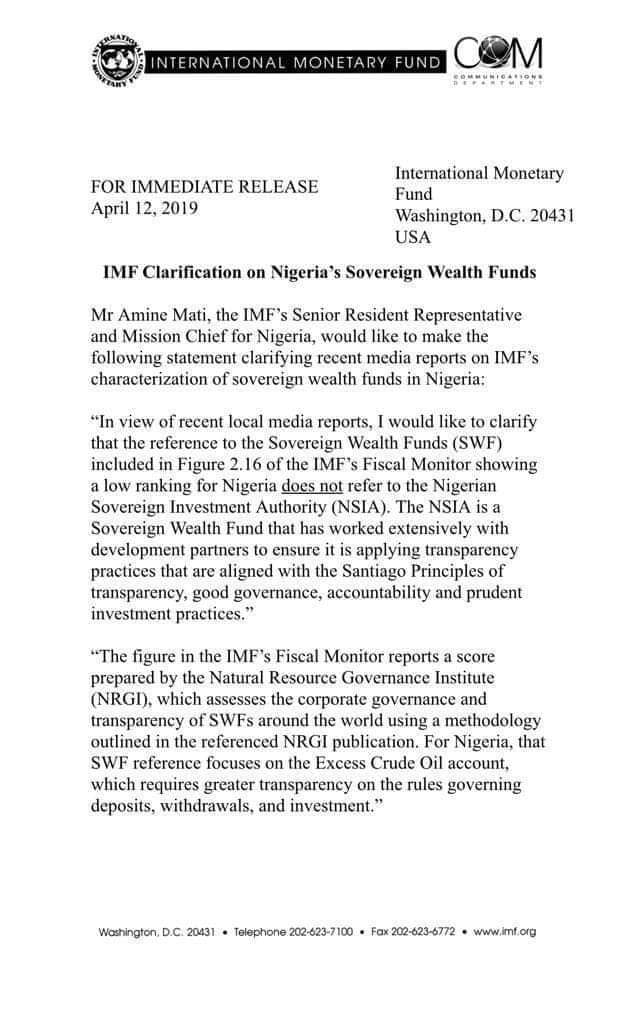
A very big confusion in economics and global public policy: IMF (International Monetary Fund) does not know the clear difference between Nigeria Sovereign investment Authority (NSIA) and Nigeria’s Excess Crude Account (ECA), as per terminologies. That IMF got trapped in that after years of those hard hitting articles on Nigeria is a concern. But thank goodness the local media challenged it, and the Fund has clarified. IMF had used “Sovereign Wealth Fund” (SWF) to refer to ECA which Nigeria has never designated as a SWF. NSIA has been Nigeria’s SWF.
The latest report by the International Monetary Fund (IMF) ranking Nigeria as the world’s second worst user of sovereign wealth funds is “fundamentally flawed”, the Nigerian government says.
The managing director of the Nigeria Sovereign investment Authority (NSIA), Uche Orji, said the report was “laughable”.
The IMF in its Fiscal Monitor Report released on Tuesday as part of the ongoing IMF/World Bank Spring meetings in Washington said Qatar was the only country worse than Nigeria on the index.
According to the Fund, the index was compiled based on the corporate governance and transparency scores of the sovereign wealth funds and the size of assets as a percentage of 2016 gross domestic product of the affected countries.
The IMF blamed Nigeria’s poor ranking on pervasive corruption, saying out of the 33 oil-rich countries considered, Nigeria faired barely better than Sudan, with depleted Sovereign Wealth Fund.
Columbia, Ghana and Chile were ranked top three best performers several resource-rich countries, on average.
The IMF’s Senior Resident Representative and Mission Chief for Nigeria, Amine Mati, has provided more explanation on the report.
“In view of recent local media reports, I would like to clarify that the reference to the Sovereign Wealth Funds (SWF) included in Figure 2.16 of the IMF’s Fiscal Monitor showing a low ranking for Nigeria does not refer to the Nigerian Sovereign Investment Authority (NSIA),” Mr Mati said in a statement sent to the media on Friday
Yet, despite the confusion, the points IMF made on ECA stands. Nigeria has works to do there to make it more transparent.
Hahaha – emails are flooding my blog with people asking how to list in NYSE. Inspired by the Jumia IPO success, some want help to get listed on NYSE (New York). Yes, they want that company to be listed on NYSE to hit Jumia’s $3.9 billion and take more chieftaincy titles.
Calm down people, do not fall victim of “419” or evil people. This is not like opening Facebook or Instagram account. For the fact you are emailing me is clear evidence you are not ready to even list in Nigerian Stock Exchange. Simply, stop it and get to reality. But for research purposes, these are conditions to list on NYSE.