DD
MM
YYYY

PAGES

DD
MM
YYYY

spot_img

PAGES

Home Blog Page 6954

10 Costly Mistakes of Sustainability Implementation and Reporting in Nigeria

0
Lagos Island (source: Guardian)

CSR reporting is gradually becoming mainstream in Nigeria and other developing countries for any organisation committed to responsible business practice especially with the support and encouragement from regulatory agencies such as the Central Bank of Nigeria (CBN) and the Nigerian Stock Exchange (NSE). But when done incorrectly, reporting can do more harm than good both to the organisation and society at large.

The following are 10 mistakes to avoid when planning, implementing and reporting on your sustainability efforts:

1. Lack of Sustainability Strategy

Before thinking of reporting, you need to integrate sustainability principles within your organisation, assess through both internal and external audit depending on your operations and improve on performance to enable you collect valid and verifiable data for reporting and assurance. The process can be summarized as follows:

  • Know thyself: Assess the organisational attitudes and understanding of social responsibility by leadership. Your CSR strategy must be authentic and must ring true for your organisation and stakeholders
  • Choose a globally recognised standard to implement your strategy: An example of such standard is ISO 26000 Social Responsibility which covers 16 out of the 17 Sustainable Development Goals (SDGs). This provides for credibility and scalability.
  • Implement and integrate Social Responsibility within all operations of your organisation including your relationships
  • Work from the inside out: Implementation of SR strategy starts from within the organisation, for instance ensuring that you have implemented occupational health and safety within your organisation, stakeholder mapping and engagement, labor and employment conditions, fair operating practices, etc. then philanthropic and intervention schemes or activities and communication with external stakeholders.
  • Continual improvement: Assess, measure and improve on sustainability strategy. Ensure that data is continuously being collected and verified for management review

2. Mismanaged data

Good data collection is essential to gaining meaningful results from initiatives such as auditing or foot printing. Assign data collection responsibilities to trained people (not just on sustainability reporting but on strategy and implementation as well) – either inside or outside your company – and continuously check the numbers for accuracy. Remember, you must work from Strategy to Reporting.

3. Materiality and Relevance

Avoid disordered priorities. Recognise that the pillars of the triple bottom line are interconnected, and that long-term sustainability goes beyond shareholder profits. A good manager will prioritise sustainability in the CSR reports by weighting it equal to financial performance. As well, implement within all organisational operations but report on things that are relevant. ISO 26000 SR has a procedure to determine relevance especially on field audits which is important in order to collect data for reporting.

4. Discounting feedback

Reporting shouldn’t be a one-way endeavour. Take the advice of third parties such as auditors and stakeholder panels, who can comment on your report and help verify data accuracy.

5. Breaking the rules

Good reporting should follow a trusted framework or guideline. The Global Reporting Initiative (GRI) is a good example. However, never ask your reporting firm to implement your strategy or allow your strategy consultant to be involved with assurance even if they have the skills to do so. Otherwise, the credibility and authenticity of your report or assurance will be questionable; avoid that conflict of interest.

6. Tenuous comparisons

Organisations are inclined to track their progress internally. Accept that you’re one fish in a large sea. Stakeholders will want to know how sustainable you are compared to your industry peers, not necessarily your own benchmarks.

7. Unreachable targets

Targets in CSR reporting should be linked to corporate priorities. Make them relevant and aggressive but still achievable. Always remember that you will still need to report for the next year therefore may be required to report on those targets set out in the current report.

8. Underreporting/overreporting

Don’t limit communication of your
sustainability performance to the sustainability report. Use a variety of media to communicate your progress and challenges. Ensure your message is consistent across media. However, do not make it look like an advertisement for the organisation.

9. Inadvertently greenwashing

While it’s important to convey your environmental and social progress, it’s a mistake to focus solely on the positives or on programmes immaterial to your organisation. Make reporting meaningful by acknowledging the areas where you still have room for improvement and tying your SR goals back to your company mission.

Done correctly, CSR reporting increases share price and bolsters stakeholder confidence in your firm even with the small and medium enterprises (SMEs). Done poorly, CSR reporting opens your company up to consumer derision and stakeholder criticism.

10. Image Laundering

Avoid using reporting as an image laundering tool. Address market, operational or stakeholder challenges with the aim of finding lasting solutions to the issues. Adopting globally recognized standards will help through due diligence to identify salient risks in any part of your operation, mitigate or completely eliminate them.


5G Technology Enables World’s First Remote Brain Surgery

0

By Nnamdi Odumody

Dr Ling Zhipei, a surgeon at the People’s Liberation Army General Hospital, has performed the world’s first ever brain surgery over a 5G mobile network. Using surgical robots, he put a deep brain stimulation implant, a medical device, into a patient with Parkinson’s disease while he was at Sanya, on the island of Hainan, while his patient was in Beijing more than 1,800 miles (3,000km) away.

A Chinese surgeon has performed the world’s first remote brain surgery using 5G technology, with the patient 3,000km away from the operating doctor.
Dr. Ling Zhipei remotely implanted a neurostimulator into his patient’s brain on Saturday, Chinese state-run media reports. The surgeon manipulated the instruments in the Beijing-based PLAGH hospital from a clinic subsidiary on the southern Hainan island, located 3,000km away. The surgery is said to have lasted three hours and ended successfully. The patient, suffering from Parkinson’s disease, is said to be feeling well after the pioneering operation.
The doctor used a computer connected to the next-generation 5G network developed by Chinese tech giant Huawei. The new device enabled a near real-time connection, according to Dr. Ling. “You barely feel that the patient is 3,000 kilometers away,” he said.

According to him, the technology will make it easier for medics to operate on people who live in more remote areas and can’t travel. The operation was performed using surgical robots controlled by Dr Ling who connected to them through a 5G mobile network while he was working in Hainan. The procedure lasted for about three hours, and the patient was fine after the operation.

Deep Brain Stimulation (DBS) helps to control problems associated with movement, and is the main type of surgery used to treat Parkinson’s disease. It involves implanting very fine wires with electrodes at their tips into the brain. These are connected to extensions under the skin behind the ear and down the neck which then connect to a pulse generator. When the device is turned on, electrodes deliver high frequency stimulation to the targeted area which changes signals in the brain that causes Parkinson’s.

Dr Ling said that the 5G network has solved problems like video lag and remote control delay experienced under the 4G network ensuring a nearly real time operation.

The operation was performed with the help of China Mobile network and Huawei’s 5G technology. Also recently a liver surgery was recently carried out over 5G.

5G is enabling intelligent capabilities of the future of work, and healthcare is not left out.

What is 5G? All You Need To Know

Tekedia Webinar – I will be on Air at 2pm Lagos Time Today, Again

0

Good people, I will be on air at 2pm Lagos time today. After the Tekedia business webinar Q/A session yesterday, we have more questions for the Saturday session. So, I will be live at 2pm to provide insights and guidance on same. Login with your credentials on the link team had provided.

Dates: Friday March 22 2019 (repeat, Saturday March 23, 2019)
Venue: Online.
Webinar Theme: Winning in Nigeria (and Africa)
Register: There are two ways to register (you need to pay to value my time); please email tekedia@fasmicro.com after payment to set up your account.
  • Use Paypal and pay $15 here

  • Pay into any of the Nigerian bank accounts (N5,000) listed here.

Meanwhile, the recorded sessions for the five sessions covering Mission, Operating Frameworks/Models, Investment Options, Starting & Taking Action, and The Opportunities in Africa remain. As you go through them and you have questions, comment on the Comment section or email my team.

The recorded Q/A session of yesterday has deep insights also. Everything is recorded to simplify the stress of bandwidth and time availability – just use the same link to access all. Watch them.

See you on air at 2pm.

Entrepreneurial Governance as a Panacea to Sustainability of Nigerian States

0
The coat of arm of Nigeria

By Nnamdi Odumody

The Senate of the Federal Republic of Nigeria recently approved the sum of 30,000 naira as the national minimum wage. Over the past few months the Federal Government, States and the Organized Labour representatives have been involved in discussions with the Senate making a case of impossibility of meeting up with the sum. Considering rising inflation in Nigeria, the sum of N30,000 is nowhere near sustaining an average working citizen for a month. The Nigerian Labour Congress said that the Federal Government and States spend huge running costs which if slashed will make it possible for them to pay the demanded wages.

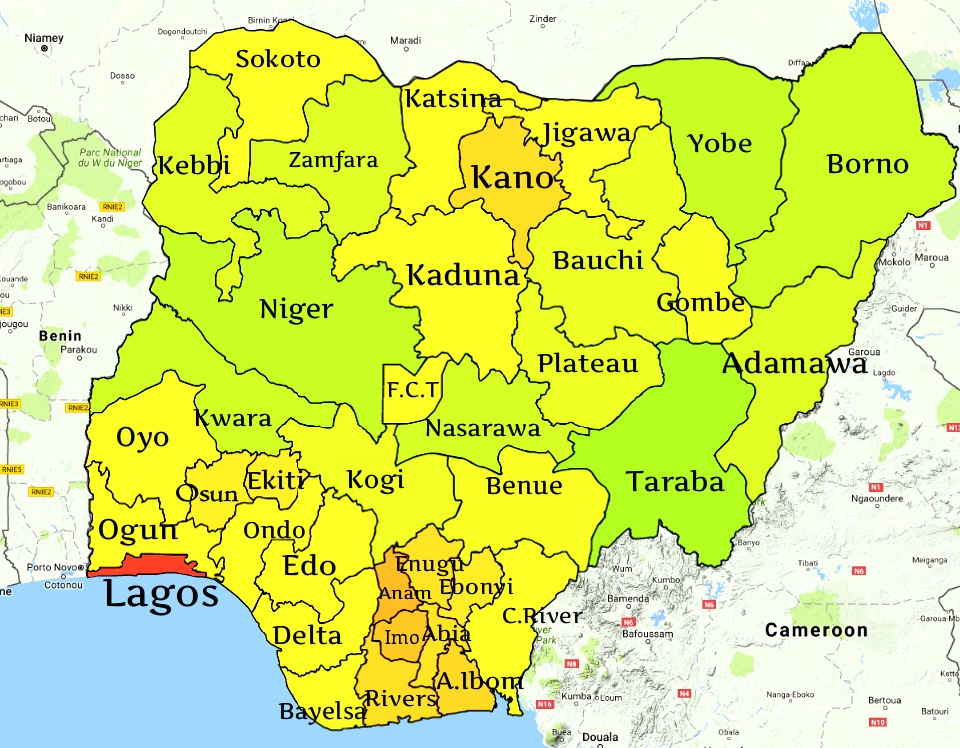
Nigeria runs a dependency system where all the 36 states and Federal Capital Territory, despite the numerous natural resources available in them, depend on monthly allocations from crude oil earnings. The federal government takes a large percentage while states take the rest.

Abia State estimated Gross State Product was 838.89 billion naira or 0.74 percent of Nigeria’s GDP in 2017. Its agricultural output was 45.59 billion naira (0.19 percent of the country), crude oil output was 117 billion naira. Its Non Oil Industrial Output was 63.1 billion naira contributing 0.4 percent of the country’s non oil industry while its Manufacturing output was 43 billion naira.

Considering the fact that Abia State is home to Aba which is famed for being home to leather and garment manufacturers and other industries, due to absence of enabling infrastructure by previous and the current administrations, its potential and capacity hasn’t translated to prosperity for state government in terms of revenue generation.

Despite its abundant hydrocarbon deposits, there is no petroleum refinery, gas processing industry or petrochemical plant which will have aided its industrialization drive. Its Internally Generated Revenue was 18 billion naira- a paltry sum. Recurrent expenditure, at 31.1 billion naira, was more than capital expenditure, an enabler of unlocking its productivity, which stands at 16.9 billion naira. This made it impossible for the state to pay salaries, and was bailed out by the Paris Club package which the Federal Government gave states across the federation.

Nasarawa State had an estimated Gross State Product of 1.2 trillion naira. Its agricultural output was 962.8 billion naira in 2017, and earned 4.4 billion naira as Internally Generated Revenue. Considering the rich deposits of solid minerals in commercial quantity around the state, the state could have increased her earning capability if it had marketed the assets well. She too was a recipient of fund bailout by the FG to pay salaries of her workers.

States in Nigeria

Kano State, the Commercial and Industrial Hub of Northern Nigeria, had an estimated Gross State Product in 2017 of 4.26 trillion naira. Considering its rich human and natural resources, strategic location, it should do better in Internal Revenue Generation than it did with 22.2 billion naira generated. Her recurrent expenditure was 157 billion naira while Capital Expenditure was 9.8 billion naira an amount too low to make impact on her 13.4 million people.

Nigerian State Governors should adopt an entrepreneurial approach to governance by unlocking the potentials which abound in their states to create competitive economies which will grow the GDP of the Nigerian economy.

Pursue a first major win with vigor

0

Victory makes relations, enabling more victories: pursue a first major win with vigor. It could be a talk, an article, an exam, a trade, or whatever you find yourself doing. There is always a First for all legends who have built or transformed empires.