DD
MM
YYYY

PAGES

DD
MM
YYYY

spot_img

PAGES

Home Blog Page 6998

The Business Model of Data Expiration in Telecom Industry

0

Few years ago, I wrote in Harvard Business Review, on a piece on business model innovation, that one of the pillars of Microsoft success was not really technology but innovation on the legal mechanics of licensing software. Yes, while Windows was a generation-shaping technology, its success was anchored on the premise that you could pay for software and never completely own it, and must keep paying licenses to be legally allowed to use it, as a corporation.

If Toyota had done same, we may never completely own our cars even on full payment. That means you must return to a Toyota dealer yearly to service your car and pay a fee, if not, you could be seen as someone who is illegally using Toyota intellectual property. That Microsoft got away with it on software does not mean Ford could not have done the same, and got away with it, if that business model has been trialed at the onset of the automobile industry.

So, you will continue to pay for Windows or Oracle and unless your firm renews the yearly license, you will be under the wrong side of the law.  There is nothing you can do about it because it is now the industry practice. And that brings me to something challenging in the telecom industry: why do fully paid data expire?

I mean why should I buy MTN, Glo, Airtel and 9Mobile, and after a certain period of time, the stuff will expire? Interestingly, the option for data expiration makes data affordable.  Provided not many people will exhaust the sold-data, telcos price to discount it, instead of forcing everyone to pay the full price in a case data does not expire. There is a huge debate in South Africa on that right now.

To stop operators from offering data bundles which expire will limit consumer choice and result in higher data prices.

To call for the end of expiring data bundles will therefore not help consumers, but rather limit their choice and result in higher-priced data.

The chart below illustrates how the lifetime of data influences the price. It is clear that the longer data lasts, the higher the price is.
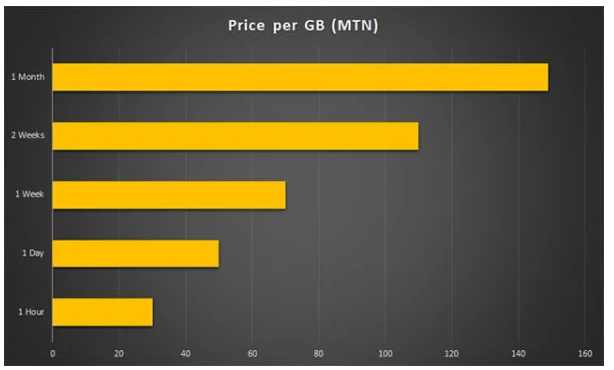
If you make it to expire in one month, it becomes more expensive (compared to one hour) because it could possibly be used. So, if you legislate that data will not expire, telcos will price at infinite “time” which means expensive data.

MTN South Africa explains:

MTN provides a wide variety of data bundles to the market to suit customers’ needs and usage requirements.

A variety of prepaid bundles are available to customers, ranging from a validity of one hour to one month. These bundles can be used on prepaid and can be added on to post-paid packages.

This enables customers to select a product, which meets their volume and validity needs.

The prepaid bundles are cheaper when the validity period is the shortest. For example, a customer can purchase a small data bundle for as little as R1.50 for a short validity period.

These small purchases are typically made to update a status on social media or check and send messages without having to make a large financial commitment.

Smaller purchases allow customers more control over their spend and increases data affordability by lowering the cost barrier.

At the same time, it allows the network to be used consistently over a period so that the investment in infrastructure does not lie idle.

This is an efficient utilisation of network capacity that may otherwise not have been used.

Expiry rules are also important for data network capacity and coverage planning purposes.

MTN must take into consideration the data service requirements of customers over a specific period of time and for specified data volumes. This information is vital for planning purposes.

Planning occurs well in advance, at least 18 months ahead, due to the long lead times for network deployment.

Capacity is planned to cater for this requirement and in addition thereto to allow for a margin of headroom on the network for unexpected traffic growth volumes.

If traffic exceeds these volumes, the quality of service experienced by customers on the network will be impacted negatively.

If, however, capacity is over provided for and not utilised this in turn will impact the ability of the network operator to manage the cost of providing data to customers.

If MTN were not able to determine the data requirements of customers and the period over which it will be used (indicated by expiry periods), the quality or cost of data will be affected.

It is important to note that MTN would need to pay its upstream providers for said capacity, regardless of whether customers utilise the capacity or not.

A longer expiry period would result in a substantial increased liability on balance sheet.

MTN is not able to recognise revenue for data bundle purchases until the data is utilised.

The increased financial unearned revenue liability on the balance sheet would have a negative impact on the MTN’s overall cost of capital.

As a result, the price of data would need to increase because the cheaper bundles with shorter validity would effectively become redundant.

MTN would need to rebalance data tariffs to cater for longer or no expiry rules.

This would mean that the current discounted in-bundle rates would not be available, and customers will pay a higher tariff for data.

My words to South Africa: it is not everything that must be regulated, leave telcos alone on this one. Expiring data makes data affordable as telcos play many optimization models to bring mobile connectivity inclusion based on the premise that not many people will end up using all paid data. Take that flexibility away, price will go high: the longer the time, the more expensive the data because you will likely use the data.

LinkedIn Comment on Feed

Sometimes regulations do regulate businesses out of existence, and then government turns around giving bailouts or seeding capital for businesses to grow again; a balance is always necessary. When we think we are fighting for the consumers, we end up hurting everyone, including the very consumers we should be protecting.

Telcos already have enough challenges going forward, not minding the substantial capital investment still expected of them, they also need a breathing space; they are being hit from all sides, including those from digital natives.

It’s always a challenge when you stuff regulatory agencies with people who never managed any business in the very sector they are meant to regulate; they barely understand the pain points the operators have. Too much bias towards consumers is always a problem, businesses also need to survive.

If businesses must continue to make investments and serve their customers well, there must be viable and clear path to profitability, else everyone will go home with poor services or no services at all.
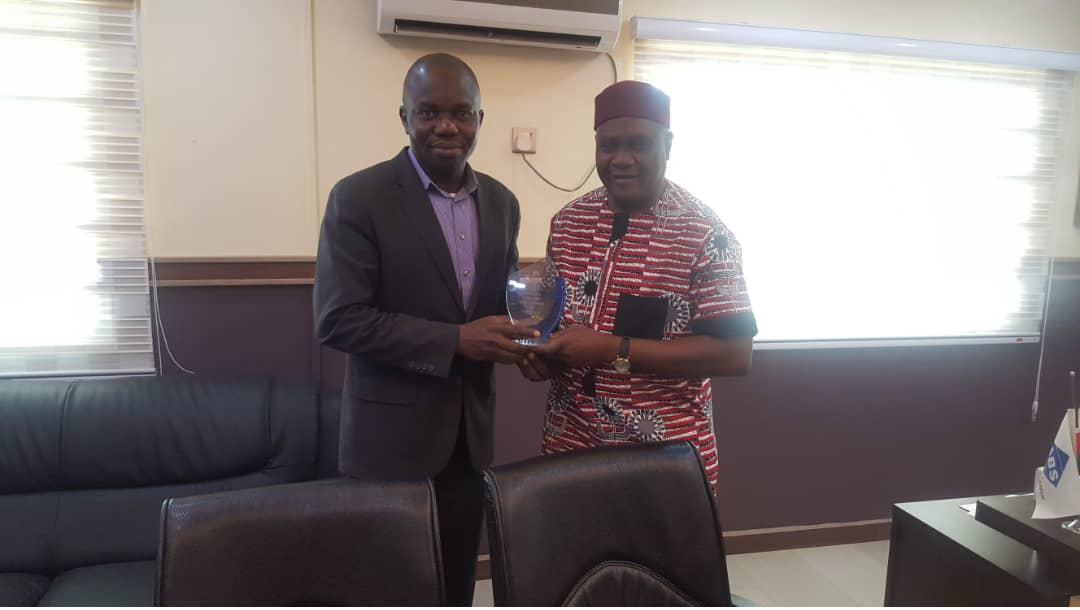

2018 Zenvus Enterprise Award

0

I went in person to give Zenvus Enterprise Award for 2018. Chief Uche Sylva, CEO of Rewardn, made us better; with his partnership, we found new markets and territories. The quest to cure cure extreme poverty continues.

Rewardn is a leading soil water trap which works on different types of crops. It increases the water holding capacity of soils and generally enhances plant growth. With Rewardn, water and nutrients are available in the root zone for optimal absorption by plants. In agriculture, use cases include tree planting, nurseries, transplanting, landscaping, large scale farming, etc.

Also, Rewardn provides a buffer effect against climatic hazards with applications in erosion control, land reclamation, land embankment, among others.

Nigeria Plans “Entrepreneur Bank”

0

The Nigerian government has hinted that it would establish an Entrepreneur Bank to help fund companies. Vice President Osinbajo dropped the hint when speaking with women traders. This bank would become a more structured form of TraderMoni, MarketMoni, and FarmerMoni through which the government has used to offer micro-credits to micro-entrepreneurs. The vision is “a bank that will be a bit more nimble about entrepreneurship; a bank that has a bit more flexibility”. Certainly, government has given up Bank of Industry which was designed to seed enterprises as a local DFI but transmuted into a colossal bureaucracy, demanding  sureties that only those with rich uncles can have.

Vice President Yemi Osinbajo says the federal government plans to establish an Entrepreneur Bank to provide flexibility in provision of facilities to businesses.

Mr Osinbajo disclosed this while fielding questions from a cross-section of women traders at a programme tagged `Next Level Conversation’ on Monday in Abuja.

The women, who were mostly entrepreneurs, were drawn from the education, environment, agriculture, real estate, hospitality among other sectors.

The vice president said the issue of giving cheap loans to small businesses had featured prominently in the President Muhammadu Buhari-led administration.

“We have been able to deal to some extent with small and micro businesses; we have TraderMoni, MarketMoni, FarmerMoni; which are basically very small credit schemes.

“We are also looking at an Enterprise Bank or an Entrepreneur Bank which is one of the types of establishment we are looking at.

While I commend this micro-effort to fix the funding paralysis in Nigeria, the nation needs reforms to stimulate real capital injection into the economy. Government cannot be involved in all these areas: private sector can do them more efficiently if government offers the path for companies to make money, and do well for society.

  • Government should offer new VC (venture capital) firms in Nigeria a ten year tax incentive on profits if they have asset base of at least $50 million and will deploy the capital in Nigerian startups within 10 years.

  • Offer new VC firms in Nigeria the opportunity to repatriate 100% of profit within ten years. That will help the country to attract foreign investors to make Nigeria home.

If we have this type of incentive, we will see many VC funds making Nigeria home to explore opportunities in Nigeria and continental Africa. That influx of capital will have many multiples of benefits to our economy, our people, and the Nigerian technology space. Most especially our tech firms will stay home.

Yes, Entrepreneur Bank can have asset of $100 million but Nigeria can unlock $50 billion through smart reforms in the venture capital and private equity sectors. Mr. Vice President should take that conversation to the next level and push for reforms in the capital market. We need entrepreneurs and not just small business owners; TraderMoni is for small business owners, VC capital (and similar funds) create entrepreneurs. Entrepreneurs build nations; TraderMoni supports families.

The Miracle in Aba Shoe Sector [Video]

3

A LinkedIn update has something that looks like a real miracle: Aba is going to get a makeover just the way you want it. Yes, those things many have written including yours truly are about to happen in the Enyimba city. If this Leather City Park works, by 2030 Ibom Deep Seaport will be running. Yes, they are connected as building the seaport will become an urgent national project.

Platform Capital is pleased to announce the ground-breaking ceremony of its Leather City Park (“Leather City”) and NIBRA Designs Limited (“NIBRA”) – a shoe production initiative in Ariara market, Aba, Abia. The shoe factory will be the largest in sub-Saharan Africa, leveraging world class Brazilian technology.
The NIBRA facility will launch with an initial capacity of 10,000 pairs a day, growing to 100,000 in 5 years. The project is scheduled to be commissioned by Q4’2019. NIBRA will employ 1,000 people for a start growing to over 5,000 in the medium term. Under secured offtake arrangements for our initial installed capacity, we will serve domestic and international markets. Leather City on the other hand, will provide opportunities to increase productivity and product quality for a significant number of the 120,000 individuals currently in Ariara market.
We at Platform view this as a transformational initiative for the state of Abia, the entire South-East region and is a testament to Nigeria’s tested entrepreneurial spirit. Our sincere appreciation goes to our partners who have made this possible.
This represents further validation of Platform Capital’s growth strategy, where we take a long-term view with a bottom-up approach to value creation.

I welcome Platform Capital, the investor, to Abia State (God’s State) and certainly wish the team the best of luck in my home state. Our governor has waived taxes to anyone investing. I personally took that opportunity and invested in my state. Take advantage of this and invest in Abia. If you have any issue, email me, I will connect you with the government people. We are serious in Abia State on development.

May I note that Obinna Ekekwe is the commissioner of Strategy & Development – he is the best commissioner in the nation!