DD
MM
YYYY

PAGES

DD
MM
YYYY

spot_img

PAGES

Home Blog Page 7

Oil Rally Triggers Heavy Losses as Traders Double Down on Bearish Bets

0

Volatility has returned to the global oil market with remarkable force, leaving leveraged traders scrambling as crude prices continue their upward climb. Fresh data shared by blockchain analytics platform Lookonchain highlights just how costly the latest rally has become for traders attempting to bet against oil.

One of the most notable casualties is a trader identified as loracle.hl, whose sizable bearish position was completely wiped out as prices surged.

According to the data, the trader was fully liquidated on a 104,848 CL short position valued at approximately $9.68 million, resulting in a realized loss of around $680,000.

A liquidation occurs when market losses consume the margin securing a leveraged trade, forcing the trading platform to automatically close the position to prevent additional losses. Such events are common during periods of heightened volatility, especially when traders employ significant leverage.

Despite suffering a substantial loss, the trader appears unwilling to abandon the bearish thesis. Shortly after the liquidation, loracle.hl opened another short position consisting of 33,500 CL contracts worth roughly $3.07 million, signaling continued confidence that oil prices will eventually reverse lower.

The move underscores a common psychological pattern in speculative markets, where traders often re-enter positions after losses, convinced that their original market view remains fundamentally correct despite recent price action.

The timing of these liquidations comes as crude oil prices have been climbing sharply, fueled by mounting geopolitical tensions, supply concerns, and uncertainty surrounding global energy markets.

Escalating conflicts in key oil-producing regions have heightened fears of supply disruptions, encouraging investors to seek exposure to energy commodities.

Resilient global demand and tighter production expectations have added further upward pressure to prices. These developments have created a challenging environment for short sellers.

Traders positioned for declining prices have faced mounting losses as each new wave of buying pushes oil higher. Leveraged positions are particularly vulnerable because even relatively modest price movements can trigger forced liquidations when borrowed capital magnifies exposure.

The latest episode also demonstrates how blockchain-based trading data is providing unprecedented transparency into market behavior. Platforms that operate on-chain allow analysts and observers to monitor large positions, liquidations, and trading activity in near real time.

This visibility offers valuable insights into market sentiment and highlights how major participants are responding to rapidly changing conditions. Interestingly, the trader’s decision to immediately establish another short position may reflect a belief that the current rally is overextended.

Many experienced traders view sharp commodity rallies as temporary reactions driven by emotion rather than long-term fundamentals.

If geopolitical tensions ease or supply conditions improve, oil prices could retreat, potentially validating the trader’s renewed bearish position. However, timing such reversals remains one of the most difficult challenges in financial markets.

For investors, the incident serves as a reminder of the risks associated with leveraged trading. While leverage can amplify profits, it also magnifies losses, often leading to rapid liquidations during volatile market conditions.

Effective risk management—including position sizing, stop-loss strategies, and maintaining adequate collateral—is essential for navigating unpredictable markets. As oil continues to respond to geopolitical headlines and macroeconomic developments, traders are likely to remain on high alert.

Whether loracle.hl recovers losses or experiences another liquidation will depend on the direction of crude prices in the coming sessions. For now, the episode stands as another vivid example of how quickly fortunes can change in highly leveraged commodity markets, where conviction alone is rarely enough to overcome powerful market momentum.

Until the Referee Calls It, It Ain’t a Foul – Crime, State Capture and Sustainable Development in Africa

by Chux Gervase Iwu1 & Nnamdi O. Madichie2

 1University of The Western Cape, South Africa

2Woxsen University, Hyderabad, India

 In any organised sport, players do not stop playing until the referee blows the whistle – whether because of a foul, an injury or the end of the game. Basically, the referee decides when to blow the whistle – not the crowd, the other team, or the offending player. Even if a player’s offence is clear to everyone in the stadium, the game continues until the referee calls it. The final decision lies with the Referee – Referees blow their whistles to transform unofficial observations into infractions. Without that intervention, the practical consequences of the ‘foul’ may never materialize.

We use “sport metaphor” to examine the African continent’s economic growth, political authority, criminality, and sustainable development. The premise is that many crimes go undiscovered – whether socially or politically – until the ‘State’ investigates and brings culprits to book. Picture this:

“Using sports as a useful metaphor for understanding political and social realities, one of the most instructive observations from competitive sport is that an apparent foul does not automatically translate into punishment.”

 The question thus becomes one of ‘how long people should wait’ for government action on infractions including criminality among other vices? Based on the effects of delayed or non-existent government engagement, impunity undermines public trust, the rule of law, and economic growth. Think about it, prolonged state delay, despite legal capability to punish crime, raises questions about accountability, public involvement, and institution functioning.

On a personal note, watching football is not an atypical formal amusement for many – including the authors of this article – this is until it features on the global stage, e.g., FIFA World Cup or Olympic Games. The recently concluded FIFA World Cup 2026 has brought us back to the “beautiful game” – and we have both, independently, watched several matches where a foul, in our collective view, and those of others around us, have been committed without the referee calling it. Notable examples include, the France-Senegal match, alongside the France-Morocco encounter and again the controversial Argentina-Egypt clash among others. This leads to our thinking and/ or proposition on matters arising from interference.

Football Interference and Governance – Matters Arising

Our sporting metaphor – “until the referee calls it” – helps explain the relationship between football interference and football governance. We contend that unless government authorities investigate, convict, and punish violators, like a football game without a whistle – the outcome would remain the same. Responsibility is absent, yet violation is acknowledged – Africa represents the best spot to learn these lessons – administrative failures, corruption, organised crime, violent crime, and political instability plague the continent. Three critical questions crop up at this juncture – First, one wonders whether lengthy investigations, administrative delays, or apparent governmental inaction should not spur democratic participation, public accountability, and institutional change? Second, should these not become crucial avenues for people to pressure the government to act? Third, should individuals do nothing while being told to be law abiding and avoid vigilantism?

We thus briefly discuss the referees’ symbolic role as an authoritative figure whose silence accentuates ‘wrongdoing.’ Silence on the part of government strains people’s patience, which has led to economic collapse and difficulties in taking responsibility.

The Referee as a Reference on State Authority

Referees interpret and enforce regulations in competitive sports due to their authority. For the game’s fairness, players can not penalise each other. An impartial authority, the referee, upholds justice and order. In the same vein, courts, police services, prosecutors, and regulatory agencies collectively function as society’s referees. The comparison is not perfect, but it highlights a key fact – efficient implementation of a legal system requires institutions to enforce the rules. Again, picture this:

The referee does not call a foul, even if supporters say so – such behaviour can cause serious problems. Losing trust in law enforcement may cause voters to doubt its impartiality – a referee who consistently ignores fouls compromises the integrity of the game. 

Likewise, a government that fails to respond to crime risks weakening public confidence in the rule of law.

While democracy in Africa can be said to rely on constitutionalism, citizen responsibility, and legal equality, the continent struggles with institutional capacity and the enforcement of legal standards. Public concern has arisen over delayed investigations, corruption allegations, procurement issues, organised criminal networks, and public administration issues. It appears that government action on alleged misbehaviour takes months or years following public disclosure – thereby extending the ‘waiting time’ for social justice – in other words, the ‘waiting game’ begins in the quest for fair play.

How Long Should Citizens Wait?

When we talk about citizens here, we go beyond just football fans, and two questions may well be worth pandering over – should the government appear inactive, how are citizens expected to react? Should they simply wait? Afterall, investigative procedures follow the pattern of evidence determination, court review before infringements are legally dispensed. There are serious risks to waiting forever anyway. Noting that the determination of an offence procedurally takes time, it is equally noteworthy that public confidence in the mechanisms for dealing with crime and corruption may erode owing to the seeming delay in prosecuting an infringement. In responding to the question ‘how are citizens expected to react’? ‘Should they simply wait’?

One can argue that citizens should actively engage democratic mechanisms instead of waiting. This engagement can be in the form of investigative journalism, public advocacy, litigation, political activity, and support for independent oversight institutions. While citizens should not wait passively for the referee to blow the whistle, the conundrum is to justify active citizenship that shows up as  vigilantism, xenophobia, and/or intimidation. The frustration may push citizens to play referee instead of using constitutional procedures to push the official. The economic consequences of unaddressed crime can take several dimensions. When crime and corruption remain constantly unaddressed or ignored by authorities, socioeconomic growth is inadvertently stunted. Sustainable (both social and economic) development requires capital and labour gains, as well as strong institutions that implement the law fairly. 

Beyond Waiting – Strengthening Accountability

Institutional response to crime and corruption is as big an issue for Africa as crime itself. Long-term solutions need our elected officials, police forces, and residents to work together to maintain peace and the rule of law. We thus argue that:

Building responsibility requires improving law enforcement efficiency and oversight. All law enforcement must be ethical, transparent, and professional. Robust monitoring, regular performance reviews, and strong consequences for misbehaviour and corruption may restore public trust in the criminal justice system.

The independent monitoring organisation should investigate allegations and penalise officials who abuse their authority. Fair and efficient criminal justice is also essential. Protracted investigations, prosecutions, and litigation damage public trust in the courts. Criminal prosecution and quick justice need appropriate resources, technology, and qualified people. Anti-corruption measures at the federal, state, and municipal levels must reinforce public institutions to prevent criminal groups from exploiting gaps. Empowering responsibility demands community involvement. Community policing forums, corporations, civil society organisations, and residents should work with law enforcement to address crime hotspots, share data, and develop effective local crime prevention programmes.

Conclusion – The Final Whistle

As we conclude this piece, the government, police, courts, and society at large, must work together to hold criminals accountable for most of the observed infractions on the “beautiful game.” Africa may improve safety and trust in the law by being more transparent, eliminating corruption, improving institutions, and encouraging community engagement.

In competitive sport, a foul does not acquire official significance until a referee recognizes the infringement and blows the whistle. Consequently, and bowing to prolonged inaction, questions arise regarding the relationship between legality and enforcement. One important question in this regard should be – does wrongdoing effectively become actionable only when government institutions acknowledge it? Afterall, the legitimacy of any rules-based system depends upon the existence of an authority capable of interpreting and enforcing the said rules.

Broadly speaking, our sporting analogy illustrates this principle with remarkable clarity. Football players cannot independently assign penalties to opponents. The authority to determine violations belongs exclusively to the referee. The effectiveness of the game depends on broad acceptance of this arrangement. But, does it really? We ask this question simply because US President Trump admitted to having personally called FIFA’s President Gianni Infantino to ask for a review of an order, and FIFA subsequently suspended the ban. A similar experience is playing out in Zimbabwe where President Emmerson Mnangagwa changed the rules of the game. He will now stay on until 2030!

Both Trump’s and Mnangagwa’s interference highlight an important vulnerability. In sporting (football) terms, if referees’ decisions are now open to such ‘wanton overruling,’ players may lose confidence in the fairness of the competition. In political terms, the rule of law depends not only on legal frameworks but also on institutional willingness and capacity to enforce them.

We recap with some food for thought that takes us back full circle:

The challenge, therefore, is to balance respect for legal institutions with demands for accountability. Citizens must neither replace the referee nor remain silent when the referee fails to act – democratic legitimacy depends on this delicate equilibrium.

So what do you think about our proposition that “Until the Referee Calls It, It Ain’t a Foul – Crime, State Capture and Sustainable Development in Africa”?

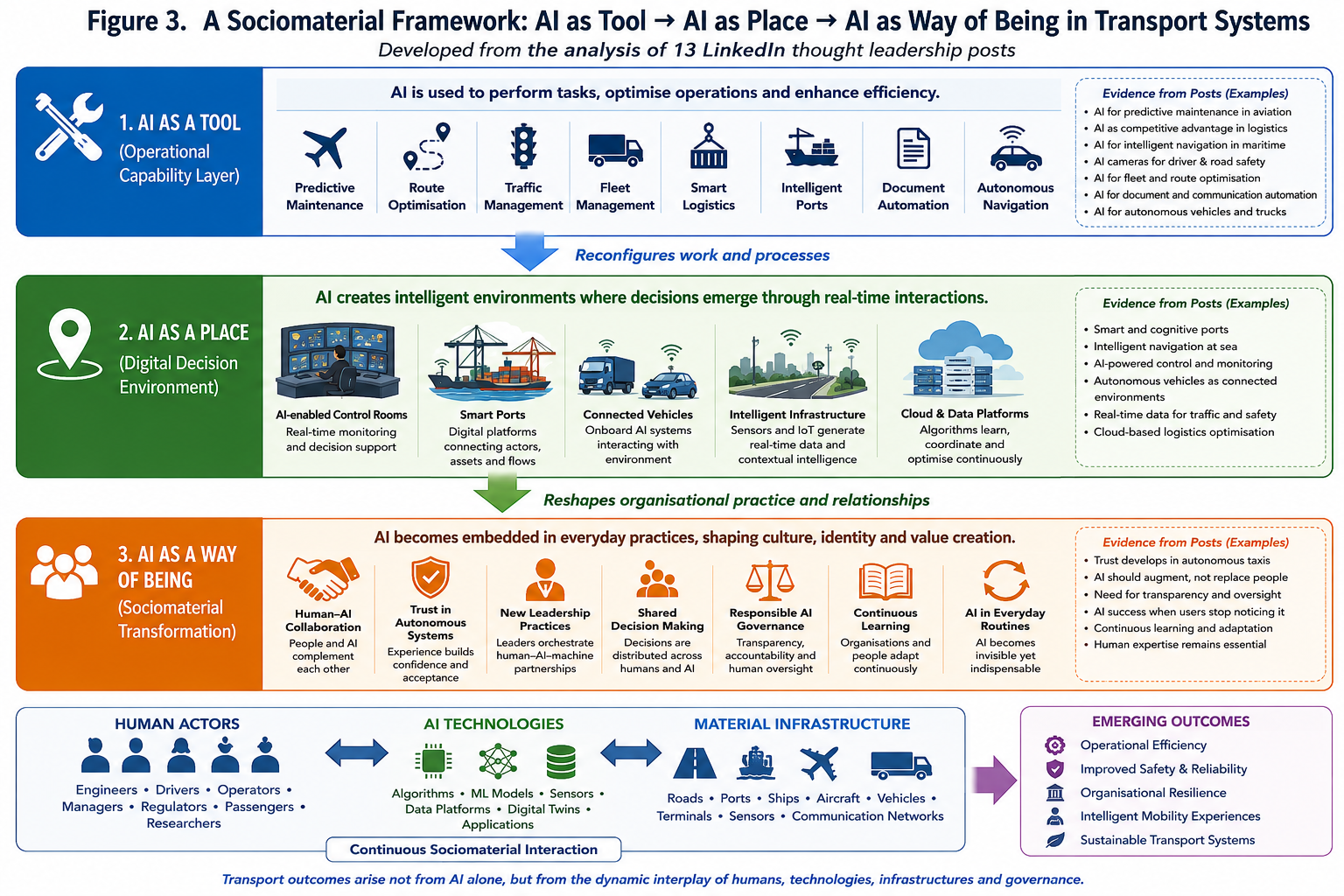
AI as a Tool, Place and Way of Being in Transport Systems

0

Artificial intelligence (AI) has become the dominant narrative in discussions about the future of transport. Across aviation, logistics, maritime shipping, autonomous vehicles, road safety and even space transportation, AI is portrayed as the technology that will optimise routes, predict maintenance, improve safety, automate decisions and redefine mobility. This narrative is particularly visible on professional social media, where industry experts, executives, engineers and researchers increasingly use thought leadership posts to shape how organisations understand AI and its future.

Drawing on an analysis of thirteen thought leadership posts published on LinkedIn, this article argues that while AI is consistently framed as a catalyst for efficiency, automation and innovation, an important part of the story is missing. Most discussions present AI as a technological solution to operational problems. While this perspective captures AI’s practical value, it overlooks a deeper transformation already underway across transport systems. AI is not simply becoming another digital tool. It is emerging as a place where transport decisions are produced and a way of being that reshapes how transport organisations work, collaborate and govern themselves. Recognising these three dimensions is essential if transport leaders are to move beyond technology-centred thinking.

The first misconception is viewing AI solely as a tool. Much of the current conversation celebrates AI’s ability to automate routine tasks, reduce costs and improve operational performance. Airlines use AI to predict equipment failures before they occur. Logistics firms optimise delivery routes through machine learning. Maritime operators deploy intelligent systems to improve port efficiency and supply chain visibility. Autonomous vehicles promise safer and more efficient mobility, while AI-powered fleet management and document processing reduce administrative burdens. These developments are significant, but they also reinforce an instrumental view of AI as something organisations simply deploy to improve performance.

This perspective underestimates the reciprocal relationship between AI and organisational practice. AI does not merely support existing work. It changes how work itself is organised. Predictive maintenance reshapes how engineers schedule inspections. Intelligent routing alters the role of dispatchers. AI-assisted communication changes how logistics professionals coordinate complex supply chains. Human expertise does not disappear. Instead, it is redistributed across people, algorithms, sensors and digital platforms. AI becomes part of organisational practice rather than an external assistant.

The second dimension receiving insufficient attention is AI as a place. This idea may initially seem abstract, yet it reflects one of the most significant shifts taking place in transport systems. Increasingly, operational decisions no longer originate exclusively in control rooms, offices or boardrooms. They emerge within digital environments where algorithms continuously interact with sensors, infrastructure, vehicles and people.

The autonomous vehicle provides a useful example. Its ability to navigate safely depends not only on sophisticated software but also on cameras, radar, high-definition maps, cloud infrastructure, traffic conditions, road regulations and passenger behaviour. Likewise, intelligent ports are no longer simply physical locations where cargo is loaded and unloaded. They are becoming digital environments where information flows alongside goods and where operational intelligence is generated continuously. AI therefore functions as a place where transport systems are monitored, coordinated and optimised in real time.

Perhaps the most overlooked dimension is AI as a way of being. Every technological transformation eventually changes organisational culture, professional identity and human expectations. This transition is already visible in the dataset.

One contributor reflects on riding in a fully autonomous taxi. The first journey felt extraordinary. The second quickly became routine. The observation was simple yet profound. AI succeeds not when people continue to admire the technology but when they stop noticing it. Trust replaces novelty. Routine replaces excitement. The technology becomes embedded in everyday experience.

This insight extends well beyond autonomous vehicles. Organisations often evaluate AI through technical indicators such as speed, efficiency and accuracy. These measures matter, but they do not explain whether AI has become part of everyday organisational life. AI becomes a way of being when transport professionals instinctively incorporate intelligent systems into how they think, decide and collaborate. It becomes woven into organisational routines, relationships and professional identities rather than remaining a visible technological intervention.

This shift also challenges conventional ideas of leadership. Future transport leaders will not simply oversee fleets, ports or infrastructure. They will manage relationships between human judgement and machine intelligence. Their role will increasingly involve creating organisational environments where AI complements human expertise instead of competing with it. Success will depend not only on technological capability but also on the ability to cultivate trust, adaptability and collaboration across increasingly intelligent transport ecosystems.

Encouragingly, the analysis shows that the conversation is beginning to evolve. Several contributors move beyond celebrating innovation to raise questions about transparency, explainability, accountability and human oversight. This suggests growing recognition that successful AI adoption depends as much on trust as it does on technical sophistication.

Yet governance is still treated largely as a compliance issue rather than an organisational capability. Too often, governance is presented as something applied after AI systems have been implemented. A sociomaterial perspective offers a different understanding. Responsibility is not located solely within algorithms or human operators. It emerges through the ongoing interaction among software developers, engineers, regulators, transport professionals, passengers, digital infrastructure and physical assets. Governance is therefore embedded within everyday organisational practice rather than added as a final layer of oversight.

Perhaps the greatest omission in current thought leadership is its limited attention to people. While automation dominates the conversation, relatively little consideration is given to how engineers, drivers, dispatchers, maintenance personnel and logistics professionals adapt alongside intelligent systems. AI does not eliminate human agency. It redistributes it. Understanding this redistribution is essential because transport systems are not simply technological networks. They are sociomaterial systems in which people and technologies continuously shape one another.

This insight is particularly important for organisations seeking to develop responsible AI strategies. Investment in algorithms alone will not deliver transformation if organisations neglect workforce development, organisational learning and institutional trust. The future of intelligent transport depends as much on how people engage with AI as on the sophistication of the technology itself.

The future of transport will not be determined solely by more powerful algorithms or larger datasets. It will be shaped by how effectively organisations integrate AI into the social and material fabric of transport. AI is simultaneously a tool that augments capability, a place where operational intelligence is created and a way of being that reshapes organisational identity, decision making and collaboration.

Thought leaders who continue to frame AI only as a technological innovation risk overlooking the more profound transformation already underway. The transport organisations that lead the next decade will not necessarily be those with the most advanced AI systems. They will be those that recognise AI as a sociomaterial ecosystem where technology, infrastructure, governance and people continuously shape one another. In the age of intelligent mobility, competitive advantage will come not from deploying AI faster than everyone else but from embedding it more thoughtfully into the everyday practices that define how transport systems operate.

Moody’s Warns AI Spending Boom Threatens Big Tech’s Finances as Trillion-Dollar Infrastructure Race Raises Credit Risks

0

The race to build artificial intelligence infrastructure is fundamentally changing the financial profile of the world’s largest technology companies, with the industry’s unprecedented spending spree eroding free cash flow, increasing leverage and introducing new balance-sheet risks, according to Moody’s Ratings.

In a research note published this week, the ratings agency warned that the shift toward AI is forcing even Silicon Valley’s most financially resilient companies to abandon the asset-light business models that underpinned decades of exceptional profitability and instead embrace capital-intensive strategies more commonly associated with utilities and industrial manufacturers.

The warning comes as hyperscalers including Microsoft, Alphabet, Amazon, Meta, Oracle and CoreWeave collectively spend hundreds of billions of dollars building AI data centers, purchasing advanced chips and securing the power infrastructure needed to support increasingly sophisticated AI models.

“Previously, these companies relied on asset-light structures centered on software, intellectual property, and scalable cloud services that required modest capital investment,” Moody’s said. “The transition from asset-light to asset-heavy models requires unprecedented levels of investment and capital raising.”

According to Moody’s, the aggressive expansion “threatens credit quality” across the six companies it tracks, although the immediate risks vary significantly depending on each firm’s financial strength.

The ratings agency projects that capital expenditures by the group will reach $785 billion in 2026 before climbing to approximately $1 trillion annually in 2027, underscoring the extraordinary scale of investment now flowing into AI infrastructure.

The forecast indicates that generative AI has overturned Silicon Valley’s traditional economic model.

For decades, software companies generated exceptional returns because their products could be replicated at virtually no cost after development. AI, however, requires a massive physical footprint consisting of specialized data centers filled with thousands of high-performance graphics processing units (GPUs), networking equipment, storage systems and expensive electricity infrastructure.

Unlike software, those assets require continuous investment, shortening replacement cycles and consuming enormous amounts of capital before meaningful revenue is generated.

That dynamic is already weighing on one of Wall Street’s most closely watched financial metrics: free cash flow.

Moody’s noted that AI infrastructure demands significant upfront investment while revenue from AI services accumulates over a much longer period, creating pressure on cash generation even for companies reporting record earnings.

As a result, hyperscalers are now turning to external financing to sustain their AI ambitions.

Direct debt across the six companies has climbed to roughly $460 billion, according to Moody’s. Companies are also raising capital through equity markets. Alphabet recently announced an $85 billion stock offering, one of the largest equity raises ever undertaken by a technology company, highlighting how even cash-rich firms are seeking additional financial flexibility to fund AI expansion.

Beyond traditional borrowing, Moody’s highlighted a rapidly growing source of financial exposure that receives far less attention from investors: off-balance-sheet obligations. Rather than owning every new AI data center outright, hyperscalers are increasingly signing long-term leases with specialized infrastructure developers.

Those arrangements allow companies to avoid recording the facilities as conventional debt, but Moody’s considers the lease commitments economically equivalent to borrowing because they create long-term contractual payment obligations.

According to the report, lease commitments across the six companies have surged to $1.2 trillion, with more than $820 billion tied to facilities that have not yet entered service and remain under construction. As those projects come online over the coming years, the associated lease payments will become recurring financial obligations regardless of fluctuations in AI demand.

The growing reliance on leased infrastructure also reflects the emergence of a new financing ecosystem around artificial intelligence. Instead of building every facility themselves, technology companies are relying on specialized developers, private equity firms, infrastructure funds and real estate investment trusts to finance, construct and operate AI campuses before leasing them back under long-term agreements.

This approach accelerates deployment but shifts a substantial portion of future financial commitments away from traditional balance-sheet debt.

Despite these concerns, Moody’s stressed that the largest hyperscalers remain among the strongest corporate borrowers globally. Microsoft, Alphabet, Amazon and Meta continue to maintain exceptionally strong balance sheets, substantial liquidity and resilient cash generation from mature businesses such as cloud computing, digital advertising and enterprise software.

Consequently, Moody’s does not believe their investment-grade credit ratings face immediate pressure.

Instead, the greatest financial vulnerability lies with companies operating closer to the lower end of the investment-grade spectrum.

Oracle, which has dramatically expanded AI infrastructure spending in an effort to compete with larger cloud providers, carries a Baa2 credit rating with a negative outlook, leaving it only two notches above speculative, or junk, status.

CoreWeave faces even greater financing challenges.

The AI cloud provider operates with a Ba3 high-yield rating and depends heavily on complex private debt structures to finance massive fleets of Nvidia GPUs, making it significantly more sensitive to changes in financing costs or shifts in investor sentiment.

Moody’s also identified what it described as a growing structural circularity within the AI economy.

Many of the largest cloud providers have invested billions of dollars in leading AI developers such as OpenAI and Anthropic. Those same AI companies then spend billions leasing computing capacity from the cloud providers that financed them, creating an ecosystem in which capital, infrastructure and revenue increasingly circulate among a relatively small group of companies.

While those arrangements have helped generate enormous AI backlogs for cloud providers, Moody’s warned they also create concentration risk because much of the industry’s future growth depends on the same customers, the same infrastructure providers and similar assumptions about long-term AI adoption.

Should enterprise demand for AI services grow more slowly than expected, or should pricing for AI computing come under pressure, those interconnected relationships could amplify financial stress across multiple companies simultaneously.

Nevertheless, Moody’s believes several factors continue to support the sector. Demand for AI computing remains robust, hyperscalers continue to report strong growth in cloud businesses, and many have secured hundreds of billions of dollars in long-term customer contracts that provide visibility into future revenue.

Those strengths help offset concerns surrounding the current investment cycle. Still, the ratings agency argues that investors should recognize that the economics of Big Tech are undergoing one of the most significant structural transformations in decades.

For years, investors rewarded technology companies for producing extraordinary cash flows with relatively modest capital requirements. The AI era is reversing that equation, requiring companies to commit unprecedented amounts of capital years before realizing full economic returns. As a result, future market leadership may depend less on which company spends the most on AI infrastructure and more on which one can demonstrate that those investments translate into sustainable earnings growth and attractive returns on invested capital.

“Investors will increasingly focus on these companies’ ability to realize an adequate return on investment,” Moody’s said.

Kaito Partners With X as Phantom Expands Through Robinhood Chain Integration

0

The blockchain and digital asset industry continues to evolve through strategic partnerships that improve accessibility, data availability, and user experience.

Two recent developments highlight this trend. Kaito has secured a data agreement with X to unlock a new generation of AI-powered crypto applications, while Phantom has integrated the Robinhood Chain into its wallet ecosystem.

These announcements signal that the next phase of crypto growth will be driven not only by new blockchains but also by stronger infrastructure, richer data, and seamless user experiences.

Kaito’s agreement with X represents a significant milestone for the rapidly growing AI and crypto intelligence platform.

Kaito has built its reputation by aggregating and analyzing vast amounts of blockchain and social media data to provide actionable insights for traders, developers, researchers, and institutions.

Through its partnership with X, the company gains access to a broader stream of real-time public conversations, trends, and engagement metrics that can enhance its intelligence products. The collaboration is expected to power a wide range of new use cases.

AI agents can become more context-aware by combining blockchain activity with live social sentiment. Investors may receive faster alerts about market-moving events, while developers can build smarter applications that understand both on-chain transactions and public discussions.

As artificial intelligence becomes increasingly embedded within crypto products, access to high-quality data has become one of the industry’s most valuable assets. Kaito’s agreement positions it at the center of this growing intersection between AI, social media, and decentralized finance.

The partnership also reflects a broader industry trend where structured data is becoming essential infrastructure.

Rather than simply tracking token prices, platforms are increasingly focused on interpreting narratives, identifying emerging trends, and delivering insights before they become obvious to the wider market. This capability could prove invaluable as digital asset markets become more sophisticated and information-driven.

Phantom has announced the integration of the Robinhood Chain, marking another important step in expanding blockchain interoperability. Phantom has grown into one of the most widely used self-custody wallets by supporting multiple blockchain ecosystems while maintaining an intuitive user interface.

Adding the Robinhood Chain further strengthens its position as a gateway for users navigating an increasingly multi-chain crypto landscape.

The integration enables Phantom users to interact with assets and applications on the Robinhood Chain without leaving their familiar wallet environment.

Users can manage tokens, participate in decentralized applications, and access ecosystem services through a single interface. This simplified experience reduces friction, making blockchain technology more approachable for both experienced crypto users and newcomers.

For Robinhood, the integration provides immediate exposure to Phantom’s large and active user base. Greater wallet compatibility often leads to increased network activity, higher developer engagement, and stronger liquidity across decentralized applications.

As blockchain ecosystems compete for users and capital, strategic wallet integrations have become critical for accelerating adoption.

The Kaito-X partnership and Phantom’s Robinhood Chain integration demonstrate how the crypto industry is maturing beyond speculation.

The focus is shifting toward building interconnected infrastructure that combines artificial intelligence, high-quality data, and seamless blockchain access. These developments enhance the tools available to developers while improving the overall experience for users.

As AI continues transforming financial technology and blockchain networks become increasingly interconnected, companies that prioritize usability, intelligence, and interoperability are likely to shape the next generation of Web3 innovation.

Kaito and Phantom have each taken meaningful steps in that direction, reinforcing the industry’s movement toward a smarter, more connected, and user-centric digital economy.