There is a trend in Nigerian governorship campaigns: promise you would fix the states, pay workers better and advance the welfare of citizens. Then once you become a governor, you would issue a statement: we have looked at the state accounts, and unfortunately, we cannot deliver our campaign promises because there is no money.
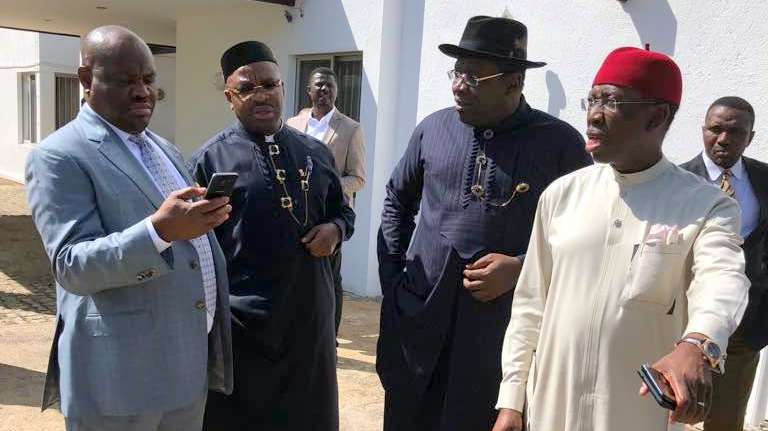
The Nigeria Governors Forum dropped one today on the minimum wage debate: $84 per month salary ‘neither realistic nor sustainable.’ Nigerian Labour Congress (NLC) cannot understand, and certainly feels betrayed because most of the governors promised to be different.
I absolutely understand the challenge of the Nigerian governors: it is a very risky game to promise to pay what you cannot afford. Yes, it is better you do not promise. Yet, if in 2018, going into 2019, Nigeria cannot afford to pay some public workers $84 per month, insisting on about $63, it means more work needs to be done in the nation.
The N30,000 minimum wage demand of labour unions is “neither realistic nor sustainable,” the Nigeria Governors Forum has said.
Instead, the NGF said, states should pay a minimum wage of N22,500 but any governor who can pay more than this is free to do so.
The forum also said insinuations by the Nigeria Labour Congress (NLC) that its members were unwilling to pay N30,000 minimum wage were untrue. It said its members were willing but unable to meet the demand of the workers’ union.
This is a tough one: the labour union wants to see at least $84 but states have no money. The most troubling is that state revenues are dropping despite jacking-up efforts on internally generated revenue. As revenue flattens or drops, with increasing population, you may ask: these current governorship aspirants, do they know what they are going in for?
“Yet, NLC remains adamant that its will must be done, or the heavens will fall. Already, revenue to states has dropped drastically while demands by competing needs keep rising astronomically. Last year alone, revenue to states dropped from N800 billion when the Tripartite Committee was appointed (November 2017) to between N500 billion and N600 billion by the time Ms Amma Pepple submitted its report in October 2018,” he said.
Certainly, I am not sure many do. And this is my suggestion: INEC should mandate states to publish their books comprehensively and conclusively so that governorship aspirants can see what lies ahead. By doing that, the recurring excuses would be meaningless since the shocks of discovering “empty treasury” on assumption of office will fade.
I just scheduled with my elder brother, Engr Dr Okey Ekekwe, Area Pastor RCCG (Redeemed Christian Church of God) in Port Harcourt for a yearly tradition: a New Year prayer.
A chemical engineer in one of the largest global corporations, he takes a practical approach to this: you want this, but God would also want to see your work to qualify into it. Largely, you cannot have these expectations without clarity on how to execute them despite the grace that abides.
Once that prayer is concluded, the new book with 365 pages will have its first entry. I am hoping to have a really “great book” for 2019; 2018 was supremely awesome. Yes, we exceeded all expectations we set except my personal desire to join a public company board. Sure, we joined boards of super category-king private companies.
Enter 2019 with confidence because despite the headlines, this world is getting better, and abundance is ahead of us. The energy to triumph comes from the optimistic exuberance that the future is bright.
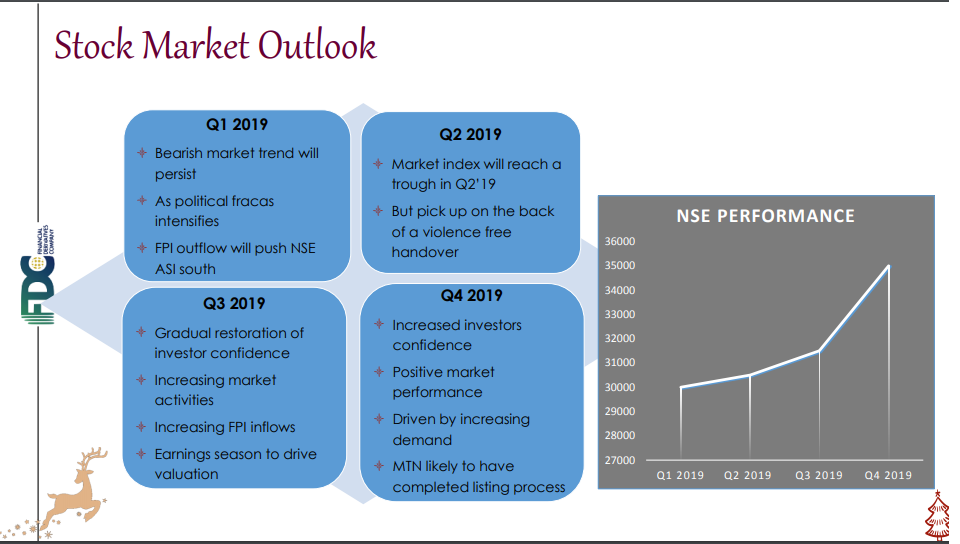
The first Lagos Business School (LBS) Executive Breakfast focusing on 2019 has been published. It is titled “2019 – A Year of Trepidation and Growing Uncertainties”. Presented by Bismarck Rewane, CEO of Financial Derivatives Company Ltd, the document gives you insights into the state of the nation as we march into 2019.
He has captured trends, anchors, and indicators which businesses should watch. On telecoms, he summarized as follows “Squeeze in operators’ profit will tighten”. He basically wrote Q1 2019 off but was evidently bullish later in the year.
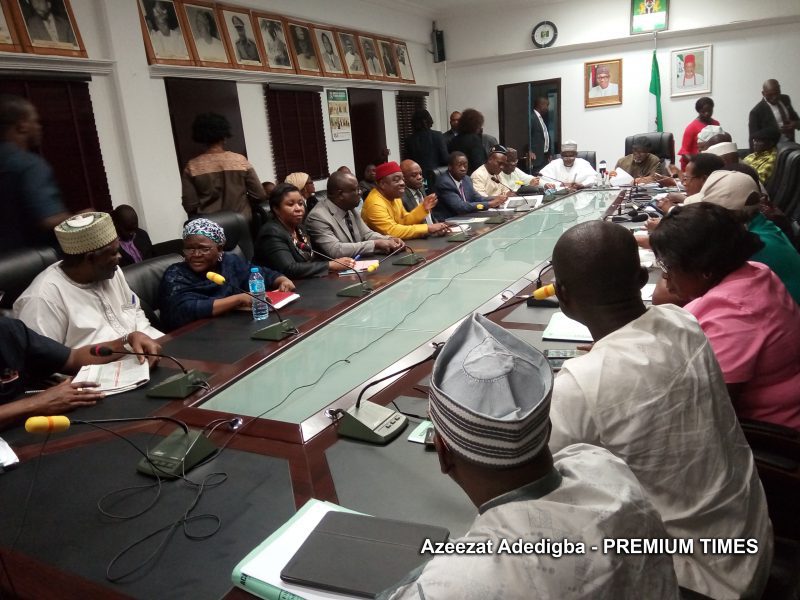
Many have wanted to know my perspective on the ongoing ASUU (Academic Staff Union of Universities) strike in Nigeria. The fact is this: I am not a fan of ASUU when it comes to strikes. In a piece last year, I explained that our problem is not really university education. I made a case that Nigeria “needs a conference on how to fund education in the 21st century”. For all the agitations from tertiary education (universities and polytechnics), no one is representing primary and secondary educational systems to make them better. Interestingly, the latter is where we need improvement, urgently.
I am a big advocate of quality education, not just at the university level but also at primary and secondary levels. Nigeria needs one. I enjoyed my time in Federal University of Technology Owerri, despite having to go to class at 4am for a lecture starting at 10am, to “colonise” a seat in the front. ASUU demand makes sense – more funding could have solved that problem. However, I have also noticed that it was not just about funding when I made it into U.S. It was more of an efficient utilization of capital and factors of production. Yet, we can talk about those even for a university. Most U.S. university leaders are professional managers who are well experienced in managing large organizations. That a crop scientist professor has published many papers does not qualify him or her to be running a university when he/she cannot read a simple balance sheet statement.
I respect our professors; many taught me. But here, I am not a fan! ASUU has used advocacy and voodoo statistics to rig Nigeria for the privilege few (I belong to that few). This is a country where millions of kids cannot get decent primary education, and yet it has money to subsidize tertiary education.
I largely attended FUTO free and if you went to a federal university in Nigeria, government subsidized your education. Yet, that same government does not have money for primary education which naturally should be free and compulsory at high quality. Also, the secondary education has become anything goes. But come to tertiary education, ASUU wants to make it GREAT. That is a good vision as we want a great university system; but wish is not all that it takes for things to happen.
The problem is this: when we subsidize few thousands in universities, we deny millions opportunities to attend primary schools. Some states still think that paying a primary school teacher $50 per month is excessively unaffordable. Check well – the professors earn above $1,500 monthly (I get it, purchasing parity plays here. Do not compare with U.S. and Europe).
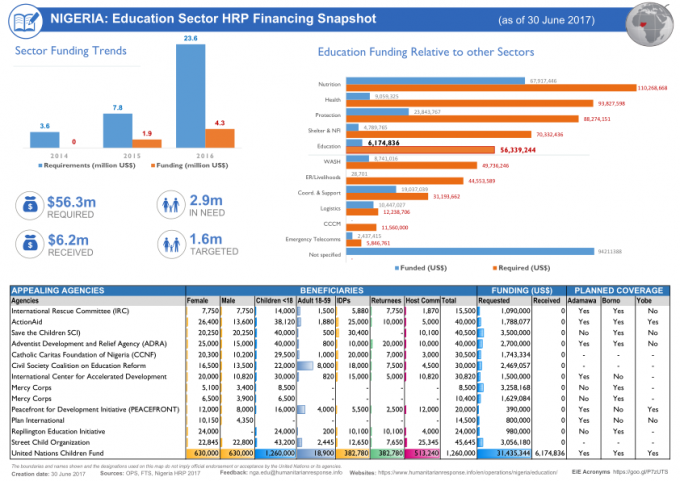
source: reliefweb
Simply, the failure of our primary and secondary educational systems is one of the main reasons why Nigeria remains underdeveloped with skyrocketing unemployment where mass illiteracy is common. The fundamental rights of many kids across Nigeria, according to United Nations – the right to basic education – have been trampled. While we want great universities, we cannot forget where the priorities should be.
I will support ASUU when it is fair to include primary and secondary education in its advocacy. Interestingly, primary and secondary school teachers do not strike easily despite the extremely challenging working conditions they operate. ASUU is not Nigeria’s problem. Our major problem today is that we do not have functioning primary and secondary educational systems.
China has 99% primary education enrollment with less than 10% university attainment. They put all the good money in primary education. America does the same where primary and secondary are largely free. But in Nigeria, we flip it, taking care of few to the detriment of many. Why should a professor be paid $2,000 per month when a primary school teacher cannot even get $50 monthly? The most important education is primary education. Yet, from state to federal levels, Nigeria continues to pump more money into universities, leaving primary and secondary severely underfunded.
We need a comprehensive funding strategy in Nigeria. And government needs to engage with our professors with respect. You cannot sign a document and then run away from it. No matter how you look at it, this is a problem government has created. Our professors have the rights to pursue avenues to get more funding, as they would like to compete academically with others across the globe. But at the end, it is the government that should balance these issues: ASUU should come below primary education.
But I must say that the government must be honest on how it handles our professors. You cannot sign a document with full awareness that you would not implement it. That is degrading and insulting. Everyone has a role to play here because at the end, only the students suffer. Where you know you do not have money, stop opening new public universities. Rather, make it easier for the private ones to meet the demands of what you have in mind, while supervising them for quality. Nigeria, by now, should not be closing universities on strike. The fact that we continue to close universities is a shame. It needs to stop
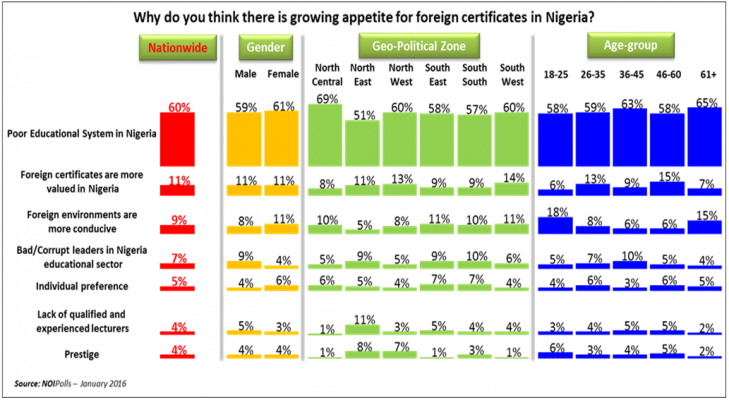
Source: NOI Polls
Plotting the Future of Education in Nigeria
Primary education should be free and compulsory in Nigeria, and must be high quality. Even as we inject more funding to improve it, we should make secondary education nearly free, making it accessible to our citizens. University education which remains the center of all agitations should be funded but must not be the main priority: we need to take care of the millions before we focus on the privileged few. Yes, tertiary education should come last in the funding priorities in Nigeria.
As federal government scales access to tertiary education even as budget dwindles, strikes will become the new normal. Simply, tertiary education will not improve in Nigeria over the next two decades unless our economic system changes. Yes, the same government that does not have funding is the same that launched and added more than 20 new tertiary institutions in the last decade. As that happens, do not expect quality to improve. Interestingly, unlike before when government used to have money, today, it has none. So, even strikes will not change much, permanently.
I have suggested some options for the government to consider:
Revamp the tax system to make it more attractive for private sector to support universities.
The Nigerian tax system is not designed to support philanthropy. That is why we do not have a vibrant one. It does not mean that a nation must be rich first before its tax system can be engineered to stimulate philanthropy. ASUU can lead on that, through Tax Reform, and make it possible for individuals and companies to put money in the schools and get tax benefits. Sure, ASUU members may be busy, but that should not stop them from helping the government to revamp our tax codes to drive innovation
Establish Education Loan Scheme that is linked to BVN (bank verification number) where people that receive government funding must be asked to pay back. The private sector should manage it in partnership with the government. In this scheme, provide academic scholarships to the most academically qualified in the nation. There are people that do not need to be in universities but attend anyway because its nearly free.
Give universities FULL autonomy. Yes, let them pay themselves whatever they want to pay themselves but they have to source the money by themselves. With competitions, they would come at parity on quality, pricing and value.
All Together
Every generation of university students has seen continuous decline in quality. The reason is thus: the model we run is not sustainable and as more people aspire to attend universities, what used to work will crumble. The golden years where university students lived like kings and queens in UNN, UI, Ife and ABU cannot be sustained today. The present cohort of students would be better than those coming in ten years under the same model, unless Nigeria fixes it. Unfortunately, our economy has not expanded to inject more funding in critical sectors of the economy.
ASUU funding model is outdated and it is time they realize that no strike can change that. It costs about $55,000 to attend Harvard in a year. If you think you can strike to get that quality, you have not started. And if you think students can pay $500 and get that quality, you are not real. Nigeria needs a working model – the one advocated by ASUU is an expired one.
You just wrote today like someone possessed by a Higher Being, because average Nigerians rarely speak the truth, and also struggle to handle the truth when told to them.
You mentioned full autonomy, unfortunately nothing in Nigeria is autonomous; the States still depend on Federal, universities are even dependent on NUC and politicians, the Police is suffering the same.
No independence of mind, body, idea or anything, in this country; everything is convoluted and contrived.
The same false narrative makes governments to promise what they cannot do, because truths and falsehoods are similar in this clime. We want to fund lifestyles we cannot afford, and that’s why nothing works anyway.
We always fight for the privileged minority, just look around Nigeria and see where we usually spend money; all about wealthy and privileged minority.
People who shouldn’t have business with university education are going there, and we want to send more people and fund their waste of time and resources; strange land.
Anyway Nigerians are specialists in fighting the wrong battles, and that’s why we don’t produce sustainable winners; always a short term thing, and then we go back to whining and complaining.
vision concept with business elements on blackboard
As 2018 sets and 2019 arises, you need translators of visions into actions. For years, my Practice has worked with leading local and global firms to CREATE a future which becomes predictable.
How do you connect dots in areas which appear uncorrelated? Yes, what is the risk of that local ecommerce startup to that real estate (mall) project? With uncommon insight, the architect will redesign for a multi-purpose real estate.