In 1776, Scottish economist and philosopher, Adam Smith wrote his classic – ‘The Wealth of Nations’. That book became one of the most important works in understanding the nature and causes of the wealth of nations. From Milton Friedman to Maynard Keynes and my favorite, Joseph Schumpeter, scholars have pursued the noble course to understand the economic mechanics of nations.
Clayton M. Christensen’s upcoming book, The Prosperity Paradox, has posited that strong corporations build better public institutions because for all government policies, companies have to fund them, through taxes and fees. So, Nigeria’s inability to build enduring corporations would continuously hurt Nigeria’s capacity to improve our public institutions. Yes, if MTN, Glo, Airtel and 9Mobile do not make money, NITDA (National Information Technology Development Agency) will not have money to fund its mandate. And if Nigerian corporations are not profitable, the education tax (TETFUND) would struggle. And interestingly, you do not need governments to be perfect before great companies can be created. Before Central Bank of Nigeria Owerri office, First Bank of Nigeria was partly acting like the bank of last resort in eastern Nigeria, clearing cheques for other banks!
Applying the rigorous and theory-driven analysis he is known for, Christensen suggests a better way. The right kind of innovation not only builds companies—but also builds countries. The Prosperity Paradox identifies the limits of common economic development models, which tend to be top-down efforts, and offers a new framework for economic growth based on entrepreneurship and market-creating innovation. Christensen, Ojomo, and Dillon use successful examples from America’s own economic development, including Ford, Eastman Kodak, and Singer Sewing Machines, and shows how similar models have worked in other regions such as Japan, South Korea, Nigeria, Rwanda, India, Argentina, and Mexico.
Good People, we need to have new operational manifestos in Nigeria. Can we have a Center for Corporate Longevity in each region, hosted by regional leading universities? These centers would focus on understanding the root causes of our industrial paralyses (like the fading of Diamond Bank) which continue to undermine a once virtuoso pragmatic economy.
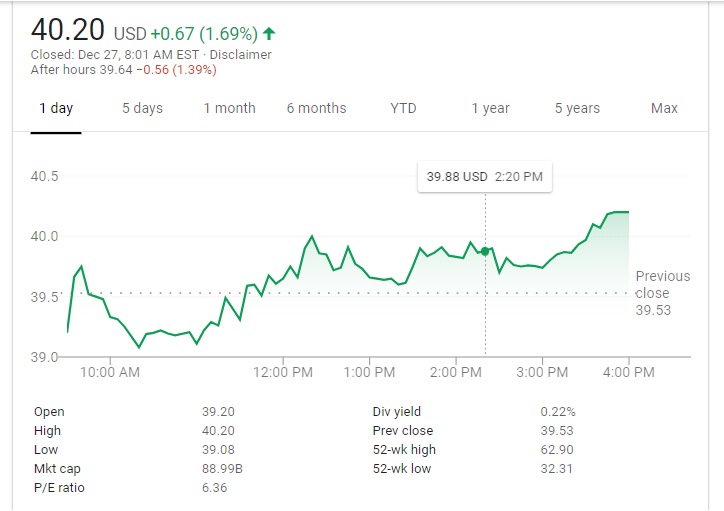
Nigeria’s Access Bank Plc agreed to take over struggling local rival Diamond Bank Plc in a deal worth about $200 million that would create the nation’s biggest lender by assets. Both companies’ shares rose.
Access will buy Diamond for 3.13 naira a share, with almost a third of that, or about $64 million, being paid for in cash and the rest in shares, the Lagos-based lenders said in statements to the Nigerian stock exchange on Monday. That’s more than triple Diamond’s previous closing price.
Our regulators have not fixed these issues and it seems our companies do not have the capacities to save themselves. As I have noted before, finding enduring companies in Nigeria is hard:” In short, if you sort companies by “40th birthday” in the Nigerian Stock Exchange, and carefully remove entities with international origins, you may struggle for two dozen.”
I was shocked that after 260% premium, Diamond Bank went for $200 million. Think about it – that is one of the nation’s leading companies. In South Africa, one company, Naspers can buy all the companies in Nigerian Stock Exchange with less than 50% of its market value: the Nigerian Stock Exchange total market cap is about $34 billion while one South Africa firm commands $89 billion.
Naspers cap today is about $89 billion while the whole of Nigerian Stock Exchange is about $34 billionThere is a reason why our equities are priced the ways they are: investors do not have the long-game plan in Nigeria. And only Nigeria can change that perception. We need to deepen capabilities to make sure we have long-view corporate institutions.
To our emerging technology hubs, incubators and accelerators, we need to add components that deal with corporate longevity and succession. And it is very important for our universities to spend efforts to have centers that can help our corporations understand these issues. This is no more a regulatory challenge – it is a national problem which must be fixed. Because our firms are not dying because of creative destruction, we need to investigate and discover new roadmaps on the corporate longevity in Nigeria.
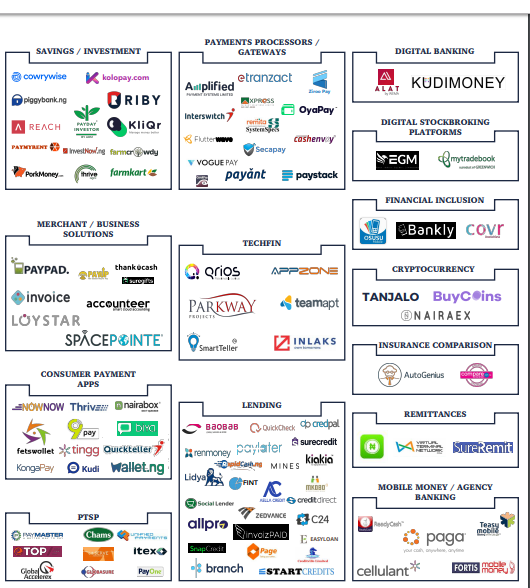
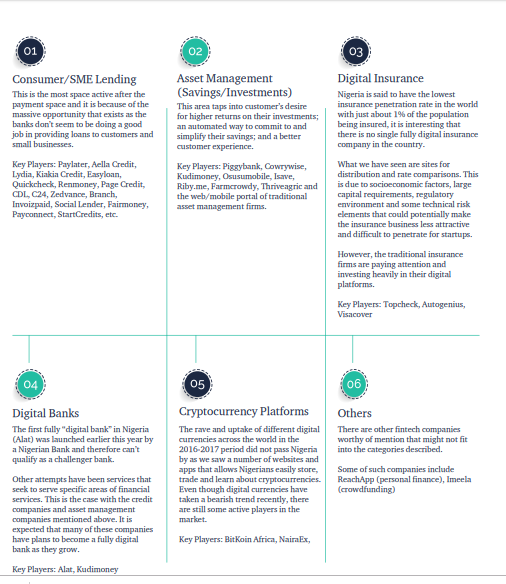
Segun Adeyemi, CEO of Amplified Payment Systems, has written a short ebook, A Guide To The Payments and Fintech Landscape in Nigeria, for lovers of payment, digital banking and fintech with focus on Nigeria. It is a good one. You can read and download it here.
Across the continent, over $560million was invested in tech companies in 2017. Of the $114million reportedly raised by tech companies in Nigeria, 75% of it went to FinTechs. So far in 2018, Nigeria FinTechs have raised over $95million according to publicly available data. If you have been following the startup ecosystem in Nigeria, you are probably inundated with news about FinTechs and their activities on a daily basis. This media attention can be largely attributed to these major investments.
[…]
The payment space is the most vibrant and active of the fintech areas in Nigeria. This is as expected because Nigeria is a largely cash based society and there’s a huge opportunity in the digitization of cash transactions. However, beyond the payment space, there are other very active FinTech categories and companies in Nigeria that are tackling big opportunities and using technology to solve real problems in the financial services space
Source: S. Adeyemi, herokuapp
Here are some of the leading payment and broad fintech companies in Nigeria
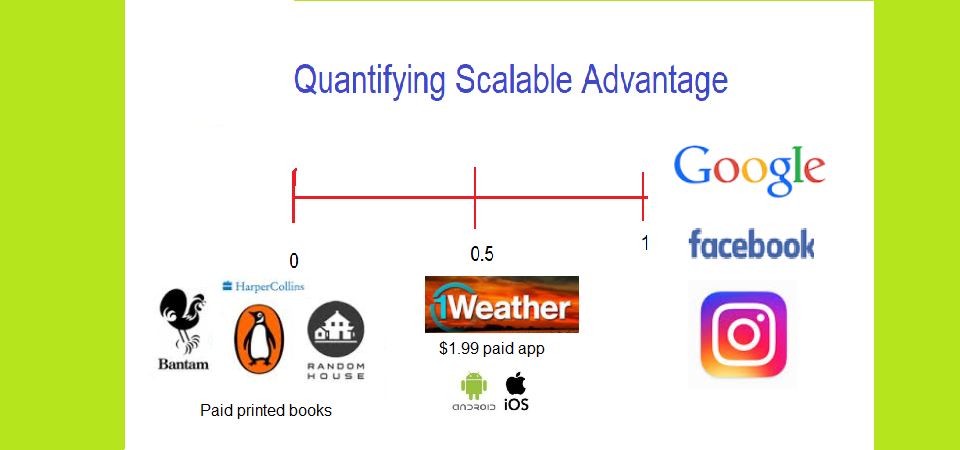
If markets are perfect, the marginal cost of a digital product would be zero. Marginal cost is the cost added by producing one additional unit of a product or service. The implication is thus: if marginal cost is zero, users can pay zero or near-zero. Unfortunately, markets are not perfect, and that means marginal cost is not zero.
In a perfect market, the marginal cost of a digital product is zero. This means that the price of a digital product tends to zero: welcome freemium and ad-supported business. However, only firms with network effects dominate and benefit. The core reason is that if in a perfect market, and the marginal cost of producing digital product is zero, the price will inevitably go to zero.
This is the heart of the freemium model where you get many things free, which is possible because of the aggregation construct, where companies provide those digital products and then create an ecosystem to sell adverts. The firms benefit more than the suppliers by providing the platforms [Facebook makes money for photos supplied by families. Sure you like the Likes]. As shown in the Figure, great companies deliver the near-zero marginal price for high quality product, making it challenging for anyone that carries a non-zero marginal price to compete, exacerbated if the product is even not top-grade. This is one of the biggest challenges digital entrepreneurs face.
Nonetheless, as a web entrepreneur, your job is to make that marginal cost near-zero. It is only when you make that possible that you can improve your scalable advantage.
Digital marginal cost comprises mainly transaction cost and distribution cost. The transaction cost includes processing fees like the ones Paypal and Interswitch charge you. Largely, that cost is agnostic of domain: it is paid whether online or offline.
But distribution cost is the real deal. That is the cost associated with distributing the goods. For a digital product like subscription to my blog, the distribution cost is zero. But if you run an ecommerce company, you have a huge cost to ship the items after the customer has paid. If that distribution cost is not near-zero, you have a problem as a web entrepreneur.
By that I mean: if your distribution cost is huge like an ecommerce company, even though you think you are a web entrepreneur, you are actually NOT running a web business since your cost is now dominated by the offline component. That is the reason why I maintain that an ecommerce company in Nigeria is not a web business but a physical business with a web channel.
Yes, the largest component of the marginal cost is offline and that makes ecommerce an offline business. You know what? Ecommerce entrepreneurs fix that problem by mapping geographical locations within a nation where they can serve customers, making a case why they are not a web business since web businesses are neither constrained nor bounded.
In summary, understand your marginal cost by watching this video below.
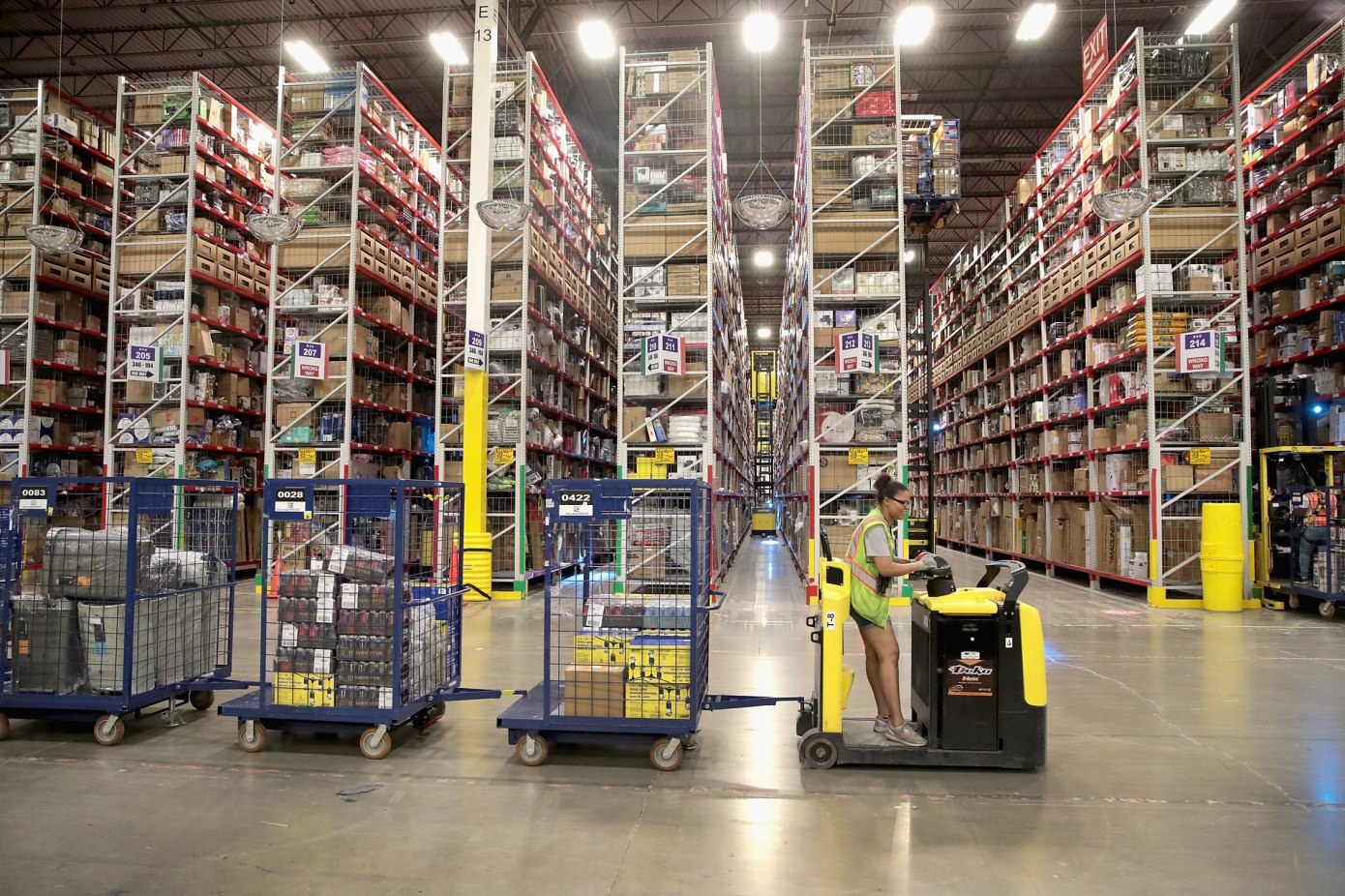
ROMEOVILLE, IL - AUGUST 01: Workers pack and ship customer orders at the 750,000-square-foot Amazon fulfillment center on August 1, 2017 in Romeoville, Illinois. On August 2, Amazon will be holding job fairs at several fulfillment centers around the country, including the Romeoville facility, in an attempt to hire more than 50,000 workers. (Photo by Scott Olson/Getty Images)
From Nigeria and Africa, when you look at Amazon, you see an ecommerce operator. But if you try to copy Amazon, you would likely struggle. There is one product which Amazon offers its customers which no ecommerce operator has created in Africa: Amazon Prime, a paid membership service offered by Amazon that gives users access to free two-day delivery, streaming music and video, and other benefits, for a monthly or yearly fee. Citigroup projects the membership number to hit 275 million members over the next decade. (At the moment, Prime has less than 150 million members.)
If you take an average of $100 per year, in the club membership, you are looking at $27.5 billion [projected] per yearly revenue. That is money Amazon will receive from users simply to grant them privileges to buy things from its ecosystems.
Now, if you clone amazon.com website and forget to “clone” the Prime Membership, you would be off by miles. Yes, Amazon can afford to lose $10 billion on discounted wares and shipping because it knows that it would collect $27.5 billion [projected] from the club membership. At the end of the day, the company would be made whole. This Prime membership is an engine that powers the Amazon business: it added many new users this holiday season.
Amazon had another record-breaking holiday season, the retailer announced this morning. The company says it added “tens of millions” of people who signed up for Prime memberships, both paid and on a trial basis. Its worldwide customers also shopped and ordered more items than ever before, including “millions more Amazon devices” compared with this time last year. The device best-sellers, as on Black Friday, again included Amazon Echo speakers and Fire TV.
[…]
Prime membership continued to grow this holiday – tens of millions of people worldwide started Prime free trials or began paid memberships, to benefit from FREE Same-Day, One-Day or Two-Day shipping, in addition to FREE two-hour delivery with Prime Now.
Largely, if you follow its massive discounting without remembering the revenue it collects from Prime, your strategy would not be worth the paper it is printed on. Or if you have the strategy in an electronic format, it would not be worth the digital space it is occupying in your device.
Prime is one key reason Amazon ecommerce strategy will not work in Africa until someone can figure out how to build a local Prime equivalent. Amazon through Prime offers users competitive prices when compared with physical stores. Without your Prime equivalent, you would face some of these challenges I had noted in Harvard Business Review while also struggling to beat prices offered by open markets and local supermarkets. You cannot win with that level of double-whammy against you. And that explains why we have to invent a model that can work at home.
The same $100 people pay for Amazon’s Prime is not far from the monthly pay for several categories of middle-class income earners, and somehow we expect magic. By the time you settle your landlord, pay for security, buy fuel for your generator; you might be struggling to eat.
We simply do not have the numbers to experiment like Amazon, both from the operator and consumers sides, the economy isn’t that robust to do these things at scale.
If you look at our demographics, most people who are enlightened and tech savvy do not have money, while the minority with deep pockets either do not trust the web or are pure illiterates. So we are limited at the moment, it goes beyond models and strategy; the most important thing would be to expand the economy, to allow the demographics who can drive growth and adoption to participate.
As for the operator side, Amazon was patient enough to build something huge and intimidating, and a lot of investment went in there. Raising $2M or $5M and expecting returns within three years may not do much, if anyone even attempts to clone Amazon.
A success in the ecommerce sector must have a precedence, from where the bloc of the purchasing power would be modelled after, we do not have such yet.
#2 Comment
You’re right that local solutions are needed for local e-retailers to survive. And indeed, I believe our retailers are making great strides in that already. For instance, the pay-on-delivery solution that has worked so well.
However, it’s good to remember that Amazon Prime did not start until 11 years (1994 – 2005) after Amazon itself was born. And for those 11 years, they survived just okay with the normal sales and discounts. As such, it might not be totally correct to say that African e-retailers cannot successfully discount without a Prime-like offering. Sure it might be tough, but not unnecessarily impossible.
My Response: [ ]- you made the point. Amazon lost money during those early years. Because of American markets, it could continue to lose money until it started making money. If you want to copy that, be open to keep losing money. However, from Kalahari to old Konga, no one is open to absorb those loses before the turning moments. So, in our models, we want to achieve profitability since we do not have access to that next capital under loses.
#3 Comment
What really drives the high Amazon Prime subscriber base is the fast delivery of purchased items (without any extra cost for the subscriber), and what makes that feasible is the unique mix of efficient mailing/shipping systems available to Amazon (US Postal Service, UPS, and now … their own home-grown Amazon Logistics to fill delivery gaps in the short term….and soon to be deployed are drones as part of Amazon Logistics in the longer term).
You def. can’t copy that in Nigeria or Ghana today, because such robust logistics systems simply do not exist. Just “cloning” Amazon’s prime membership or any paid membership is not enough.
The main selling point for Amazon prime membership is the fast delivery of items… and not the other added services (video streaming, etc). Find a way to deliver items quicker and safer and customers will pay any nominal club membership fee to join in.
My Response: Absolutely – the marginal cost of logistics in Africa is high without functioning postal systems. Our path to solid ecommerce MUST include great postal systems
#4 Comment
Amazon adapted the Sams club, Costco, and BJ’s model for ecommerce and it has worked beautifully. Let me remind you that for the first 10 years Amazon did not make a dime but the investors stuck with the management because Amazon was transparent in its objectives to investors. Amazon controls all the value chain. Logistics, payments and warehousing. Amazon has the numbers so they have the customer base to play with. The keys to Amazon success are 1. Superb Management. 2. Access to Capital 3. Superior infrastructure and lastly 4. The bottom of the pyramid which majority belongs to. We are all looking for “deals”.
My Response: Awesome – expanding your points: (1) Africa has great managers (2) Because we do not have access to next capital, no one will wait for 10 years to see profitability. That is the issue why old Konga, Kalahari etc struggled. Our gestation period to be profitable does not exceed 5 years in African startups before investors flee. (3) The best infrastructures Amazon enjoyed are US Postal service and tax collection waivers which tripped online for shoppers in U.S. Nigerian startups enjoy neither. (4) We have more bottom of pyramids. As you noted, there are many inherent advantages which cannot be cloned and the need for adaptation.
#5 Comment
Prof ,when you say local invention is needed ,I understand adaptation is needed. If the rate for membership is lessened and the delivery system meticulously elaborated ,I don’t see why cloning Amazon in Nigeria will be impossible .If in the next 10 years Amazon does not reinvent itself ,they might face a serious competition from the new technologies evolving everyday . Adaptation is the key .
My Response: Sure – my point is the “delivery system”. Without US postal system, we would not have Amazon today. And without the tax collection waiver, Amazon would have failed. But by waiving the tax collection burden for online stores (US is gracious there), Amazon products became artificially cheaper by 8-10%. Magically, no one wants to pay tax because if you buy from Amazon, it is tax-free! (I know one has to self-report the sales tax. Too bad, no one does that)
#6 Comment
Very well said sir. But just as someone already pointed out, and having worked for a while at one of Amazon’s fulfillment centers, one thing that is key to Amazon’s success is its commitment to her customer- prompt service and delivery. Moreover, in these developed nations, there are already in place, infrastructures to facilitate their services. Also, We must not forget that Amazon has grown over the years. They did not as a matter of fact start up with the Amazon prime initiative. Infact, Amazon consistently lost money as a public company during its early years. Amazon prime was only initiated in 2005. I would therefore not say that it is entirely impossible to clone the Amazon business in our continent but we must first address issues pertinent to our continent which our counterparts have already found solutions to.
On a recent visit to Nigeria, I purchased an affordable smart phone from the popular ‘Computer Village’, in Ikeja, Lagos. As affordability has often been highlighted as one of the barriers hindering the adoption of smartphones and newer generation services in developing countries, it therefore comes as a welcome development to find out that there is a wide range of affordable smartphones targeted at the Nigeria mass market. The smart phone adoption in Sub Saharan Africa has been predicted to be around 35%.
Within the Nigeria smart phone market, there has been a proliferation of affordable phones from manufacturers like Tecno, Itel, Infinix, Samsung, Nokia, Huawei etc. This has also encouraged more indigenous companies like Imose to enter into the smart phone race. This is very encouraging as competition would only translate into a positive experience for consumers.
However, as I began to use the smart phone, I realized that the mobile phone produces heating after usage for a while. Besides heating, I was equally concerned about the electromagnetic radiation emitted by the mobile phone. This concern is borne out of the fact I have been privileged to investigate electromagnetic radiation exposure to users using mobile communication devices and network.
There is a common misconception among users’ that electromagnetic radiation from mobile station (e.g. mast, antenna) is more dangerous than that from mobile phone. This has always been an issue among users resident within developing as well as developed countries. Users tend to associate huge risks (like radiation) with visible antennas whilst associating low risks with antennas perceived as invisible (like the ones embedded in their mobile phones). This was confirmed from the findings of a European survey. Such survey could also be conducted in Nigeria and other developing countries but I doubt if the findings will be any different, considering the public outcry from residents whose homes are close to installed base stations. This is not to discard any such outcry but I think it should be thoroughly investigated through the collection of scientific data.
According to the World Health Organization (WHO), it has been concluded that electromagnetic radiation is possibly carcinogenic and there are currently studies investigating the long term effect of electromagnetic radiation on human health. The radiation mainly affects the head (or body) of the user. And an increase in temperature is one of the best ways for accessing the health and biological effect of electromagnetic radiation. It is for this reason that the use of ear piece has been recommended for heavy smart phone users’ as a way of mitigating electromagnetic radiation exposure. There are of course, other smart technology solutions that can help mitigate the radiation exposure.
Most Nigerians use cellphones
In more advanced markets, mobile phones are subject to strict regulatory requirements like measuring and testing that the Specific Absorption Rate (SAR) is below the regulatory limit before allowing such phones within the market. Whilst I am happy about the decline in the price of smartphones due to the wide availability from the different manufacturers within the Nigerian Market, I think it is equally important that these phones are subject to strict regulations which would no doubt protect consumers from the hazardous effects of smart phone usage. This would also help to ensure that Nigeria, alongside other developing countries, are not perceived as a dumping ground for dangerous phones.
I therefore would first like to congratulate the bodies in charge of regulating mobile communication services like the Nigeria Communication Commission (www.ncc.gov.ng) for the adoption of policies encouraging the widespread adoption of smartphones as well as facilitating an enabling environment for indigenous companies to compete within this space. This has no doubt led to the decline in the prices of these devices. Most importantly, I would also like to implore these bodies to look into regulating smart phones made available within the Nigeria market, as a matter of urgency.