DD
MM
YYYY

PAGES

DD
MM
YYYY

spot_img

PAGES

Home Blog Page 7037

[Full TED Video] “Igbo apprenticeship system that governs Alaba Int’l Market is the largest business incubator platform in the world” Robert Neuwirth

0

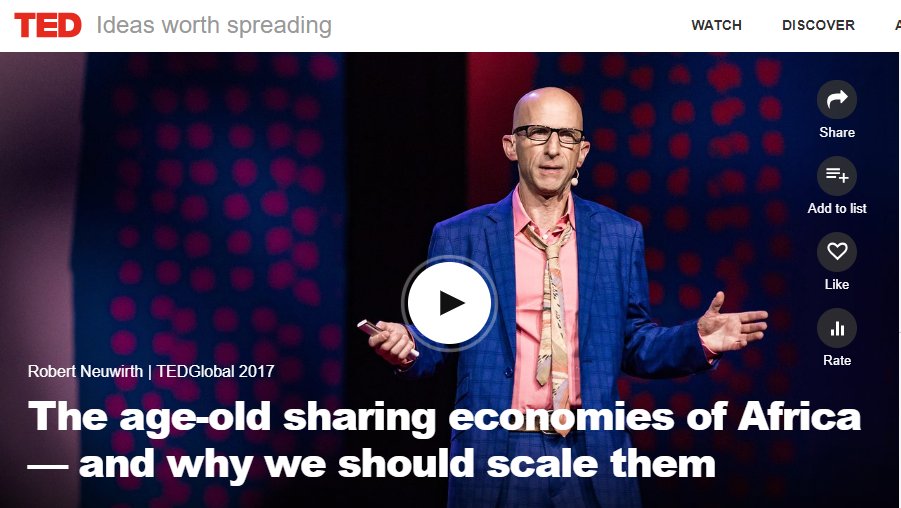
This is the full video of the TED talk on Igbo apprenticeship system which I wrote here. The TED Speaker, Robert Neuwirth, made a strong case and concluded thus: “And I can say with almost certainty that the Igbo apprenticeship system that governs Alaba International Market is the largest business incubator platform in the world.” The full transcript of the section of interest is below for those saving mobile credit.

So the interesting thing is that this mutual aid economy still exists, and we can find examples of it in the strangest places. So, this is Alaba International Market. It’s the largest electronics market in West Africa. It’s 10,000 merchants, they do about four billion dollars of turnover every year. And they say they are ardent apostles of Adam Smith: competition is great, we’re all in it individually, government doesn’t help us. But the interesting reality is that when I asked further, that’s not what grew the market at all. There’s a behind-the-scenes principle that enables this market to grow. And they do claim — you know, this is an interesting juxtaposition of the King James Bible and “How To Sell Yourself.” That’s what they say is their message. But in reality, this market is governed by a sharing principle. Every merchant, when you ask them, “How did you get started in global trade?” they say, “Well, when my master settled me.” And when I finally got it into my head to ask, “What is this ‘settling?'” it turns out that when you’ve done your apprenticeship with someone you work for, they are required — required — to set you up in business. That means paying your rent for two or three years and giving you a cash infusion so you can go out in the world and start trading. That’s locally generated venture capital. Right? And I can say with almost certainty that the Igbo apprenticeship system that governs Alaba International Market is the largest business incubator platform in the world.

Nigerian Igbos Run the Largest Business Incubation System in the world – TED Video

17

It is not news that Nigerian Igbos run one of the oldest venture capital industries in the world. It is also not breaking news that Igbos have one of the most advanced business incubation systems in the world. And these things happen without anyone thinking about them. A kinsman is a merchant – he goes to China and imports containers. When I talk to him about bank supports, he laughs: “Bro, we have better banks without CBN wahala”, he reminds me.

Simply, under the Igbo apprenticeship system, the strength and measure of a man is based on how he has made those that worked under him better. In some villages in Ohafia (Abia State), you cannot speak in the village square if your “boys” are not progressing. In some communities in Arochukwu (Abia State), before elders can permit you to talk, you must begin by naming sons you made men.

Alaba market (Lagos State, Nigeria)

In my practice, I have worked with some moguls and observed reverence. Yes, you have made money more than your master. But till grave, he remains a demi-god to you. That is why a boy who did not enter university can run the largest (indigenous) car manufacturing company in Africa. That is why if another closes his fuel depot, Nigeria will experience fuel scarcity within days – but that guy dropped out in JS2.

I have asked the Nigerian government to work on the formalization of the Igbo apprenticeship system. We have a great system, and certainly do not need to invent many new things. Interestingly, in this TED Talk, that Igbo apprenticeship, using Alaba market, was celebrated

The Igboland incubation system does not take equity. It does not require raising huge capital. It is driven by human-platform and it works. Nigeria needs to deepen this system even as we celebrate the modern forms of incubation. If government can find human-platforms to work with the youth, we can comfortably fix unemployment. With minor checks and balances, we will provide opportunities to young people.

The TED video expands that message (I could not upload the TED video because of copyright issues. But if you click, you will listen to the audio). The speaker used the Alaba market as a case study.

Update: I have just tracked the video (embedded below on this post) on TED. This is the transcript of the section to focus.

So the interesting thing is that this mutual aid economy still exists, and we can find examples of it in the strangest places. So, this is Alaba International Market. It’s the largest electronics market in West Africa. It’s 10,000 merchants, they do about four billion dollars of turnover every year. And they say they are ardent apostles of Adam Smith: competition is great, we’re all in it individually, government doesn’t help us. But the interesting reality is that when I asked further, that’s not what grew the market at all. There’s a behind-the-scenes principle that enables this market to grow. And they do claim — you know, this is an interesting juxtaposition of the King James Bible and “How To Sell Yourself.” That’s what they say is their message. But in reality, this market is governed by a sharing principle. Every merchant, when you ask them, “How did you get started in global trade?” they say, “Well, when my master settled me.” And when I finally got it into my head to ask, “What is this ‘settling?'” it turns out that when you’ve done your apprenticeship with someone you work for, they are required — required — to set you up in business. That means paying your rent for two or three years and giving you a cash infusion so you can go out in the world and start trading. That’s locally generated venture capital. Right? And I can say with almost certainty that the Igbo apprenticeship system that governs Alaba International Market is the largest business incubator platform in the world.

This is the video I made before connecting the original TED, trying to avoid copyright issues from the portion someone sent me.

The Nnewi has a tradition there also, as shared by an indigene here.

An interesting take, Ndubuisi. But as an indigene of Nnewi, I will argue that government should actually not get involved or in anyway interfere in the Nnewi apprentice model. It has worked for decades and we really do not need government to come tell us how to run it. If it’s not broken don’t fix it, they say.

Innoson, Cocharis, Ibeto, Chikason, Ekenedilichukwu, are all from our great city of Nnewi. None of these may ventured anywhere near the gates of a secondary school, some didn’t even finish primary school, but control multi billion dollar empires. It’s starts with an apprentice system where a master takes a young boy of about 10 years, the boy serves his master for about 7 years. At the end of the 7 years, the master settles the boy with some capital. Most times depending on their relationship, the boy remains in the master’s house even though he is now free, eats there and sleeps there for the next 2 years or so, to save money. In addition to the capital, the master also extends credit facilities to the boy and gives him goods on credit to sell.

The interesting thing is that nothing is in writing, it’s all done on trust and credibility. The boy’s family would usually come together and meet with the master at the commencement of the arrangement. And at the end of the apprentice period, the master will also bring the boy home and settle him in the presence of his family. Government can not replicate that. They can only complicate it.

This is the full video from TED


How Nigeria’s Next Generation Moguls Will Win

0

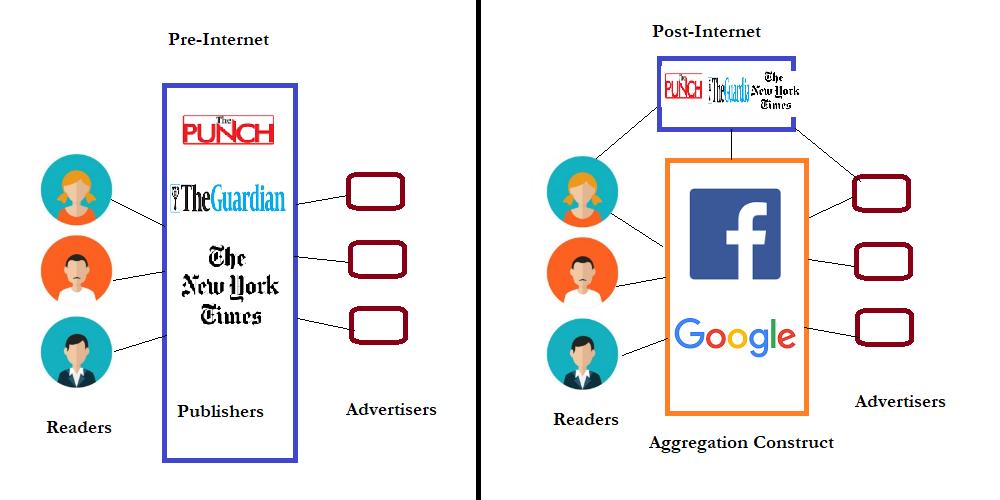
In the past, moguls built business empires by controlling Supply. By controlling supply, they were able to move the price equilibrium points to their advantages. Demand (the users) just went along. So, in the grand scheme of competition, rivalries evolved out of the needs to control Supply. If you control the supply of rice into Nigeria, you would make tons of money, as you can fix the price. If you control the supply of cement, the same happens. That same applied across markets and industrial sectors, from banking to real estate.

Today, in the digitizing internet world, the game plan is to control Demand (not Supply). It is assumed that Supply is already unlimited and there is no need to build capabilities to control it. If you want to control Supply, you would break in the Internet because you are absolutely going to fail. Yes, how could you control supply of all news posted on the web, from Twitter to Punch to Facebook? You have no chance – only aggregators are positioned for such.

Facebook and Google control demand

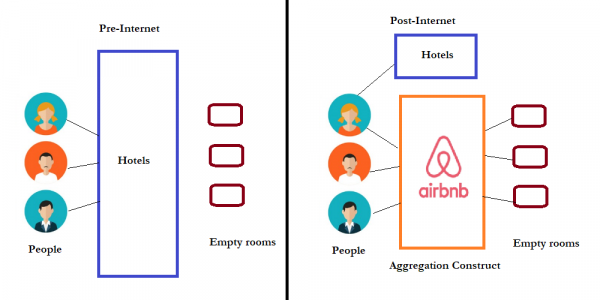
Airbnb controls Demand

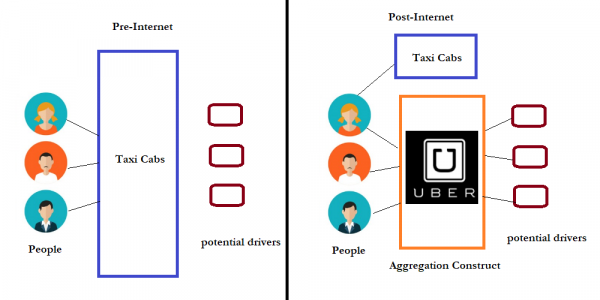
Uber controls demand

But in that web economy, there is a smarter strategy: control Demand. Simply, in a market that is unbounded by distribution mechanism and unconstrained by geography, the only remaining opportunity is controlling how all the supplies reach Demand (the users).

Magically, companies like Facebook, Twitter and Google focus on just that. They provide platforms that control Demand leaving the unlimited suppliers to provide the goods. Yes, you have the news (the contents), but if Google does not help to deliver them to the readers, you are in trouble. When Facebook revoked access to some websites after the debacle of Cambridge Analytica, many went bankrupt in days. Those firms had supply but they have been cut-off from Demand.

Facebook is going through a redesign with its privacy policy and strategy. The social media giant has started to significantly limit data access to Facebook’s Events, Groups and Pages APIs. It has also shut down part of the Instagram API. This is expected as the company battles scandals with the mess it found itself with the Cambridge Analytica related privacy violations.

Now, you can see why that your old book may not be helping your strategy as what worked in the industrial age economy might crash in the web economy. Sure, you can call Facebook and Google the modern supplies. But you must know they have no factories to produce the items you consume on their platforms. Google depends on all open global sites in the world to do that “supply”; Facebook feeds on stuffs we post. So, it is clearly not the type of supplies which used to break banks to execute. If you can “supply” their types of supplies, you are in control of Demand!

Comments on LinkedIn on this Topic

In this era of abundance on the supply side, the game has shifted to demand, turning entities with capabilities to control demands into the newest emperors. The digital supply chain even supports this model, where your superiority and differentiation is on your ability to stimulate demand, and also going ahead to decide who gets what.

It’s a radical shift, because for centuries, many things have been rigged from the supply side: just create artificial scarcity, and suddenly – more billions in your bank account! Times have changed, inventories are managed better, with less losses, meaning that you can technically stimulate demand, control the levers, without having ‘leftovers’ anyway.

With the way many things have been democratized, aided greatly by internet and web, tearing geographic boundaries along the way; households are turning themselves into mini factories, schools, markets, consulting firms, etc, without needing to break banks just to manage assets.

Human capital remains the most valuable asset in this knowledge economy, everything else is just a supporting cast.

This is the greatest time to be alive, if you are not living now; I am sorry!

Apple Goes Services

0

Apple reported a healthy 20% gain in revenue to almost $63 billion. Compared to Q3 in 2017, that was $10 billion growth. It did that growth by deepening cash-generating services and other things (think of Google paying fees to be default search engine in Apple products) while also getting more dollars per hardware (iPhone, iPad, Mac, etc) sold. The great numbers came despite largely no major growth in the number of iPhones sold when compared to last year. Of course, for Apple, that was not really important as the price of iPhone had jumped from $618 to $793 on average.Yes, it makes more money per unit.

Apple’s revenue rose 20% to $62.9 billion while net income came in at $2.91 a share. Both surpassed analyst estimates, which is often good news for investors. This time, however, the focus was put on Apple’s outlook, amid broader concerns that economic growth may slow down in coming quarters.

Largely, the company could continue to make more money even when it is selling lesser number of phones. From what is happening, I can see two things:

  • The high cost of Apple hardware is pushing many people to extend the useful lives of their devices. Had it been cheaper, users might have upgraded.
  • By Apple continuously jacking up the prices of its devices for better margins, it is making it harder to get new cohorts of buyers into the ecosystem.

On average, these trends are negative for Apple: anything that declines the absolute number of iPhone sold is bad because even the services which are supporting higher revenue cannot grow without more people using iPhones since Apple services are exclusive to the hardware. Markets did not like the trajectory; Apple stock went down by 6.63%.
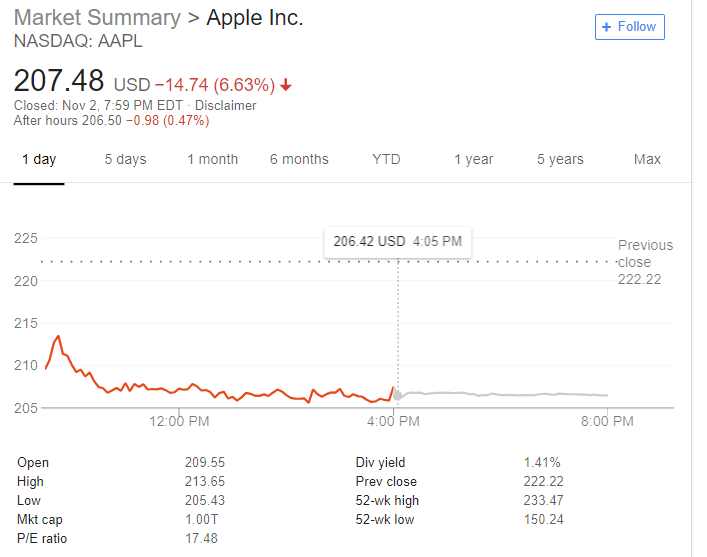
Apple stock value

Apple Withdraws

Apple plans to avoid reporting the number of its devices sold per quarter. No company does that when in the position of strength. Yes, Apple knows that it can extract more money per device even when selling lesser number of devices. Yet, not disclosing how many iPhones, iPads, etc it is selling does not make it look better.

[Apple] will stop disclosing how many iPhones, iPads, and Mac computers it sells every quarter. Thus, analysts will no longer be able to see trends in iPhone unit sales, calculate average selling prices, or discern other key trends.

[…]

Looking for more reasons why Apple will stop reporting iPhone sales? Third quarter global smartphone shipments decreased 6%, the fourth quarter in a row of shrinkage, Strategy Analytics reports. “The global smartphone market has now declined for four consecutive quarters and is effectively in a recession,” said Strategy Analytics director Linda Sui. Rival market forecasters at Counterpoint Research predicted yesterday that 2018 will be the first calendar year ever of smartphone sales declines.

(Fortune newsletter)


All Together

Apple will be fine and investors will align. Simply, the company is making it clear that its future is going to include services. So, if you hold Apple stocks because of iPhones and iPads, you may have to reconsider. By dropping the disclosure, Apple wants investors to focus on its revenue bottomline and not the number of devices sold. As far as the company is concerned, if it can grow revenue through payment, apps, licensing, etc, investors should not overly care what is happening on hardware as the company transmutes into making services a key part of its future. Simply, Apple has gone Services.

LinkedIn Comment on this Feed

Apple has officially become a profit making machine: if units sales aren’t increasing, prices can as well go up, and the money keeps coming…

We live in a time where a mere ‘beautiful’ announcement from company’s CEO could add $50 billions to its stock value in one day, and when you misspoke – as high as $100 billion could be wiped off within 24 hours.

Interestingly, Apple is trying to shift the goalpost, something Elon Musk must be happy to hear. Some CEOs have complained about quarterly earnings reporting, on how it does not allow them to pursue long term strategic goals. Of course you hear these ‘complaints’ only when the forecasts are no longer favourable, so smart guys go ahead to change the narrative.

Apple is always smart, now it’s reengineering how it wants both analysts and investors to view its performances, no longer from the lens of hardware units sold; you can call it perception innovation, Apple is king at that…

Lagos Housing Market Size

0

Lagos has 22 million population with 3.8m Lagos households earning more than $5,000 per annum. Lagos has 3.9 million households that earn more than US$5,000 or N1.83 million per annum, according to a report by the Economist Intelligence Unit (EIU). This comes to an average of N152,500 a month. The number of households that earn above $5,000 per annum is projected to rise by 96.4 percent to 6.9 million in 2030.

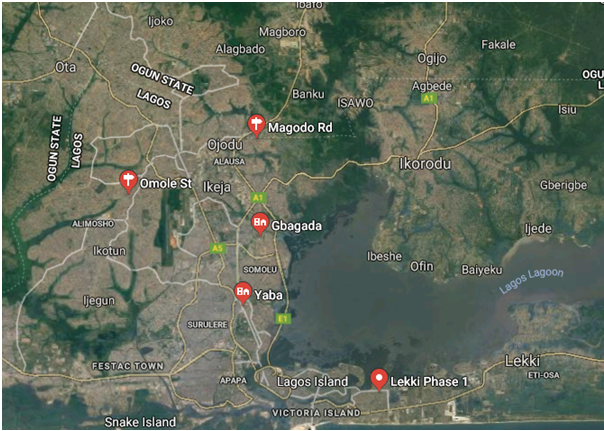
Around one-third of 3.8m household in Lagos represent roughly the upper and upper-middle household income of about 1.2m household, the latter ( remaining 2.6m population) are mostly resided on the Lagos Mainland Market mainly within central locations that have close proximity to link roads and bridges leading to other locations particularly the Central Business District (CBD) of Ikeja GRA, Maryland, Anthony Village, Ilupeju Gbagada, Ogudu GRA, Magodo GRA, Omole, Yaba, Surulere while the former are resided in Ikoyi, Victoria Island/Lekki Phase 1 respectively.  These household segments have the interest and purchasing power that is required to acquire both upscale and medium-priced real estates.

Generally, asking rents for 3bedroom multiple family units on the Mainland ranges between N 1,200,000.00 and above while on the Island its ranges between a 1.8m, 10m  and above per annum, according RAC Nigeria.

Insights & Analytics

  • Defining Household Income today, comes with a lot of disparities and school of thought as revealed in a number of report from the renaissance capital/TNS, Africa Development Bank and Economic Intelligence Unit. Social strata that exists in Nigeria has its own peculiarity for instance some quarters have classified middle income class as those that earns average monthly income of NGN75,000-100,000 ($480- 645, or roughly $6,000-7,000 pa) while others put it 152,000 and above.
  • Upper & Upper-Middle Household Income are the most heterogeneous as compared with Middle & Lower class, Upper/Middle includes entrepreneurs of different class like the Small but growing businesses SBGB owners, Senior Managers & E-Class Executives, Directors/Founders, top politicians and heads of MDA’s.
  • Arguably Nigeria boasts of over 50 blue-chip firms operating in Lagos. These set of firms operate a globally competitive payroll, middle managers take-home ranges between N500,000 and N1.2m. The combination of these blue-chip firms employs at least 35% of (the 1.2m population that belongs to the upper & upper-middle household numbers that form part of the 3.8m household in Lagos) a workforce population that works daily in Lagos, which is put at over 420,000 workforces. The remaining population in this bracket 75% of (1.2m) people falls either within a self-employment, entrepreneur. Small but growing business owners, captain of industries/serial entrepreneur, facilities & equipment vendors, Suppliers/Import & Exporters at different bulk market like Alaba Int’l, Int’l Trade Fair, Ladipo Market etc, independent oil & gas marketers, Independent building contractors & Real Estate Expert, Architect and Engineers, Industrial Farmers, Manufacturers or Craftsman and woman that makes a least of N10m total revenue quarterly.
  • Other narrative that can reflect the household distribution in Nigeria is the shopping pattern and disposal income, the likes internet service and/or cable TV access. Cable TV, Car model & class, Social Affinity and Spending/Investment Orientation are all differentiators. There is a strong relationship between Household income and Internet & Cable TV access level, in Nigeria, DSTV has the largest market share in the Pay TV space with subscription ranging from N1000, 5400, 1600, 4000, 6800 up to N15,800, meanwhile the premium bouquet of 15,800 a month, is a bouquet mostly subscribed by the upper household income and a share of the upper-middle household, these population are resided within Ikoyi, Lekki phase 1, Omole, Gbagada, Magodo, Yaba, Surulere and GRA Ikeja, including Northern part of the country in Abuja, Kaduna and Kano. This is an indication that there is a high number of Upper and upper middle house income that resides in these areas.
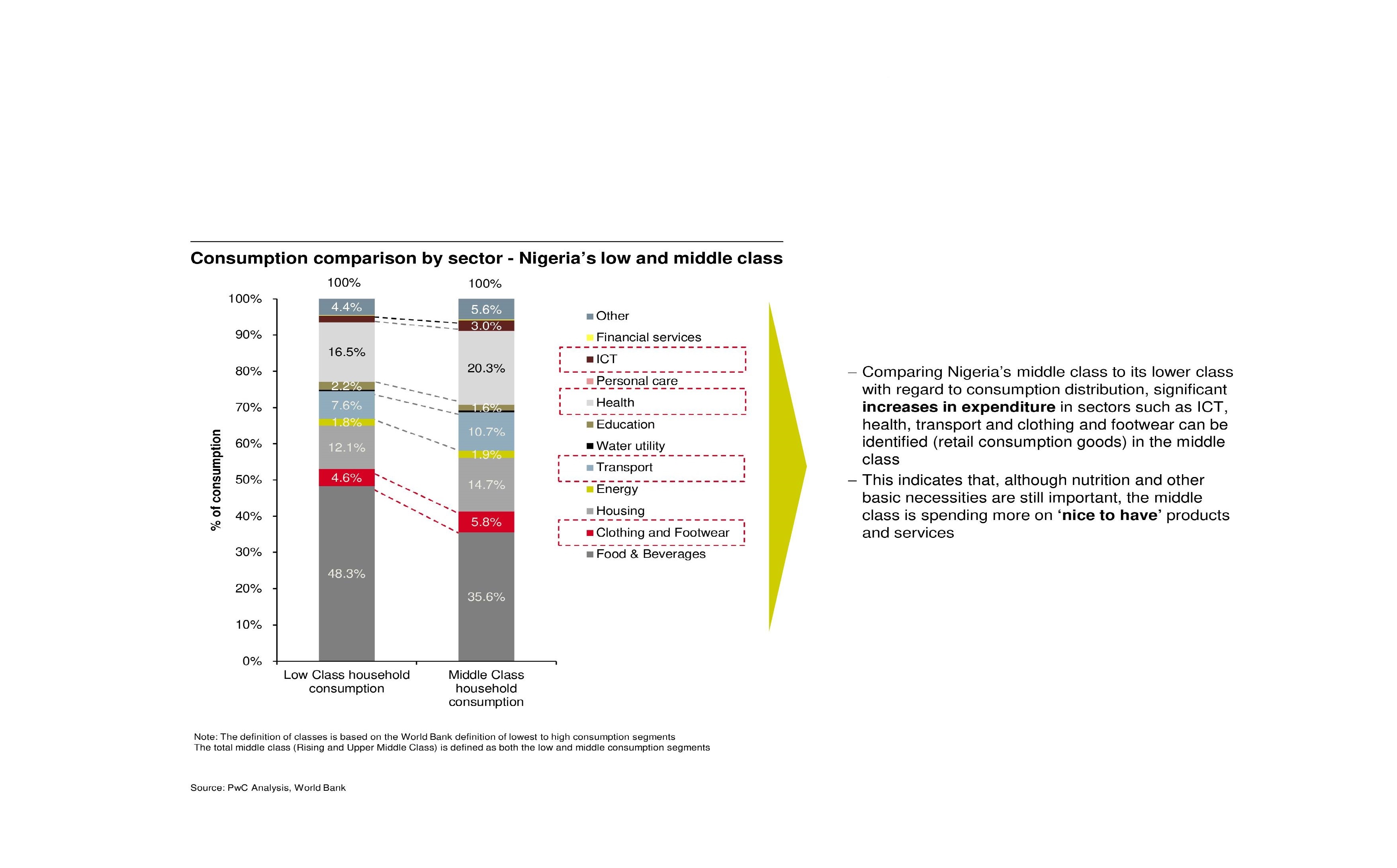
  • Consumer pattern in figure 1 below revealed how the Middle House Income spend their disposal income on healthcare, ICT, Education, Water Utility, Transport, Clothing & Footwear, Food & Beverage, ICT, Clothing & Footwear, Health, Personal Care, Transport, Financial Service, Education, Energy, Others and Housing. Housing is third after Food & Beverage and Health at 14.7%, 35.6% and 20.3% respectively. Thus, real estate/housing is taking a large churn of the household income within upper and middle-income household annual spending and plans.
  • A high number of upper middle household live in leased/rented accommodation (68%) with an average household size of 3.7 people. The average number of children in each household is 1.6 (excluding those away at school) vs a national average that is closer to 3; larger families are more common in rural areas. Nearly half of the upper-middle have no immediate plan to move to a new house, 18% are planning to move to a newly completed self-owned apartment, others have desire to own a house or property but do not have plans or don’t really have know-how to go about this and those who have seen or heard about a number of real estate plans have not yet made a final buying decision.
  • The average number of cars per upper-middle-class household is 1.9 (around one third of upper-middle-class Nigerians have a car that is less than five years old); 60% upper-middle of homes have two cars. Car ownership remains a social symbol and prestige, among this class.
  • Nigerian Upper household invest largely in estates/assets, Oil & Gas, Equity/Share/Bond, Manufacturing, International Trading and/with future re-investment plans while the upper-middle class have a good saving culture, they care little about the deposit rate and don’t expects to borrow from a bank. If they had the funds, they would rather invest in land/or completed property than shares or bonds. Most do not have mortgages (which represent approximately 1% of GDP) or credit cards, though many expect to apply for the latter.


Map: Google Satellite Image 2018

Note:

Strategic marketing and positioning of real estate investment that is targeted at the upper and upper-middle household in Lagos, requires both online & offline location-marketing effort. This would eliminate waste in circulation and afford accurate visibility for prospective brands proactively. E.g a Facebook, twitter, Search Engine and Truecaller ads should be narrowed into all aforementioned location where this household are concentrated.

  • In 2017, only 26% of people used the services of a real estate agent. This year, the number will reduce further because of the growing (number of digital native young successful captains of industries, senior executives with top blue-chip firms and entrepreneur) population. They are tech savvy, urban and conduct their own research before making a rent or real estate investment decision.
  • Social affinity and extra-curricular places, that falls in these locations can also afford networking or where need be destination/hotspot co-branding for prospective realty brands. This are places people in this upper-class bracket as descried above, have good footfall and are frequently visiting with their friends and family at their leisure time. E.g. Strategic fuelling station or Hospitality place.
  • This household class are frequent users of mobile taxes such as Uber, Taxify & OgaTaxi etc within and out of the locations mentioned above, during the 5 working days and weekends, an alliance that affords an experiential marketing with this modern taxi operator can be a sales Growth trajectory.
  • Ad agencies designing the copies and motion pictures for realty products in this segment may need be sure of the most effective channel and social language to use by looking deeper into the above insights and understanding the pain points and concerns of this segment, and their behavioural patterns continuously to keep building the brand that whets their appetite. This segment of household are well learned people and rarely make impulse decisions on real estates, rather an informed or referral and thought led decisions.
  • Videos that depicts past similar projects success, testimony and learning or cases videos that lead a prospect to take-action, can also deliver an effective marketing and sales Growth using the Big 3 digital channels for realty brands (FB, LinkedIn and YouTube).
  • Organization of Seminars or attending high-level seminars in town, seminars and corporate event are usual spot, where this Household segments find themselves attending this kind of gathering at least once or twice in a quarter. This serves as a Consumer Touch point for realty brand to network and touch prospects with their products and promises, the population that fall into this space have strong believe for Seminars and workshop, so there is high possibility of closing deals and networking further at this venue.
  • E-mail newsletter is a powerful instrument to establish and maintain a long-term relationship with this type of audience. To achieve this, one need to collect emails from website visits and also genuine corporate email vendors or strategic partner, although one need ensure what is been send falls into their concerns/pain point not just direct marketing designs or contents. Like sending them information on a new property on the market and tips that help them make better decisions.