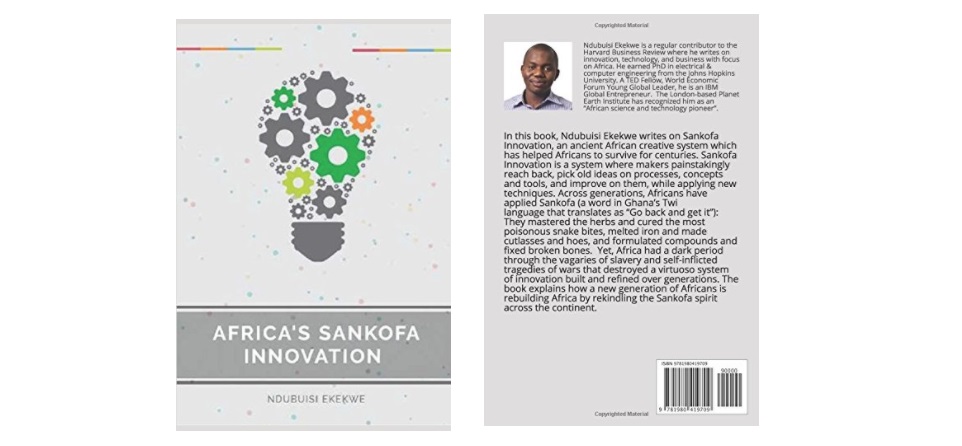
Amazon sent payment and I could not believe that people are actually buying my book. These are the direct links to get the book – Africa’s Sankofa Innovation – which is also available on Tekedia with our consolidated subscription.
The book, titled Africa’s Sankofa Innovation, examines many important issues on the African innovation ecosystem. It has 13 chapters broken into nine sections covering Systems, Makers, Opportunities, and more. Every chapter presents key issues from African perspectives drawn from African startups, entrepreneurs, businesses and communities.
The book requires a subscription of $20 per year. It is a living book and I will be updating it regularly. The version number is “current” because its contents will be regularly refreshed to cover technology, business, entrepreneurship, and other pertinent innovation elements, on Africa.
PayPal and bank transfer are supported. Just click the Subscribe Here button and you will be taken to a checkout. But if that is complicated, for Nigerian readers, you can send N7,000 to our bank account in Nigeria (account numbers provided here). Once done, send your email and name to tekedia@fasmicro.com, my team will create an account and send you a password to access the portal.
The best pay raise in a job is the starting salary. If you miss it, you would be out for long. That starting salary becomes the basis upon which the 5% or whatever will be built upon in later years.
In Nigeria, especially in banking, there is nothing like pay raise – everyone in the same level earns the same basic salary. The difference is function-related; for example, an IT staff can use overtime and night-shifts to add extra 25% of income above counterparts at the same level. But that does not remove the fact that everyone at the same level is earning the same basic wage. In a case like that, the focus moves from the money to the level since it is the level that will determine the pay.
But in U.S., there is nothing like “equitable wage” among peers in many companies. There, it is about what you can get through negotiations under many scenarios. You can be earning more than your boss! Yes, that “boss” there is just like a coordinating manager. In some design teams, there is a manager who has the big picture of a product. He now gives out part of the units to different sub-teams/people to design. In electronics firms, the instruction is simple: this is the input you are getting; this is the output we expect from you. Just by doing that, 600 people in 10 locations can be working on one product. That manager ensures the whole handshakes and interfaces are in order. Within that unit, there could be a genius power design engineer who could be earning more than his boss. So, it is really irrelevant who you report to as in America when it comes to money, everything becomes very opaque.
Yes, it is very common. People earn more than those two levels ahead of them. Personally, I noticed while in the industry that I was earning more than a lady who was a level ahead of me. It could be demoralizing but that is America. Capitalism is not fairlism – crazy things happen.
When I saw that, I knew this game was really about negotiation than waiting for one nice man to help you. You can be working, and no one will care to bump up the money!
My Case Study
I needed to add more benjamins (US dollars) and the only way was to earn more. I went to my boss who was obviously earning more than me and asked:
“[His name]. I do want to earn $abc [the amount]; what do I have to do to achieve that before the beginning of the next financial year?” We had a conversation and he asked me to put a small proposal on what I could offer the company for the money I was asking for. I went home, and that evening I built a matrix, expanding my role and assuming more responsibilities. The next day, I presented it to him. He approved the raise.
A week later, a colleague complained how he could not get a simple raise. He explained he dropped a number but it was ignored.
I knew despite all, my strategy was better – I was not blatantly pushing for more money; I made a case that the company could get more productivity from me, first. Then, afterwards, if I execute as promised, I would be rewarded.
Every expects the numbers to keep rising. But it is not automatic
Lesson
When you want to ask for a raise, do not just put a hard number out. It is better to think along the line of John F. Kennedy, former American president: “ask not what your country can do for you, ask what you can do for your country.”
Yes, ask what you can do for the firm besides the expected monetary numbers you are asking. It takes away the perceived greed, coded selfishness and guilt we feel when asking for raises.
It is always good to ask for more money when joining – though that does not typically apply in Nigeria where most jobs are in buckets of levels, making raise not possible. In Nigeria, you negotiate for level, not monetary terms since the money is tied to the level. It is hopeless to ask for more money when a level has been settled since the level and the pay are correlated.
But in U.S., you can keep the same job title for 35 years but could have received pay raises more than 20 times. It is a crazy system I must confess. In Intel, a global semiconductor giant, the number of levels between an entry level engineer and the CEO could be 5 levels. They have designed a flat organization where the phrase “job title” is not close to whatever you see on LinkedIn.
Understand the economy you work – in Nigeria, we are not in the employee market. So, be guided as you ask for raise. It is possible your company has not made profit for a year. So, be very smart over it. Some men and women in our system can frown and that would not be a good outcome. But when you see huge growth and expansion, if the boss has forgotten, find a way to try the model: I want this, what can I do more to earn it.
When I wrote last year that MTN Nigeria had made a profit of more than $28 billion since it started operations in Nigeria, many in the community said it was impossible.
2. Total tax MTN Nigeria has paid
MTN has said it’s paid out over two trillion naira ($5.5 billion at today’s rates) in taxes to the federal government since it began operating in Nigeria.
Insights
My numbers might have been low. If you take at least 10% as tax (VAT, corporate tax, etc) on total revenue, it is possible to assume that the $5.5 billion tax had come from $55 billion in profit. Of course, Nigerian corporate income tax is about 30% and that means if you do direct extrapolation, MTN Nigeria might have made a profit in excess of my original $28 billion – yes, excess of at least $100 billion.
Resident companies are liable to CIT on their worldwide income while non-residents are subject to CIT on their Nigeria-source income.
The CIT rate is 30%, assessed on a preceding year basis (i.e. tax is charged on profits for the accounting year ending in the year preceding assessment).
This explains one thing – Nigeria is a very great market. But you need to crack that Nigeria Inc. Vodafone had the opportunity but passed it under the whole premise that Nigeria was a risky market. But here, MTN Nigeria has made billions of dollars in the market Vodafone passed.
Nigerian officials like to tell a story about the telecoms revolution that began in Nigeria in 2001. It involves how Vodafone, the British telecoms giant, had been offered the chance to enter Nigeria’s nascent market on the cheap. The mobile phone company considered Nigeria a risk not worth taking and passed on the opportunity. In the end, MTN, a younger, smaller rival from South Africa, and a couple of other operators took a chance on the country in an auction where they each paid $285m for a license.
Please note that this has nothing to do with the sentiment against MTN Nigeria with all the crazy fines and penalties. I have noted that Nigeria should be fair to this company. My note here is to make a case why Nigeria should be recognized as a place where foreign and local investors should explore. MTN Nigeria numbers are the best publicly available to make that case.
Most times we simply think we can only do innovation via technology. Interestingly, where R&D is very limited, because of limited funding, we do not need to spend limited resources to pioneer new technological and scientific breakthroughs. There are many opportunities to build great firms, in Africa, by innovating on business models. Yes, you just apply new business models on existing matured technologies from the Western and Asian worlds in Africa.
As you work hard to make your products better and improve your processes, do not forget that business model could be as catalytic. Yes, business model innovation is one of the most overlooked areas by startups in Nigeria despite the fact that the right model could help you thrive.
I did note in this Harvard Business Review article that thriving in business goes beyond engineering and technical superiority. Yes, there are many other elements like branding and marketing which must work in a symphonic way to deliver value at scale. This follows my point that business is not just about who can create the most sophisticated technology in the world: “Rather, it is about fixing the frictions which exist in markets.”
In the tech startup world, technology is important for success, but it does not disproportionately determine winners and losers. Two companies can invent similar technologies; one will win and the other will lose. Focusing on technology supremacy alone is a model for failure. Over the years, I have consistently seen what I call “latent factors” — business features that are generally outside the scope of the core tech team — to be real factors in a company’s success.
Writing in Quartz, Andrew Alli made a similar point: we can innovate not just from technology but via business models. He used the mobile telephony innovation in Africa to explain his points. The African telecom entrepreneurs did not invent GSM and CDMA technologies; they simply built new business models which used those technologies to deliver better values to customers.
These entrepreneurs didn’t invent cellular technology. Rather they combined their understanding of the market and the African consumer, with Western cellular technology and improvements in computing processing power and software to develop and adopt the “prepaid telecom business model” turning mobile technology from the preserve of the rich who could afford to be billed for their usage after the fact into a mass market product accessible by anyone with some amount of buying power. Massive wealth generation in non-rent extractive industries generally indicates that massive positive economic value is being created, and this was, and is, the case with the mobile telecoms industry in Africa. Business model innovation is perhaps the most important but unsung type of innovation available to Africans. It allows us to borrow innovation that might have cost hundreds of millions of dollars over long time spans to develop, and combine and adapt them to solve uniquely African problems in a way that achieves what Silicon Valley investors call product market fit. This is corporate nirvana if you can achieve it.
This paradigm thinking of inventing at business model is very important in Africa as we continue to struggle on creating systems which can engineer solid R&D in science and technology.
If you are looking for a job, do not expect companies to change their rules to accommodate you. The #1 rule in Nigeria today is that grades matter in the sectors most would like to work – oil & gas, telecoms, banking & tech startups. The top 10% of any graduating class will desire to be in those sectors as first options. Simply, in these sectors, good grades are key.
I understand the narrative that America does not look for grades. Rather, they focus on capabilities. Yes, that is true because America’s economy is so huge that there are many things which may not require grades or simply university education. In that case, the grade the company requires is GED (WAEC equivalent) – yes, that is still a grade, as if you do not have it, you would be out of luck in America, on many things. In some states, this GED is compulsory – if you are not in school until the 16th birthday, your parents could be jailed! So, depending on how you look at it, U.S. does follow certificates.
Now, on the university one – the main certificate – U.S. does require good ones when absolutely necessary. I can bet you that a Harvard degree will set up better in life than a degree from an unranked school even when the kid who attended the unranked school may be more talented. If you do the average, you will notice that Harvard graduates achieve more in life than graduates of unranked schools. That does not mean that a kid who graduated from an unranked school cannot find success.
It is the same logic when people say that Mark Zuckerberg dropped out and yet built the Facebook empire. They forget that out of every 1000 dropouts, there may be only 10 successes. But when you take students who stayed in school, the average improves up to 500. It is that average that matters, and not the specificities of individual cases, for counselors.
Despite the exciting stories of Mark and Bill Gates, another dropout, the world has been built by those who stayed in school. The co-founder of Intel Corp, Gordon Moore, has PhD. The founder of Qualcomm was a professor. That they went to school should not be lost on the worship of dropouts. Across all nexus, the game favours people who graduated to thrive in life. Plus, getting a teaching job depends largely on where you graduated. Some of the best jobs on Wall Street are for Ivy League graduates.
When former U.S. President George Bush nominated Harriet Miers for the Supreme Court, many U.S. Senators did not like the idea. Some complained that she went to Methodist Law School – a mid-tier school. The problem was not her skills, but the school she attended. They later got an Ivy League graduate (a graduate of Princeton) and they smiled to confirmation. Today, the present AG Jeff Sessions is despised in some circles because he has no Ivy League education.
Simply, if you have the opportunities in this world to get good grades and better certificates, get them. Stop the illusion – every country does the same thing in different ways. There is a need to sieve through many applicants, and increasingly more continue to use grades and certificates as instruments.
Unless you can invent an alternative system, the propensity to hire an A student will always be higher than an F student who may turn out better. The problem is that the F student has already lost before the action began. He failed on something – yes, he got F. Why would you expect the next thing – the job – to have a different outcome? That is why many will run away, and go for the person already doing well. It is the path of lesser friction.
It is simple logic and no company will change the rules for you if you think you can lazily graduate with poor grades [I have always maintained that poor grades are not killers but the processes that lead to them. If someone got a poor grade after doing his/her best, he/she will be fine in this world. Yes, despite failing the exam, that process will lead to a better life on something else. The problem arises when bad processes result to poor grades, and the individual does not want to fix the bad processes].
In this world, Victory has relations; Vanquish is an orphan. That means employers will always congregate around victorious graduates with good grades. Never expect that rule to change for you.