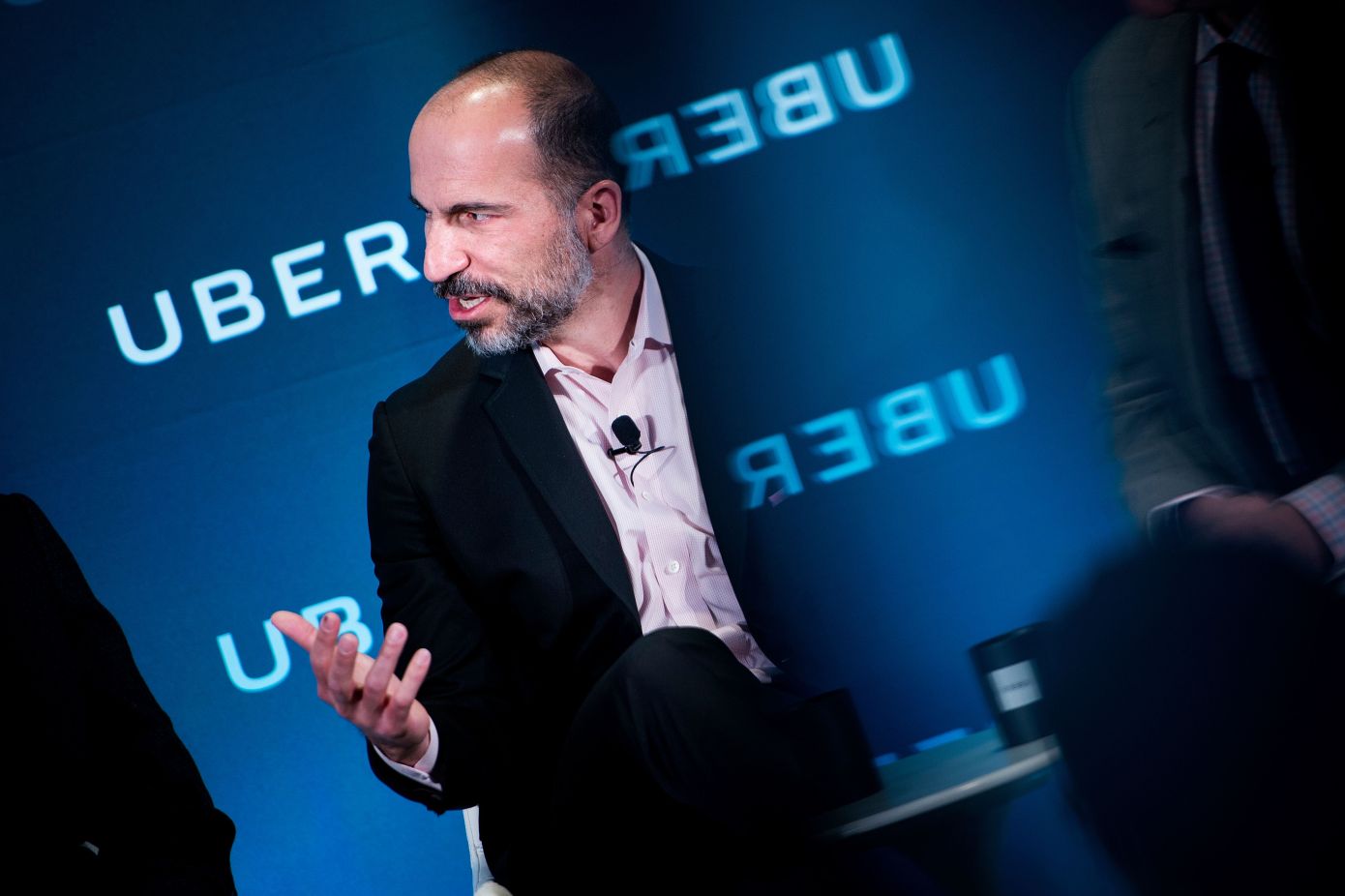
Dara Khosrowshahi, CEO of Uber, speaks during an event at the Uber DC Green-light Hub April 11, 2018 in Washington, DC. / AFP PHOTO / Brendan Smialowski (Photo credit should read BRENDAN SMIALOWSKI/AFP/Getty Images)
Uber is the category-king ride-hailing business in North America. It makes more money than all the competitors in North America combined. But Uber made a very poor strategic decision many years ago: getting into self-driving business. Sure, Uber’s major cost element is drivers, and removing drivers will improve its margins. But that argument does not account for the fact that Uber is not the right company to bring to fruition the generation-shaping technology leap of autonomous vehicles. Simply, Uber is a cash-poor company to fund and develop self-driving cars.
Uber sunk between $125 million and $200 million per quarter into the division over the past 18 months, amounting to 15% to 30% of its quarterly losses. The company, which is gearing up to go public in 2019, revealed that it lost $404 million in the second quarter. (Quartz Newsletter)
The best thing for Uber is to continue to grow its community, as a leading aggregator, making sure that anyone that has self-driving cars will call Uber first before any other person because it has the user numbers. Self-driving cars will need platforms to work: Uber has the largest users in its core North American markets. Besides, there is nothing that says that Uber cannot buy these cars from the makers. Making cars, especially the ones many ride on Uber, is a commoditized business where margins are hard to get. Financially, it may be cheaper for Uber to order them in bulk than making them itself.
Google can fund a self-driving business; it has the ad business, the best in the world, which generates free cash. Apple can get into that business; it enjoys great margins on its iPhone business. But Uber is technically a startup and cannot afford decade-long investment to develop autonomous vehicles.
That distraction of self-driving cars has cost the company in many ways. Without the money-losing self-driving unit, Uber would have competed better in China and other markets it lost. There is no reason to continue to sink that cash into something that does not have much strategic value. Yes, Uber should sell that unit, invest more in its core business of connecting users and drivers, and strike strategic partnerships with Google, Tesla, GM and others, waiting for them to make these self-driving cars. Because it has the largest platforms, these entities will gladly consider Uber whenever the time arrives. And even if they do not, Uber buying in bulk will not feel the pains that it did not make the cars in-house.
It is about returning to the edges of the Smiling Curve.
And when you are there, remembering that under the nexus of Aggregation Construct, value comes when you do not have to do the hard work by yourself.
What is your next frontier? How do you get there? I explain in this video.
I called this video today after someone shared a very positive feedback after watching it. Do not be tired watching it – it provides core elements of advancing business and personal missions.
One of my Abuja clients is scaling across Africa. The firm, in financial services, will need a Chief Financial Officer (CFO) and Head, Human Resources. The request came to our practice few days ago and team is finalizing the elements. By Monday, the application link will go live.
For those in the community looking for job, this could be a good one. Update your profile and resume. Besides, there are some entry level jobs (full time) in business development and marketing.
For the CFO, we would be looking for accountants with demonstrated capabilities in understanding the elemental components of commerce that can affect forex. My client has currency exposure via international trade especially in Asia.
How can a decision made today help you save money in six months? This is not going to be a bookkeeping job! We want accounting engineers with awareness of political economy and international market dynamics which move currency at scale. If you cannot model the future and create it, it is evident you cannot predict it. That is why I prefer Accounting Engineers: people that can predict the future of firms by financially modeling and creating that future.
Mass-distributed solar energy business has a promising future in Nigeria. I want to let our readers understand that the MAP (Meter Asset Provider) policy of the Federal Government is a big deal in accelerating investment opportunities in that space. By allowing mini-entrepreneurs to have access to the metering component of energy distribution, government has fixed one of the biggest challenges in scaling solar business. Possibly, startups can power Nigeria in near future!
For many quarters, I have noted that agriculture is a very solid investment opportunity in Nigeria. It remains because our farming systems are still at infancy. I provided 30 solid business ideas to readers of my daily blog Tekedia here with a video that explained how they could unlock some of the opportunities. But agriculture needs a break even as we need more investments in that sector.
There are many opportunities in the Nigerian (and indeed African) agriculture sector for entrepreneurs to unlock, starting from the traditional agro-businesses to the evolving agricultural technology (agtech) businesses. We have listed some of the ideas in this piece where we noted that agriculture could be on its way to $1 trillion cumulative revenue in Africa within seven years. Agriculture employs more than 65% of Africa’s working population, making it a very important part of our economy. It presents immense opportunities because the sector is still at infancy, and can only grow looking at the renewed efforts by investors, entrepreneurs, farmers and governments to deepen African competitiveness through agricultural production and processing.
I have also noted that the biggest idea in telecom right now in Nigeria is pioneering contract-based billing at scale to deal with the challenges of revenue loss and erosion. It is going to be very hard in a country with limited data, but good for the telcos, they have the biometric records of mobile subscribers. Anyone that can create that system in the age of Skype, WhatsApp and Google Station will have a great business with many telecom companies across Africa.
In a piece yesterday, I wrote that Nigerian telcos should build contract- subscription-based billing system to overcome the challenges of WhatsApp and other OTT solutions. Simply, if the user had paid a fee, under a monthly plan, the telco would become ambivalent to whatever the user is doing with his or her phone. That way, the telco would preserve its ARPU (average revenue per user). This is the idea as noted, and I do think entrepreneurs can make it happen, not the telcos themselves.
Today, I am calling that solar energy, distributed for the mass market, is entering a new phase. The government has removed one of the biggest hurdles in the industry: metering paralysis. Yes, the installation of meters is no more the exclusivity of distribution companies (DISCOs). This means that any solar entrepreneur can power a village or community without having anything to do with DISCO. In the past, that was not possible because after the generation of power, the entrepreneur must still find a way to negotiate contract with the local DISCO. Of course no entrepreneur has any chance of coming out of that contract well because DISCOs know that they have all the aces. That has changed, for good.
The DISCOs are concerned because if these entrepreneurs have access to meters, DISCOs as we know them have been completely disintermediated. The reason DISCOs are relevant today in some places is because third parties cannot install meters. But with MAP, that has been fixed, making it easier that anyone can produce, transmit and distribute power in communities. And by the time the entrepreneurs are done, DISCOs will have no business.
The energy sector is a $6 trillion per year business. Over the last four decades, the cost of solar panel materials has dropped 250x as a result of innovations in materials science, according to Singularity University. Shell predicts that peak oil demand will arrive sometime between 2021 and 2029. Simply, we will still have fossil but photons and electrons will be the future of energy.
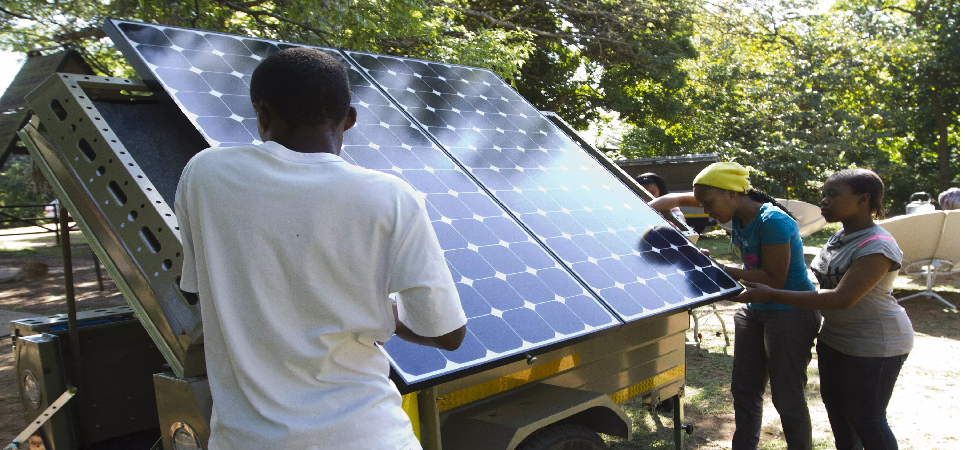
Solar installation
Current Solar Business Models
The following are the major models for solar power business which you can adopt. I have also provided practical cases if you click.
Sell solar product to customers: Here, the customers buy the products, and own them. This scares some customers because despite not having to find money to buy the solutions, they have to handle the maintenance element which includes seasonal change of batteries, solar panels etc. Owing to that decision inertia, many have not become solar believers. In this model, the customer is investing in the equipment. Two cost elements are noticeable
Initial equipment cost
Maintenance cost throughout product life
Hire purchase: In this model, customers receive the solar equipment with options to make payments via installment plan. At the end of the installment plan, the customer owns the solution. The entrepreneur may increase the product cost to cover the extended payment plan. One challenge with this model is that the customer is investing in the equipment and not just focusing on getting the electricity. Two cost elements are noticeable
Installment payment for equipment
Product maintenance cost post-payment (usually the maintenance happens after the payment plan has been completed)
Lease 1: Here, customers are never given the option to ever own the equipment. The solution is leased to them and the cost of the electricity consumed is also charged to them.
The customer pays for the equipment but with no intention of ever using it (this is similar to a U.S. home broadband company renting the modem which the customer pays monthly. But the day the service is cancelled, the customer must return the equipment to avoid being billed the product full price)
The cost of electricity consumed is charged to the customer.
Lease 2: Here, customers are never given the option to ever own the equipment. The solution is leased to them but no cost of the electricity consumed is charged to them. The cost of electricity is included in the equipment lease amount
The customer pays for the equipment but with no intention of ever using it (this is similar to a U.S. home broadband company renting the modem which the customer pays monthly. But the day the service is cancelled, the customer must return the equipment to avoid being billed the product full price)
Energy-as-a-Service: A potential winning model that can scale massively could be delivering electricity to customers, with no requirements for them to buy equipment. They pay for what they have consumed and the company owns all its equipment. You may need to get a contract where the customer must commit to use the solution under defined Key Performance Indicators. Once the customer signs, you take your equipment and install in the customer residence, at no cost to the customer. You make money by billing for electricity consumed. With this, the customer does not have to invest in any equipment. Also, risks move to the entrepreneur who is now incentivized to make sure the equipment works, as without it working, there will not be any electricity to bill the customer. Yes, all maintenance costs are not concerns of the customers.
I sent this email to a commissioner of agriculture in a Nigerian state. Please forward it to your state commissioner or better His Excellency. If you do, please get back to us: we have something really exciting for you. The contact came from a present client.
Dear Sir,
Greetings! I am writing to explain that we have a comprehensive agro-solution which provides services in all the key areas of crop farming. Our solutions are designed to support farmers to improve farm productivity and most importantly become business-people. Here are some features:
Zenvus Boundary: Zenvus Boundary enables the mapping of farms while helping governments to easily verify ownership of farms and farmlands via search. With Zenvus Boundary, if two people register one land as belonging to them, the system will automatically trigger a flag. With our technology, your state can easily search owners of farmlands on our public search which helps banks, insurers, governments etc to ascertain farmland control. This helps banks make loans to farmers as they can authenticate control fast.
Zenvus Services: Zenvus Services provide farm diary, digital platforms to sell items, farm insurance solutions, farm capital, city-level pricing information and even the ability for farmers to raise money from neighbors in exchange for produce in farms. We would help your state farmers and businesspeople expand markets, deepen services and advance the state.
Zenvus sensors: We have the most advanced small-scale precision sensors in African agriculture, making it easier for farmers to make decisions based on farm needs.
Zenvus Fusion: This solution is designed to help governments map soil nutrition across farmlands and make that information freely available to farmers. The goal is to make it possible to apply the right fertilizers. Your state can build the soil geography of the state just as U.S. has. That will help farmers advance the state’s agricultural mission.
We would be honored for the opportunity to work with the state. Our solutions provide jobs for the youth even when improving local economy and general wellbeing. We would treasure an opportunity to present before you and His Excellency.
As always, on behalf of your fellow citizens, we thank you for serving our Nation.