DD
MM
YYYY

PAGES

DD
MM
YYYY

spot_img

PAGES

Home Blog Page 7105

Thank You Nigeria

1
Thank you Nigeria
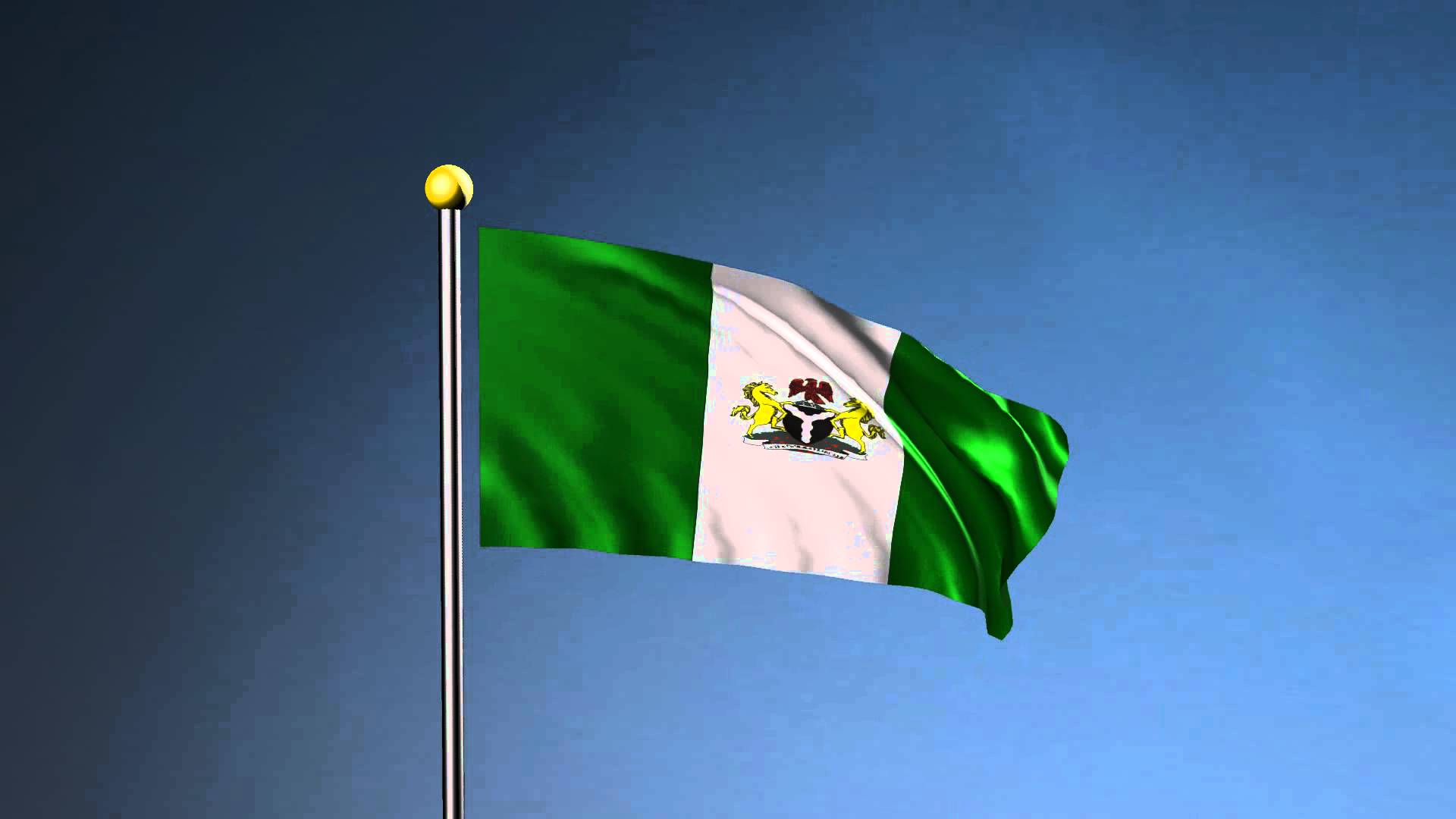
Nigerian flag

Few hours ago, we received an email from one of the leading agencies in the Federal Ministry of Health that they would like to work with us on Medcera. Our Community Manager reached out asking what to do. Quickly, I told her the only response was Big Acceptance. Yes, we are honored that the agency reached out. But to avoid bureaucracy we would streamline the interface to make sure everyone gets value from the partnership. Our vision is to help fix a major friction in the healthcare system in Nigeria: disparate data resulting to poor patient outcomes.

Getting support from government in Nigeria is not very complicated if you understand Nigeria. Yes, our leaders are looking for help in some key areas. If you can help, they would come with support. I have made videos and wrote about this in my book – Africa’s Sankofa Innovation. Watch the videos, and read the piece. Ideally, government is majorly about policy; it is only through markets it can execute. If you position to attack those forgotten areas where they have real pains, they would call.

I can tell you that the focus has been qualifying partners over the last few days to support in Liberia, Namibia, Botswana, Ghana, Sierra Leone, Nigeria, etc [apply here]. They are coming and we are working with these businesses to strengthen execution models across markets. We have not even started government aspect of business development. I am happy they have noticed our vision: we welcome and ready to work together.

Thank You Nigeria, as always.


Africa’s Most Fearsome Fintech Competitor

0
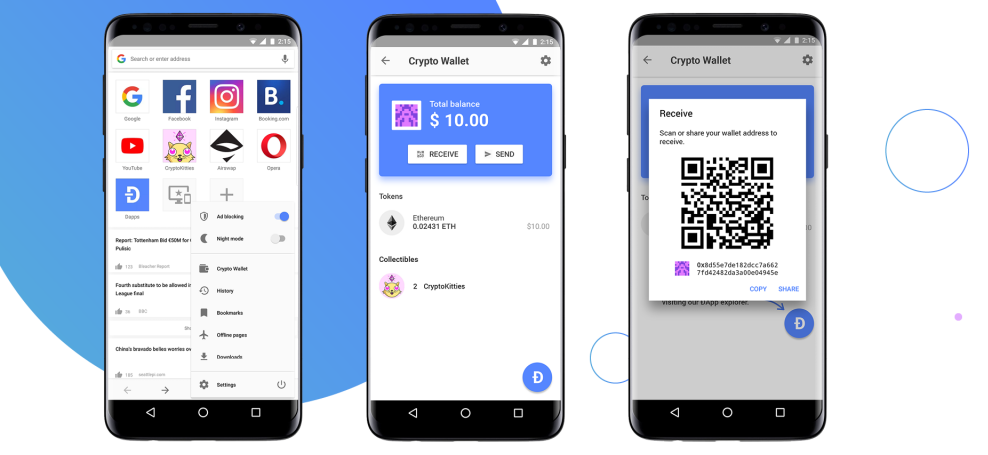
opera crypto wallet. opera payment

I delivered a presentation to a South African client today via video. It is a fintech company, and I was tasked to offer the state of the fintech industry in Africa. Everything went fine (no tension) until I went into latent competitions of the near future. We examined them across different nexus. One is really fearsome.

Yes, one of the major latent future competitors is not really the fintechs getting licenses from the Reserve Bank and its agencies (like Central Bank in Nigeria and units). Rather, the biggest threat on the web payment is OPERA for the firm and most African fintech firms.

(USSD, mobile money and things like MPESA are not popular in South Africa. Typically, areas with pre-existing fairly mature infrastructure do not need such “leapfrogging” as what was available is just good enough for people to bother. That explains why no one would pay huge attention to MPESA in U.S., Germany and Canada.)

Opera’s strategy is brilliant for the firm, but it will put it in the crosshairs of many local companies. As more Africans use Opera, most local companies can experience erosion in their brands. Yet, it is also possible that Opera can move in the path of aggregation where it can make it easier to find leading payment, ecommerce and other partners through its browser. But no matter what happens, I do expect massive dislocation as Opera becomes a platform with commercial activities happening at the level of browser. It will be very interesting: Opera needs a business model to make money.

Opera is evolving as a web operating system in Africa. This company has a promise to automate out the need for most financial services to go beyond a browser. Why launch a web app for payment when that is available right in the browser? Yes, if your browser can enable you to make that payment, there is no need of visiting a fintech website to do so. And when you notice that Opera is really popular in Africa, you get the picture why this company can redesign the sector.

Across the continent, the trajectory is that Opera will build platforms with capabilities to abstract away most internet services at the level of its browser. My thinking is that Opera will increasingly make it easier for the bulk of its customer base to do more on its platform, thereby saving them more money in visiting the main Internet. Technically, your Internet can end in Opera because it will allow you do most things there. Simply, Opera is transmuting as an aggregator right at the browser level.

Because Opera is engineered to save you money when you browse, keeping you to its platforms makes a lot of sense. You do not have to visit websites where you spend too much mobile credit if you can get your news, games, financial services, etc delivered by Opera at the browser level [Opera technology minimizes the consumption of mobile credit]. It is investing $100 million in Africa to do just that.

Now, the company wants to add crypto-wallet at the browser level, enabling the transition to Web 3.0 and web decentralization at scale. If it enables that, it may be winning Web 3.0 payment even before it begins in Africa. This is why this company is at the payment forefront even though most refer to it as a browser.

In a first for the company, Opera is launching new browser software that has a built-in cryptocurrency wallet.

The browser maker said Wednesday that its “new version of the Opera browser for Android… combines easy-to-use crypto wallet functionality with support for the Ethereum Web3 API.” The browser is currently in private beta, which the company is now inviting new users to join.

This means users no longer have to open a new web browser or download a separate extension to send, receive and pay in cryptocurrency – now they can do so directly from a toggle on their browsers on mobile Android devices.

It is an especially useful announcement for developers of decentralized web applications – more commonly known as dapps – given that the new browser functionality indicates users can now more easily interact with dapps being built on the ethereum network.

The Opera crypto wallet and general payment tool would be the grand-king of the consolidation of payment interfaces in Africa and could become ubiquitous that if you are not in it, you may be hidden in the “dark web” of African web payment. That is a threat to anyone doing fintech/payment in the continent.

Business Lessons From Croatia’s Football Call To Mission

0
Croatia team

Croatia is a very small country. It is a country of about 4.2 million people (think of Greater Ikeja in Lagos). Yet, it has booked a ticket to the Final of the World Cup. Its players and flag would grace almanacs across nations where football remains a religion and sports. What they have accomplished is mind-blowing. In the world of technology, it was like the young Google in late 1990s going after Yahoo on search. The difference here is that sports is an ephemeral endeavor with no gross margin. But make no mistake: there is nothing that endures in any generation like when legends make histories in sports. When I visited Greece for a conference, many knew Nigeria because of sports and specifically Nigeria’s 1994 World Cup squad.

The fascinating achievement of Croatia should teach us a big lesson in business: building and nurturing teams matter. Except Ivan Perišic (Inter) and Mario Mandžukic (Juventus), I did not know of any other player in the Croatian national squad before this competition. These men came to play, and with commitment and dedication, they have reached the zenith of their professions. The coaches brought them together and executed a mission.

From companies to nations, those that answer great missions typically shape everything. But sometimes they do pay severe personal penalties. At different levels, a Call to Mission requires extremely committed people. Even in your business, you must have that capacity to find and recruit people that can help you execute a great mission. You must prepare them. Equip them. And push them to come and get glory.

Go back to your business. Check how you can build a team with what you have. There may not be Ronaldo or Messi. But you have people. It works for nations across sectors and industries. America continues its mission of technological advancement. China is doing just that also. Croatia has shown that even in sports, a nation can pick 11 men from a population of 4.2 million to win at least a silver medal when some with excess of 100 million barely qualify. Simply, if people commit to something, they have a chance to achieve.

Croatia will play France on Sunday for the Gold; they would look good on the medal stage. They have done well and would possibly expand the number of countries that have won the World Cup. France had experienced that glory before; Croatia will want to complete this Mission. It would be good they do it, though I have predicted that France will win this.

New Road Safety Laws For All Commercial Vehicles

0
road safety

On May 24th, a Gaagaa bus collided with a tractor and a trailer carrying crates of beer in Kiryandongo district. 23 passengers were killed and 15 injured in the tragic accident. Unfortunately, the number of deaths caused by road traffic accidents is on the rise in Africa. In fact, the continent currently has the worst death rate for road traffic accidents in the entire world — almost 250% more than Europe. The Gaagaa bus accident quickly prompted the government to implement new measures to help tackle this grave problem.

New measures for road safety

A recent cabinet meeting at the State House in Entebbe gave the Ministry of Works and Transport the green light to implement a number of new measures with the goal of reducing the impact of road traffic accidents across Uganda. Frank Tumwebaze, Minister for Information, gave a statement explaining that drivers of commercial vehicles — including buses, passenger service vehicles, and goods-transporting trucks — are now required to install Road Speed Limiters (RSL’s). These devices are designed to limit the speed of the vehicle to a set number by controlling the fuel feed to the engine.

Mandatory licensing and refresher courses

The cabinet also announced all goods vehicles are now subject to mandatory licensing; they must fulfill certain regulatory requirements including inspection for road worthiness. Moreover, the drivers of commercial vehicles will also be required to undergo refresher courses at government-run automated driver test centers. Drivers who pass will be issued a graduated driving license, as well as undergo further routine refresher courses, training, and tests. “This system is intended to minimize human bias and to allow learner drivers to undergo rigorous testing to confirm their competences to drive before issuance of driving permits,” Tumwebaze also revealed in his statement.

Improvements on the past

These new safety measures come after a string of other unsuccessful past measures taken by the government to prevent road traffic accidents. Over a decade ago, most notably, the Ministry of Works and Transport introduced mandatory speed governors. These were meant to limit the speed of commercial vehicles on the road to below 80 km per hour, however, they weren’t well-enforced. In 2008, the measure was relaxed completely.

Road accidents are a serious issue all over the continent. Traffic accidents now kill more people than malaria in many African countries, such as, Ethiopia, Kenya, and Sudan. It’s hoped these new changes will go some way in reducing road carnage and bring these shocking statistics down.

Nigeria’s Press Mistake to “Actively” Support Google’s Next Billion Users Plan

0

LinkedIn Summary: The Vice President is doing a great job in his U.S. tour, making a case that Nigeria is open for tech business and investment. We need that; I am a fan.

But his press secretary is getting carried away after Mr. Vice President met Google CEO this week. Today’s press release was a mistake: “Buhari administration would be actively supporting Google’s Next Billion users”.

Nigerian government cannot “actively” work to support Google’s quest for the next billion users. Rather, Nigeria should get Google to help execute its ICT Strategy. If Google follows and assists, it could get its numbers to get another billion of users.

You cannot use a national asset to bless Google in this way [Google may not even care; it is a planet while Nigeria is just a country]. Yes, the same press secretary will never be generous to Nigerian companies like Remita, IrokoTV, etc in their visions for the next 1 million users.

Nigeria must support ALL but not anyone. I will not like to read how Nigeria will help Instagram to get 5 billion users. Rather, how Instagram will connect into Nigeria’s ICT Strategy and working on that get its 5 billion users.

I am confident that our National ICT Strategy would be given to Google, Facebook, etc. It is their jobs to see how they would adjust to execute their business models within it. Their strategic visions should not concern Nigeria.

Mr. Vice President, safe travels.


Our Vice President, Prof Yemi Osinbajo, met Google executives in California this week. He is touring America as part of the much needed branding of Nigeria to technology powers around the world.  Possibly, more people will know of Yaba tech cluster than those “I have money to send you” emails. He is doing great; I am a fan.

Nonetheless, they need to check the person who is writing the press releases. I have some kind words for him or her.

The press release today that Nigeria is committing to help Google in meeting its Next Billion users is out of order: “Buhari administration would be actively supporting Google’s Next Billion users”.

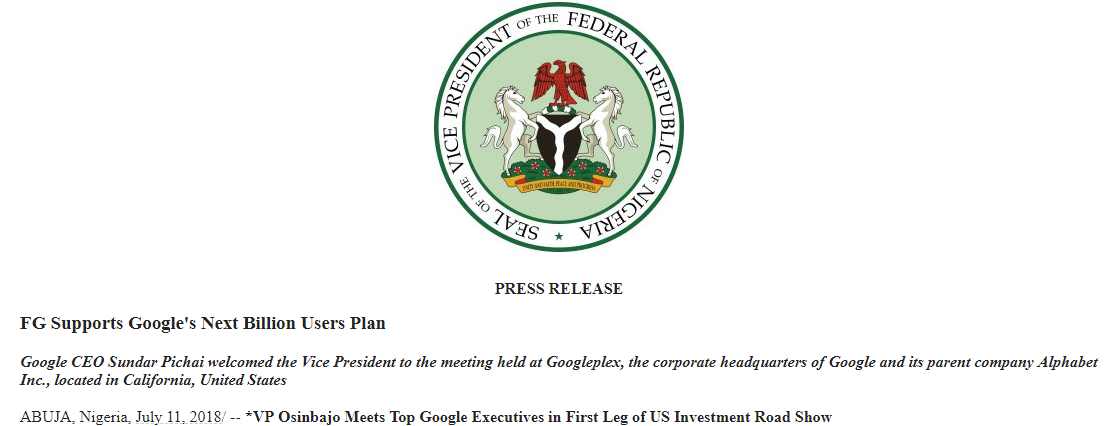
 In line with its Economic Recovery and Growth Plan, especially its strategy to diversify the economy by making technology an enabler for forex revenue earnings, the Buhari administration would be actively supporting Google’s Next Billion users plan intended to ensure greater digital access in Nigeria and around the world.

This will afford millions of Nigerians access to the Internet and particularly support content distribution.

Vice President Yemi Osinbajo, SAN, gave the assurance during a meeting with Google executives at the company’s corporate headquarters in the Silicon Valley at the start of the investment road show he is leading to San Francisco and Los Angeles.

Certainly, that is not what the Vice President is projecting as he travels the world. No nation should be seen working to help a (foreign) company in executing a business vision in this way.  Google should key into Nigeria’s ICT strategy and not the other way around. If Nigeria plans to be on auto-pilot on Google plan, we would cause problem as Facebook, MTN, Glo, and other technology companies will cry fouls.

Google has gotten its first billion users. It also got second billion users. …That it want another billion users should not be a national importance that Nigeria should “actively” support.

Google is doing great for Nigeria but Google will not fix the Nigeria technology space. It is a company built on aggregation, delivering marginal value to partners while it keeps most of the value.

Our Vice President possibly has the ICT plan from the Ministry of Communications. I know the Ministry of Science & Technology has its own version. They should share them, focusing on what Nigeria wants to do over what Google plans for the world. If Google wants to do whatever it has to do, it has to link into our national ICT strategy. We are a nation, Google is just a company. Let us borrow models from China where the nation sets its ICT plan and anyone that wants to do business there follows them. Possibly, through that plan, Google will get its next billion users.

Our nation must support ALL but not anyone. Google can get 100 million users from Nigeria because Nigeria’s ICT strategy has a plan to bring users online. But the essence is not to help Google next billion users.
Please, press writer take note. Do not tell us that Nigeria is going to help Instagram reach 3 billion users by next five years. Focus on Nigeria’s ICT strategy and what the nation offers to help any of these nations meet their strategic visions. Your statement today from a national government is unnecessary. I am not sure if you can send such on behalf of Remita, Zinox, etc which are our indigenous firms.

Mr. Vice President, thanks for the trip and continue to tell them that we have brilliant minds in Nigeria. We need capital in the land; safe travels.