
DD
MM
YYYY

PAGES

DD
MM
YYYY

spot_img

PAGES

Home Blog Page 7108

Towards Nigeria’s NairaCoin with Central Bank Support

0
NairaCoin, Bitcoin

Rwanda has executed a very fascinating vision and in line with my proposal for Nigeria to have a digital currency (NairaCoin or any other name) that is tied to the Naira and under the supervision of the Central Bank of Nigeria.  In Rwanda, I&M Bank has partnered with a Norwegian fintech company, Blockbonds, to launch a blockchain-based banking application called SPENN. SPENN does digitize national currencies and makes it possible for bank customers to perform different types of cost-free transactions. It has digitized the Rwanda currency, making the Rwandan Franc the first national currency to be digitized. It also means that mobile money may fade and being replaced with blockchain digitized currency depending on how this evolves.

 As I noted, my preference is for the government to create our own cryptocurrency, NairaCoin, and tie its value to the Naira. I have a reason for that.

In commercial contracts which need to be insured, most times, you need to put monetary figures on them. If you have a contract that is created on blockchain and quantified in Bitcoin, in Nigeria, for the supplies of items and your partner refuses to do its part, after you have paid, you have to go to court to seek help. I do think most Nigerian courts may note that the Nigerian law does not recognize Bitcoin to assess the true value of that contract. In short, your partner can even countersue that the contract is voidable. Technically, you will have two issues to deal with:

You have to prove to the court that blockchain contracts are legally enforceable in Nigeria. I know of a time when emails were not admissible in courts. And banks would not accept emailed instructions or mandates

Overcoming challenges like this is the reason why SPENN is a brilliant idea and why Nigeria needs to consider NairaCoin. NairaCoin would help Nigeria in its quest for a cashless society as it would eliminate all the transaction fees which are common in Nigerian banking.

Blockbonds together with I&M Bank Rwanda, yesterday officially announced the rollout of the first blockchain based platform, SPENN.

The platform is a mobile banking application that will enable Rwandans to make a range of financial transactions.

SPENN was developed by Blockbonds, a Norwegian financial technology company that is working to formally financially include the unbanked population which remains relatively high in the country.

The application allows smartphone users to transact and pay for goods and services.

Unlike many other blockchain technology platforms, SPENN uses a different model whereby it removes the need for cash by digitalising national currencies.

With Blockbonds partnering with I&M bank, it means that they are the first financial technology players to digitalise the Rwandan franc. It also means that people, regardless of whether they are customers of I&M, can now own a SPENN account.

All services through the platform are free.

The brilliance of SPENN is simply digitizing the national currency and turning into a blockchain system. With that, blockchain-based transactions and contracts can happen without the regulatory quagmire of if Bitcoin or any of the other currencies would survive or not. Yes, there is a high possibility that a new version of cryptocurrency could evolve just as Google came and knocked out Yahoo on search.

If that happens in cryptocurrency, would the presently stored Bitcoin valuable? That is the risk of denominating deals on these currencies, outside the government regulations, because I do believe that out of the more that 1,300 cryptocurrencies we have today, more than 90% would fade within a decade. A national currency, in my opinion, remains the safest way for any nation especially in the developing world to get this right. NairaCoin will do that for Nigeria.

NairaCoin for Agriculture

Also, I do believe that Nigerian agriculture will benefit from cryptocurrency if it is correlated with Naira. Besides the quest for financial inclusion and cashless society, most customers are watching the bank fees. So, it is very critical if the nation can advance financial inclusion and deepen cashless society through a system where financial transaction fees are free. Sure, government is part of the problem with the new 0.005% levy on financial transactions in Nigeria.

I want to see the youth earning NairaCoin through supporting farmers. Yes, when you plow or till the ground, you get paid via NairaCoin. That NairaCoin would be correlated with other major cryptocurrency in the world.

All Together

We need NairaCoin as I have noted many times. Yes, simply create a Nigerian cryptocurrency backed by the Central Bank of Nigeria so that Nigeria has its cryptocurrency (NairaCoin) which is tied to the Naira. That will make blockchain contracts more efficient. The NairaCoin will maintain exchange rates with Bitcoin and others, just as paper Naira has with U.S. Dollars and Euro, while making sure that the paper Naira and NairaCoin are always correlated. The impact could be huge and the adoption would redesign industrial sectors since the banking fees will disappear for customers. NairaCoin would not be mined; it would be earned just as the paper Naira. Workers could select to be paid in the digitized Naira. Government can pay youth who are supporting farmers in different extension services via NairaCoin.

Why MDAs, Private Firms Shun Nigeria’s ONSA Cybersecurity Solutions

0
ONSA, national security adviser

Few years ago when the Office of National Security Adviser (ONSA) embarked on its endeavor to invest on cybersecurity solutions with capabilities to support government ministries, departments, and agencies (MDAs) alongside private companies, many Nigerians were concerned. Many noted that it was a very big mistake for the ONSA to think that companies would send their confidential data to a quasi “spy agency”. Interestingly, it has turned out that MDAs do not even want to support the ONSA solutions. You can download the National Cybersecurity Policy & Strategy here [those are the final versions excluding the signature of the NSA; they had sent me some copies then].

Office of National Security Adviser (ONSA) has expressed concerns over lack of interest by government agencies and private organizations to use its robust cyber security infrastructure for monitoring and securing their digital networks against cyber-attacks, Nigeria CommunicationsWeek has learnt.

Bala Fakandu, deputy director, Office of National Security Adviser (ONSA), said that there are huge gaps between government agencies and private organizations capacity to handle cyber-attack, noting that ONSA has overwhelming information generated through its deployed infrastructure to monitor cyber- attacks in the country which are not being use by the people.

“We have found out that Agencies are scared of using our robust cyber security infrastructure to protect and monitor cyber-attacks because, they feel that we are going to use the opportunity to spy on them,” he said

When they were crafting this, many people received the drafts, and sent comments to the government. It was also during the same period that they embarked on acquiring one-solution-fits-all cybersecurity technology which caused problems then. The Nigerian government had “awarded” about $40 million but the Israeli supplier in a press release “erroneously” celebrated it won $10 million deal in Nigeria [they later deleted the press release]. The contracts continued with the government focusing on tools and solutions over human capabilities.

Many experts had explained that it was an extremely poor strategy for government to invest on security at the level they had conceived the project. Typically, governments invest on peripheral defense – that means securing the cyberspace of Nigeria over securing intra-data used by companies and individuals. It makes sense to secure nodes and gateways that connect Nigeria to the external world – only government has the capabilities to do that. But it would be sheer stupidity to expect a bank to join on the illusion that government can secure its customers. Even other government agencies would not necessarily commit because digital data is really the business. If the government has access to it, you cannot predict how far it could use it!

Unless government is spying, legally or otherwise, it typically does not look at customer data. But to offer some of the solutions ONSA has, the likelihood of access to data is there. So, as the Director noted, the observation should not come as a surprise: no one will give its digital door key to government to secure its business.

Simply, the Director said it all – “We have found out that Agencies are scared of using our robust cyber security infrastructure to protect and monitor cyber-attacks because, they feel that we are going to use the opportunity to spy on them”.

Lesson on Market Study:

This is what happens when you do not do market study. Had they done one, they would have noticed that no company would hire government to secure its data. They did not, and went ahead and invested huge money. As I note in this piece, governments are better on peripheral security, not helping firms on securing their customer data.

Different Revenue Models for your Business

0
Different Revenue Models for your Business

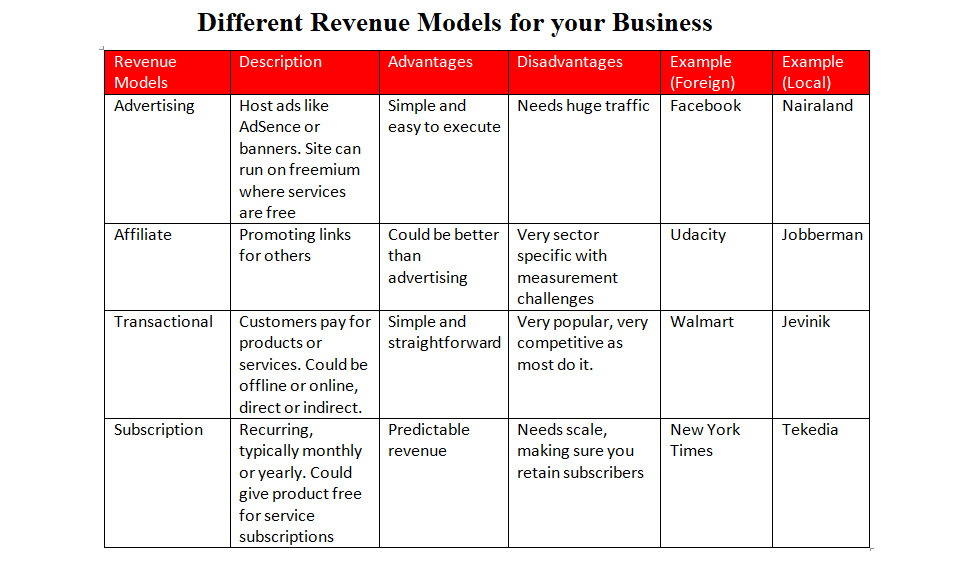
Business is really about margins, and revenue models anchor margins. You need to bring in revenue if you plan to be in existence for long. It is from revenue that profit would come. Without revenue, over an extended period, your mission would stall and the vision lost. In this table, I present some revenue models for your consideration. Your business strategy would drive the one to adopt and it is not cast on stone. Yes, you may pivot from one model to another until you hit the sweet spot where customers are happy: paying, spreading the message, and enjoying the value you have created.

Largely, we are in business for profit margin. It may not be obvious because there are many companies which operate for years without profitability, by raising tons of money, in successions. But even with that, over time, the companies will be expected to make money.

Always remember that when most startups talk of execution, they really mean revenue. Yes, sooner or later, all executions would be linked to revenue.

When you execute, you enable growth. Growth fixes all problems. Growth makes you a good presenter before the Board. Growth makes your grammar to become flawless. Growth brings respect as you stand before the investors. Growth makes legends. When you grow, you are moving. It means you have momentum. The bigger your size, and the rate of that growth, the more is the momentum [In Physics, momentum = mass x velocity; velocity is speed with direction]

Different Revenue Models for your Business
I have created this table from a piece on Founders Institute. There, they explained the revenue system, and how business model connects with revenue stream and revenue model.
  • A revenue stream is a company’s single source of revenue. A company can have zero or many revenue streams, depending on its size.

  • A revenue model is the strategy of managing a company’s revenue streams and the resources required for each revenue stream.

  • A business model is the structure comprised of all aspects of a company, including revenue model and revenue streams, and describes how they all work together.


Revenue Models Description Advantages Disadvantages Example (Foreign) Example

(Local)

Advertising Host ads like AdSence or banners. Site can run on freemium where services are free Simple and easy to execute Needs huge traffic Facebook


Nairaland
Affiliate Promoting links for others Could be better than advertising Very sector specific with measurement challenges Udacity Jobberman
Transactional Customers pay for products or services. Could be offline or online, direct or indirect. Simple and straightforward Very popular, very competitive as most do it. Walmart Jevinik
Subscription Recurring, typically monthly or yearly. Could give product free for service subscriptions Predictable revenue Needs scale, making sure you retain subscribers New York Times Tekedia

Nigerian Graduates, Go and Find a Job First!

0
Go and Find a Job!, Nigerian Graduates

Dear Nigerian Graduates,

Congratulations for your graduation; you have done well.

Today, I have some words for some of you on entrepreneurship. Yes, I have been getting some notes on one idea or another. You want to start a company and move to the mountain-top, immediately upon graduation. In America, they even drop out. But here, you have at least graduated. There is nothing that should stop you [you think].

As I have maintained, it is pure illusion to think you could find success as a fresh graduate in Nigeria in the entrepreneurial world [sure, that does not mean it cannot happen]. It is not really about you. It has to do with our system. Nigeria is not America where there are VCs that could mold young entrepreneurs into elite operators. Most of those founders you read have executive coaches who are like private teachers. Also, there is a different culture which makes execution easier when compared with Nigeria.

While you can hire people as you grow, it is very likely you would do most things at the beginning. So, it makes sense to learn how to do those things while working for another person.

Entrepreneurship is a high intensity call – it is not a vacation. Do not be deceived by Americans that dropped out of college to build empires. No one would tell you that most have “mini-teachers” or executive coaches helping them. And the VCs that pump those millions into them are super-mentors which could be like teachers. We do not have these elements yet in Nigeria. That is why working for at least 3 years would help your vision

Do not get me wrong. I understand that government wants everyone to go into entrepreneurship. It is the buzz thing around the world. But I can assure you that if you have the discipline to work for someone for say 2-3 years, you would find higher success.

Of course, where there is no job, my recommendation breaks. Here, I am assuming that you could actually find a job. To have top-grade skills, with confidence to open your shop, upon graduation, implies you have something people would pay for in Nigeria.

Being an entrepreneur is different from being a small business owner. While you can operate easily as a small business owner without prior work experience, becoming an entrepreneur would be challenging.

Today, I responded to a graduate who wanted suggestions with a simple answer that ended with “Go and Find a Job First!”. My point was driven from my personal experience. Profitability does not come easily in Nigeria – it has a long gestation period. During the period, if you have not carefully planned the voyage into business, you could have serious problems. Being a fresh Nigerian graduate complicates that process further. Besides, there are very few VCs and angel investors across Nigeria that would support any vision when the executor has zero working experience.

My Talk on America’s “New Byte Road” at Brussels Centre

0
New Byte Road

Yesterday, in Brussels, I spoke before founders/owners of mainly small and medium scale businesses, from across continental Europe, connecting what I have called America’s New Byte Road with African business opportunities.  My job was to present the evolving opportunities and challenges of doing business in Africa. During the talk, I examined the emerging growth sectors, and delved into how firms could unlock opportunities in them.

These businesses are small, by European standards, as they averaged about 10 million Euros on revenue. They see Africa as a growth region but are also concerned with the shifting policies, cyclical developmental indicators and our heterogeneous market structures which make scaling business visions more challenging.

Of course, the emerging backward regulations like penalizing bloggers and imposing excessive financial burdens, to use social media portals, in some countries like Zambia and Tanzania, are issues. From the breaking news on CNN to the commentaries on BBC, you have elements.

I handled those elements and presented key pillars and enablers which could help them, with specific insights per sector. When I gave a similar talk in 2016, in Brussels, there were 17 business-owners. So, it was progress that 79 came this year. Who knows we may need to run this as a TV show in 10 years! Go figure, good people.

Certainly, I was not there to be campaigning blindly to do business in Africa. I was there to call it the way it is. But in the midst of the paralysis, I offered roadmaps for opportunities. I believe that Africa is a frontier. Yes, the future can only get better in Africa.

Deepening my talk, I presented to them that despite the historical connection Europe has with Africa, Africa may be pulling away. I noted two key forces which are emerging – China’s New Silk Road and America’s New Byte Road; I made up the latter.

The New Silk Road is China’s commitment to broaden Africa as a major trading partner. The New Byte Road is America’s efforts to own Africa’s digital space through its world leading digital empires. I referred my audience to a recent piece I wrote in the Harvard Business Review. As it stands now, America is winning the bytes; China is running the show on atoms. Europe needs a strategy, for a space.

The unbounded and unconstrained nature of the internet has made it possible for competition to become global. Online, geography does not protect a company from competition. That unbounded competition is a challenge for local entrepreneurs. African consumers know about the best global products, and local ones are expected to match them on price and quality. The elite global technology firms typically offer better solutions at zero cost.

That is the paralysis we are seeing in telecommunications, in e-commerce, and across the broad ICT sector. When WhatsApp makes texting and calls free (in some cases with better quality), local telecom giants bleed cash. When Instagram provides an amazing gallery to display products, local newspapers struggle.

During the Questions & Answers section, the business-owners zeroed in on the digital trajectory in Africa. They certainly understand the power of the Internet. I used that moment to also explain that China and U.S. are ferociously fighting a “new war” I have called the New Knowledge War. The results are already out; the top 20 digital firms belong to either U.S. or China. These are empires upon which future digital systems would be anchored upon.

2018 Internet Trends – Top 20 Global Internet Firms; US 11, China 9

I spoke for 2 hours including the Q&A; the venue was Square Brussels Meeting Centre.

Meanwhile, I will be running a workshop in Lagos later this year on innovation. I would like to have you as a participant; register here.