DD
MM
YYYY

PAGES

DD
MM
YYYY

spot_img

PAGES

Home Blog Page 7112

Platform-Financial Services: This Will Make You Very Rich

0
platform financial services banks

I am in Brussels, the heart of Europe and would be working here all through the week. The event I am attending began yesterday. It is a carnival to examine innovation and build pillars and models for growth in Europe. When I checked into the hotel which the European Commission had booked for me, my name popped up: the associate said “Welcome, you are a regular”. Yes, I have been coming to this event and Europe did great, upgrading me from Business Class to First Class this time. Certainly, they do appreciate the value we are adding through Fasmicro Group (my company) and African Institution of Technology (my non-profit).

Today, we had a conversation with some of the leading European Banks. It was coming out of the open banking legislation in the United Kingdom. In my talk, I presented three core pillars (and product frameworks) for what I have called Platform-Banking Era. (I will not share that publicly, yet, as I have a talk coming up in South Africa with clients and would not want it to be boring to them. They need to hear me live first before the “declassification”).

Tomorrow, I will be speaking on the nature of work and the day after, I will talk on global technology. Most times, I present the fusion of global and Africa, helping those without African operations to understand how change is happening. For example, MPESA remains a mystery and WeChat confuses many bankers in Western hemisphere.

Banks Never Make a Cut

The future of consumer payment has been built in China. Yes, Alipay and WeChat have demonstrated that digital companies can build a payment system where no bank could get a cut of the action. That is just the beginning.

The future of consumer payments may not be designed in New York or London but in China. There, money flows mainly through a pair of digital ecosystems that blend social media, commerce and banking—all run by two of the world’s most valuable companies. That contrasts with the U.S., where numerous firms feast on fees from handling and processing payments. Western bankers and credit-card executives who travel to China keep returning with the same anxiety: Payments can happen cheaply and easily without them.

Even as Nigerian banks are falling over themselves to work with Visa and MasterCard, China has already moved past the era of cards. And I do think the future is going to be where no one would need a debit or credit card to do consumer transaction. Simply, banks would be the entry elements into the ecosystems and once the money is there, customers can move the money to their digital wallets from where they would pay for things. As they do that, there would not be a need to do anything with banks. If that happens, banks become dump pipelines just as telcos have become dump pipelines for Skype and WhatsApp. That would happen if the banks do not take actions. It happened in China, and many banks have paid heavily with erosion of value.
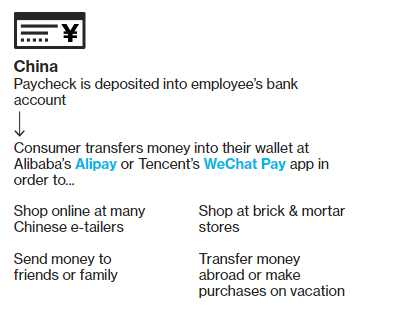
WeChat payment process (source: Bloomberg)

The interesting thing in WeChat and AliPay is that they are making it easier for users to stay longer in their ecosystems through different solutions, services and products they offer to customers. And if they do just that, the need for the typical banking fades. This is already causing major problems with some small Chinese banks where liquidity has become a challenge.

Specifically on that, the Chinese banking regulator has to request that the BAT( Baidu, Alibaba and Tencent) move funds from their wallets to their bank accounts within 72 hours as local banks were having liquidity issues [yes, that does not help local banks. It only helps the banks where the BAT bank].

Alipay and WeChat command 520 million and one billion monthly active users, respectively. Together, both moved $2.9 trillion in 2016. That number has been estimated to be excess of $3.5 trillion for 2017 [the companies do not disclose the numbers].

The Nigerian Opportunity

The payment system in Nigeria is anchored on our banks. That is expected as we are mirroring U.S. and Western Europe in our strategy. That is why every payment connects back to banks, from cheque, debit, credit (where available) and fintechs. For the fintechs, the systems are largely designed to tie directly to the banks. The implication is that it is still the banks. The element of abstraction and disintermediation is not real because our banks are still at the center of the hubs.

Breaking that hold on banking is where the opportunity lies. But it would not be easy. Anyone that does that in Nigeria would win it all. The Chinese experiment makes that very clear. Yes, I am not sure we hear of Chinese banks, but we know of WeChat and Alipay because these ecosystems are huge and growing.

In Africa, Facebook and Instagram are potential suspects if regulations would allow them. They are already working with Nigerian banks.

The banks are doing what they have to do: with Facebook Corp, there is no other alternative – you either fall in line or you go extinct. This is going to be the future of banking in Nigeria. No one goes to a bank in China; most go to WeChat to do banking. Facebook has a plan for that in Nigeria. The plan is now under execution.

Yet, besides the technology, one has to change the attitude of Nigerians. For this to work, Nigerians would be open to park their cash into apps from their bank accounts. That may not be easy; we are yet to become believers of digital ecosystems [blame Yahoo boys for that]. But where that happens, it means the digital ecosystems would use that money to lend, extending their powers over banking institutions.

Meanwhile, Chinese consumers are starting to park more of their savings with the apps. In 2013, Alipay began offering money-market accounts. By last year, it had built that business into the world’s largest money-market fund with about $243 billion. For banks, that’s yet another bite. They traditionally hold customer deposits and use that money to fund loans—generating significant profits. If U.S. consumers were to start storing their extra cash with apps, banks would have to find an alternate—probably more expensive—source of funding.

This Will Make You Very Rich

If you are looking for wealth online, do not look further: a platform like WeChat is what will deliver the glory. Just as MPESA in Kenya is trying to transmute its solution into an ecosystem, expect many Nigerian banking apps to have the same plans. GTBank (Nigeria) wants to do the same thing as noted in its grand strategy by the CEO. Yes, GTBank wants to meet your basic needs, not just the banking needs, digitally.

To  “create a platform and partner anybody who has a service to offer. So that if as a customer, one comes into our ecosystem, you can do just anything. You could do your banking business, buy your tickets, insurance, travel; if you wanted a 10-day pay day loan, you can do it. So, really we want you to come into our ecosystem, maybe five times a day to do different things other than banking.”

You would have to beat Mr. Segun Agbaje [very tough indeed] if you want to get the glory. But what needs to be done is very clear: banking will be part of social connections, and going forward, would not be measured by one-off transactions, at consumer level.
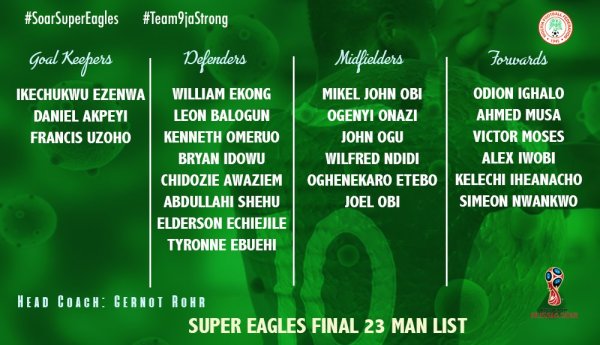

List of Nigeria’s 23-Man Squad to Russia 2018 World Cup

0
List of Nigeria's 23-Man Squad to Russia 2018 World Cup

The coach of the Super Eagles of Nigeria, Gernot Rohr, has released the names of the 23 men he has chosen to represent Nigeria in the Russia 2018 World Cup.

Goalkeepers: Ikechukwu Ezenwa (Enyimba), Daniel Akpeyi (Chippa United) and Francis Uzoho (Deportivo La Coruna).

Defenders: William Troost-Ekong (Bursaspor), Leon Balogun (Brighton and Hove Albion), Kenneth Omeruo (Kasimpasa), Bryan Idowu (Amkar Perm), Chidozie Awaziem (Nantes), Abdullahi Shehu (Bursaspor), Elderson Echiejile (Cercle Brugge) and Tyronne Ebuehi (Benfica).

Midfielders: John Obi Mikel (Tianjin Teda), Ogenyi Onazi (Trabzonspor), John Ogu (Hapoel Be’er Sheva), Wilfred Ndidi (Leicester City), Oghenekaro Etebo (Las Palmas) and Joel Obi (Torino).

Forwards: Odion Ighalo (Changchun Yatai), Ahmed Musa (CSKA Moscow), Victor Moses (Chelsea), Alex Iwobi (Arsenal), Kelechi Iheanacho (Leicester City) and Simeon Nwankwo (Crotone).

Nigeria is in the same group (D) with Croatia, Iceland and Argentina.

List of Nigeria’s 23-Man Squad to Russia 2018 World Cup


This is the value of MTN Nigeria

0

MTN Group is a South Africa-based category-king multinational mobile telecommunications company with presence in many African, Asian and European nations. It is a leading Africa brand, serving approximately 221.3 million people in 22 countries. Its vision is to deliver a bold, new digital world to its customers. MTN Nigeria is the leading mobile operator in Nigeria with approximately 54.5 million subscribers. According to reports, about 30% of MTN Group’s revenue comes from its Nigerian operation where it holds at least 35% of the market share. For financials of MTN Nigeria, I have analyzed them here: the company (i.e. MTN Nigeria) made either N81.4 billion or N248.3 billion in Q1 2018 depending if you believe the Group financial report published in the Johannesburg Stock Exchange or another report hosted by MTN.

What is the Value of MTN Nigeria?

As MTN Nigeria plans to list on the Nigerian Stock Exchange, investors would model how much the company is worth. I did try using available numbers in the past here.

Option A: I concluded that MTN Nigeria would be worth $4 billion (30% of the company would be $1.2 billion).

So, if MTN Nigeria should sell 30% of its value and MTN Ghana sells 38% and both generate $1 billion, I would see that as a discount. Let us assume that MTN Ghana brings in $300 million while MTN commands $700 million. Using that we can say that 30% of MTN Nigeria is $700 million. (Bloomberg noted $500 million for 30% though that was not the most current number on this).

But from 9Mobile sale price (not certain until it is done), I had modelled 30% of MTN Nigeria to command $1.2 billion. So, if they are going for $700 million, it means MTN Nigeria is coming at a big discount. If that is the case, investors would go for it.

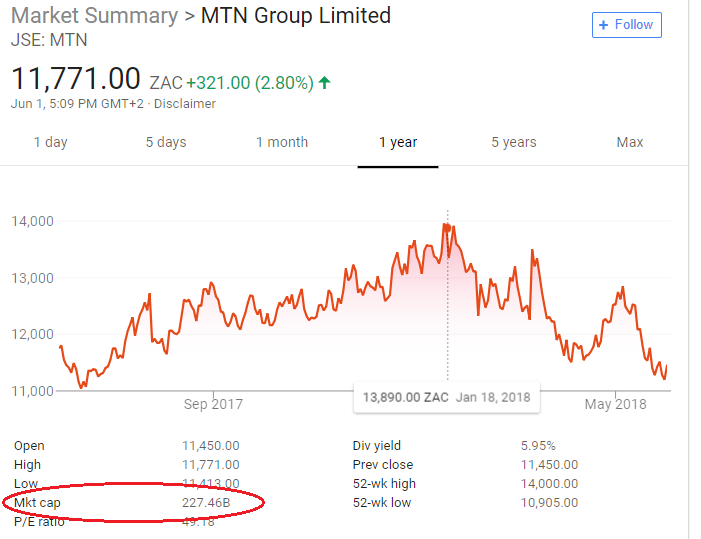
Option B: I used the market cap of MTN Group to arrive at the value of MTN Nigeria (MTN Group market value has lost value since the piece was published but it is insignificant to change the analysis).

About 33% of MTN Group revenue comes from Nigeria. Also, Nigeria commands more than 25% of its total subscriber base.  Largely, Nigeria is perhaps the most profitable market for MTN Group. If you take the subscriber base alone, you can put MTN Nigeria at a market cap of $4.25 billion (25% of the $17 billion). By the time taxes are taken, the value of MTN Nigeria can down as $4 billion.

MTN Group market cap, June 2018 (figures in Rand)

MTN Nigeria Value – Reuters

This piece from Reuters provides solid numbers on the value of MTN Nigeria: $5.23 billion.

MTN plans to list its Nigerian unit worth $5.23 billion by July in a debut IPO on the Lagos bourse and will raise fresh funds to reduce debt, according to pre-IPO presentation seen by Reuters.

[…]

MTN shares are currently traded over-the-counter in Nigeria at $13, giving it a market value of $5.23 billion, down from $25 billion in 2015 before a Nigerian government fine, sources said.

MTN Ghana – Updated

This is the most authentic data we can use since MTN Ghana had indeed filed the paperwork with the regulators. It is selling 35% of the business for $745 million. Certainly, the old reports are wrong since MTN cannot be seeking $1 billion from both Nigeria and Ghana, and Ghana is contributing already $745 million.

Through the Initial Public Offer, MTN Ghana seeks to raise about of GHS3.48 billion (over US$745 million) with each share sold at GHp75. The offer is expected to end on July 31 and possibly list on the Ghana Stock Exchange on September 5, 2018.

MTN Ghana on the 20th of April, 2018, received approval from regulatory bodies including the Securities and Exchange Commission (SEC), Ghana Stock Exchange (GSE) and the Ghana Investment Promotion Council (GIPC) to proceed with the 35 per cent IPO which forms part of MTN’s 4G LTE license requirement in which the company had to sell 35% of its shares to Ghanaians by June 2018.

MTN Nigeria Value

MTN Ghana has 17.8 million subscribers and commands a market share of 47.6%. MTN Nigeria has 54.5 million subscribers with a market share above 35%. Neglecting the market positioning and focusing on the subscriber base, 35% of MTN Nigeria should give 3.06x of the $745 million from Ghana (i.e. $2.3 billion). With this number, MTN Nigeria would be worth $6.57 billion. But since MTN Nigeria does not have the same market positioning as it has in Ghana (48% vs 35% market share), we would drop $1 billion from the number. That brings the market value of MTN Nigeria to be $5.57 billion. Post-IPO, that would give it about 13% of the total value of the Nigerian Stock Exchange, depending on the exchange rate you use.

A Roadmap for African Industrialization by Akinwumi Adesina

0
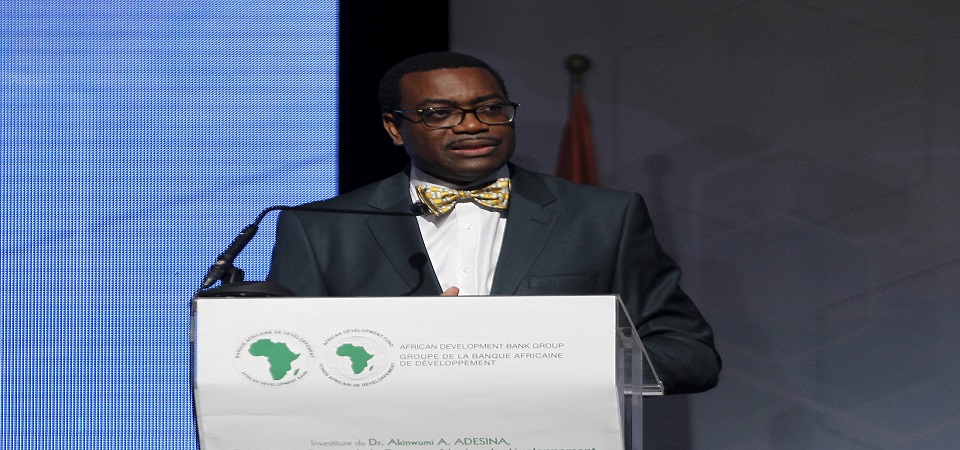
AfDB president Akinwumi Adesina
Akinwumi Adesina

Although Africa has recorded strong economic growth in recent years, and will continue to do so this year, its gains will remain fleeting until it undergoes a long-awaited transition away from commodity exports and toward manufacturing. That, in turn, will require leaders who are willing to put the economy before narrow political considerations.

ABIDJAN – Africa is at a crossroads. Six of the world’s ten fastest-growing economies are now located in the region, and the continent’s GDP is expected to grow at a rate of 4.1% this year, up from 3.6% in 2017.

Yet Africa’s economic growth has not been accompanied by a commensurate level of job creation, which has particularly negative implications for women and young people. In fact, today’s jobless growth could even reverse the gains made in eradicating poverty in recent years.

The problem is that Africa’s growth, while impressive, has been volatile, because it has been driven mainly by high commodity prices, rather than by manufacturing. The economic effects of this imbalance should not be underestimated. Among other things, it explains why a region that produces about 75% of the world’s cocoa accounts for just 5% of the nearly $100 billion annual chocolate market.

Despite its vast natural resources, Africa will remain at the mercy of commodity prices and trade flows until it undertakes a profound structural transformation. The time has come for Africa to unlock its true economic potential by following in the footsteps of every modern economy and undertaking the transition from agriculture to manufacturing.

Africa’s manufacturing sector is the weakest link in its ongoing integration into the global economy. Today, primary products (raw materials) comprise 62% of Africa’s total exports, the highest share in the world. At the same time, manufactured exports per capita in 2014 totaled just $218, which is among the lowest levels in the world, and far below other developing regions such as Asia ($883) and Latin America ($1,099). Clearly, Africa must start catching up.

Fortunately, there is already a global consensus that industrialization matters, and that it is in everyone’s interest for Africa to become the global manufacturing power it ought to be. With its “High 5 Agenda,” the African Development Bank (AfDB) has made industrialization a top priority. Likewise, industrialization is a key component of the African Union’s “Agenda 2063.” And, in 2016, the United Nations General Assembly declared 2016-2025 the “Third Industrial Development Decade for Africa.”

But such pronouncements are meaningless in the absence of concrete action. To change the region’s economic trajectory, African policymakers must focus on three key areas: industrial policies, infrastructure financing, and leadership.

We now know that industrial policies can be effective in boosting growth. The question is whether states possess the capacity to implement the policies they design. If they do, they can channel resources toward industry and marshal available technologies to create synergy between the agriculture and manufacturing sectors.

A number of African countries have already moved in this direction. Ethiopia, for example, has created special economic zones, where it has lowered production costs by investing in infrastructure. As a result, the country has emerged as Africa’s largest hub for textile manufacturing, attracting major players like H&M and Primark. Similarly, Rwanda’s Kigali Special Economic Zone, which exempts firms from taxes for ten years, has attracted a $20 million investment from Volkswagen for a new vehicle-assembly plant.

But industrialization cannot happen without power, roads, and railways, which is why infrastructure must be a key focus. As of now, the AfDB pegs Africa’s infrastructure gap at $130–170 billion per year. Closing it will require not just more financing, but also more innovative thinking, particularly concerning joint public-private efforts.

To that end, the AfDB has expanded its portfolio for financing new infrastructure projects in several countries. As part of our “New Deal on Energy for Africa,” we have scaled up investment in renewable energy and put $265 million toward developing two solar-power plants in Morocco. In Côte d’Ivoire, where demand for energy is surging by 8-9% annually, we are investing $60 million to bring a new 44-megawatt hydropower plant onstream.

African countries should make such investments now to reap the demographic dividend of the continent’s population bulge in the years ahead. As manufacturing activities expand, they will need to be supported by more robust knowledge- and skill-based economies, which will require higher investment in education to boost technical and vocational skills and training.

No country has ever undergone economic modernization without industry. But, more to the point, no functional industrial sector has ever emerged in the absence of strong, committed leadership. Consider Mauritius, which in the 1970s was a low-income mono-crop economy with a per capita GDP of just under $250. Today, Mauritius is an upper-middle-income country with a more diversified economy and a per capita GDP of around $9,600. It is often cited as a model of economic success in Africa.

How did this come about? As former Mauritian Prime Minister and President Anerood Jugnauth has put it, “There is no miracle. It is due simply to hard work, discipline, and will.” Leaders who want to develop a strong manufacturing base must have the political will to distribute resources fairly and pull the private sector along.

Mauritius experienced its fair share of challenges in moving from low-end manufacturing to technology-intensive goods and services. But it now stands as an example of what committed leadership can accomplish. Other African countries would do well to emulate it as they pursue their own economic transformations.

All told, Africa is well placed to seize many of the opportunities that the global economy offers emerging markets. It already has the resources and the labor; now it needs committed leaders like Jugnauth who will implement the right policies.


Akinwumi Adesina, President of the African Development Bank, distributed this piece via wire service

Nigeria’s Evolving Data Policy Will Destroy Startups

0
saraki buhari dogara

Today, we released a Data Risk Report to clients we offer advisory services in Nigeria: Nigerian government wants all telecom data to be stored locally. This is a very huge issue, as if government moves ahead, this can escalate to fintech, blogs, ecommerce and all sectors. Most Nigerian startups host their data outside Nigeria because the local alternatives are largely more expensive.

Yet, you may not blame the local hosting companies for being more expensive; they run generators and they hire their private security guards unlike their foreign counterparts. So, if this evolving mandate is enforced, many Nigerian startups would fold. It is evident that many would be unable to afford the rates of most local data center companies. This is going to become the biggest challenge for any Nigeria-based startup.

The House of Representatives has called on the federal government to mandate the Localisation of Data and Operations by Telecoms firms in the country in the interest of national security.

The house urged the Federal Ministry of Communications to take necessary action to address all undermining activities of the telecommunication firms operating in Nigeria by ensuring strict compliance with Data municipal laws.

This was sequel to a unanimous adoption of a motion by Chukwuemeka Ujam (PDP- Enugu) on Wednesday at the plenary.

[…]

He said that prevention was better than cure as it was not safe to leave such critical information in the hands of foreigners.

The Speaker of the House, Yakubu Dogara, mandated the Committee on Information Technology to ensure compliance.

I do hope government does not make this a blanket rule. Currently, one can get hosting services with $20 at JustHost or HostGator for a year [yes, it is crappy but it is a service nonetheless]. That affordable price has helped in expanding the number of web companies in Nigeria. But where the local hosting ordinance regulation plays, these small entities will disappear.

While Nigeria must work on its national security, the fact remains that Nigeria has to invest in some critical infrastructure before it makes some of these rules. Running a data center in Nigeria is not easy without constant electricity since you want websites to be available all the time. So, without light, you are essentially telling these small entrepreneurs to go first and raise thousands of dollars for local hosting which will involve buying big generators to power the servers. Many would not do that.

The Available Options

As I noted in a piece on data hosting in Nigeria, we have four main players: MainOne, MTN Cloud, Rack Centre and Vodacom. These companies are not necessarily priced for non-venture backed startups. For some, you need to have few thousands of dollars before you can begin. Many Nigerian startups would not afford the amount. While these hosting companies are evolving, they remain optimized for enterprise clients.

There are four main cloud providers in Nigeria – MainOne, MTN Cloud, Rack Centre and Vodacom. Two of these companies, MainOne and Rack Centre, have cloud services as one of the key components of their businesses. Sure, MainOne sells bandwidth, delivering connectivity services, but cloud service is a key business. MTN is known for its voice telephony and the broadband services, across Nigeria and beyond. Vodacom Nigeria is largely there to serve enterprise customers, since it is not operating any voice telephony service, yet.

For MTN, MainOne and Rack Center, which I have reviewed their cloud offerings extensively for clients, as part of my company advisory services in Nigeria, the data center technical capabilities are largely the same. They meet most of the industry top standards. However, the pricing model is totally different. (I will not get into which one is most affordable since they do not make their prices public).

Potential Implications to Nigeria

If Nigeria does not do the basic things before pushing this regulation across all sectors, it would simply make these startups to do what many have done in most countries where such laws have been put in place. Yes, many startups would just re-incorporate in U.S. and then pay U.S. taxes even though the customers are Nigerian customers. Provided the government does not block their IP addresses [they must block Netflix, Google, Facebook, etc before they could do so], nothing much would change. It is always harder to police digital companies unlike industrial-age firms with their lands and physical domains.

Besides, hosting is not just about space; it involves looking at companies with primitives and code libraries which can make developments faster. Working with AWS saves me thousands of hours because it has many primitives which I can adapt for my designs. If the local hosting firms cannot offer such [many do not], any mandate would not move Nigeria forward on the path of innovation. Yes, we would not stagnate because we are cut-off from the best in the world. So, I hope this law holds for only telecoms; they have the money to comply, locally!