In the Advisory Unit of Fasmicro Group, we have served local and global clients on their business needs, delivering superior value with absolute commitment to quality. From World Bank to UN, European Union to African Union, leading African banks to startups, we continue to deliver unparalleled insights to help our clients thrive. I lead this Practice; we focus at board and executive management levels.
These are our services, i.e. what we do (for detailed descriptions, click here).
Phone (Skype, WhatsApp) Conversation
Discovery Innovation Presentation
Discovery Innovation Workshop
Development of Business Roadmap & Strategy: Your business plan is not enough to anchor your business execution. Most times you need a Roadmap Document especially if your business is in a state of flux [changing market, changing model, startup, etc]. To avoid pursuing many windy paths or dead ends, it is always good to have a roadmap. That roadmap encapsulates the path to the vision with pillars and enablers which team members can understand. Read more here.
On a piece on how people can build decent companies even when living abroad or investing by the side, in Nigeria, a reader left a fascinating insight on the vertices of success in a career.
One thing I have noticed is that most employers are not willing to train anybody. I understand it involves huge financial implications that may be difficult for a start-up but that is the reality of the Nigeria we have. Others who are willing to train ask for bonds that have difficult working conditions attached. …. I remember one of the things I was told in Barclays during my short period there is that there are three vertices to success in a career, skills, attitude and knowledge. Hire for attitude and a bit of the knowledge, train for skills and pay a decent wage while at it; your staff on average will be loyal to your business because most appreciate that skills’ training that is quite rare to come by.
Here, the reader noted the following as vertices to success:
Skills
Attitude
Knowledge
In that piece, I had noted that one “can build a thriving business in Nigeria even when not physically present in that office. You can live in diaspora and execute a mission back home. And you can be working in a bank and found an IT firm. The key is making sure that people come to work for themselves and their families and not just you. Yes, share the fun and people will connect to execute the mission”. When you examine these three vertices, one thing becomes clear: accumulation of capabilities.
Skills, attitude and knowledge are capabilities which are very critical in career advancements. The capabilities of workers become the summation of the capabilities of firms. Firms need those capabilities to thrive in markets. Only great workers make them happen, and when companies see people with them, they nurture and retain them. That is how success comes in careers.
His ancestors had dedicated a Temple around 10th century BC to Yahweh. But Nebuchadnezzar II destroyed it around 587 BC during the siege of Jerusalem, by Babylon. It had taken many years to build that Temple.
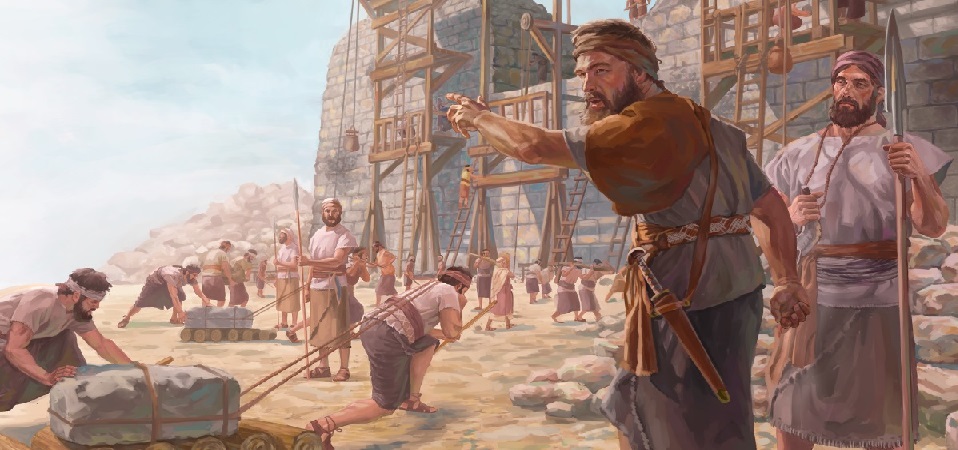
He grew up, and rose to become one of the most important men in Persia (in modern Iran): a cupbearer to Artaxerxes, king of Persia, and later, the king made him a governor of Persian Judea. To rebuild Jerusalem wall, the king gave his permission to use timber from the king’s forest. In the imperial Persia, which had conquered Babylon, commanding the territories with military and economic powers, the king’s timber went with the king’s builders and security. The wall was rebuilt within 52 days despite oppositions from Samaritans, Arabs and Philistines.
Yes, Nehemiah rebuilt the city wall circa 408 BC. That city housed the temple – the very one that stood in Jerusalem during the time of Christ. Later, Roman Generals Titus and Vespasian destroyed it during the siege of AD 67-70.
I am yet to read of any man that understands foreign policy, diplomacy and large project management better than Nehemiah. When Artaxerxes made him governor, he gave him support. Nehemiah worked for that support. The king provided him with resources. And even though enemies came, during the rebuilding, he was able to execute the mission at a very short time.
Persia was the superpower; Nehemiah had the support of the best military and the strongest economy behind him. He succeeded. Yes, Persia partly funded the rebuilding of the city wall which Babylon (modern Iraq) had destroyed. Power was shifting rapidly: from Babylon to Persia, and Rome. It continues to modern America, from Great Britain!
Nehemiah was brilliant – he understood the challenges in the region with all the battles. He could not have accomplished anything without the authority and support of the king. He mastered the art of diplomacy – the Nehemiah Diplomacy.
Solomon’s Jerusalem Temple (source: Wikipedia)
The Nehemiah Diplomacy is a type of diplomacy where a quasi not-free man can ask his master to allow him to go back to rebuild his city, requesting that the master partly funds the project, and provides security. He did not just want timber; he wanted the one from the king’s forest meaning that the king was on absolute support. In imperial Persia, wasting timber from king’s forest was a punishable offence.
So, any project that received timber supplies from the king’s forest was as good as executed. And only the most important projects qualified. As the aides shipped the timber, the guards would follow, making sure that none was wasted. Another set of guards would monitor compliance. Simply, Nehemiah would have failed without the resources and the security offered by the king which helped as he battled the enemies.
If he had used any timber that was different from timber from the king’s forest, he would have failed. Understanding the situation in the region, and asking for the king’s timber was the reason he executed within 52 days. You must have the capabilities to decipher the most important component to have a successful project. And you must make sure you have that component.
Nehemiah teaches us something on project management. One has to plan ahead especially in places like Nigeria. It is very common for companies to win contracts and then abandon them within weeks due to problems from Boko Haram and Niger Delta militants. Nehemiah thought through all phases: resources, security, etc. Within the 52 days it took him to rebuild the wall that took many years to build, he fought minor battles. Getting the support of key business leaders on critical projects are important and planning ahead remains vital. And in all, knowing the critical success factors like a timber from a king’s forest could be catalytic in delivering projects on time.
As I have noted many times, we are entering a new age in Nigerian agriculture. Nigerian graduates are going to play major roles through various ways, from doing the actual farming to advancing the processes involved in farming. A new startup, Peatuce, has joined the club, to facilitate agro-trading and enable efficient distribution of farm produce. The company, via a newsletter, made its case:
For more than decades, numerous challenges have consistently plagued the operations of smallholder farmers on the African continent; from poor financing to stringent policies, haphazard regulation, climatic changes and obsolete technology, these challenges often create a stifled environment for the functionality of local farmers playing in the Agricultural value chain.
As such, farm productivity, efficiency, and profitability has been grossly irregular, most times, at a decline. The aftermath of this irregularity is already negative, and could grow worse if it isn’t remedied timely — especially considering that the African population, which is expected to grow spontaneously by 2050 will have more mouths to feed, when in contrast, local food production is yet to circulate the present population.
Founded in February 2018, Peatuce plans to improve the local food trade within and across Africa by increasing efficiency, service quality and enhancing profitability for farmers, suppliers and buyers.
“We believe in a future where local farmers play a large role in feeding our communities, and we are working to making that a reality. We are focusing on emerging markets with a target of over 20,000 local farmers on our platform in 2018,” says Peatuce team
The company has over 500 local farmers, who are relying on it to facilitate their farming operations, expedite distribution and supply chain, as well as help enhance productivity of farm produce.
Peatuce integrates independent services geared towards enhancing local food trade across Africa by boosting production and improving supply chain.
As I had noted, there are many ways to become a “farmer” in this age. Find yours and let us have food security in Nigeria. Here are some guides:
Precision agriculture by making sensors: here, you make electronic sensors; may be a little hard depending on your skill level
Agriculture insurance technology: making insurance products geared for farming
Agro lending technology: delivering capital to farmers at scale supported by technology
Agro financing – investing in farmers and farms through digital aggregators
Direct Farming: owning farms and growing crops and/or raising farm animals
Farming ecommerce: expanding farmers’ markets by providing digital platforms for trade
Pricing aggregation: facilitating trading through provision of produce price data
Storage: African farmers struggle with storage of produce. Building solutions in this area will be catalytic
Logistics: there is a huge opportunity to facilitate the delivery of produce from rural areas to urban areas across Africa with our poor road networks
Digitization of transactions: from payment to tracing origins of produce, we have a huge need to digitize farming systems in Africa
Commodity trading: building exchanges for trading commodities
Farm digitization: most farms must be digitized for them to be tech-ready
Others: there are opportunities like making digital tools farmers can use. These could include farm diary, mapping solutions, etc
Folarin ‘Falz’ Falana takes Nigeria apart in a new rap video, ‘”This is Nigeria”. It is a parody of Childish Gambino’s “This is America”. He rapped on many issues including special anti-robbery squad (SARS), Yahoo boys, IGP transmission speech, and herdsmen.
In the piece, he rapped: “This is Nigeria, look how I’m living now, look how I’m living now. Everybody be criminal/ Person wey no get work dey check if my watch is original.”
He just demonstrated why artists are great messengers. He might have achieved more than his father, Femi Falana, a social activist and legal legend, who also provided voice-over in the music, this year, in moving our consciousness on many topics.
Now, Falz should do another video and offer some clear plans on what could be done. That way the nation would have another set of conversations especially as 2019 election arrives.