This is hilarious – a stolen bag would not come down from a man’s head. That is Isaac Newton’s work error code. Yes, gravity ceased and the man needs the old woman he had stolen his bag to help. He went to Police; Police could not help. Someone says the technology needs to be patented by Tanzania before NASA knows about it! Watching the video, you would pity the guy: the bags cannot fall down.
A man from Tanzania was compelled to report himself to the nearest police station after a bag he had stolen from an old woman refused to come down from his head.
It is not clear under what circumstances Frank Buhet stole the bag and what it contained.
The man reportedly told police that he made every effort within his powers to get the load off his head, including lying on the ground, but to no avail.
I am Nky Udo. I am the community coordinator in all Fasmicro Group ecosystems, handling digital support on Facyber, Zenvus, AA, Fashostit Web Hosting, Tekedia, etc. For our workshop – Innovation for Growth Workshop– which is scheduled in Sept 2018, I want to engage partners. Simply, we have a generous commission for agents or partners who can bring participants. For example, today, we closed a deal for an Abuja-based hub to send participants. If interested to work with me on promoting this workshop [you get commission], please email tekedia@fasmicro.com.
This September, I will bring an innovation workshop to Nigeria. I always come to Nigeria to lead programs for banks, insurers, technology companies, governments and more.
[…]
The workshop is designed for mid and senior leadership teams. These include CEOs, VPs, directors, technology, sales, marketing, strategy and finance leads in all business sectors. The workshop is aimed at:
Companies looking for new growth areas and products
Companies with potential, ambition and capacity for high growth
New company owners, founders and entreprenuers who want to build robust businesses.
Existing companies who want to engineer innovation within existing enterprises
Startups and their leaders who need directions on roadmaps and strategies
Governments and policy makers working to stimulate innovations
Meanwhile, to those that want to register, click here or email me at tekedia@fasmicro.com
You have done well in Nigeria. To a large extent, it is your market to lose. But you need to take action very fast because in the next 18 months, the smartphone market would be radically transformed. I expect the next (major) version of iPhone to have blockchain integration. Also, I expect the next major upgrade of Android to have blockchain native integration.
Blockchain smartphone is just around the corner. I do believe that all the hard techs behind blockchain would be demystified with smartphones, making blockchain easy for ordinary people.
Make a blockchain-powered Android phone and call it Tecno Block. It should have a universal wallet with capabilities to support decentralized apps and cryptocurrencies. That means support for Bitcoin, Ethereum, etc. Build the trading system natively in the hardware and OS core to make it seamless. Just as you have Messages, have one for Blockchain Apps.
The phone will be the hub making it possible for people to own their identities, data and private keys. All the issues of privacy would be managed more efficiently. You want to get ahead of this because it is coming.
And remember, you may need a Chief Decentralized Officer to manage this interface with the Nigerian youth.
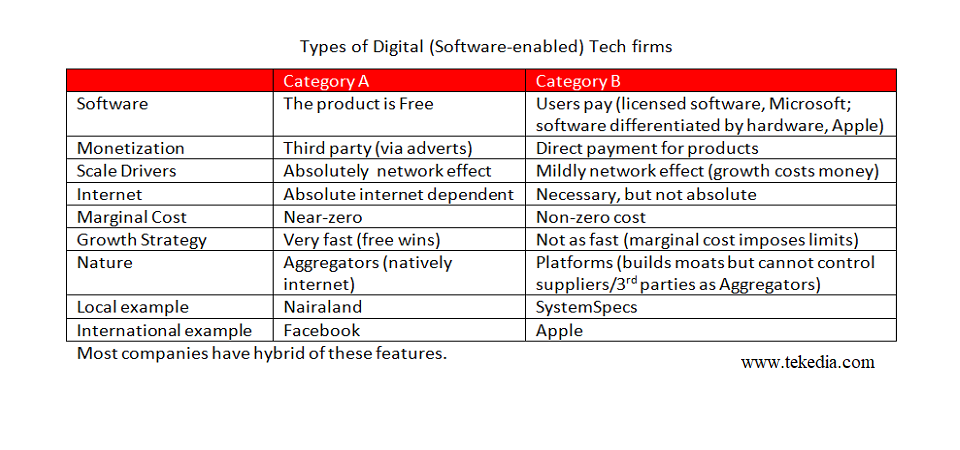
The following are some features which distinguish digital (software-enabled) companies, knowing that most companies are now quasi-conglomerates. That means they exhibit both features. The structural business model of your business will likely bound the monetization strategy from day 1. In other words, you cannot expect to make money like Facebook (or Nairaland) when your business model is structured like Apple’s (or Interswitch). The implication is huge as how you make money drives most decisions you make on products.
Apple can build a top-grade privacy product in U.S. because its business model does not require “selling’ user data. Facebook can do that technically but it would be stupidity to execute that since its main raw material is the customer data. Unless Facebook changes its business model, its privacy will never match Apple’s [that does not mean Facebook cannot create a balance].
That is why when people compare what Apple offers on privacy to what Facebook has, they miss the point. Facebook engineers can deliver top-grade user privacy. But if they succeed, they would all go home, out of jobs. Yet, to show you that it is about business model [by that I mean, growing margins], Apple handed its encryption keys to the Chinese government on its Chinese customers, making it clear that if the pursuit of margin requires playing with privacy, Apple will fall in line.
So, as you begin the monetization strategy on your startup, look at how some ecosystem elements could shape what you can do. Most times, the business category defines the value-trajectory more than anything any accountant/strategist can envision.
Category A
Category B
Software
The product is Free
Users pay (licensed software, Microsoft; software differentiated by hardware, Apple)
Monetization
Third party (via adverts)
Direct payment for products
Scale Drivers
Absolutely network effect
Mildly network effect (growth costs money)
Internet
Absolute internet dependent
Necessary, but not absolute
Marginal Cost
Near-zero
Non-zero cost
Growth Strategy
Very fast (free wins)
Not as fast (marginal cost imposes limits)
Nature
Aggregators (natively internet)
Platforms (builds moats but cannot control suppliers/3rd parties as Aggregators)
This is exciting – two companies with similar business models merging. Typically, in Nigeria, we do struggle on that. Everyone wants to have the title of “CEO”, and at the end, there is no company that remains to have a meaningful one. From Aba to Lagos, Kano to Ife, Nigerian business owners must have a redesign where people understand that merging or coming together is not a sign of weakness. The merger of Senegalese Teranga and HotelOnline to create a stronger traveltech company should inspire us across Nigeria.
Senegalese Teranga Solutions has merged with HotelOnline to create a traveltech industry leader in the global frontier markets. The companies individually had systems and business models that were complimentary and together they now have a cloud-based ecosystem platform for independent hotels – the first of its kind, making HotelOnline a global leader in frontier markets.
[…]
In a joint statement the four founders said “by joining forces we are able to provide a complete solution specifically designed for hotels in frontier markets. The global frontier markets comprise majority of the world’s hotels. But these hotels are yet to catch up with digitization of their operations and markets hence they are the low-hanging fruits.”
Eric Osiakwan, Managing Partner of Chanzo Capital who is an investor in Teranga Solutions and now joins the board of HotelOnline indicated that by coming together under HotelOnline we have the clout to conquer and dominate the hospitality industry in the global frontier markets for the foreseeable future. “I am proud to be part of this amazing global team combining Africa and European expertise and experience considering the tremendous growth opportunities of the merged company.”
Largely, when you do not have a lot of growth capital, the best path to hold your territory from local and foreign competitors may be combining resources. Through a merger, you improve unit economics and most importantly become bigger before clients and customers.
Sure, you do not just have to merge for the sake of merging. The message here is that merger is a very important element of business systems. Recall how some banks during the Central Bank of Nigeria capitalization phases, many years ago, went under because the owners simply refused to merge their banks with other banks. Yes, when a big man merges with another bank, he would be unable to use the phrase “my bank” because he does not control all aspects of the institution, they reason! Yes, the same person would praise the durability of generation-shaping banking institutions in U.S. and Europe. Unless we are ready to do what they do there – combine resources when necessary – we cannot make progress in our economies.
From government and trade association data, more than 79% of Nigerian companies collapse within three years of establishment. It is possible that with merger and (possible acquisition), we could salvage more value from those entities.
The best job right now is the job you have now. That is very important. Do not make the mistake of thinking that you can resign tomorrow and become Dangote. More than 79% of new businesses collapse in Nigeria within 3 years. So, the system is not that easy. You can open a business in Lagos and operate for two years without one kobo of revenue.
The Benefits of Mergers
Across markets, it has been clearly understood that mergers deliver great benefits to companies and economies when done appropriately and strategically.
Economies of scale.
Tax benefits.
Financial resources.
Entry in global markets.
Growth and expansion.
Helps to face competition.
Increase in market share.
Increases goodwill.
Research and development (R&D).
Miscellaneous advantages.
All Together
As you create value for your stakeholders in Nigeria, be watchful where merging with another entity could open up more opportunities. Teaming up with others, when done correctly, opens many new opportunities in markets. Titles do not build empires – capabilities do. Mergers do bring capabilities in markets.
Sure – men cannot talk at beer joints that they hold the titles of CEOs and Managing Directors post-partnerships in some cases. We like titles – a lot. But we need to understand that they are ephemeral. It is far better for three shoemakers to make progress when one is indeed a CEO, another is focusing on production while the other is driving sales/marketing. While the egos may be muted, the bank accounts will grow. And as the banks see the growing scale, those loans will begin to come in because they are seeing better digits hitting the bank accounts.
Another key thing to know is that merger could help you to avoid the destruction of value in your market. That is why I still believe that Uber and Lyft would merge one day as traditional car companies rattle them with avalanche of competition: “As they become peer-competitors and rivalries, they will destroy the sector. Similar rivalries have ended together: Elance/Odesk (now UpWork), Groupon / LivingSocial, Sirius / XM and Rover / DogVacay. Please add DraftKings and FanDuel in the list”.
LinkedIn Feed Comment
I believe a lot of work needs to be done, in making the business owners understand the mathematical and economic meanings of this simple but complex word called – PERCENTAGE.
Actually, 100% percent is not always bigger than 5%, there are countless businesses whose 1% share is far bigger than the famed 100% ownership and control, which our small business owners are always in love with.
A mind shift is needed in our business space; with the refined and elevated mindset, we can better understand and appreciate the immeasurable benefits of coming together to achieve something big.
There are thought processes and ideas that are very difficult to place a price on, by joining forces, some of these valuable resources would naturally come the company, without needing to spend fortunes in search of great talents.
Mergers and acquisitions when properly done, would help to erase the ever-present stunted growth syndromes that are prevalent and palpable in our market space.