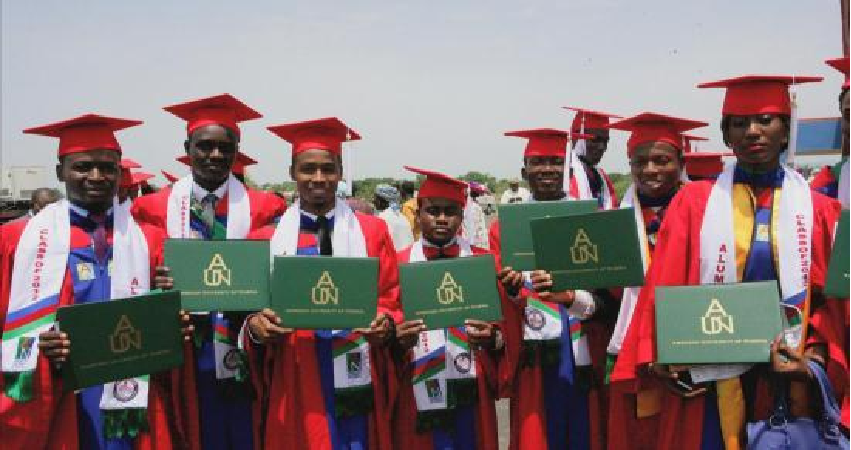
According to Premium Times, Nigeria wants to add an extra year of studies in our tertiary education system. This is expected to fix the increasing lack of quality from our recent graduates. Yes, that could re-position our young people to avoid the “lazy” tag from Mr. President.
Mr [Anthony] Anwukah [Minister of State for Education] said this was being considered because many university graduates were not good enough to be employed by industries.
He said the proposal was similar to the extra year currently being undertaken by law and medical students.
“Law students attend Law School for one year before going for NYSC and medical students go for one year Housemanship before they are allowed to practice fully, so it will be necessary for other courses to also go through this process,” Mr Anwukah said.
{…]
“The universities are producing products that are not matching the needs of the industries. I urged the Committee of Pro-chancellors and Committee of Vice-Chancellor to end the decline in the standard of education,” he said.
Finding a way to fix our education system is certainly commendable. But adding an extra year of studies may not necessarily solve the problem. There are many things which we must consider before we blame the students:
- University Infrastructure: While it is true that some students are not well prepared for the industry, it is also fair to point out that government has not positioned its schools to train those students. Largely, when schools have limited resources, you do not expect them to do magic. These resources include lack of teachers with many carrying teacher-student ratio that is beyond acceptable global standards. Besides, we do have schools that cannot boast of constant electricity. The professors cannot do magic to educate.
- Secondary Education: The success in tertiary education is correlated with preparation at the secondary school level. If government does not fix the secondary school education, it should not expect magic at the tertiary level.
- Merit System Entrance: The quota system remains in force, with some students who are not qualified admitted ahead of those who are, mainly due to their catchment areas. This cuts across the nation. The implication is that birth place has become a strategic asset to gain admission in government schools. When such is the case, you cannot expect quality from the system.
- University Funding: The schools that would produce these great students are the same that cannot even guarantee when their teachers or workers would be paid. Government has been opening many schools with no clear plan on how to fund them. That continues to force it to divide the little money it has for many schools. The implication is that the schools have lesser resources to work with decreasing budgets. We should not expect them to do magic. At the moment, some staff of most universities are striking. That is not a problem created by the students.
- Proliferation of Schools: Nigeria’s policy is quantity in education over quality. Provided that stays in place, it should not expect magic from the graduates.
- Regulations and Standards: Besides more money, we need to improve accountability, governance and other elements that would make it possible for the little investments to go further.
Largely, most schools in Nigeria run engineering and other areas five years. In some parts of the United Kingdom, a student can finish some of those programs within 3 years. United States is about 4 years. Besides, these countries plan to find better ways to reduce the number of years students spend for their degrees. This means that Nigeria should not be talking of increasing the number when others are looking at reducing them.
Also, the extra year in secondary education under the 3-3 system from the original five years would have prepared the students. But data shows that asking students to spend extra year in secondary school have not improved their preparedness for university education. There is no clear indicator that another year in the tertiary education system will equip these students better for the industry. The solutions are very obvious: until government invests and measures what happens in the tertiary education system, the students would “not [be] good enough to be employed by industries”.
Industrial Training Fund
Interestingly, Nigeria already has an extra year of studies through SIWES which is supervised by the Industrial Training Fund (ITF). Companies fund ITF by paying to government a percentage of their human resources budgets. For some technical universities, by the time a student has gone to the industrial training (IT), an extra year of study has actually taken place. In Federal University of Technology Oweeri (FUTO), my alma mater, there are at least 2 three-months and 1 six-months of IT before graduation. If you run the number, you have a full year added. The problem, however, is that ITF is not working as the minister noted.
SIWES, established in 1974 by the Nigerian government, is a programme of the Industrial Training Fund (ITF). It is designed to give Nigerian students studying occupationally –related courses in higher institutions the experience that would supplement their theoretical learning.
But according to the minister, “the project is not working” and remains a major problem for the university system.
All Together
As Ayo Banjo, the Chairman of the Governing Board of Nigerian Universities Commission (NUC), noted in the report that the “university system must be well-funded before it can achieve high ranking and fulfill its mandate”, I do think government must fund schools to attract more talent while also making sure that it can supervise them better. I have noted that this funding should not just come from government. Indeed, private capital can come in if government redesigns its tax system. We need more money in schools; government has to be innovative on that process.
The Nigerian tax system is not designed to support philanthropy. That is why we do not have a vibrant one. It does not mean that a nation must be rich first before its tax system can be engineered to stimulate philanthropy. ASUU can lead on that, through Tax Reform, and make it possible for individuals and companies to put money in the schools and get tax benefits. Sure, ASUU members may be busy, but that should not stop them from helping the government to revamp our tax codes to drive innovation.
The 501(c)3 tax structure in U.S. has unlocked a lot of private sector capital into the “doing good” business. Nigeria must find its own model. I explain why this will be appealing in the educational system.
If Company A wants to start a factory in Owerri Nigeria and needs to train 1000 people in the areas it does business. It can ask Federal University of Technology Owerri to do that training, providing the manuals and documents required. It will fund it say with $3 million for three years. FUTO may integrate the program in its curricula (NUC may need to approve). FUTO has received funding, expanded its program and at the same time graduating students that will likely have jobs when they finish. Brilliant!
For Company A, it has moved the non-core training out to focus on its business, knowing that whenever it wants talent, FUTO is preparing them. Then on that $3 million, Nigerian government allows it to deduct it, non taxable. Simply, the revenue where that money has come will not be taxed because it has been used to do good to the society. Just like that, the company has saved money and at the same time assisted FUTO to deepen its programs. That is an incentive which does not exist right now, and Nigeria needs to update our tax system to make it possible.
Today, what is possible is to deduct that $3 million as an expense, meaning that it is recognized in the tax book as pure business. That is not enough as the resulting balance will be taxed accordingly. In U.S. that $3 million is treated differently, offsetting not just its expense but other areas the company might have experienced losses. So magically, you use donation to make-up. That is why giving is financially good, under some circumstances, for both the recipients and the givers.
Currently, Nigeria has a total of 163 universities: 47 are owned by states, 42 are owned by the federal government and 73 are privately owned.
Like this:
Like Loading...