In microprocessor design, we engineer built-in redundancies. They waste transistors and silicon real estate. But you need them just in case. In finance, they have a different name: risk management. The world of commerce is driven by market forces for the dynamic equilibrium point. If you cannot manage risk, you have no future.
Yes, it has been 10 years since Bear Stearns collapsed. On a fire-sale to JP Morgan, it went for less than 7% of its market value from two days prior. As I noted in my First Day in America & Kindness of Diamond Bank, it was a turbulent period.
Then I started buying stocks in New York Stock Exchange and NASDAQ. One day I lost $26,700 when they nationalized Freddie Mac and Fannie Mae. I had cut-off all stock research to finish my dissertation and was not following market news. I felt bad and learnt a huge lesson – the professionals deserve their wages!
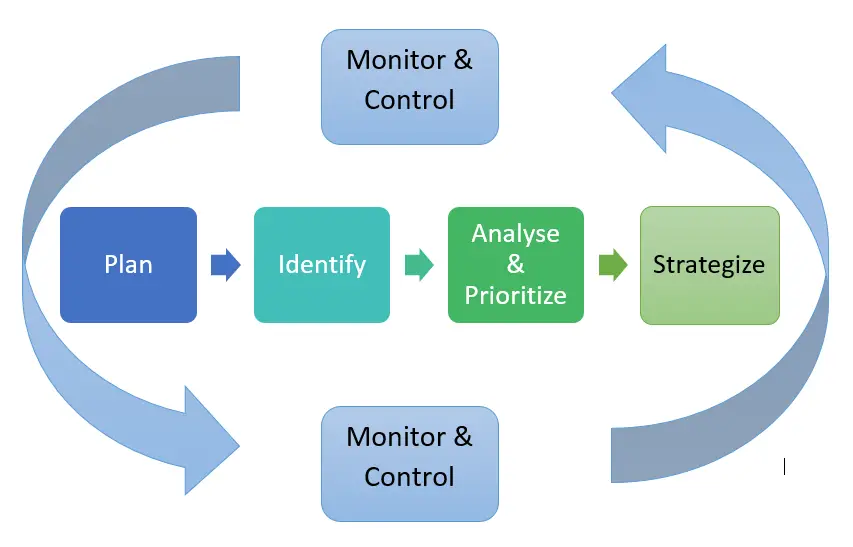
Remember this: if you have not identified 3 risks that could cause severe dislocation in your business, abandon everything this week and find them. Then, once discovered, find mitigation strategies.
Risk Management Process (Source: PIN)
Risk is good because without risk, there would not be business. Every business exists to fix frictions in markets. Those frictions are anchored on risks – endogenous and exogenous to the participants. Fixing them demands capabilities, the very reason customers look for those, with abilities, they can pay to help them.
Discover your risks, fix them.
Another presentation of a Risk Management Process (source: PM by PM)
Happy Easter, it is the day of resurrection. It is that day when that big unsolvable equation has a meaning.
Yes, [All Things]/ 0 = Infinite Grace.
Anything and all things, under that miry clay of life burdens, sorrows, pains, and hopelessness turn into infinite grace of hope after our Christ experienced death (the zero).
I experienced the rising of Christ this morning. Let the resurrection power catapult you into His pastures, out of the miry clay.
“He drew me up out of a horrible pit [a pit of tumult and of destruction], out of the miry clay (froth and slime), and set my feet upon a rock, steadying my steps and establishing my goings.”
It is hard over there for our teachers in Africa. A teacher in Ghanahas to draw a word processing window on blackboard to teach his students. I commend this teacher and I would be happy to send his class a laptop if anyone knows him [Possibly the kids would see how a real Word Processing Window looks]. He is genuinely built to teach for investing such an effort for something that may be wiped out after 3 hours since he would need the same board for other things.
This was the old classroom.
THIS IS THE NEW CLASSROOM
Never doubt what one person can do in the lives of many.
Bitcoin is flawed but NairaCoin offers promise in Nigeria
In your business, do not do “herding” where everyone does the same thing. As I noted in Tekedia [had a long piece on that in Harvard Business Review print around 2011], when you do that, a new entrant has only one strategy to annihilate your industry. Yes, since everyone is doing the same thing, conquering the market is easier by a newcomer.
The same analogy above applies in many modern industries. Companies increasingly congregate in their competitive strategies. They tend to do similar things in order to self preserve themselves. In the era of Yahoo and AOL, they provided similar services. Cell phone companies provide services and pricing models that are largely the same. Everyone wants to eat from the same pot and let the help offer assured preservation or total destruction whichever flips.
Even the network televisions are not spared this effect. From casinos to airline industry, we can see an ordered communality across industries. They mutually agreed, though never admitting it, to move in features, services and prices alike. The airline industry was notorious for it about fifteen years ago. In most developing markets where Internet has not penetrated deep enough, the media empires move in tandem on their stories, prices and distribution networks.
I call this communal competitive strategy because it simply means that these firms in their respective industries form communal ties and agree to provide services that will preserve them with lesser disruption to their industries. They may not band together because that could be illegal but the outcome shows they watch one another. Many have called this win-win strategy. It has also been seen as co-opetition where, especially in banks, they cooperate though competing against one other in other to keep the industry healthy
This applies to how we grow wealth. When it seems like everyone is making profit with no apparent bleeding for some, it is probably MMM and will turn out bad. And when everyone seems to believe it will be all parties for everyone, hello cryptocurrency and Bitcoin.
Simply, any business or sector where there is no obvious risk of loss or gain by different participants in short term, it is probably not based on sound economics. If MMM says everyone would win, that is against the laws of markets. When Bitcoin promises same, it is an illusion.
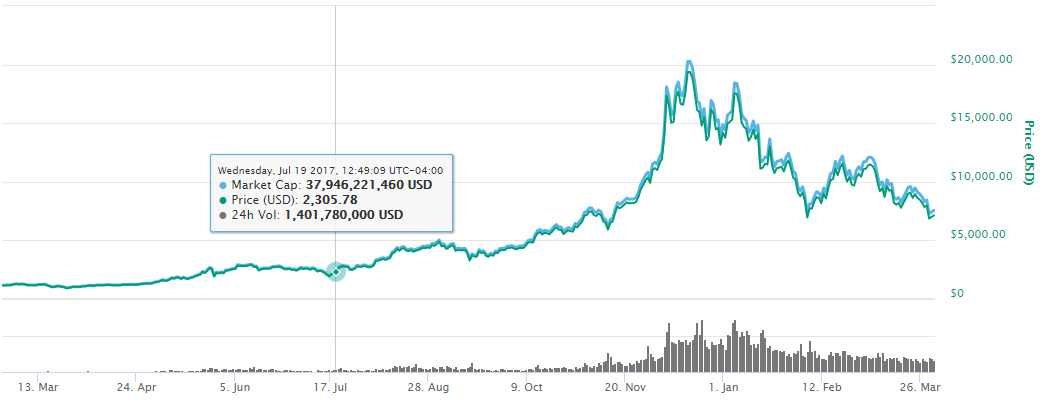
This is the Bitcoin price today (see the plot below): around $8,000. From Google to Facebook to Twitter, they are caging it. Now, the fraternity that did not want government is asking for government to come and regulate it. It wants legitimacy because the ICT utilities are indeed regulating it.
If you are banned by Facebook, Google and Twitter, you probably do not belong in this world. You are irrelevant. If you do not reverse it, the only destination is oblivion. You can see that from the price of Bitcoin. (Advertising on crypto-related products including ICO (initial coin offering) are banned by these ICT utilities. Simply, the ICT utilities have decided that they are not important for the real economies).
Price of Bitcoin
All Together
Just hope you did not buy Bitcoin at $22k because unless government can regulate it, it may be in deep trouble. Facebook, Google and Twitter are banning adverts on it. If you are banned from the ICT utilities, you do not belong in this world.
The gestation period to profitability in a typical Nigerian startup is long. That long gestation is also the reason why many startups or small businesses collapse few years of founding. Typically, one way to deal with this is to raise capital, ramp up market entry to grow fast enough to attain profitability. But in our extreme volatile economy, if the timing is off by months, the company can collapse. You just run out of cash.
This is one problem we deal with in my Practice as we work with clients: how do you invest without getting into a trap where one sneeze in Saudi Arabi or Iran [America coming with shale gas] can kill your business because Nigeria’s economy would be affected due to its dependence on crude oil.
According to a report by Pearl Mutual, a consultancy, an average of 5.7 million Nigerians are considered to spend within US$10 to US$20 per day. The country has an estimated $115 billion annual consumption spending.
That is a big one but the market is extremely fragmented that economies of scale rarely happen due to lack of infrastructure. Kano and Osogbo have little in common except that Osun and Kano states go to Abuja to collect cheques monthly. So the average national statistics has little meaning in the real execution of business strategy in Nigeria. We have heterogeneous markets making things more challenging.
While you may think that raising capital may help you, most people have noticed that you can raise capital and still crash. Think of Efritin which just gave up on Nigeria. It happens daily. They think that market growth is the solution when the path to profitability is what matters [path to profitability may not matter to a U.S. founder because they have massive sources of new capital. We rarely have here].
Yes, your new business problem in Nigeria is not just capital but the long gestation period required for profitability, affected by many factors at scale.
Advisory Services: Most times, after our presentations and workshops, clients usually engage us for Advisory Services. This is totally decoupled from the first two. In other words, you can engage us for either the presentation or workshop without the advisory services. Yet, we always welcome the moments when clients ask us to come and lead the implementation. Because we are already practitioners, making things happen is always the most exciting part of our works.