The easiest way to waste money and destroy value in Nigeria is to start an ecommerce business with B2C model. As I have noted many years ago in a seminal piece in Harvard Business Review, making money on ecommerce in Africa would happen but would take a really long time. I do not expect any to work till after 2023 (2022). But before then, it is putting good money in a value-destroying venture that would bleed cash until the owners give up. Ecommerce today in Africa at B2C is simply a loss-making online endeavor only people with deep pockets can do. You can be in it if you do not care for profitability.
In Nigeria, ecommerce is not a digital business. Yes, it is a traditional business because the highest element of its marginal cost is offline. That you have a website should not confuse you on that reality. Until we have a postal system that works, running ecommerce as a business would remain challenging [please continue to expand sales channel through your website; doing that does not make you an ecommerce firm. That distinction is important to avoid confusion here].
All ecommerce firms in Nigeria have defined geographies to manage the logistic problems [they do not deliver nationwide]. Interestingly, doing that removes one key element of the supposedly internet business from the typical global attributes: unbounded and unconstrained by geographies [Amazon ships across U.S relying on the United States Postal Service]. In other words, they are not internet companies because they are structured by limits imposed by geography due to marginal cost.
At a time, I asked one question: what is your marginal cost? It was very tough as we spent minutes looking at cost. Largely, to have scalable advantage, your marginal cost must tend to zero in a digital business. In other words, having an additional customer must not carry any new cost
{…}
My client had a great marginal cost in the web side of the business, but in the logistics side, the amount goes high. To add an additional customer in a new city will require cost, even though the marginal cost in an already covered city may be low. So, the only way to bound the cost is to narrow the service region. By coming to that conclusion, the company is no more an Internet business. That scalable advantage has gone and the unconstrained distribution channel which Internet offers has been made meaningless.
Jumia Evolution
An OLX shrinks and Konga redesigns, Jumia is looking for a way out via IPO which will be good if it can attract great value in the market. But unlike the first African unicorn (at least $1 billion in valuation when insurer AXA invested €75m for 8% in 2016), Jumia is now worth less. (Jumia’s parent Africa Internet Group is now largely Jumia as the firm has seen massive consolidation under the Jumia brand in Africa).
Jumia, the pan African online retailer present in 14 countries, maybe put up for sale. The company’s owner, Rocket Internet, is reportedly seeking an IPO for the business with a listing of shares to the value of €200m ($246m).
Rocket Internet is reportedly seeking to release cash by exploring a stock market listing for Jumia, the online retailer it helped establish in 2012. Jumia has operations in 14 African countries, and currently has 500,000 merchants using the platform, and more than 5m SKUs. It also operates a hotel booking platform and an online food delivery service connecting consumers with local restaurants.
In the first nine months of 2017, Jumia saw its losses widen to €80.7m ($99.1m), while revenues were just €57.3m ($70.4m). To put this in context, Amazon launched in 1994, and first delivered a profit in Q4 2001, seven years later. It wouldn’t deliver a full year profit until 2004. Until 2016 it was still considered unusual that Amazon delivered four consecutive quarters of profit. Jumia’s group revenues mask the importance of one market: Lagos, Jumia’s first market and by far its single largest driver of revenues. The Nigerian market generally has seen sluggish growth since 2014, although it is picking up now, and slower growth in demand has been compounded by fragile market conditions in Algeria, South Africa, Kenya among others.
All Together
The biggest challenge in ecommerce is the marginal cost paralysis. And unfortunately, no ecommerce company can fix it since none can price without consideration of losing buyers to supermarkets and open markets. So, any ecommerce operator that wants to keep its products low must discount it and that means absorbing the marginal cost. That is what they do. And they keep doing so until they run out of more money.
As I explained in the HBR, buyers have options, from local open markets to hustlers on traffic lights. Any ecommerce must beat the alternative ecosystems on price to win new customers and keep present ones. To do that, they would need volume, only possible with a nationwide or regional operation. But without logistics like postal systems, that will not happen. Do not waste your money starting an ecommerce business in Nigeria until 2023 (2022). It is the most unfortunate way of wasting capital in Nigeria. Only the post office can make our ecommerce take off and without that infrastructure, ecommerce is a waste of efforts, in Nigeria.
Rex Tillerson was fired by Trump. Before he became U.S. Secretary of State, he was a long time CEO of ExxonMobil. In my opinion, the CEO did not read his job requirements very well. He was hired to be the American top diplomat. Rather, he wanted to be a czar for cost-cutting [cut budget by a third] and reorganization [“We’re going to redesign” the dept]. He wanted to bring efficiency to government. Sure, bring the business experience; everything in government would be normalized.
Far from it: in business, you have market segments. In government, there is no segment. In business, you sell your $1,000 phone, $2,000 perfume, etc. You define your territory. But a politician’s market segment is ALL. Once a diplomat does not understand that, he would fail to see why bureaucracy is part of government.
When Trump team started complaining [he had traveled less than 50% of his predecessor over comparable time period], he did not take note. He was holed in Washington DC to bring process efficiency he perfected in ExxonMobil to State dept. The former has gross margin target; in the latter, it is largely immaterial.
Tillerson managed a Fortune 10 company, handled complex projects with close to $40billion in annual budget. More than 70,000 people reported to him. The efficiency in ExxonMobil which improves profit is not the most important factor expected from a top diplomat in the State dept. Sure, efficiency is important but it is not the end. If pursuing efficiency affects the diplomacy, that efficiency is now a problem. As he spent time reorganizing and redesigning the department, Trump felt they did not have a visible diplomat.
Although the former secretary of state’s contentious relationship with the president didn’t help matters, Tillerson’s management style left a department in disarray.
{…}
Tillerson certainly seemed to think so, notwithstanding the fact that he hadn’t spent any time in diplomacy or, for that matter, government affairs. He had barely introduced himself to the career civil servants at Foggy Bottom before he concluded that the agency they staffed was a portrait of bureaucratic mismanagement. “We had very long-standing disciplined processes and decision-making, I mean highly structured, that allows you to accomplish a lot,” he told reporters in July of his time at ExxonMobil. “Those are not the characteristics of the United States government.”
Yes, as he was cutting cost and reorganizing, he forgot his main role: be the face of America in the world of diplomacy. He might be improving State Dept, but Trump was not seeing the value on diplomacy. This is a business where out of sight is out of mind. Going out there to shake hands of allies could melt tensions which saving $100 million in State Dept budget would not compensate for.
Efficiency brings profits but government is not just about margins. I learnt that lesson when a Nigerian Senator reminded me that “no person comes to Senate to preach cost-saving; we are here to spend money” [I had proposed a National Chief Information Officer to help government and MDAs (ministries, departments and agencies) consolidate purchase of software licenses to save cost from Microsoft, Oracle and the rest].
The business of public service is not that easy. If you are appointed as one [a great honor], approach it not with arrogance but humility that no external business experience can serve ALL citizens since no business has ALL citizens in their market segments. That means, you must invest efforts to understand why bureaucracy is part of government processes. Government plans for all and that makes things harder. That does not mean that we cannot improve the system. But never think those inside do not wish things are more simplified.
All Together
Trump might have fired Rex for many reasons. But he made that easier. He traveled less, was invisible to allies while holed in DC reorganizing bureaucracy. Efficiency is important but it must not be the end. As you grow in your career, find out what is KEY in that role. Focus mainly on that. That is what they would use in assessing your performance. While other things could be added, the KEY metric must be your focus. No one would remember a Secretary of State in U.S. that saved $100 million in a year. But Americans would remember that guy that melted tensions in global territories. If improving efficiency gets in that call, you have lost the mission.
[Remember the 7 Habits of Highly Effective People. Focus on the main things and other little things would fall in place]
Following the advice by my pundit Ndubuisi Ekekwe on Linkedin, I prepared an article on my prowess in embedded and IoT system design. And I asked for his opinion, to my surprise, he gave me this platform to express myself, for which I am very grateful.
I will use this platform to share two of my major projects.
A) Design and implementation of LED-based electronic notice board controlled wirelessly using a smartphone
My insight and interest in embedded systems became profound in my final year degree project, where I had the opportunity to work in a team of three students on the design and implementation of LED-based electronic notice board controlled wirelessly using a smartphone.
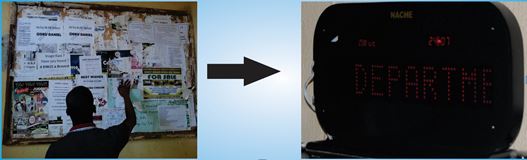
The objective was to reduce the environmental and economic waste caused by using the traditional paper notice board, especially in the electronic engineering department. I was responsible for designing the 512 pixels dot matrix display screen and the control panel on Proteus software, through-hole soldering of components and programming the Arduino Nano microcontroller boards using C.
We encountered a major challenge in configuring one Bluetooth module to receive information from the smartphone and transmit it to two different microcontrollers used in the project. But through perseverance, we overcame our challenges and received a grade of A on project defence day and came second at the Young Innovators Regional Workshop organized by the Innovation Centre at the University of Nigeria, Nsukka (UNN). This project showed me the intrigues of how things work beyond text and classroom knowledge.
Project Background
Technological advancements and globalization have paved the way for a world controlled by information and communication technology. Information dissemination (to distribute or broadcast information) is an essential part of the 21st Century society. Among other methods of disseminating information, the mass media is a sure method for reaching the public with information. The mass media provide indirect, one-way communication where a large number of people can be reached without personal contact. This category (mass media) is clearly where a notice board belongs.
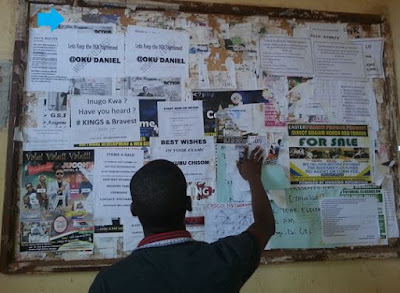
Traditional notice boards are relatively cheap and fairly easy to use but they become very uneconomical in the long run as papers and pins are constantly purchased to keep it running. Also, after a while, information on these papers becomes redundant and they have to be removed from the board constituting solid waste causing environmental pollution. The world is fast changing to the use of electronics to solve problems and reduce human stress encountered in the use of traditional and crude equipment and the notice board a vital tool of mass media cannot remain in its traditional and crude form. Hence, the need for an interactive electronic notice board controlled using Bluetooth technology.
With an interactive electronic notice board, information can be disseminated at the push of a button and from a distance. The messages will be more visible, clear and contribute to the aesthetics of the environment. Unlike the traditional notice board, no solid waste is generated. In this project, an interactive electronic notice board is designed and constructed.
Problem Statement
Traditional notice boards make use of written or printed information on paper. The information on them after a while becomes irrelevant and has to be changed causing environmental pollution as the paper will constitute solid waste and changing of the information becomes costly on the long run – purchasing paper, pins and printing cost. Also, electronic notice boards (especially in our locality-Nsukka) are not interactive, that is information on them cannot be changed once they are programmed on the chip, this limits their use and relevance.
Aims and objectives
To restrict the change of information on the board to authorized users.
To reduce the use of print media in disseminating information in public places.
To wirelessly change and control the message on electronic notice board quickly and easily.
To design a digital clock that would be attached to the board.
The scope of the project
The project is limited to the following;
A 512 LED dot matrix (i.e. eight 8×8) pixel mono-colour display screen.
Wireless communication medium.
The board will be able to display 250 characters per message.
Project approach
This project is developed using a modularized approach which involves the use of dedicated components integrated to develop subsystems. The subsystems are then interfaced to produce the electronic notice board as follows;
Developing a display screen using Led dot matrix and display drivers to show the information contained in the microcontroller.
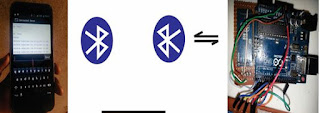
Using a wireless input device that will send information to the microcontroller via an interfaced wireless module.
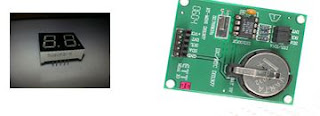
Developing a digital clock and calendar that will display the time and date held by the Real Time Clock (RTC).
Developing a computer program that runs on the microcontroller to control the system.
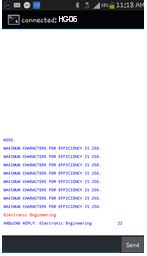
The Bluetooth Android application (developed by QWERTY) used to interact with the e-Notice board:
Block Diagram
At the heart of the interactive electronic notice board is the Arduino Nano microcontroller board, which is programmed using Arduino C language to receive, manipulate, and convey signals to peripheral components and modules in the system.
As an interactive system, the notice board is equipped with a Bluetooth module (HC-06) which uses the Universal asynchronous receiver/transmitter communication protocol which allows for full duplex communication in its operation. HC-06 receives signals in form of messages typed on the user’s Android device and transmits same to the microcontroller on the Arduino board.
The microcontroller receives these signals, interprets it and determine through the embedded code, which data is meant for the scrollable display, digital clock or which is a command to adjust specific properties such as speed, brightness, set time/date etc. Message signals are transmitted to an array of 8×8 LED Dot matrix modules (forming 512 pixels display screen) through LED drivers (MAX7219). MAX7219 works using the SPI communication protocol, the microcontroller utilizes the precise clocking protocol of the MAX7219 to select the right slave device (here LED Dot matrix) for a particular signal per time.
This causes the right LEDs needed to form the desired character(s) to lit up per time at a scan rate of between 500-1300 Hz, and by the persistence of vision, we tend to see a scrolling message. Special controls have been added via code for the user to adjust the speed of the scrolling message as appropriate for the event, environment and use.
The digital clock aspect works using the precise DS1307 Real Time Clock (RTC) module to get the time/date using the 12C transmission protocol. Here, the microcontroller acting as the master uses the SDA and SCL (2-wire bus system) to get the time/date from the DS1307 and when necessary, to set the time/date on the DS1307.The microcontroller again uses the MAX7219 to convey the correct time/date to the seven segment display which displays the right time and date on the notice board.
Design and Construction
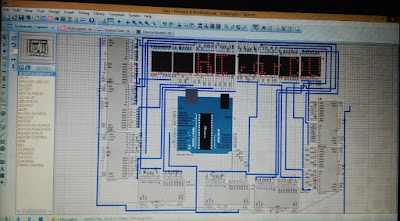
The display circuit is first designed and simulated on Proteus design suite. This is important to help confirm circuit designs before physical implementation to avoid failure of electronic components.
Display circuit design on Proteus software
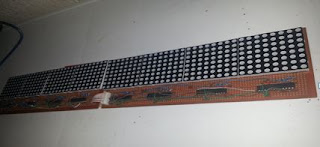
After confirming the circuit design on Proteus, through-hole soldering of electronic components is done as shown below.
Through-hole soldering of components
With the soldering completed, the sub-systems are connected together using Ribbon cables. Sub-system method of design is necessary to aid in troubleshooting and replacement of damaged components/modules if need be.
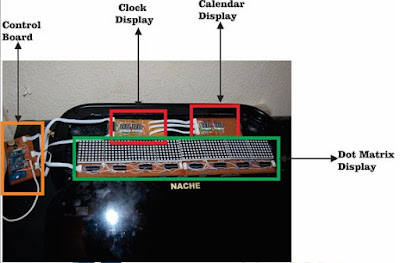
Integration of Electronic Notice Board sub-systems before packaging
Hurray!!! we are home and dry as each sub-system works properly. The displayed time is 7:22 pm (blue light on), the date is 24th, July (2016) and the message sent to interactive e-Notice board ” ELECTRONIC ENGINEERING DEPARTMENT” is scrolling by.
Final Packaging and Test of Electronic Notice Board
The interactive e-Notice board is housed in a package made of carbon fibre reinforced plastic for strength and durability.
Package Dimension
Recommendation
The LED display notice board is a technology that has so many applications like in banks, church, hospitals, airports etc.
There is also room for further improvement in the following areas:
Speech to Text conversion: This application will enable users of the board to speak through the phone and get the speech information converted to text form. The text is then sent through the Bluetooth to display on the board.
Doubling the Dot Matrix: By doubling the dot matrix, the information on the e-Notice board can be viewed from a far distance.
Using Zigbee Connection: Using a Zigbee or Wi-Fi module will enable messages to be sent to the e-Notice board from a longer range. This will also make it easier to network many e-Notice boards.
B) A smart-farm project using embedded systems and IoT (Internet of Things) technologies.
I am currently working on a smart-farm project using embedded systems and IoT (Internet of Things) technologies to collect data about farmland conditions (moisture, PH, temperature/humidity, UV rays, etc.), and send these data through an internet gateway for analysis to help predict and forestall crop diseases in other to improve farmland productivity.
Background and Problem Statement
Currently, the Global Hunger Index for Nigeria is 25.5, with a rank of 84 out the 119 countries ranked.Also, UNICEF 2016 hunger statistics indicate that 12.9 million Nigerians are HUNGRY.
Now, 12.9 million might seem insignificant in a nation with about 193 million people, but 12.9 million is approximately the population size of Singapore, Finland and Botswana combined together.
If the numbers are these bad, you can imagine what the real figures are.
As the saying goes, A Hungry man is an Angry Man. And hungry people can’t think well, let alone develop.
One of the main causes of Hunger is low agricultural productivity.
The price of crude oil is capricious which contributed to the recent recession experienced. So, the government is making efforts to diversify the economy by going into agriculture.
Apart from corruption in the system, there is another problem; we have too few people involved in agriculture to provide the amount of food needed for food security and for export.
The problem might be obvious; agriculture is considered out-dated by the youths, and considerably strenuous in this era of “smart things “. Simply put, agriculture is unattractive.
We need to change the tide and make it super attractive.
As an IoT( Internet of Things or Internet of everyThing as I like to call it) enthusiast, to make agriculture comely, we ought to make it “smart” by the use of embedded systems, data analysis and the power of the internet to fully automate the agricultural industry.
This will also make farmers proactive, for example, a farmer can know by the push of a button the conditions of his/her crop and take measures to stop hazards even before they occur (farm forecasting). Hence, increasing agricultural productivity. But to what extent will be determined by other factors like if the fertilizers will reach the farmer on the farm.
The pith anyway is that “smart agriculture” is crucial to eradicate Hunger in Nigeria and boost our economy via export of farm proceeds.
Else, whenever the price of crude oil goes below expectations, we go to negative GDP aka recession.
Block Diagram
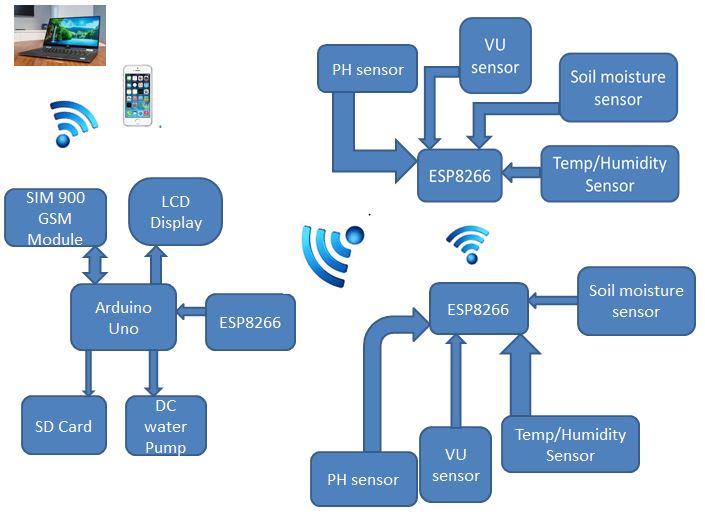
Smart-farm Block Diagram
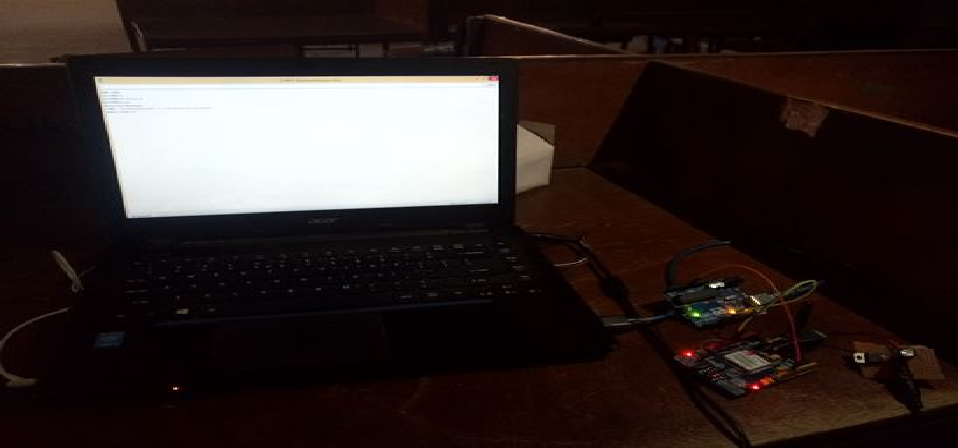
GSM Module(SIM900) Transmission test
Using the ESP8266 Wi-Fi capability, a sensor mesh network communicates to a central station in the farm that is equipped with Arduino UNO and SIM900 GSM module.
The GSM module enables this project to be classified as an IoT project, as its GPRS capability is used to push data online using the MQTT (Message Queuing Telemetry Transport) protocol.
With the help of the MQTT protocol, the central station in the farm can publish data from sensors to an MQTT web broker. This will enable a Website and mobile app client subscribers to get data for the sensor topics they have subscribed to.
The user/analyst then makes use of the Website/app tools to transform this data into useful information about the welfare of crops, make timely predictions to help the farmer in the farm improve productivity and farm yield.
This project can easily be extended to perform other functions, for example, if the sensors and actuators are replaced as desired, an IoT based home automation system can be created.
I received my first job offer nine months before graduation in FUTO (Federal University of Technology Owerri, Nigeria). I neither applied nor interviewed for the job. I was away on business in Onitsha and Aba for a week [I published a campus news magazine FUTO Bubbles and was out to collect money from advertisers, mainly bookshops and electronic component sellers]. I made it back to school. I was told that the Head of Department wanted to see me. I met him and he gave me a document. Prof SOE Ogbogu had already signed and accepted the job for me. I thanked him, collected the offer and left. (Those days in FUTO, top 1% of graduates get jobs while in school. Before graduation, I received three jobs excluding the academic Grad Assistant offer to teach in the school).
It was an experience: I was going to start work three days after defending my final year project [defend on Friday, start work on Monday]. It was a great job with an apartment, a car with a driver, and a good pay. Nigeria set me up with many choices in life. I am always positive on Nigeria – it has been good to me.
Think about it when you look at the challenges our young graduates are going through. It is a national problem and our government must do all necessary to make sure our economy works better.
We have a big problem in Nigeria right now. Unemployment is destroying the promises of a generation of young people. With extremely limited decent labor entry points, our young people would lag their peers in career developments within years.
In America, they talk of black swans: ” high-impact risks that are highly improbable and therefore almost impossible to predict”. Yes, “an unpredictable or unforeseen event, typically one with extreme consequences.” That is it: “something extremely rare”. So, because it is rare, you do not (usually) plan for it. Arab Spring was a black swan as the leaders of North Africa could not have modeled that risk.
In Nigeria, we do not just have black swan. We have gray lizard. It is a high impact risk, that is highly probable and evidently visible but totally, widely and irresponsibly ignored. The massive youth unemployment in Nigeria is a gray lizard. Governments see it daily but it is totally ignored.
Graduates attending an immigration recruitment program
Nigeria has about 96% of all its enterprises within the SMEs categories but those SMEs generate about 50% of the employment, according to the World Bank [Broadly, 96% of Nigerian businesses are SMEs while the MSME (micro, small and medium scale enterprises) sector employs over 59 million (84.02% of the total labour force) people in Nigeria. The MSMEs remain the engine of economic growth in Nigeria]. The implication is that our SMEs are not creating jobs at the rates that would help the economy. One way to fix this problem is to make it easier to put private capital in them. I had advocated a tax incentive that would see massive injection of capital in Nigerian small businesses and startups. Government can also modernize the apprentice system in most southeastern communities to make it more efficient.
Government should offer new VC (venture capital) firms in Nigeria a ten year tax incentive on profits if they have asset base of at least $50 million and will deploy the capital in Nigerian startups within 10 years.
Offer new VC firms in Nigeria the opportunity to repatriate 100% of profit within ten years. That will help the country to attract foreign investors to make Nigeria home.
It would be really good for many young people to experience the kind of opportunity Nigeria gave me. It boosts confidence and helps people pursue visions. I have built on that support Nigeria gave me.
There are five major attributes of digital (internet-based) startups which you must examine as you build. They are Aggregation Construct, Inversibility Construct, Marginal Cost, Diminishing Internet Abundance, and Commoditization Paralysis. In this video, I explain the Aggregation Construct using OgaVenue and Printivo to bring it home. The foreign ICT utilities like Google and Facebook are also used in the case studies. For the other attributes, they are extensively discussed here.