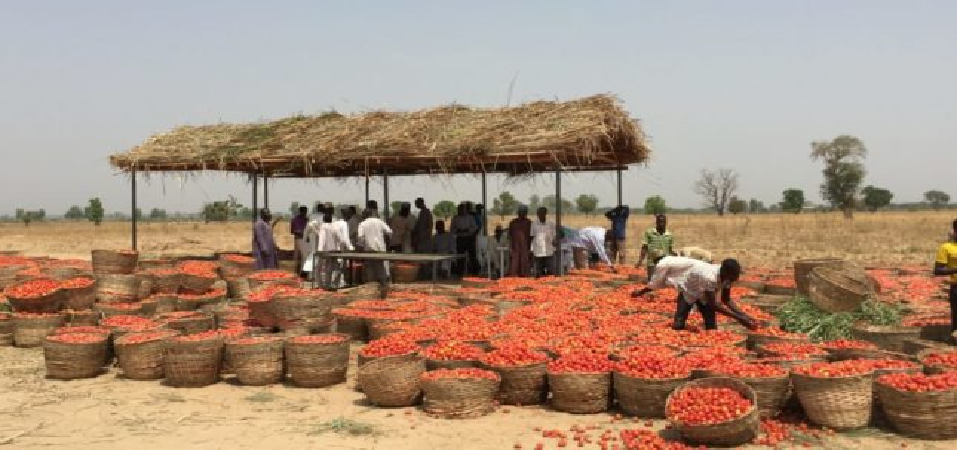
Agriculture is the lifeblood of Nigeria’s economy. Forget hydrocarbons; that one is for the money men. More than 60% of working Nigerians are employed in agriculture. Unfortunately, the agricultural practice in the land is heavily subsistence in nature with practically no productivity gain in years. The implication is a great stasis requiring government to feed farmers. Yes, you read that well: government needs to send food to farmers to prevent severe hunger.
But change is coming, and we are seeing a fundamental reboot in the sector. Government is working now to fix one of the root causes of the agricultural paralysis: limited agro-insurance. According to Punch, Nigeria plans to increase agro-insurance from the paltry current 500,000 farmers to 3.8 million farmers (too bad the reporting did not give timeline). Sure, the new target is still small, but that is progress.
The Federal Government is planning to increase insurance coverage for the agricultural sector from the current 500,000 farmers to 3.8 million farmers.
The Managing Director, Nigeria Incentive-Based Risk Sharing System for Agricultural Lending, Mr. Aliyu Abdulhameed,while speaking at a forum in Abuja, noted that the move would help increase the level of output for the sector.
To achieve this, he said NIRSAL had commenced discussions with Royal Exchange Assurance, Nigeria Meteorological Agency among others for the development of a technology-driven Hybrid Index Insurance product.
Most private insurance companies have not paid attention to agro-insurance because the process is extremely challenging because of the small sizes of our farms. Yes, when you put men and women on suits to administer such programs, finding profitability becomes challenging. The only strategy for decades was to ignore agro-insurance in Nigeria, leaving it mainly to NAIC (Nigerian Agricultural Insurance Corporation), the government agro-insurer. Of course, even NAIC does not have scale to do much.
So, we have remained where we are, focusing on mobile apps innovation when the most important innovation in agriculture remains elusive to farmers for decades. But modern technology is changing that. Yes, you can administer the programs and still find value even for small farms. If the government can unlock insurance, a catalytic element of modern commerce, it would reboot Nigeria by making farming a business.
We need that glory because if we can fix agriculture, we would fix poverty. And if we fix poverty, our democracy would be magically strengthened.
One of the best things that happened in Nigeria during the 2015 recession, and the associated foreign exchange scarcity, was Nigerian entities being forced to look internally to find solutions. With no foreign exchange, there was no option to even consider importation. As I explained in a Harvard Business Review piece, even paint makers were innovating. Of course, the recession was a very challenging time across our industrial sectors, from real estate to banking, insurance to pharmaceutical, as many lost their jobs. Yet, in the midst of the miry clay, something positive happened: our indigenous startups got second looks.
The paralysis was contagious; even banks struggled. Within months, they started engaging local companies to provide some elements of their software needs. Many companies benefited immensely on that industrial redesign, moving from foreign software to local ones. One of them is Lagos-based ATB Techsoft Solutions. It is a relatively young company that is yet to celebrate its fifth birthday, but it has blossomed in what it does. It has mastered the business of scaling innovation where great products, out of software R&D, are massively scaled across market segments. It generates revenue that would make most insurance companies in Nigeria envious.
ATB Techsoft Solutions Limited is an IT Solutions delivery Company incorporated … to undertake and provide various IT as well as advisory services to the banking and manufacturing sectors of the Nigerian economy including Government departments & agencies as well as educational institutions.
The founder, Abiodun Atobatele, saw a need (that friction at heart of free enterprise) in the market: Nigeria would be a market for indigenous software solutions that offer unlimited customization capabilities which are largely impossible with any foreign software. He left where he was employed and became an entrepreneur. Eminently brilliant, he started coding, not for fun, but for alpha. Yes, he wanted to fix frictions in the market and expected to be compensated by the markets. Doing that requires delivering excellent solutions to clients and partners. Today, ATB Techsoft is growing and providing employment to many Nigerian citizens.
Selection of ATB Techsoft team (by my right is the CEO of ATB Techsoft, Abiodun Atobatele)
The All-Industry Portfolio
Abiodun wants to build a local software powerhouse that could compete with any foreign brand in the Nigerian and broad West African markets. Unlike the complainers who delight in reminding us that Nigeria has no talent, he saw all he wanted in Nigeria. He hired tens of Nigerian graduates and gave them assignments to build technologies and solutions which their brothers, sisters, parents and friends would use in our economy. The nerds and the geeks responded.
Today, ATB Techsoft has one of the largest collections of indigenous software portfolio in Nigeria covering any sector you can imagine, for any need you can think. I mean there is no industry it does not have enterprise software. Its development process is supreme. That process is the reason it has achieved success within its short existence.
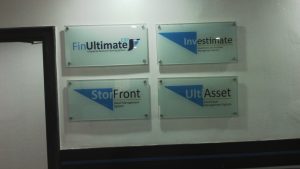
Selected ATB Techsoft Brands displayed in its office
ATB Techsoft grand vision is to deliver a one-stop software solution across market sizes and industrial sectors in West Africa. All the solutions are packaged and promoted under its oasis, the FinUltimate.
Finultimate offers the most comprehensive portfolio of applications software designed to help companies improve operational effectiveness, profitability, product innovation, distribution / delivery channel growth, customer relationships and enterprise information management.
FinUltimate is an African brand and would lead the future for ATB Techsoft. It is making software in ways that allows small companies to afford them, and get the benefits of productivity gains which software make possible. I am a believer; I love the software for my businesses. With ATB Techsoft, I do not have to worry on endless licensing fees with foreign companies. Call it pricing software in the old ways Africans used to break kola nuts: giving more to make your neighbor feel comfortable in your house.
ATB Techsoft has a multi-pronged growth strategy: it has a very profitable software business and a technology advisory service business. The business is built into four groups which include Infrastructure, Security, Networking, and of course the Software. All are closely integrated in the business. Through these groups, it serves tens of clients in Nigeria and beyond. Its services have also extended into central Africa.
My best part in the firm is the open innovation house where the geeks hang around as they plan the next industry to eat with software.
ATB Techsoft In-house Open Innovation Space
Software for Nigerian Companies
Abiodun plans to make its software to work for any business in Nigeria. It has built this end-to-end software solution that can help any business in Nigeria. Indeed, in anything software can do, ATB Technsoft would provide the necessary software. And because there are many things software can do, the company believes it has opportunities.
I asked him how he plans to make that happen. He explained that it makes sense for any company with a bank account in Nigeria to get most of its software largely free from the bank. He wants to be the one supplying the software to banks in order to make bank customers happier. This is what he is working on right now. That sound exciting that you can get your enterprise software from your bank, and with the software you can handle HR, accounting, taxation, supply chain management, fixed asset, inventory management and more. All that for free through your bank.
Indeed, he is providing a new level of customer engagement opportunity to his banking partners. That would be great for Nigerian businesses. The massive savings from importing foreign software would be catalytic to local companies. I have gone ATB Techsoft in my business and we indeed love the seamless integration that comes with its technologies. If my bank makes that possible, that would even be priceless. I think a synergy exists here between ATB Techsoft and our banking sector. If they integrate the banking transactions into the software, one would expect more productivity gains in how our local firms function.
All Together
ATB Techsoft has done well over a very short period. But the future is going to be competitive since every market share it wins, someone is losing. That is why it has to vigorously innovate. But looking at the faces of the young people at the heart of the firm’s mission, there is no need to doubt the promise.
Furthermore, the firm has to also deal with issues of software piracy and making sure that its intellectual properties are protected and respected. I feel so excited when I see some local banks solutions and I know that some of them are now created and supported by companies like ATB TechSoft. Getting Nigeria out of our stasis would come when companies like ATB Techsoft are supported not just by the private sector but by governments. That is how you turn a company with dozens of staff into one that employs thousands.
The promise of that Nigeria with optimism, opportunity and unbounded energy would only come when we look inward to find solutions to frictions that exist in our markets and economies. ATB Techsoft is a messenger of that redesign which is critically needed in our great nation.
Disclosure: ATB Techsoft is a Fasmicro Group Advisory Services client
We have a big problem in Nigeria right now. Unemployment is destroying the promises of a generation of young people. With extremely limited decent labor entry points, our young people would lag their peers in career developments within years.
In America, they talk of black swans: ” high-impact risks that are highly improbable and therefore almost impossible to predict”. Yes, “an unpredictable or unforeseen event, typically one with extreme consequences.” That is it: “something extremely rare”. So, because it is rare, you do not (usually) plan for it. Arab Spring was a black swan as the leaders of North Africa could not have modeled that risk.
In Nigeria, we do not just have black swan. We have gray lizard. It is a high impact risk, that is highly probable and evidently visible but totally, widely and irresponsibly ignored. The massive youth unemployment in Nigeria is a gray lizard. Governments see it daily but it is totally ignored.
My case remains: the Nigerian government must stimulate the economy through extended and massive injection of loan guarantees to help small businesses grow to absorb these young people.
I project the following as impacts: Each of the 50,000 benefiting companies would add 10 employees within a year for a total capacity of 500,000 (direct) new jobs. The boom in the economy as result of this expansion (the new workers would spend money, the banks would expand, the firms doing business with these 50,000 companies would expand, etc) would result to additional 1 million jobs.
So, within a year of the initiative, government would have created very good 1.5 million jobs. And it can do this without losing a dime if the loans perform well.
We need to prevent this gray lizard from blowing up. Do not think it is impossible for the young people to wake up one morning, out of frustration, and cause mayhem. Yes, we need to create jobs through the private sector. And I challenge the government to declare emergency on youth unemployment in Nigeria.
I have written extensively on the brilliance of aggregation construct where companies make money on raw materials generated and created by users. For example, Facebook feeds on our photos while Google depends on our websites, to run their businesses. The assumption has been that these IT utilities would remain gatekeepers making it harder for others to break in.
Under the aggregation construct, the companies that control the value are not usually the ones that created them. Google News and Facebook control news distribution in Nigeria than Guardian, ThisDay and others. Because the MNCs tech firms “own” the audience and the customers, the advertisers focus on them, hoping to reach the readers through them. Just like that, the news creators have been systematically sidelined as they earn lesser and lesser from their works. But the aggregators like Facebook and Google smile to the bank. The reason why this happens is because of the abundance which Internet makes possible. Everyone has access to more users but that does not correlate to more revenue because the money goes to people that can help simplify the experiences to the users who will not prefer to be visiting all the news site to get any information they want. They go to Google and search and then Google takes them to the website in Nigeria with the information. Advertisers understand the value created is now with Google which simplifies that process.
But Google’s 2017 fourth quarter results do show that while Google could technically use all contents on our websites for free, it would need to put money on the table to have access to other aggregators. Last quarter, Google spent approximately $6.5 billion to pay such aggregators for traffic.
Even without the one-time tax charge, Alphabet’s adjusted earnings came in at $9.70 per share in the fourth quarter, which still fell short of the $9.98 per share that Wall Street expected. The disappointing earnings came as Google’s traffic acquisition costs, the amount it pays to partner websites, continued to rise in the most recent quarter, jumping to $6.45 billion (or 24% of Google’s ad revenues) from $4.8 billion in the same period a year earlier. The company has said that its traffic acquisition costs will likely continue to rise as it shifts more of its ad business to mobile search. Google’s aggregate paid clicks also increased by 43% year-over-year in the fourth quarter
LinkedIn is one of the aggregators selling aggregated contents to Google. If you type any name, not a celebrity on Google, the first search result is usually from LinkedIn. Google pays LinkedIn for that information. Another is Twitter whose feeds or tweets are now part of Google search results. Something new is happening here: these large aggregators can find revenue beyond advertisers; they can make money from companies like Google, Bing and Baidu by commanding hefty amounts on data they have aggregated from users in their ecosystems. I call this Double Aggregation Construct: aggregating data which has already been aggregated from users who originally created them.
Certainly, this has implications to Google business: if these companies have this strong market positioning, Google’s margin would be weakened over time. Twitter has the best real-time data than any ecosystem within the free open web at the moment (Facebook is largely closed). LinkedIn has the best human business diary which is also valuable to Google. These firms can see themselves as movie production companies, producing contents, which are then licensed to search engine platforms in bulk. The only difference is that the produced contents are our data which we give out for free.
Investors did not like the results. The fear is that if Google continues to pay this money, nothing would stop the companies from asking for more. That is the reason the stock fell 4% after the earnings call. You may wonder why it is even necessary for Google to pay in the first place. It is paying because it wants to keep Google Search extremely valuable to users since it is the oasis in the Alphabet empire. If it does not, and Microsoft Bing takes over the agreements especially for Twitter, it could see a massive loss of market share.
Africa’s largest company by market capitalization which is so big that the whole of the Nigerian Stock Exchange is not up to 40% of its value is still searching for another winner. It saw alpha when it hit glory with investments in China’s Tencent. Naspers has seen many disappointments in its broad internet (ecommerce) investments in Africa. It shuttered Mocality, a digital business directory, and also killed Kalahari, one of Africa’s foremost ecommerce companies. In all these entities it closed, it complained of one thing: lack of profitability.
Naspers chief executive officer Bob Van Dijk said Africa’s largest company will consider “structural options” if the value gap with its stake in Tencent Holdings persists.
Naspers has a 33% stake in Shenzhen, China-based internet giant Tencent, valued at about $158 billion, while Naspers itself has a market value of about $112 billion. The discount is “too high,” and has been accelerating in the past 20 months, Van Dijk said on Tuesday in New York. Leaving aside Tencent, analysts place Naspers’ asset value at more than $180 billion, said chief financial officer Basil Sgourdos.
The deal with Tencent was extremely good for the South African company. It has continued to look for another moment like that. Despite exiting many ecommerce companies, it got back few years ago with investment in Konga for 50% equity.
Naspers, South African media giant has acquired a 50 percent holding in Konga.com, the leading Nigerian online general merchandise store, for an undisclosed amount.
Meloy Horn, Naspers’ group information relations officer confirmed the acquisition adding that the media giant was “anticipating favourable collaborations involving both parties in the near future.”
“Nigeria will possibly soon be the largest economy on the African continent, therefore as an investor we are keen to participate in the growth of a promising African market,” Horn said.
Naspers loves Nigeria with MultiChoice, DStv, GoTv , etc all doing just fine in the country. Yet, its ecommerce investments have not turned out well. It tried Kalahari and Mocality in Nigeria before it gave up. It has at least one major ecommerce business in Nigeria through OLX, a digital classified business. OLX early this year started running adverts in its platform to help boost revenue, and it is now within the crosshairs of Facebook Marketplace which is now the second ecommerce platform in Africa, behind Jumia..
Yes, Facebook has a marketplace; the very business companies like OLX and Jiji depend upon. With nearly everyone on Facebook, these companies would have real challenges ahead to get people to get out of Facebook. After all, the same users OLX and Jiji target are the same people selling and buying on Facebook.
Facebook would scale Marketplace across Africa in coming months. That would be bad for OLX which just introduced advertising in its ecosystems to make extra revenue. The future with Facebook, WhatsApp and Instagram evolving into SME and business ecosystems could be devastating to African startups working in the ecommerce space.
Konga was sold to Zinox Group this weekend. That is certainly not the exit Naspers was expecting. The story of Naspers’ foray into ecommerce tells us clearly that ecommerce in Nigeria would be hard to figure out. This company has essentially burnt tens of millions of dollars as it continues to look for a working model. Sure, one day, someone would figure it out. It could be that the solution is not just the money, but the right business model. That “right business model” remains elusive.
You can always read my Harvard Business Review piece that captures some of the challenges which most ecommerce platforms cannot control, unfortunately.