I think it is official now that the era of ecommerce is over. We have officially moved into hybrid-commerce (or h-commerce). Any talk of ecommerce is for history; the global business has changed the “e” with “h”. So, I want to begin that conversation in Africa by focusing on h-commerce. Today, we are reading that Alibaba is spending billions of dollars for a stake in Sun Art, the largest retail chain in China, call it China’s Walmart.
The fundamentals of this redesign are correct: it is the marginal cost and where the money is that must drive retail strategy. The money remains offline and you need an expanded strategy to meet the needs of customers in a business dominated by logistics cost (an offline component cost).
For Africa, the case for h-commerce is even stronger. We do not expect the total online retail market to move up to 1% over the next decade in Africa. Today, total online market is well below 0.1% and the players do not have the leverage to change that due to our open market system (four market days, etc in most parts of Africa), fragmented market (everywhere is market), poor distribution systems, and lack of tax advantage which helped U.S. e-tailers (Amazon enjoyed no sales tax burden collection for years, making its products cheaper than those sold in brick and mortar stores).
The path to profitability will pass through physical commerce. Why compete for 1% when 99% is out there? Amazon and Alibaba know that in 5 years as physical stores move online, their advantages will be neutralized. So, they are playing offense. If the world runs in the physical space. especially in grocery, you better go there to get the deals.
Simply, we need a hybrid commerce strategy in Africa if we want to be on the path to profitability. Marginal cost of ecommerce is dominated by atoms and not (direct) bits. (Sure, information is physical, but let us avoid that complexity here.) Hybrid commerce will require returning to offline partners, and we need to make that work for Africa. It may not be complex if our companies are open to work together and where possible merge.
I visited an Amazon local store in U.S. You can call it a pickup location. Interestingly, that is the very reason that makes it a brilliant idea. Amazon is trying to flip the logistics burden: instead of going to your house to deliver, it offers you the choice to come to its store and pick up your purchased items. In that store, you cannot buy anything physically. Largely, people come there to pick up items.
It offers deep convenience as it solves the problem of delivering items when people are at work, and away from homes. It also reduces costs for the shopper since you do not have to pay shipping cost. Generally, Amazon will save money doing this. It plans to have many of them across American cities. The implication is that Amazon will increase its real estate or rent expenses. Sure, the stores are very small, and rent cost will not be that significant, when compared with the savings for not sending people to homes to deliver items.
Leaving work at 5pm, place the order at 1pm and on your way home, you can pick up the items at Amazon Store. This is one way Amazon is showing that the “e” in commerce is all but gone. We are in the age of hybrid-commerce because winning this will involve winning on atoms besides conquering all the competitors in bits and bytes. I have written extensively on the marginal cost element of ecommerce and how the logistics component dominates that. So, Amazon is doing all necessary to reduce that cost with these pickup stores.
[Updated this section Nov 20th with news of this Alibaba deal] Alibaba is also betting big on brick-and-mortar retail. The Chinese e-commerce giant paid $2.9 billion for a 36% stake in Sun Art, the largest operator of Walmart-style stores in China. These firms are pushing into offline shopping.
Alibaba Group Holding Ltd.’s $2.9 billion deal to buy a slice of China’s largest hypermart chain pits it against Wal-Mart Stores Inc. in the world’s largest retail arena.
China’s biggest e-commerce company agreed to acquire 36 percent of Sun Art Retail Group Ltd., which operates about 400 hypermarkets under the Auchan and RT-Mart banners. As part of the deal, France’s Auchan Retail SA will raise its stake in the Hong Kong-listed company to a similar level, and form an alliance with the internet giant to tackle the same Chinese food retail sector Wal-Mart’s targeting.
The physical world is where the money is: “The U.S. online grocery market is estimated to generate sales worth of about 14.2 billion U.S. dollars in 2017, with sales forecast to reach 29.7 billion U.S. dollars by 2021.” But “in 2016, U.S. grocery store sales amounted to about 626.98 billion U.S. dollars” . Simply, to win in grocery, you need a physical element.
I predict that within the next few years Amazon may offer coffee and tea in these local stores with devices where people can order things while they drink!
Nigerian local entrepreneurs should consider how the market is changing and adjust. It may be time for them to start striking partnerships with local stores. Amazon bought a local Indian supermarket primarily to have pickup locations to reduce delivery cost. That also helps it to mount more pressure on the physical competitors. Alibaba has been operating supermarkets for three years now, and opening new ones. If U.S. and Chinese markets are not easy to deliver great value via pure ecommerce, Nigerian market should not be expected to be different. Konga and Jumia should study these elements, even as they roll out their own pickup stores, to explore if they need to move into the physical commerce with more vigor.
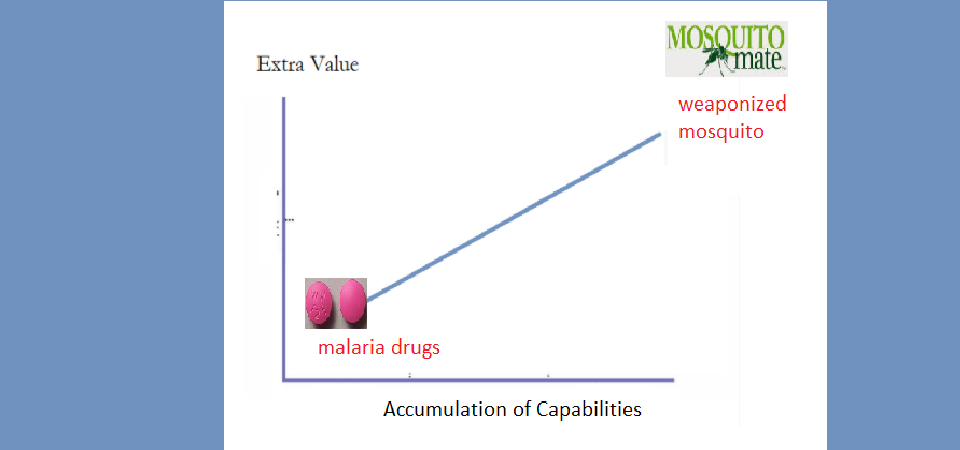
Nigeria spends billions of naira fighting malaria daily. Our fight, unfortunately, is at the downstream level with no impact on the upstream level where we can achieve more. Drug companies sell their drugs to citizens brought down by malaria. It is a vicious circle because no efforts are made to eradicate the mosquitoes which cause the malaria. For decades, malaria has been a common ailment across communities. We lack the capabilities to deal with malaria in a way that will make it history.
Companies must develop and accumulate capabilities in order to compete in the market place. In this video, I explain how any firm can do that and why accumulating capability is very strategic. From Google to Dangote Group, when companies accumulate capabilities, they see themselves operating in the segments of markets with higher value (usually upstream) compared with where their competitors operate (usually downstream).
Contrast with news that U.S. wants to take out any mosquito in its land. The US has released an army of “mosquitoes” which has been weaponized to deal with the bad mosquitoes that cause malaria. The Environmental Protection Agency (EPA), a regulator, is allowing MosquitoMate, a company, to release its lab-grown, bacteria-carrying male mosquitoes (who don’t bite) to infect females and reduce populations of mosquitoes across America. The goal is to make sure mosquitoes do not bring pains to people.
The US Environmental Protection Agency has given its approval for MosquitoMate, a Kentucky-based biotechnology company, to release its bacteria-infected male mosquitoes in several parts of the United States.
The EPA approval was first reported by Nature on Monday (Nov. 6), and confirmed by the company. The EPA said it registered MosquitoMate’s mosquito as a new biopesticide on Nov. 3, with a five-year license to sell in 20 different states. (Here are the EPA’s risk assessments and public comments.)
If you are looking for business idea in Nigeria and you have elite skills in biotech, this is an open opportunity. But it may not be easy as biotech can turn out to be evil if your agents begin to ravage communities due to a mistake in your compounds (think of bio-weapons). For U.S. to have approved this, they must have conclusively ascertained that these weaponized mosquitoes are safe. I will not want them in my village, but I cannot pass the fact that America attacks problems from the upstream level: kill the mosquitoes and malaria will be history. That seems like a better idea when compared to making drugs for malaria!
NB: I’m not sure if malaria, specifically, is included in this U.S. govt project . But the theme remains. The company does mention malaria but it is not clear if the U.S. government included it in the approval.
ICT brought productivity gains across industrial sectors, delivering immense values to companies. However, Internet is going to destroy the values in many sectors. The transfer of most of the values, from the physical world to the digital one, will not be optimal. Some values will be “dissipated” during the “transduction”, the process of converting energy from one form (meatspace) to another (online).
At the early phase of Internet publishing, many digital publishers made money when Google AdSense (Google product that helps websites show ads) made much sense. But over time, it has become increasingly difficult to earn any decent income on digital publishing, especially when your contents are not premium to command subscription. When you engage in click-bait, people can live without you unlike WSJ which drives news that move billions of dollars around the world. So financial and business journalism will be fine in the age of digital subscription, but generalists will be totally commoditized. Even fighting for more users will not save the generalists. Why will you pay subscription to read Punch Nigeria when more than 80% of the contents are in either Sun or Vanguard?
Some brands are going through what I have called the Diminishing Abundance of Internet. I explained: “It is a construct that some companies become poorer even when they are growing in numbers of customers reached. That applies to industrial sectors like publishing and telecoms. The lesson here is that risk, in any business model, must be examined from the lens of this mirage abundance, which Internet has provided in some sectors”. One company that is going through that at the moment is the very popular Mashable which has evolved as a technology blog to anything-blog platform.
Yes, Mashable has agreed to sell itself to trade publisher Ziff Davis for $50 million, compared to its earlier $250 million valuation.
Digital-media firm Mashable has clinched a sale for the company — and it’s not for a price that founder Pete Cashmore or investors including Turner were looking for.
Ziff Davis, a tech, gaming and healthcare publisher, is buying the New York-based company for about $50 million, the Wall Street Journal reported, citing anonymous sources. That’s 20% of Mashable’s valuation of $250 million following a $15 million round of funding last year led by Time Warner’s Turner.
Mashable has been trying to sell itself or raise additional outside capital for months
That is a very small amount for a digital blog pioneer. It used to have so much influence until Facebook started abstracting publishers in the consciousness of readers.
The Transduction System
When meatspace systems and processes move online, value is always destroyed. When we started chatting via WhatsApp over using SMS, value was destroyed for companies like telcos that used to make money via SMS. When Skype took up the telcos, the same happened. The only good news is that the customers save, even when getting better experience. But the enterprises at the centers always struggle. You can call this disruption.
Yes, something is destroyed and disrupted. But most times, the company destroying does not really make so much money while redesigning the industry: it simply destroys values for the enterprises in the sector, as you do not pay Skype for the money you did not pay the telcos for the one hour Skype call from Lagos to New York.
Note that Mashable is not losing readers, at scale. Unfortunately, more users may not help it. The ad revenue model does not just add up any more unless you have a big syndicated ecosystem like the type Ziff Davis commands which allows it to push adverts across its platforms. That scale helps it win contracts from advertisers. And that is why they are looking for properties.
Yahoo, TechCrncuh and HuffPost parent, AOL, enjoys the same. The old era of one popular blog in the general category with strong revenue base is challenged. Those sole blogs decimated print publishers, but the unconstrained and unbounded Internet is now after them. In the unbounded Internet, aggregation becomes critical. Selling to enterprises like AOL and Ziff Davis is a quasi form of aggregation as that helps abstract the platforms, focusing on the gatekeepers who have scale.
Everything goes back to Facebook and Google which have emerged as top publishers without budgets for contents. Any digital business that does not examine how Google and Facebook will affect it does not have a comprehensive strategy. What happened to Mashable will keep happening. Gizmodo has since sold to Univision which added six to help it has scale to command ads. You just wonder how this transduction process from the physical world to digital will play out in ten years, even for the digital natives.
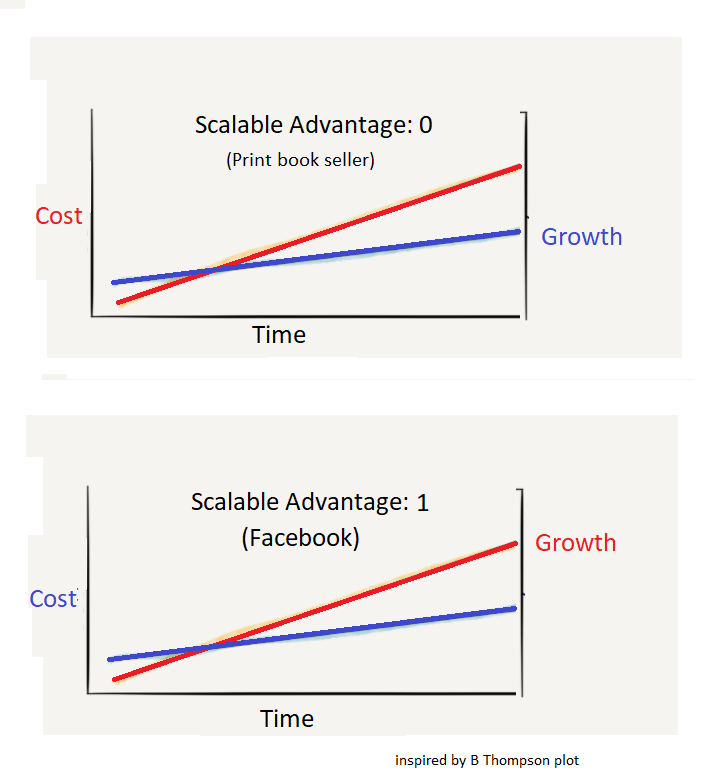
The relationship between acquisition cost and growth is at the heart of any startup operation. There are largely two paths to growth, and the one your startup follows will determine how fast you can grow through limitations imposed by marginal cost. When you follow the path that favors business models with scalable advantage tending towards “1”, your business will generate value faster.
When marginal cost goes low, a company can experience a virtuoso moment, anchored on network effects, where more users bring more partners, and more partners more users. But that happens to startups with certain characteristics which make it possible for them to INVERT the positioning of growth trajectory and acquisition cost typical in most traditional firms. At scalable advantage of 1, the acquisition cost curve can even begin to flatten, and yet the growth will continue to experience positive slope. Google did not waste money in advertisement for years, and yet it was adding many users.
In this video, I explain the two most important plots that define how fast you can grow that business or startup, especially at the early phase, before maturity. It is about ascertaining the speed of growth through The Trajectory Advantage of a business.
You can revisit the Scalable Advantage video below.