DD
MM
YYYY

PAGES

DD
MM
YYYY

spot_img

PAGES

Home Blog Page 7273

Replicating Equifax’s Positioning

0

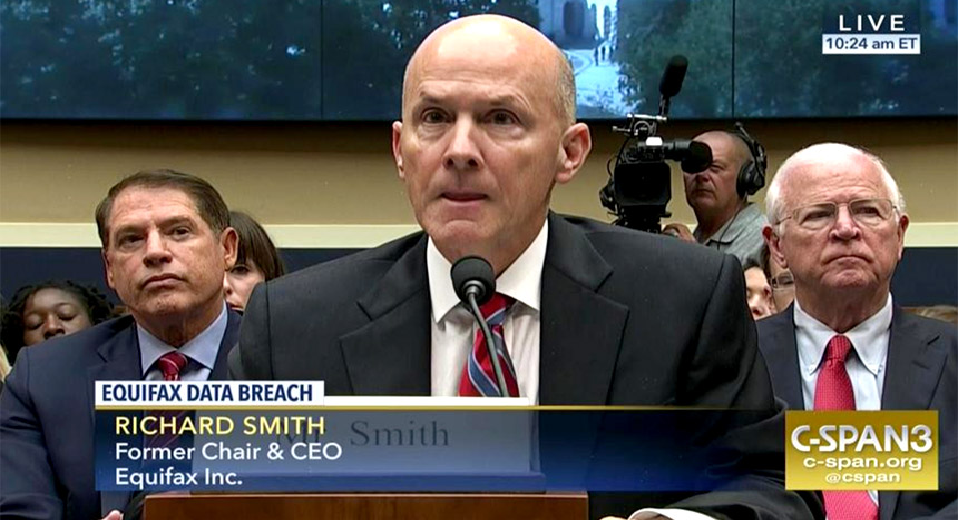
Equifax was hacked and excess of 143 million people private data were compromised. Bad people could use the data for identity theft resulting to years of nightmare to the people affected. U.S. Congress and American residents are unhappy. That is rightly so because Equifax was careless. It dropped the ball on the most important raw material of its business: the people’s data.

In a prepared testimony ahead of his appearance before a congressional panel, former Equifax CEO Richard Smith said he was “deeply sorry” about a data breach last month that exposed the personal data of more than 143 million consumers, saying his company “failed to prevent sensitive information from falling into the hands of wrongdoers.”

But as you look into this mess, there is something that is clear: Equifax has a business that is extremely well positioned that even in this mess, it can still profit. I mean, Equifax can be making money even as it is causing mayhem in the lives of American residents. Here are some ways Equifax is profiting:

  • Equifax offers enhanced credit monitoring to the same people its data breach is causing harm. So Equifax wants the customers to pay for services to help protect their identities from being used for fraud
  • LifeLock, a specialist on identity theft protection, which is experiencing massive business boom due to the Equifax data breach, buys its credit monitoring solutions from Equifax. Simply, even if you do not want to work with Equifax directly and decide to buy solutions from LifeLock, you will still be sending money to Equifax
  • U.S. Internal Revenue Service, the tax collection institution, signed a $7.25 million contract with Equifax just as the break was made public in September. The deal is for tax fraud detection and prevention.

Sure, Equifax will pay tons of money through class action. Trial lawyers are already circling. Yet, despite that, it is very evident that this company has deep positioning in the market. It can win on any side of the coin: head or tail.

Think about it, and see how you can build a company that can be structured with such deep positioning that even in crises, your customers will need your services, business partners will sell your services, and the government will come to you and buy your solutions even when you are the main catalyst of the mayhem. Its deep positioning is something every brilliant entrepreneur must aspire to replicate in its industry.

Usually when crises come, people run away from companies. But here, citizens are running to Equifax, partners are selling its solutions, and government needs Equifax help. Its positioning is very uncommon in markets.

Towards Africa’s Knowledge Economic Communities

0

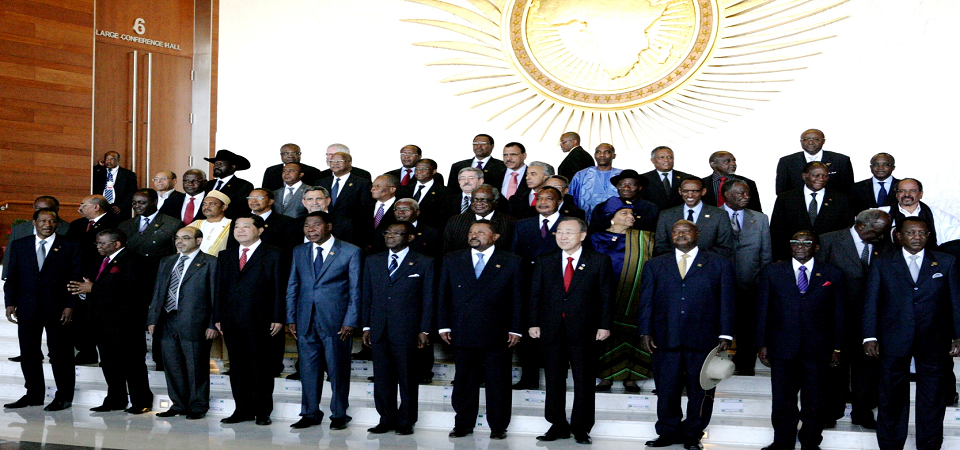
About half a century ago, African leaders established the Organization of African Unity partly to promote socio-economic structures aimed at improving the welfare of the citizens and general integration of the continent. But owing to decades of political tensions and weak economic infrastructures, the goals have not materialized.

The success of the single European currency, Euro, which has become very central to many recent transformations in Europe by offering more efficient means of transacting businesses and using the human and institutional capabilities of the continent to foster more prosperity has shown the power of integrated monetary system in a globalizing world. As the world moves towards knowledge-based economic structures and data societies, which comprise networks of individuals, firms and nations that are linked electronically and in mutually dependent global relationships, the power of a single African currency has become very important.  A single African currency, if realized, would radically redefine Africa’s social, political and economic landscapes and position the continent on a solid footing to tackle the enormous challenges of the 21st century.

This plan is poised to offer an African market with reduced internal barriers in which the free movement of goods, persons, services and capital is ensured due to lesser friction associated with currencies. A single currency stands for an Africa of unity, integration and strength. However, there is a possibility of potential failure of a single currency if implemented haphazardly with enormous consequences to not only Africa’s image but also the member states’ economies and, ultimately, the citizens.

Irrespective of the challenges and opportunities, a single currency will not just solve Africa’s problems overnight and it would be a mistake to hedge all the future developments of this continent on this venture.

As the continent continues to work towards realizing the United States of Africa (by the way, I prefer, Union of African States), it is important that we evaluate this project beyond politics and solidarity. While it is possible to be carried away by the success of Euro, it is imperative that African leaders understand that the EU has been cooperating for decades and it took many years to realize the single currency after the Treaty of Rome. Signed by six nations  (France, Germany, Belgium, Italy, Luxembourg and the Netherlands) on 25 March 1957. The Treaty created the European Economic Community (EEC) that provided the foundations for European unity based on the common values of peace, freedom, equality, the rule of law and democracy. Today, the EEC (yes, Euro Zone) is the world’s largest free trade area.

An African equivalent of the Treaty of Rome is the Abuja Treaty signed on June 3, 1991. That Treaty created the African Economic Community (AEC). AEC provides the platforms for larger African market for negotiating favorable trading terms bilaterally and globally, boosting investment and economic diversifications. A larger market will support economies of scale, better market access and production efficiency through competition.

In addition, economically integrated Africa could provide stable exchange rate, increase cross-border trade with efficient banking clearing and payment systems. There will be more potentials for improved consumer welfare, stronger political and security ties in the continent. It promises to offer better fiscal and monetary cooperation among states with long-term macroeconomic stability.

Nonetheless, despite these potential benefits, the problems of poor transport and communication structures in Africa continue to limit more intra-regional and intra-continental trades among members. The incessant political tensions across the regions continue to affect the creation and expansion of trade. From South Africa to Nigeria, African nations continue to trade heavily with their ex-colonial rulers over African Union partners. As a result, many African products get to member states via Europe. For many of the fiscally undisciplined nations, a loss of national autonomy on macroeconomic policy could be challenging. Losing autonomy on currency devaluation and revaluation, fiscal and monetary policies on interest and exchange rates will present major worries across African capitals.

How this integration will play out is still not clear. Take for example, the Francophone Africa is considered an ‘undertrader’ despite the CFA franc zone having one of the most extensive monetary unions in the world. Projected data in case of doubling of trade (from integration) suggests that some of the five regional economic communities will have net welfare gains, while others will have losses. Yet, while the feasibility and desirability of a united African currency union could be debatable, the structure and dynamics of the globalizing world makes economic integration a necessity if the continent must survive global competition.

All the continent has to do is to approach the adoption of the single currency cautiously. African Union must work to strengthen the regional economic communities (REC) for better currency unions and financial integrations.  This will involve transforming them, I suggest, into Knowledge Economic Communities (KEC) where knowledge will become the main factor of production with coherent trade shocks among member states. This means more funding for science education, better information networks and transportation systems, revamped innovation and entrepreneurial environment and vibrant democratic institutions. Afterwards, these KECs will converge to a single African economy of one currency to be managed by a continent-wide supranational central bank. A knowledge economic Africa with our vast resources will transform every aspect of modern commerce and industry and move millions out of poverty.

Authentic And Sustainable Scalability

0

Bottomline: Few days ago, we discussed scalable advantage and quantified how companies can ascertain their capabilities to scale by looking at their marginal costs, distribution channels, market sizes and industry. In this piece, I explain how that scaling can be done in the most authentic and sustainable way. You want durable scalability: ability to grow […]

This post is only available to members.

The Peerless MallForAfrica

0
MallForAfrica

Today, we have an exciting development for our beautiful continent with regards to exports. It is coming from an ecommerce company. We love it and I am very excited. Everyone has been theorizing on how to empower local makers to have access to larger markets. Like an avalanche, some brilliant guys are here. The best ecommerce business in Africa today is MallforAfrica: an electronic mall that enables Africans to purchase items from international retailers, but has added a feature for Americans to also shop in Africa. It runs on the aggregation construct, unbounded by assets or market risks. It is unconstrained: a supremely top-grade asset-light business.

Under the aggregation construct, the companies that control the value are not usually the ones that created them. Google News and Facebook control news distribution in Nigeria than Guardian, ThisDay and others. Because the MNCs tech firms “own” the audience and the customers, the advertisers focus on them, hoping to reach the readers through them. Just like that, the news creators have been systematically sidelined as they earn lesser and lesser from their works. But the aggregators like Facebook and Google smile to the bank. The reason why this happens is because of the abundance which Internet makes possible. Everyone has access to more users but that does not correlate to more revenue because the money goes to people that can help simplify the experiences to the users who will not prefer to be visiting all the news site to get any information they want. They go to Google and search and then Google takes them to the website in Nigeria with the information. Advertisers understand the value created is now with Google which simplifies that process

Through this Aggregation Construct, this company can scale without any limitation. It enjoys scalable advantages both in supply (the customers buy and ship for it) and distribution (it uses courier companies to actually ship to final destinations). In all fashions, this company is built for scale. You can put the scalable advantage at close to 0.8.


Why MallforAfrica Is Unique

Unlike other ecommerce operations in Africa, MallforAfrica does not have deep marginal cost problems. It can easily add a new user without the challenges associated with distribution costs. It is not the one distributing across the Atlantic.  In a newsletter to Tekedia, we have thus:

DHL Express , the world’s leading international express services provider recently announced its partnership with MallforAfrica (www.MallForAfrica.com), the award-winning global e-commerce company, which will facilitate selling of made-in-Africa products to customers in the United States. Businesses can do so via the eBay platform powered by MallforAfrica. Through this partnership, DHL locations will serve as drop-off points for products destined for consumers in the United States. This will be the first time businesses in Africa can sell their locally manufactured products directly on eBay.

DHL Express currently handles inbound express delivery for MallforAfrica and has enabled its customers importing from the US to receive their packages seamlessly in Nigeria, Kenya, Rwanda and Ghana. This is a watershed partnership for African businesses as it allows them an avenue to trade on the global stage.

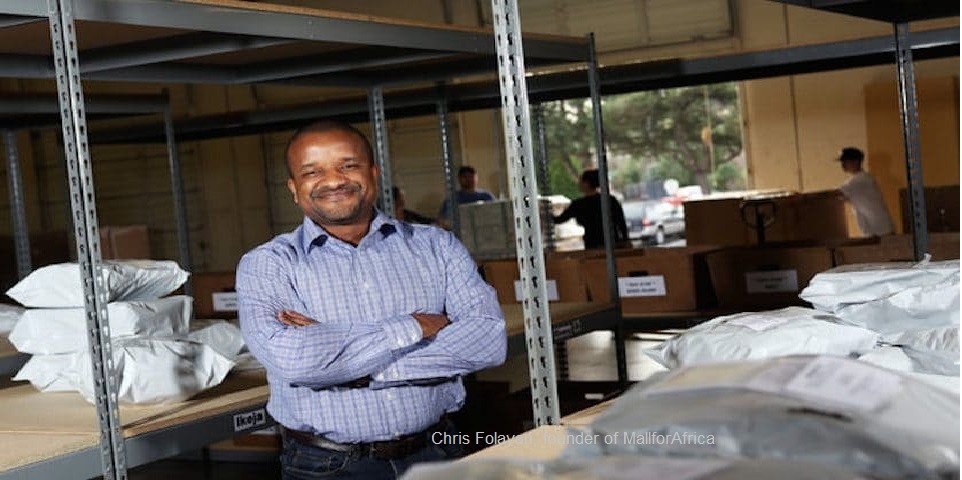
“We have been partners with DHL Express for many years and have tremendous trust in their ability to ship to our customers,” said Chris Folayan, CEO, MallforAfrica. “Both companies have a common goal of seeing African e-commerce businesses thrive on the global stage. We want to contribute to the future of e-commerce growth, African cross-border sales and most importantly, improve the lives of African artisanal arts, designs, crafts and more.”

MallforAfrica is Africa’s largest e-commerce enabler, providing Africans with a platform through which they can purchase items directly from over 200 international online retailers, such as Macy’s, eBay, Ralph Lauren, Net-a-Porter, Carters, GAP, and FarFetch – brands that, would otherwise be inaccessible to the African consumers. By managing every aspect of the order and return cycle, the MallforAfrica app offers its customers a simple, secure and convenient solution to online shopping directly from the best brands in the world.

“We are proud to be playing a crucial role in connecting African artists with American customers through MallforAfrica,” said Randy Buday, Regional Director West and Central Africa, DHL Express. “We look forward to supporting local artisans across Africa sell into America. ‘Brand Africa’ is something that has increased exponentially in popularity in recent years and this platform allows businesses to capitalize on international opportunities through seamless international trade.”

“As a business, we are focused on connecting African consumers and businesses to global opportunities. Digitalization has reduced the boundaries of doing business across borders – consumers are now able to access goods and services from pretty much anywhere in the world, and we are excited to be the ones facilitating this so African artisans can get access to the global audience they so deserve,” concluded Buday.

Simply, MallforAfrica now makes it possible for you to ship to Americans from Africa. So, it has completed the two-market phases (America to Africa, Africa to America).Yes, it is not just sending from U.S. to Africa, but also the other way. The impact of this could be extremely huge. You will see some art works, special leather works, shoes, clothes etc all finding markets in U.S. This is how you enable and empower people. MallforAfrica is doing so, at scale. By removing this distribution cost, Aba shoe can find its moments to expand into America. The Kano makers that make those special necklaces can find markets in U.S. The same applies to the brilliance of arts in Oshogbo and Ife. If the Yankees buy the products, MallforAfrica will deliver from Africa to them. The world is getting smaller, indeed.

I do not see any systemic risk in this company business model because it simply has a platform and everyone works on the pieces. It runs on the same framework as Google and Facebook: aggregation, carrying no asset risks. (It does operate warehouses by those are not inventories.)  With the unbounded internet and unconstrained distribution connected with physical distributor partners like DHL, you will agree that there is nothing in front of MallforAfrica that will stop it from becoming a billion-dollar business very soon. It is the category-king right now, and it has the moments for itself. Any competitor will have to challenge it to take the top spot.

This company business model is peerless in the African ecommerce sector. All the problems I have noted in my Harvard Business Review piece on ecommerce do not apply here. Most aggregators have zero or negligible marginal costs and operate close to the optimal state of perfect Internet. There is only one ecommerce operator in Africa that has the features: that is MallforAfrica.

Of course, the complexity of the business has increased since it will start sourcing for opportunities in Africa with our infrastructure challenges. But this firm has developed and accumulated capabilities over the years. I do think it will manage the challenges of shipping from Africa to U.S. despite our logistical issues as it in-bounds items to DHL offices. Do not be surprised that they can appoint local firms to aggregate the sub-local supplies across cities. And just like that, MallforAfrica CEO Chris Folayan will focus on processing the invoices, counting the profits, with his usual smiles. People, treasure brilliance: this one is from home.

The Data War and The Two Men To Rule The World

0

I am scared of a day I will have to wait for another man to feed me, approve my movement and communication. A day this man will have to decide what I will do and not do. This is no longer a quote or assumption, it is now a reality. Imagine the future.

The Rockefellers & Rothschild amongst a few others controlled the economy when the Tech Generated Data were small compared to today. Looking at the moment, you will observe that there are a good number of social and media platforms and many concepts which, if you pay a keen interest on them, you will understand as a person, that to some extent you are no longer in charge of your personal data/information and maybe life.

The example Tech-worms gearing my assertion, are the concepts to consider;

  1. Internet Of Things (IoT)
  2. Artificial Intelligence (AI)
  3. Electronic Medical/Health Record (EMR/HER)
  4. BigData and Cloud Computing.
  5. Blockchain

These concepts, though being a good advancement in Technology are in the other way round, harming the future of humanitarian freedom of expression; a time will come when, you can no longer decide for yourself, rather your data will be collected and used to blackmail and compel you to do things which on a normal circumstance, you will never admit to, even at a gunpoint. There is good in every bad they say; the lazy man need not to search the internet for what to buy, googling ads will serve. He need not lift an arm, but his brain nerves will do the work collaboratively with the help of AI and Robotics. Making life a bit easy, I guess. Smh!

The possibility of data war is due to the fact that there are already numerous data being generated in a day, compared to a week, which is already beyond many tech giant enterprise’s control. The same way there were war and people were killed in the past where the likes of weapon makers and sellers utilized the opportunity to become the first hands over the affairs of the world because they could analyze and understand thereby utilize the odd opportunity to enrich their valuables; the similar situation will soon rock the world where the war will be due to the outburst of data against data from different regions across the globe, whereas limited hands will be able to control the systems.

  • The future of the world and her economy lies on the shoulders of the few who can control the numerous Tech Generated data across various systems. Board the train now. by Chidiebere Moses Ogbodo, Founder CEO at PingSmile.com Tech.

The Two Men To Rule The World in Future:

There are many hard heads that will sprout to shove up ideas and enforce quickie rules, to gain some traction, but they also will fall in the list of, “Make We Just Belong,” haha! while the real men that will deal with the world so deeply; except they have the heart of Mercy, they may choose to consider humanity over their personal gains, are;

  • First culprit: The Tech Guy

This guy looks simple, dresses haggard, and talks so gentle, but na big time amo-nsu (wizard, technically).  He has taken his time to learn the art of human-oriented coding/programming; in the sense that he knows human beings behavior very well, taken his time to learn good number of soft skills, some in-born also; hence he can now relate so well and try to convert the human behavior into codes.

A man that can turn a human into code, can compel man to forget his real human sense, and focus on his or phone, graming their life instantly on a daily basis in a simple snap to chat with who he or she doesn’t even know, just by googling through maps has linked him to this alien. This tech guy is worth the concern, and he has a really great share of the future. If he doesn’t start the war, he will not want it to stop because then he will have more room to gather more data. Look out!

  • Second Harbor: Mr. Regulator

A quote reads: If you can’t win them, then join them. This Mr. Regulator has all the political, people backed and gun enabled power, but he will learn so quick, that this time, no be man go save man, even gun can’t stop this war, but a conscience imbibed judicial system may do the world a little good.

Note: Men are in things because of what they will gain out of it, so a tech guy who is enjoying his advanced coding skills and gathering data, and still being paid for his work, cannot listen to your preaching of Conscience. So, what is the solution? Mr. regulator would either go hard on confiscation of infrastructures housing the data centers, or better join the game to save his family for the future. This one is big wahala, if you can understand.

The two guys mentioned above are the President and House of Senate of the future. If you were not able to achieve this political seating now, do not worry, learn coding, and data manipulation, you will soon enjoy the hot seat. It is juicy but wooski.

The Good News

The good news comes in disguise such that, if anyone or group of persons will be able to control at least the 60% of these data, then they will be in charge of the affairs of the world and thereby become the Rockefellers & Rothschild of the future moment.

If you want to control a good share of the world in the near future, learn the strategy behind data manipulation, digital transformation and human-vice-electronic intelligence, else you will be among the willing tools of experiment.