DD
MM
YYYY

PAGES

DD
MM
YYYY

spot_img

PAGES

Home Blog Page 7273

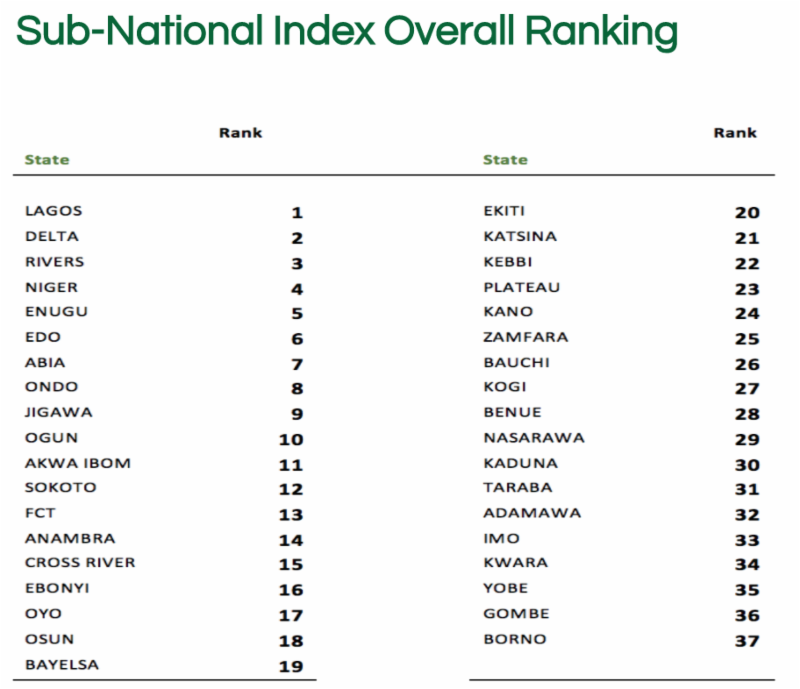
Lagos Tops Ranking of Sub-National Competitiveness, Borno is Last

5

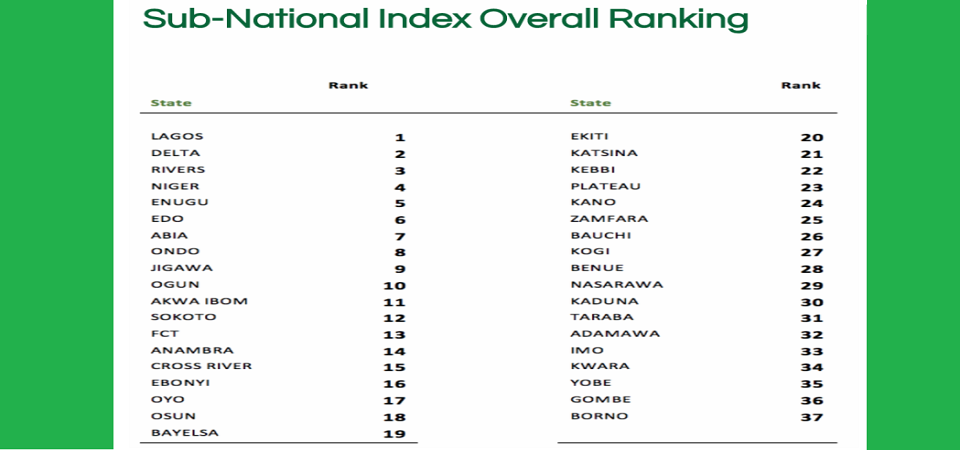
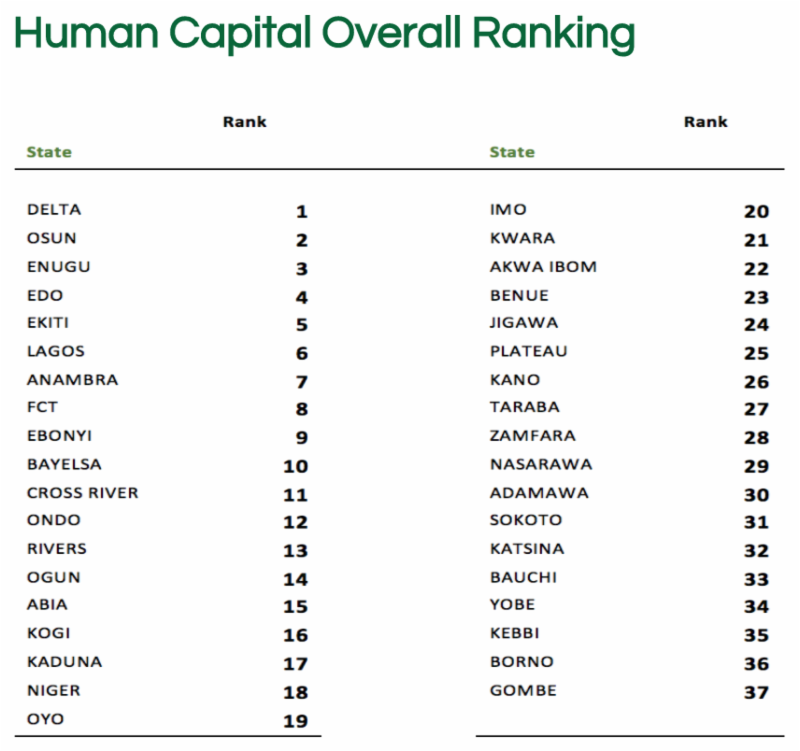
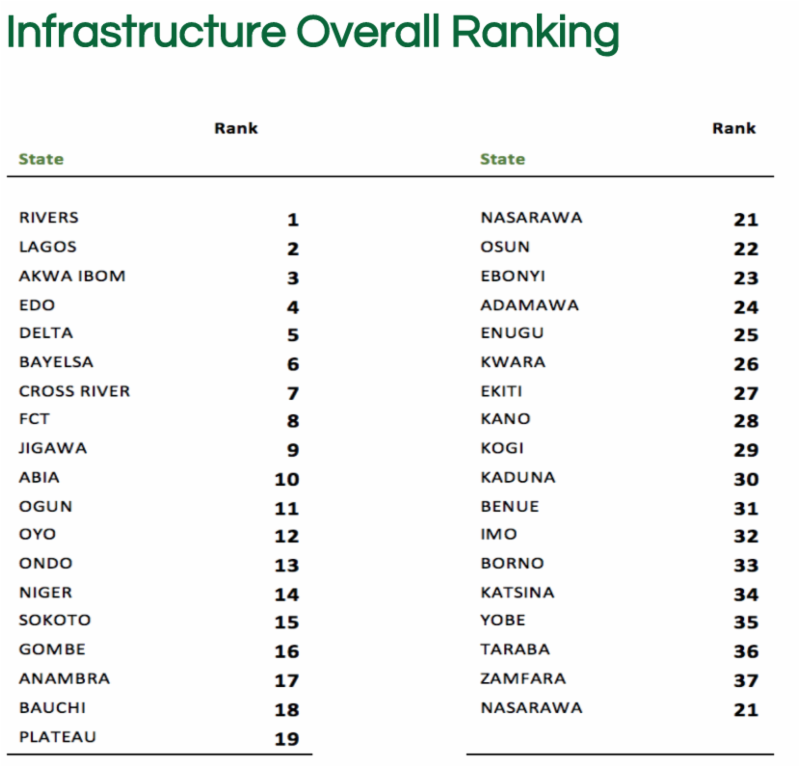
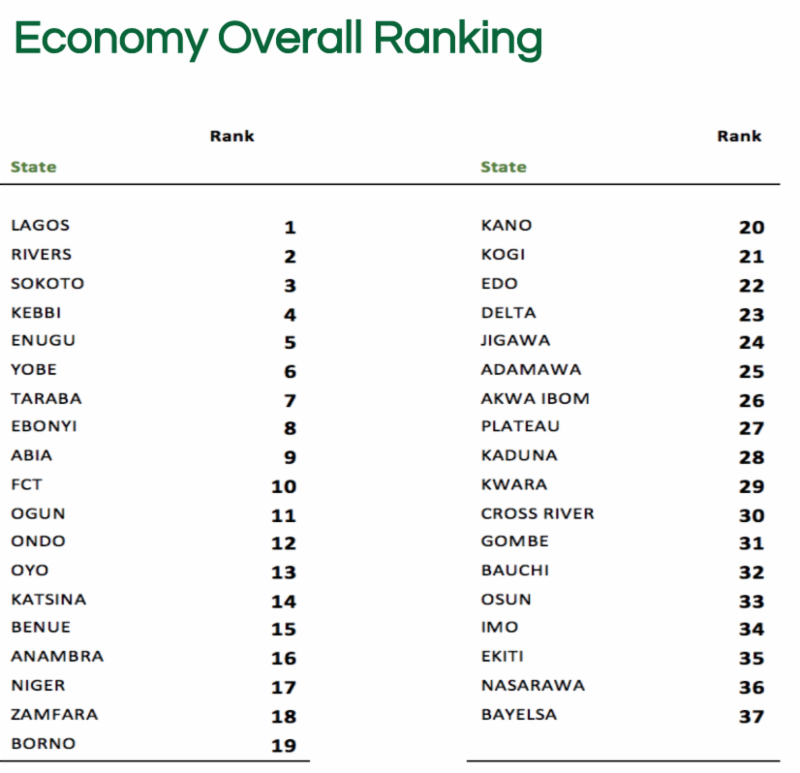
The National Competitiveness Council of Nigeria has released Nigeria’s first Sub-National Competitiveness Index. It is a two year research into the factors that drive competitiveness in Nigeria’s 36 states and the FCT. Ford Foundation and the Tony Elumelu Foundation funded the research. The research covered more than 2,000 businesses, 8,000 households, 400 indicators and 4 pillars.

  • Pillar #1 is Human Capital which covers education, migration, gender equality and heath: Delta State is #1 and Gombe is #37.
  • Pillar #2 is Infrastructure which covers roads, electricity, airport, telecom, waste and water: Rivers is #1 and Zamfara is #37

  • Pillar #3 is Economy which covers access to finance, state finances, business-sophistication and tax: Lagos is #1 and Bayelsa is #37

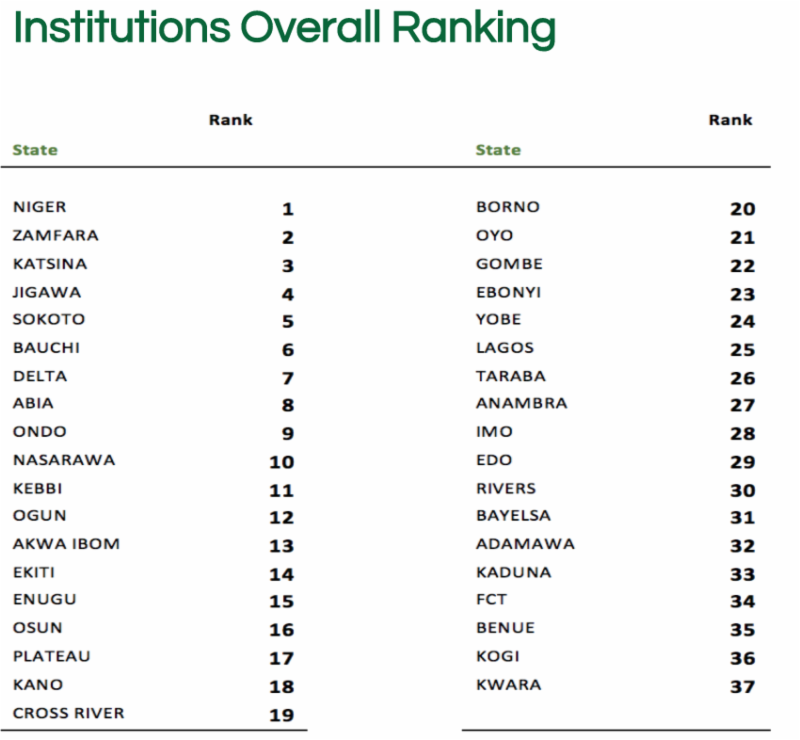
  • Pillar #4 is Institutions which covers security, transparency, justice, corruption and permits. Niger is #1 and Kwara is #37.

  • State Ranking: Lagos is #1 and Borno is #37.


Wema Bank on ALAT Now

4

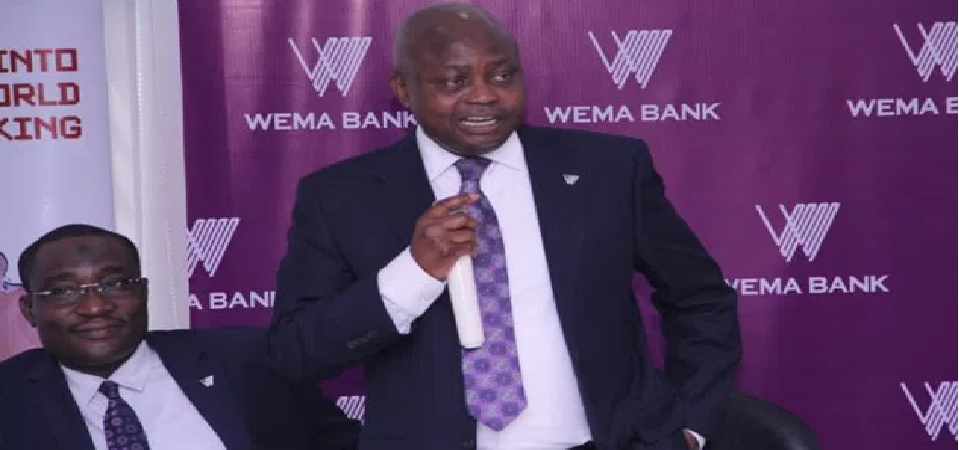
Wema Bank is on a great mission: the bank wants you to know about ALAT, its digital (mobile) banking solution, even more than the bank itself. It does seem that the bank has decided on what its future will be, and that future is ALAT. If you drive through 3rd Mainland Bridge, Lagos, you will see the ALAT advertisements with barely noticeable logo of Wema Bank. They are positioning ALAT as the future, even providing a website for it, the alat.ng. The following notes are evident with regards to Wema Bank’s ALAT:

  • Strong Promotion: Wema Bank is promoting ALAT more than the bank itself. I do think over time, the brand ALAT will become bigger than Wema Bank, and Wema Bank will fold into ALAT. Simply, Wema Bank wants the young people to know about ALAT, and not necessarily Wema Bank.
  • Unique Domain: The bank is one of the few banks in Africa that created a unique domain for its mobile banking solution. This means that ALAT itself is expected to become a bank, but without the traditional branches.
  • Strong Digital Future: Wema Bank is banking on a strong digital future. And ALAT will provide that to it. They have invested massively to create this product and are also doing more to make people know about it. It offers some of the best deals in African banking with 10% interest rate ( I noticed that one on 3rd Mainland Bridge). This is the future of Wema Bank.

Wema Bank is brilliant on what it is doing with ALAT. I have noted in the past that one of the ways of dealing with the heavy regulations banks face is to create separate fintech companies and run them to support the bank products. In other words, a bank creates a fintech company that markets its products, even when doing other things. The advantage is that the fintech can move fast, without the regulatory challenge. While a fintech can use a press release to be in 54 African countries at once, a bank has to work with the respective central banks before it can operate in the countries. That gives the fintech firms the advantage to move fast and corner the opportunities. But if a bank has its own fintech, sequestered from its operations, and complying with regulations, it can compete more fiercely with the fintechs.

ALAT is the first step for Wema Bank. In the next few years, depending on its progress, ALAT can be divested from Wema Bank, to allow it to compete more aggressively in the African market without being tethered to a bank and the associated regulation. The regulation is important and there is nothing wrong with that: banks like Wema Bank take customer deposits, unlike most fintechs, and should be regulated. So, ALAT can become an operational arm of Wema Bank while the bank remains a dumb pipeline, typical of most traditional banks today (i.e. not much intelligence due to lack of deep insights), to support what that modern banking named ALAT does. Perhaps in 10 years, Wema Bank may even simply change its name to ALAT if this new modern banking solution evolves into its future.

ALAT is a bank, and it can become a truly African banking institution, if it pursues new opportunities in Africa, with growth typical in most highly scalable businesses. I am expecting the management to make ALAT a pan-African “bank”, and use it to redesign the banking experience for young people which it continues to pursue. Wema Bank is working. It is on ALAT now and that is a good thing.

The IBM Banking and Implications to African Banks

0

I have written extensively on the implications of Internet on businesses. We are enjoying the tremendous productivity gains which technology has made possible. But in the future, Internet will cause massive economic dislocations in markets and economies. Yes, at maturity level, Internet could enable seamless linkages between sellers and buyers in many industries: the implication is that many companies will disappear. Who needs an accountant when all transactions are powered by blockchain? Many areas we see in fintech (financial technology firms) will go.

While ICT provided unprecedented productivity in the Nigerian banking sector, Internet is seriously “destroying” value. This is a “problem”. ICT made them, Internet could destroy some of them. Internet is bringing the construct of creative destruction in the Nigerian banking sector where values are destroyed and new opportunities unlocked. But those new opportunities are not going to be, exclusively, within the controls of the banks.

What Internet is doing today is expanding distribution of banking services thereby putting pressure on banks to control pricing on their own terms. Before Internet, they could charge huge fees to transfer money for clients to foreign accounts via their treasury departments, but today, with internet, there are options. The customers could simply use their debit and credit cards to settle the bills without first spending money on bank fees.

That future is not going to be very far: IBM has started building the infrastructure, at scale, of the 21st century banking: the blockchain banking. Yes, IBM and its partners have started making a business on what most thought was just an idea. It is now making it possible to move money across borders, seamlessly and efficiently.

In a breakthrough for payments technology, IBM and a network of banks have begun using digital currency and blockchain software to move money across borders throughout the South Pacific.

The significance of the news, which IBM announced on Monday, is that merchants and consumers will be able to send money to another country in near real-time, accelerating a payments process that typically takes days.

The banking network includes “12 currency corridors” that encompass Australia and New Zealand, as well as smaller countries like Fiji and Tonga. It will reportedly process up to 60 percent of all cross-border payments in the South Pacific’s retail foreign exchange corridors by early next year.

The news also comes as an important validation of blockchain technology, which has long promised enormous efficiencies for the financial sector, but has been slow to move from the concept stage to the real world.

Blockchain, which relies on a disparate network of computers to create an indelible, tamper-proof record of transactions, is most famously associated with the digital currency bitcoin. But it can be used in many other applications such as tracking shipments or, as in this case, to record a series of cross-border transactions.

If IBM gets this right, every bank in the network will be paying IBM tax to use its solution. This also means that the remittance business will likely collapse for most African banks. The very product which no fintech or bank in Africa has been able to build will now be made possible. I have discussed of the need to build a truly pan-African digital remittance/transfer banking product which is agnostic of location or currency in Africa. None of the products we have today meets that standard. Largely, I envisage a situation where all you need to buy and sell across Africa is one bank account in just one African Union country. With that, you do not have to even think about the specific currency of that account as technology will seamlessly make it possible to access other African markets for payments, transfer etc. The banks or fintech companies must still comply with all regulations related to inter-national transfers, forex etc. The only difference is that customers will not see them as they will be hidden with technology. What IBM is doing could potentially fix that friction and that means it will take major revenue base from African banks.


 The IBM Banking

IBM has moved into banking without necessarily being a bank. That is a very good position to be. If it can pipe transactions across its systems, the real banks will pay taxes to use its networks. IBM will become the 21st century SWIFT (society of worldwide interbank financial telecommunications), a global payment network, assuming that the international payment network and enabler does not evolve.  Many have written on the power of Amazon on consumer commerce, and the implications to markets.

But Amazon’s unprecedented logistics and delivery infrastructure, paired with access to personal data about Americans’ purchasing habits, means it is unique in the history of global commerce. No company has ever wielded this combination of consumer insight and infrastructure, say historians and legal analysts, which means the company grows stronger and less assailable with every purchase.

But what Amazon is doing will be small if IBM can make itself the category-king for blockchain banking. In other words, if IBM can build a system that essentially makes SWIFT irrelevant, IBM will have the highest impact in modern banking and commerce. The influence of Amazon in America cannot even come close because the implication is that IBM can just provide the infrastructure and over time move into other areas like insurance, legal contracts and more. The key thing is becoming #1 to enjoy the network effects and the benefits of invertibility construct.

All Together

This is a total redesign in the structure of digital commerce. Blockchain will have consequential impacts. There is nothing that it cannot power including making it possible for Finnair, an airline, to weigh its customers in Helsinki airport to ascertain that its estimated total weight, fuel, and safety are accurate. Of course, banking is going to be the first area that will be affected because that is where the money is. I do think African banks should work hard to form their own consortium with local technology leaders for intra-African remittance, at least, and get the African Union to charter that blockchain network. We need the regulation that makes transactions on blockchain to be legally enforceable and binding and that means governments may need to make that clear to avoid any uncertainty. This becomes necessary because at the onset of the web, most banks were not accepting email documents as legally binding. But over time, nations upgraded their laws to make it clear that emails and digital documents are valid in courts. We need same for blockchain and I hope Africa Union leads there. If they do, local banks will have the opportunity to build the capacity before the foreign ones define the markets.

Why Amazon’s Strategy Will Not Work In African Ecommerce

0

Amazon plans to dominate the retail world by using its best product: the e-commerce operation. This product will be accumulating losses even as it takes retail market share from physical stores and malls. The strategy is that over time, Amazon will deliver fatal wounds to many physical stores that few will exist.

But that is just part of the equation. As Amazon bulldozes and dismantles physical stores, more of them will move online. Amazon hopes to provide the platform through its Amazon Web Services for most of these companies. Yes, Amazon has the best solution for these physical stores to operate online, after they have lost any relevance in the physical domain.

Simply, Amazon’s ecommerce operation can make losses, provided that incurring the losses will create new business opportunities for the AWS which will have more customers as offline retails move digital. With this model, it does not really matter if the e-commerce ever makes profit since its impacts are generating businesses for another unit of Amazon.

Amazon has no choice: if it does not pursue its loss-enabling market share against physical stores, they will not move online to require the services of the AWS. (Of course, I am exaggerating here. There are many other areas AWS can make money, including supporting non-retail businesses. But I hope you get the point.) So, there is a big correlation: the more businesses move online, the more potential opportunities for AWS, the cloud services industry leader. It does not matter if the ecommerce makes any money as it causes havoc in the markets.

This Amazon’s strategy is the reason why any African ecommerce company that is copying it will likely struggle.  None has a unit that can deliver this kind of reverse gain that Amazon enjoys with AWS despite its losses in the ecommerce business. Without an equivalent of AWS, any Amazon’s cloning strategy becomes half-baked because the strategy will fail to have the profit-enabling element.

Diversifying with Bytes and Atoms

0

Dangote plans to invest billions of dollars outside Africa to have a geographical diversification.  When you have most of your assets in one region, you open up yourself to risks. Sure, Dangote knows that Africa is not blowing apart, but he does not want to take the risk. Besides, when he does that diversification, most investing models will remove geographical risk as they evaluate his stocks. The end game is possible positive movement of the stocks.

The Dangote Group plans to invest up to $50 billion in U.S. and Europe in coming years, according to Bloomberg.

Africa’s richest man, Aliko Dangote, plans to invest $20 billion to $50 billion in the U.S. and Europe by 2025, in industries including renewable energy and petrochemicals. The 60-year-old Nigerian cement tycoon aims to move into these territories for the first time in 2020 after completing almost $5 billion of agricultural projects and an $11 billion oil refinery in his home country, he said in an interview with Bloomberg Markets Magazine this month.

But diversification goes beyond geography.  Most times, firms build multi-product lines with defenses that deliver assured survival. If Samsung does not have a semiconductor unit, it might have collapsed under the weight of its mobile devices catching fire. But with the semiconductor business, it overcame that problem and returned with record profits.

The same can be said of IBM which saw its hardware business shrank within years. But with its services and consulting, IBM had the opportunity to remain as a business while it worked on fixing anything that was broken. The company continues to find that path, and new businesses anchored on its Watson AI solution will play a major role.

One company that went through the wilderness, lost focus and was internationally beaten down was Sony, the Japanese electronics giant. The camera business was decimated when the world moved from thin film to digital photography, reducing margins. The smartphone unit was an also-ran in the age of iPhone and Samsung Galaxy.  But Sony relied on other products and businesses to remain relevant while it turned itself around.  The revival seems near: products like high-end TV, image sensors, Spiderman, and PlayStation are doing well in markets. The market has responded, pushing the shares to its highest in nine years. From Fortune Newsletter:

As Reuters explains, Sony predicts its profits will mark a peak for the first time since 1998, when its PlayStation first appeared and when its film unit struck gold with Men in Black. Like much of corporate Japan generally, Sony, its home country’s global champion, went into a multi-year tailspin. Sony’s problems were many: brutal competition for its once-dominant television group; being bested by Apple’s iPod, a humiliation for the Walkman pioneer; high-cost manufacturing in Japan; a failure to seize the music-streaming initiative despite years of trying

Sony did many things to get to this level: it restructured the business and redesigned its operations. It also fired many workers in Japan which is not always common. Above all, it refocused by killing many multiple product lines. Today, the revival is evident: “Sony reported a blow-out quarter and said it was on track to post its highest-ever annual operating profit. Its share price has more than doubled in the past three years.”

But most times, you do not even need to be in trouble to redesign a business. Even Samsung Electronics thinks it needs new ideas. It wants a diversified insight into the future of competition.

… the resignation l…of Kwon Oh-hyun, the influential CEO of the semiconductor business of Samsung Electronics. Kwon is 64 and did a couple of unusual things on his way out the door. He stepped down unexpectedly, and he also fired a public warning shot across his own company’s bow, saying the company “needs a new leader more than ever,” given the imprisonment of third-generation scion Jay Y. Lee. Kwon also said: “We are hard-pressed to find new growth areas right now from reading the future trends.” This a shocking admission that even as Samsung racks up impressive profits based on its past innovations, one of its top leaders doesn’t think the company is well positioned for the future.

Offline Diversification

I will be leading a Board strategy session for a client next week. My job is to shape the company’s strategy. In the brief I prepared last week, every Board member called me back: they were interested that I asked them to diversify by going offline in some synergistic ways to the online business. The digital business, from the performance numbers, has been on stasis. I did note that it would be a fatal mistake to give up on the digital-first strategy of the company. While digital-first strategy is sound, digital-only strategy in Africa is really an illusion unless you run a blog or facilitate payments online. To unlock growth, in monetary terms, not just clicks and user base, on time, we need to think beyond digital.

Sure, we will deepen our capabilities in the web, but we will find new markets offline to make money as that is where the money is at the moment in Africa. Digital is for the future, but today, the money is offline. We need that diversification. But we will not leave the web properties. Investment will be smarter but synergies with meatspace must be clearly established. I want atoms to fuse with bytes to provide possible revenue growth.

Also, I am a big believer that meatspace will continue to drive businesses in Africa. For all the talks of leapfrogging, the percentage activity online will be less than 10% of all trade even by 2030. Take a boat to Orom (Akwa Ibom) and explain to me how internet will help you buy crayfish better with no physical access to the market. The infrastructure challenges will keep commerce offline, for long. But yes, the digital ecosystem will grow, nevertheless. The Western world with infrastructure will make a faster digital redesign because infrastructures exist to close the physical elements of trade when they are finalized digitally.

Besides, if the structure of the web is redesigned with technologies like blockchain, most frictions on commerce will disappear. I do believe that most things online will become free in near future and if that happens, making money online will become harder, unless you are running a big platform with advertisers. The British company Circle, a remittance firm, facilitates remittance between U.S. and UK at zero cost. It uses blockchain and Goldman Sacks has invested in it. If that scales, simply, remittance will become free. This same trajectory will apply in other areas.

All Together

As the story of Sony shows, diversification is strategic. While geographical diversification has been moving to other countries and continents, today, it could be as simple as having web and offline businesses. The web is a continent of itself and it is important to understand that. A company that is digital-first could diversify by investing in complementary meatspace business that offers synergy online. For example, an ecommerce firm can invest in a logistics firm as part of business diversification. Your diversification needs the atoms and bytes to be balanced in this age.