DD
MM
YYYY

PAGES

DD
MM
YYYY

spot_img

PAGES

Home Blog Page 7295

Amazon’s Africa March

0

Amazon plans to deploy $5 billion to win the Indian e-commerce sector. That is a lot of money and it will help it incur losses while taking market shares from competitors. With this strategy, it becomes increasingly obvious that Amazon may not really care about acquisition. It could have used that money to buy itself pieces of companies to get its market share number up. But it does not want to do that. With just 41 warehouses in India, Amazon is running a startup operation, at growth phase, in India.

Within miles of the new Hyderabad storage hub, is one of Amazon’s largest global customer service centers as well as one of its biggest software development facilities in the world. All of these are hidden from public view – except on rare occasions like this warehouse visit. They are all testimony to Chief Executive Officer Jeff Bezos’s aggressive Indian expansion that is backed by a $5 billion budgetary allocation.

Amazon’s 41 warehouses in India are vital in a country where the largest online retailers are marketplaces without any inventory of their own in accordance with foreign investment rules for e-commerce. Their locations are crucial because the nation’s logistics networks can be unreliable. They have to be close to sellers and with easy access to a density of buyers.

But Amazon has no choice. It needs to deploy this capital to compete as its competitors are well funded. The money Amazon has budgeted for India may not buy a sizable market share, through acquisition, since Flipkart, an industry leader in India, has a valuation of $11.6 billion after a recent funding round, where it raised $1.4 billion from Microsoft, eBay and Tencent. So, it has to go the infantry way, instead of dropping competitive ammunition from the air: Amazon has  to compete and earn market share organically in India.

Following months of rumors, Indian e-commerce giant Flipkart has confirmed that it has raised $1.4 billion in new funding at a post-money valuation of $11.6 billion to battle Amazon and Alibaba. The deal includes some big-name strategic investors: China’s Tencent, eBay and Microsoft, which join existing Flipkart backers that include Tiger Global, Naspers, Accel and DST Global.

I have noted the Indian issue to illustrate how Amazon is thinking. Its strategy goes beyond India. It recently bought Souq, a Middle East ecommerce company. Where it has not done a big ecommerce deal is in Africa. We know nothing of its budget for the continent. But that does not mean that Amazon is not coming on board. I do think Amazon is just studying the continent at the moment. And it is doing so by working to get better insights through technology and business communities. It just signed a partnership to make it easier for Zambian startups to use Amazon Web Services. It is already running a light ecommerce operation in South Africa, possibly for other reasons and not necessarily to make money through shopping boxes.

Zambia’s technology and digital startups will now receive free hosting services courtesy of a partnership between BongoHive and Amazon Web Services (AWS). The offer is available to startups that have completed the BongoHive Launch Accelerator programme.

Startups from BongoHive’s Launch Accelerator programme will get free hosting services on the AWS platform.
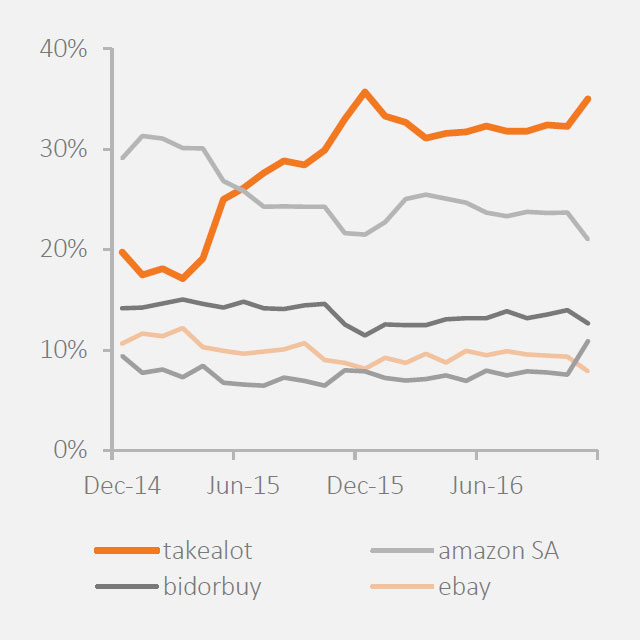
Amazon does not have sizable market share in South Africa

I expect the type of partnership Amazon has with BonjoHive to mushroom. Microsoft has a similar thing through its 4Afrika Initiatives on Azure and Google has always been local. Amazon is just getting here. This implies that everyone wants to come. But for Amazon, it needs to come with its best product, which is the ecommerce business. Until it does that, not many people will know that Amazon is in Africa.

What I expect to happen in the next few months will be for Amazon to have four locations to serve East, West, North and Central Africa. It already operates in South Africa and that takes care of the Southern Africa. With these strategically located offices, it will map its strategy to move into Africa and bring ecommerce.  Amazon will not make any acquisition. What it is doing in Africa has convinced me that Amazon will just come and compete for market share. With local players still at infancy in places like Nigeria, Kenya and Ghana, there is no need to acquire. The spending on ecommerce in Africa is less than 5% of total consumer spending. So, nothing has really happened to warrant acquisition.

Besides, Amazon’s name recognition and operational experience can generate enough buzz to get it on top. Sure, that did not happen in South Africa, but I have noted that Amazon operates in South Africa not necessarily to win ecommerce market share. It will have its moments for that.

Amazon needs Africa, and Africa will be similar to the feeling when it pioneered ecommerce in U.S. You cannot become one of the largest digital technology companies on earth without an African blueprint. It is irrelevant whether you are making money or not; the key is that you are there to defend the turf against competition. Just being in the continent will give it a favorable response from Wall Street, exactly the type it received when it bought Souq.

Amazon supports many U.S. merchants who now run businesses exclusively on its platform. African makers will surely benefit because Amazon can provide logistical support to local merchants to sell and ship continent-wide.  Through this, it will unlock opportunities for many African entrepreneurs. Enticing Amazon to invest in Africa could be a wise decision for any African government.


The Nigeria NCC’s $380 Million Remittance

0

The telecommunication sector has become Father Christmas to the Nigerian government. According to the Nigerian Communications Commission (NCC), it remitted N133.4 billion (about $380 Million), in the last two years, to the federal government purse.  This fund comes from the little taxes and fees you pay when you talk or text. Simply, Nigeria is benefiting from the liberalization of the telecommunication sector.

Over N133.4billion has been remitted by the Nigerian Communications Commission (NCC) into the federation account in the last two years.

A document by the NCC Director of Public Affairs Tony Ojobo, revealed this yesterday.Ojobo said the commission remitted over N23 million in October 2015, after an initial remittance of N6, 856,182,132 in September of the same year.

He added that the commission’s last remittance to the consolidated revenue fund, which was on June 30, 2017 was N12, 705,154,120 and came less than 10 days after the NCC had remitted the sum of N1, 282,453,138 to the account.

Also, the NCC last year, transferred N20, 000,598,873 and another N15million in March before remitting N29, 475,867,407 and N16, 500,000,000 in December 2016.

This is the impact of a good policy. When they opened the sector to market forces, government lost its monopoly through NITEL, but today, it is making more and winning despite losing NITEL. In short, NITEL was losing money; but right now Nigeria is making money through a functioning telecommunication sector. We are not talking of the impact of GSM on the economy and the lifestyles of the citizens. We mean the money in the purse of the government.

If they do what they have done in the telecoms sector to the power and water sectors, government will even win through more fees and tax revenues. Market forces make governments look like seers and wizards because when markets function well, governments win. No matter how you see it, Nigeria now has a clear insight on what works: the telecom sector is working well and government should replicate that model in other sectors.

Remember that this monstrous N133.4 billion might not have included the taxes the telcos paid to the Federal Inland Revenue Service and to state governments. And when you consider that Nigeria was largely in recession over the last few years, you can run the numbers to see the impact of the sector in the nation’s finances in the last 17 years. We need to scale markets forces to other sectors.

Ndubuisi Ekekwe To Speak In 2017 Tony Elumelu Foundation Entrepreneurship Forum

0

I just accepted an invitation to speak in the 2017 Tony Elumelu Foundation Entrepreneurship Forum . You do not miss an opportunity to speak before the top 1,000 African entrepreneurs. These are people who are redefining and redesigning the economic architectures of Africa, from the lagoons of West Africa to the mangroves of Southern Africa, and from the grasslands/plains of Central/Eastern Africa to the beautiful hills of the North. They are demonstrating bold visions, unlocking new opportunities and pioneering new paths, for the good of the beautiful continent. In them, it is not just innovation, but sankofa innovation, with the next frontiers it brings.

It is my honour to invite you to speak at the 2017 edition of the Tony Elumelu Foundation Entrepreneurship Forum taking place on the 13th of October 2017 at the Nigerian Law School in Lagos. We would like you to lead a session on the topic ‘Extending the Frontier’. The Forum is the capstone of the flagship Programme of the Tony Elumelu Foundation and has grown to become the largest gathering of entrepreneurs from across Africa.

[…]

Your professional accomplishments in your field inspires us greatly, and our 1000 eager young entrepreneurs will benefit immensely from your wealth of knowledge and experience. Thus, we are hopeful that you will honour this invitation to speak to the next generation of African business leaders.

The Tony Elumelu Foundation which was founded by Lagos banker and philanthropist, Mr. Tony Elumelu, is inventing a new model of philanthropy that focuses on mobilizing big ideas and institutionalizing luck through entrepreneurship. The mobility comes through a $100 million multi-year commitment Mr. Elumelu is injecting in the visions and aspirations of his fellow African citizens.

If you use the startup language, the Foundation is a category-king in what it pioneered and remains peerless. I remain honored to be serving in the Advisory Board of the Tony Elumelu Entrepreneurship Program (TEEP).

I will lead the session – Extending the Frontier –  which 1,300 participants will attend live. I like Frontiers because in my new book – Africa’s Sankofa Innovation – which came out two weeks ago, I had a chapter titled Next Frontiers.

Google’s Evolution On Mobile

0

Google is learning and it is a very fast learner. Many years ago, when Google unveiled Android, it pursued a path it has pursued for years: grow user base as quickly as possible and then monetize the customer data. That worked for Search and YouTube where Google has billions of global citizens engaged. It tried the same model for Android. It worked as it got the users, from those that can afford a $40 phone to people that can pay excess of $500 for a phone. But Google is not happy: it has the users, but it does not have the profits. Another company, a mortal competitor in mobile called Apple is eating all the profits.

Yesterday, Google took action. It is buying the HTC unit that made its high-end smartphone called Pixel. This is a new strategy from the typical Google playbook as I noted earlier today.

Through this deal, Google will get closer to that. It will have an opportunity to control all aspects of Pixel and then give customers a real user experience that can be closer to what iPhone delivers in the market. It needs to do that to have any chance of competing in the smartphone market. This deal is to save Android and secure the future of Google mobile business.

What Google is doing now is to change how it does business on mobile. For years, through its success on Search, Google has focused on scale, knowing that transaction cost for adding new users in Search is low. In short, the marginal cost of a new user in Google Search is zero. In other words, it does not cost Google anything for a new user that uses Search. And with more users, Google gets better: with more user data, the product becomes better and ultimately the best. So with massive scale, Google will make money and dominate the category. That was what happened in Search as Google took down AOL, Yahoo and Microsoft Bing (or its predecessor).

But when you come to mobile, the game changes: acquiring a new user on mobile does not carry a marginal cost of zero. A partner-company to Google has to make a physical device which a customer will buy. That means the phone costs the partner money. And of course, it costs the customer something also. Unlike in the search business where there is a zero marginal cost to Google for that new user, and practically zero cost (sure, besides the access cost to the web) for the user of Google Search, the mobile device commands cost.

Google did not notice that as it worked on the Android business model. As more affluent people move from Android to Apple, Google now knows that Apple has become a destination for the graduated Android users. Yes, they use Android but once they begin to make enough money, they move to Apple. For Google, that is bad, because it keeps missing the opportunities to deliver services like Play Store to more affluent customers.

For a phone business, the marginal cost is non zero because a physical device is made. So having all the users does not guarantee profit because more phone sold comes with more expenses. You have to find a way to make profits on the phone. Selling phone was not a Google business. But Google was in the services phase which is correlated with the quality of the people using the phone. For the Google Play and other services, a rich man holding a phone has more value than a kid with no money. So, all those elements are all connected. If you have richer people using your phone ecosystem, they can spend more on the services like Music, apps, etc.

It does not stop there: because a phone can be a luxury item, differentiation matters, unlike Search which cannot be further differentiated beyond the results (few care if you searched with Windows, Mac, Android devices; what mattered was that you searched using Google). Yes, a phone has more values beyond just making and receiving calls. Phone is a symbol of affluence and people play it. Today, Google wants to connect to that message by going to that upper echelon for the money. The $30 Android phones are good for statistics but Google needs to sell items on apps, music, etc which is not a new category in mobile. It needs people with the money in its ecosystems.

This HTC deal is part of that learning curve to get Google to the position in mobile where it can make more money. Apple is the leader and Google wants to get in the mix.  The path to the lowly-priced Android devices has not worked out excellently. The deal, possibly, will help Google pursue the rich where the money is, not just for the phones, but for the services which are sold in mobile ecosystems. This is an evolution for Google.

Google Android Pivots with HTC, Implications for African Startups

2

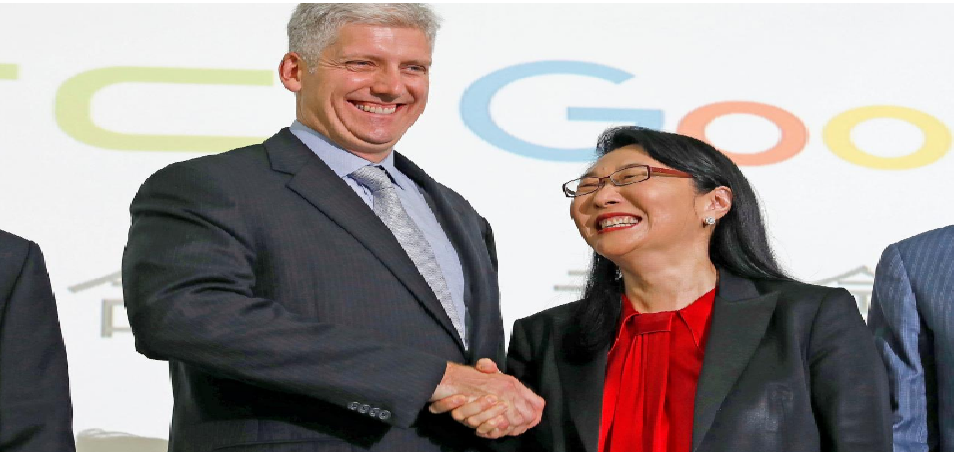
Google is paying $1.1 billion for the unit of HTC, a struggling smartphone maker that makes for Google the high-end Pixel smartphone. HTC, once an industry leader, has been struggling in the age of Apple and Samsung.

Alphabet Inc’s (GOOGL.O) Google said it would pay $1.1 billion for the division at Taiwan’s HTC Corp (2498.TW) that develops the U.S. firm’s Pixel smartphones – its second major foray into phone hardware after an earlier costly failure.

The all-cash deal will see Google gain 2,000 HTC employees, roughly equivalent to one fifth of the Taiwanese firm’s total workforce. It will also acquire a non-exclusive license for HTC’s intellectual property and the two firms agreed to look at other areas of collaboration in the future.

This deal has many implications. What is happening is that Google wants to move into a business model where it can effectively control both the hardware and software. Today, that is not possible as Android runs in many phones of different specifications and standards, making it impossible for Google Android to deliver top-grade experiences to its users. Unlike Apple, which controls all elements of its phone business, Google has relied on others for the hardware. The result has been mixed: user experience has been non optimal and Google wants to change that.

Yesterday, within just a few hours, most of Apple’s millions upon millions of users were using the latest mobile operating system, having tapped on the prompt to download iOS 11.

Contrast that experience on Android, where the company’s impressive and innovative updates are greatly hampered as it can take months, sometimes years, for those features to filter to users.

Google knows this disconnect between its software and hardware is a massive problem. And so this curious deal with HTC, which falls short of the rumoured buyout, is about solving that problem. If it can have close control over key premium devices, it can be more ambitious with its software.

In some respects, this $1.1bn deal is like a good friend lending their pal a few quid to tide them over for a while. HTC needs Google’s money to keep going. And Google needs HTC’s expertise and manufacturing capability to remain competitive with its mobile devices.

The Genius of Apple

Apple makes proprietary hardware and using that differentiation creates software and services which are highly exclusive. The ability to control all aspects of its design process makes it easy for it to make the best possible product. That helps it to achieve high margins even when serving a smaller number of people. It is a closed business model. But for Google, you have a company that cannot control its product: Android runs on different hardware which Google does not influence. The key way it can make money is to have as many people as possible, without necessarily delivering the best experience, using Android. While that makes Android look good on the number of users served, it has not worked for the profit margins desired. Google knows that and wants to own the hardware design experience so that it can more effectively control the user experience, mimicking the Apple business model.

Through this deal, Google will get closer to that. It will have an opportunity to control all aspects of Pixel and then give customers a real user experience that can be closer to what iPhone delivers in the market. It needs to do that to have any chance of competing in the smartphone market. This deal is to save Android and secure the future of Google mobile business.

Implications for African Startups

Everything you know about Google is going to change. In the next five years, try to see Google mobile device business from the same lens as you see Apple today. Google, while not going to run a completely closed business model, as Apple does with its hardware and software, will increasingly become a big player on the physical element of the mobile business. People will still buy the cheap Android but Google will set its eyes to recreate the experience of Apple. It wants the margin and it wants to pursue the most profitable customers. That means we could have “two versions” of Android possibly making it harder for some low-end phones we sell in Africa to run some of the latest Android updates. Google may not really care provided Pixel is engineered to compete against iPhone.

Simply, if Google tests a version of Android on Pixel and it looks great, it can launch it to the world. It is now left for the partners to deal with issues that arise. Yet, even if they work harder, it is not likely that those partners can get to the same level of integration Pixel will have with Android. The present model where Google thinks from outside to inside will be changed from thinking from Pixel world to the outside one. It wants to own its ecosystem and take this challenge to Apple by itself.

My suggestion is to see your mobile business with new perspectives on what the relationship with Google Android will become. It is changing and that will affect what happens to its partners in the future. By moving from a horizontally integrated model to a vertical one, Google has a new focus. Do not expect it to do well on both at the same time. It has made its decision with this HTC deal: Google wants to go vertical and offer choices beyond Samsung Android phones to iPhone.