DD
MM
YYYY

PAGES

DD
MM
YYYY

spot_img

PAGES

Home Blog Page 7310

Before Nigeria Scales Credit Bureaus

0

Nigeria is a cash-based economy. For years, the government has been trying how to re-wire the economy to make it credit-based. The Cashless Policy which encourages electronic transactions and the BVN (Bank Verification Number) policy which links biometrics with bank account numbers are some initiatives government has used to drive this redesign. Through Nigeria Inter-Bank Settlement System (NIBSS), the financial institution can easily build a good chart of any Nigerian banking customer through its BVN. When you add NIMC (National Identity Management Commission) Identity Number to it, you have a new dawn.

The new dawn is that financial institutions can use the data which have been collected from bank accounts and other sources to provide loans, mortgage and other credit services. We are following the advanced nations. But before we clone America or UK’s credit bureau system, we can modify or adapt certain elements in the credit bureau system of the countries. America’s credit bureau system is not optimal. There are widespread identity thefts, cybersecurity risks, and  other shortfalls inherent in the systems. The problems are systemic.

Last week, Equifax, a global credit bureau firm, was hacked and the financial data of 143 million Americans and 400,000 British consumers were compromised. The implication is that these people are now left vulnerable to identity theft or fraud for a very long time.

Last Thursday evening we announced a cybersecurity breach potentially impacting 143 million U.S. consumers. It was a painful announcement because of the concern and frustration this incident has created for so many consumers. We apologize to everyone affected. This is the most humbling moment in our 118-year history.

Equifax Security first discovered the intrusion on July 29. Understandably, many people are questioning why it took six weeks to report the incident to the public. Shortly after discovering the intrusion, we engaged a leading cybersecurity firm to conduct an investigation.

At the time, we thought the intrusion was limited. The team, working with Equifax Security personnel, devoted thousands of hours during the following weeks to investigate.

In U.S. and UK, credit bureaus like TransUnion, Experian and Equifax make money by selling confidential data of citizens to financial institutions who use the data to deliver credit services to the citizens. The lenders like banks provide the data from the citizens’ financial records to the credit bureaus at no cost. The credit bureaus need the data to build the credit profile of the citizens and the banks rely on them to sell products and services like mortgage, credit cards, etc. There is no involvement of the citizen in this process. Yet, it is the citizen data that everyone is making money from, but the citizen can neither restrict no control his or her data. The citizen does not need to control its data contents as you want a total picture of unfettered citizen’s credit state. Yet, there needs to be way to ensure protection of citizen data.

What Nigeria Can Do

It is evident that the credit bureaus do not really care about the security of citizen data. Banks do care because losing customer funds through cyber-breaches will cost them money. The credit bureaus do not see citizen data as being that important. Their customers are the banks and not the citizens, and that is why they never care what they send to the banks. The citizens cannot take the jobs away from them. They have no incentive to be absolutely correct on the data they send to banks. The banks pay them and the banks are their customers, and provided they are happy, the citizens are irrelevant.

So for Nigeria, we need to do things a little different. We need to have within the Central Bank of Nigeria a unit that will supervise credit bureaus the way we do to banks. Also, citizens must enroll before any bureau can monetize their data in the specific system. By asking the citizens to enroll before banks can use their data, via credit bureaus, it creates incentives for the bureaus to make efforts to be optimal in their services.

Sure, it can hurt the citizen if the data is not reported but it will also hurt the credit bureau if it has no data to monetize. We have existed for decades with no credit system and can wait for few months to get it right. But for the credit bureaus which are starting, they need the citizens’ data. I recommend the following in Nigeria to make sure we break any oligopoly power as is being experienced in the U.S. credit bureau sub-sector:

  • CBN should register and give licenses to at least five credit bureaus
  • Credit bureaus can get data from all the banks and approved sources but they cannot profit from them until a customer approves for them to monetize the data. By pushing them to wait until a citizen approves, they have an incentive to be optimal to the services they deliver to the citizen besides the banks
  • A citizen must sign up with at least three bureaus at all times
  • Where it is evident that a specific credit bureau is not performing well, a citizen can withdraw its approval to report its credit. That can happen once per two years. Once that happens, it will take another two years for that customer to rejoin that specific credit bureau. But at the time, the credit bureau will still be collecting the data but cannot monetize it with banks.
  • A citizen at all times must have its credit records approved for monetization with at least three bureaus

By having this structure, a citizen will have leverage thereby reducing the poor reporting and lack of efforts by credit bureaus to harden systems to avoid identity thefts. A credit bureau that neglects its systems resulting to massive hack can lose all customers and will have nothing to sell to banks. So that creates an incentive to deliver better protection unlike what we have today. The addition of this citizen component will seed incentives for win-win in the sector.

All Together

The alignment of the interests of the banks, credit bureaus and citizens will be catalytic in establishing a functioning credit ecosystem in Nigeria. This is not included in the current CBN’s guidelines for establishing credit bureaus in Nigeria. We cannot do it the way the Americans have done it. We need a system that provides a citizen element so that credit bureaus have clear incentives to deliver good services. You cannot be selling people’s data and yet have no incentives to serve the people and protect their data. With this proposed model, the oligopolistic system that runs in the credit bureau industry will be dismantled in the Nigerian model. The outcome will be a virtuoso credit bureau system that secures customers data as it serves its core customers, the banks.
Nigeria’s Future Banking Jobs, Three Things After Current Jobs

0
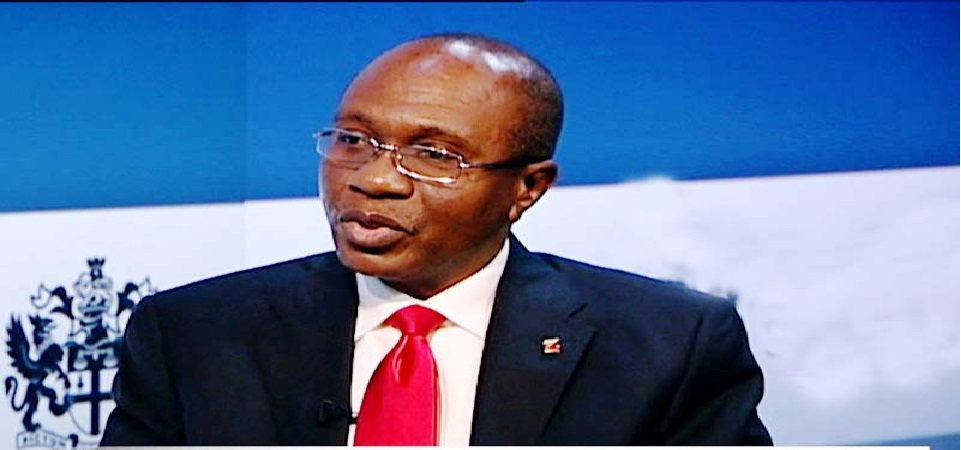
CBN Governorn, Godwin Emefiele

Information and Communication Technology ( ICT) anchored the competitive evolution of Nigeria’s new generation banks, by unleashing productivity in the sector. Internet, through its unbounded distribution, has provided new business models for most of the banks. Banks today have digital banking unit which is growing, and outpacing other channels like branches. The dawn of digital banking has anchored a new strategic redesign, and the banks are moving more operations to the web. The customers are responding and banks are expanding customer base.

With these changes, banks are retooling how they do business in terms of human capital, and one thing has been consistent: banks are using lesser number of staff per customer. In other words, the man-hours required to serve a bank customer continue to drop. Productivity enabled by technology has made that possible. We now have ATM which has automated many tellers out of jobs. We have debit cards which have reduced the need for manual cheque reconciliations. As banking moves digital, new dislocations will continue to happen. The impact may even be more consequential in African banking because we can leapfrog therein.

There is nothing anyone can do about these redesigns: most jobs will disappear. From the challenging days of manual ledgers where Union Bank recorded transactions in papers, requiring bank customers to spend hours in bank halls, to the modern days of GTBank speed banking, Nigerian banking continues to evolve. They are using lesser number of staff, per customer served. While owing to growth, the staff strength may be bigger, the reality is that productivity has reduced the absolute staff required, when benchmarked with the trajectory few years ago. GTBank through technology leadership, as noted in its half-year report, captures it all:

The Bank has continued to report the best financial ratios for a Financial Institution in the industry with a return on equity (ROE) of 38.8% and a cost to income ratio of 40.2% evidencing the efficient management of the banks’ assets.

In other words, GTBank is using lesser resources to make more money. There is nothing wrong with that. Yet, what we are seeing today is just the tip of the iceberg.

Three Things After Bank Jobs

Robotics, artificial intelligence, and natural language are collectively after Nigerian bank jobs.  ATM is a primitive service of the robotics. The same goes for the present reconciliation engines which run on bank’s general ledger solutions. But in the next 8-10 years, we will see massive adoption of the next level of technologies. I expect the Apple Face ID to be copied by other smartphone companies and that will find itself quickly into banking solutions. With Face ID, you will not have to worry much on agency banking because most components would be built in mobile devices.

Diamond Bank should work to drive agency banking with new technologies that will simplify the process and eliminate most of the inherent risks.  People call them financial inclusion for the un-banked customers, but the reality is that a very innovative bank like Diamond Bank can unlock the value here, just as it used DIBS, to create value in 1990s.

BVN is an opportunity, and NIMC (National Identity Management Commission)  provides even a richer source of data. The roadmap is to develop a technology that will help make citizens/shops extension of bank branches so that banks are closer to the people that need them, at better cost model. We do not need full scale branches to reach villages and communities. Technology provides the capabilities to scale this and also make it cost-competitive.

These are some of the roles the robots, AI and natural processing will pursue:

  • Better customer service. We will see chatbots to drive customer service
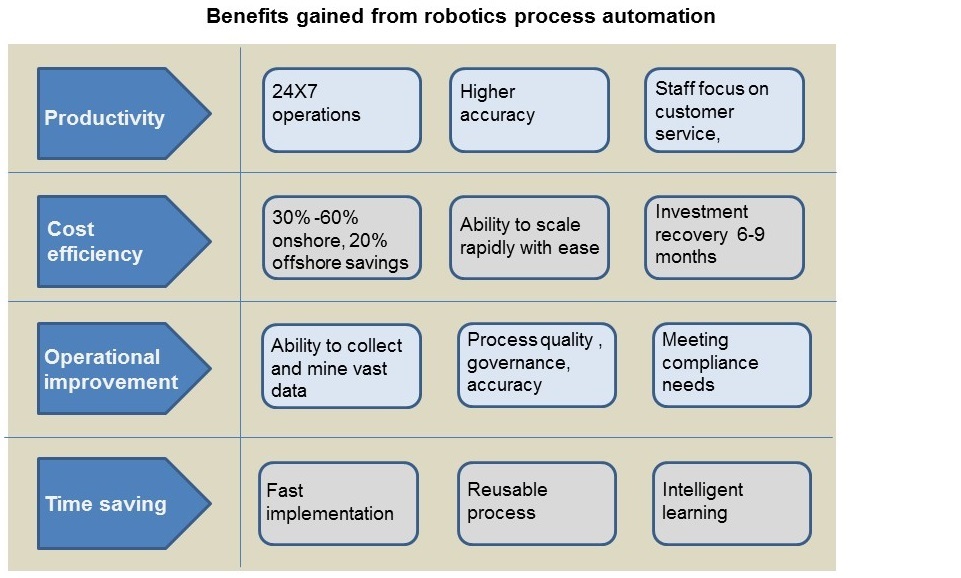
  • Process automation: from reconciliation to compliance, AI and robots will deliver higher efficiency, productivity, operational improvement and cost savings.
Source: Asian Banker Research.

According to Cognizant, the top drivers for automation beyond cost savings include:

  • Reduced error rates (21%)
  • Better management of repeatable tasks (21%)
  • Improved standardization of process workflow (19%)
  • Reduce reliance on multiple systems/screens to complete a process (14%)
  • Reducing friction (11%)

Beyond Banking Jobs

Sure, banks will cut some jobs but new jobs will be created because of the new services needed to service the post-AI banking. The following bank jobs are at risk.

…on the future of AI in banking, a study released by Oxford Martin School’s Programme on the Impacts of Future Technology evaluated how susceptible are jobs to computerization. Evaluating around 700 jobs, and classifying them based on how likely they are to be computerized, the jobs in the financial services industry that fit the studies criteria include:

  • Bank Teller

  • Loan Officer

  • Mortgage Broker

  • Insurance Claims and Policy Processing Clerk

  • Insurance Underwriters

  • Claims Adjusters, Examiners and Investigators

  • Bookkeeping, Accounting and Auditing Clerks

  • Tax Preparers

Tobot attending to customers in Japan (source: financial brand)

What will happen in the near future is that we will have more software-bankers than tellers, because the jobs will be more algorithmic, meaning that the focus will be making better AI models. That means banks will also hire mathematicians (that do maths), and people that will help to build models and perfect them. While at the moment, banks have used the casualization of staff to compete on cost, in 8-10 years, they will use the deployment of AI, natural language and robotics for competitive edge through cost leadership. The transition will change the structure of the business because anyone that does not make that leap will struggle with severe cost-disadvantages..

All Together

The golden age of banking consulting is coming in Nigeria where startups with solid AI capabilities will rule. Banks will need services, customized and structured for the local Nigerian market. They have skills gaps which tech companies have to fill. The opportunities will be immense.  The customization of Siri, Alexa, Assistant and Cortana to understand Nigerian pidgin speakers to enable banks deploy new solutions via voice opens a new market. The integration of Face ID to detect accurately black skins knowing that companies like Apple might have biased their models for white skins will create a boom.

In short, because of AI, robotics and natural language processing, fintechs will boom, not just in dealing with consumer market, but by offering solutions for banks’ back offices. It will take another level of composition for any bank in Nigeria to deploy any voice system in rural areas considering that our spoken English will confuse what Silicon Valley has built. Nigeria will need local flavors of most of these technologies. That is where the new jobs will be created in the banking sector..

Tripod Attributes of Startups

0

Bottomline: Startups, new business organizations, with scalable capabilities, differ from small businesses because besides the scalability, they are unbounded and unconstrained by geography. Companies which qualify as startups exhibit three attributes which are mutually interdependent. Any firm without these attributes is not a startup.  By understanding these attributes, an entrepreneur or one that aspires to […]

This post is only available to members.

The Problem With Technology

0

North Korea launched another missile over the heads of Japanese. I called a friend in Japan to know how he was feeling. He was not happy. He noted that he would find it harder to trust any government, going forward. He was not happy because they had been promised for years, that Japan has anti-missiles to protect them. But on two live occasions, the Japanese military technology did not answer the calls. North Korean missiles flew over their heads. No interceptor was fired.

He was even more annoyed that the military was able to detect the missile seconds it was launched. But yet nothing happened. And in Japan, for months, they have been focusing on tracking any missile from North Korea. In other words, the launch was not a surprise. They expected the launch. But at the end, they could even blow it up.

An Aegis destroyer operations room – all the computers and displays etc make up the combat system that would guide a missile interception is here. Picture: US Navy Source:News Corp Australia

Japan, U.S. and South Korea have extensive amalgam of radars in South Korea, the Sea of Japan and inside Japan, positioned and stationed for the two moments North Korea had demonstrated. U.S. has worked with these allies in developing and installing these tools.

Sure. Japan could have determined that it was not pointed at it. Yet, it flew over it. Or maybe, they wanted to know how far the missiles could go. For me, that was nonsense. That was an opportunity missed to test their defense systems with real missiles from an enemy fire.

Do not get me wrong. I just hope we do not put so much confidence in these defense technologies. All it takes is one. I mean one successful missile out of say 100 for bad things to happen.

In my opinion, U.S. should re-calibrate and call North Korea to the ceremony as a nuclear power and give it the book, DO NO EVIL, because it is now a nuclear power. Nothing else will work until we can relocate Japan and South Korea.

We continue to wish the good people of South Korea and Japan good luck because most are terrified. For me, I will not even enter plane as missiles could be flying. They are right to be worried .

In the end, the prospect of successful interception of one IRBM would come down to a great number of variables going in the favor of the United States and Japan. Even if one missile is successfully intercepted, the odds of going four-for-four with North Korea’s Hwasong-12 salvo over the Sea of Japan using SM-3s are likely to be vanishingly low.


Everyone needs to be worried because even in U.S., no one knows what they have there. It goes beyond fire and fury. This North Korean guy is a bad actor and the world must understand and deescalate the situation.

Trump has repeatedly responded to North Korea’s attempts to build up its nuclear arsenal and obtain a nuclear weapon capable of striking the U.S. mainland with fiery rhetoric, once warning of “fire and fury” if it attacked the U.S. or any of its territories.

It is scary because most have believed this technology, the anti-missile defense system, to do the protection. Now, we all know that the technology may not be reliable.

Private Financing of Nigerian Public Universities via Tax Innovation

2

The Academic Staff Union of Universities (ASUU), a Nigerian union of university academic staff, is still on strike. They want more funding in the nation’s universities. There is nothing wrong with that. But the very fact remains that government has expanded the university system beyond its possible capacity to fund. What ASUU wants, even if met by government, may not last long, before new strikes evolve.

Nigeria has to find ways for private sector to become partners in our university system financing. Private financing in the public schools will help our schools. Today, that is not happening because there is no practical benefit for companies to do so. The schools are not centers of excellence and companies cannot see them as partners in the creation and dissemination of knowledge.

The very few donations coming from individuals are also small. Most donate to get recognition and titles like Honorary Doctoral Degrees. They might have done better if there is a way government can create financial incentives for companies and individuals to open their bank accounts and donate to our public schools. When you provide incentives, which help citizens and companies to do well and also save money, great things happen..

The U.S. Model

In U.S., alumni make great donations to their alma maters. Michael Bloomberg might have given nearly $1 billion to my alma mater, the Johns Hopkins University. Across the U.S., many U.S. business schools are named after business leaders. Those people opened their wallets and made donations. Sure, they love the institutions to have made donations. But many would not have done so if the tax system has not stimulated the giving through financial incentives. Making those donations help balance many elements in their personal and company finances. Nigeria does not have that at the moment.

Right now Apple is working with 30 community colleges in U.S. as it pushes the adoption of the SWIFT language. Community colleges are like Nigeria’s OND education in our polytechnics. What Apple does is to support those schools to deepen their capabilities and help the students learn new skills which will help them in their careers. It is a great win-win, and any school chosen will be better off..

Community college students may have a lot more Apple-related course work during the new school year.

The technology giant said Friday that its education curriculum related to its Swift programming language would be offered at 30 community colleges throughout the U.S.

Apple CEO Tim Cook announced the curriculum rollout at a press conference in Austin, Tex. with the city’s mayor, Steve Adler. Several community colleges in Austin will begin teaching the Apple-sanctioned curriculum, which Apple said would reach 74,000 students this fall

There are good implications when companies like Ford, GM, Chrysler and other top American companies put money in schools. They not just fund the schools; they provide the avenues to introduce new areas the schools need. Here are the benefits for the firms and the schools:

  • Companies can outsource the training, allowing them to focus on their businesses. The schools do the work for them. In Apple’s case noted above, it wants to popularize the Swift language. There is no better way to do so than working with schools
  • Donation money given to schools is tax deductible because the schools are tax-exempt under the U.S. Internal Revenue Service tax code. This is the key reason. If Apple or GM were to do the training in-house, the tax benefits will not materialize. They will still train the young people, but they cannot deduct that money. But by giving the money to colleges, they get the trained people and still get the deductions. This makes it easier when you need scale, beyond what you can have inside as staff for talent pipeline.
  • Apple through this training will be getting pipeline of talent. The same applies to most U.S. firms. They want welders; they fund a local school to train welders to ensure they have enough for their businesses.
  • It also provides goodwill as the local economy will see a boost through the injection of capital in the schools. The implications are huge: the school fees will drop for the students as companies have subsidized some parts, nearby businesses grow, and everyone is happy.

What Nigeria Can Do

The Nigerian tax system is not designed to support philanthropy. That is why we do not have a vibrant one. It does not mean that a nation must be rich first before its tax system can be engineered to stimulate philanthropy. ASUU can lead on that, through Tax Reform, and make it possible for individuals and companies to put money in the schools and get tax benefits. Sure, ASUU members may be busy, but that should not stop them from helping the government to revamp our tax codes to drive innovation.

The 501(c)3 tax structure in U.S. has unlocked a lot of private sector capital into the “doing good” business. Nigeria must find its own model.  I explain why this will be appealing in the educational system.

If Company A wants to start a factory in Owerri Nigeria and needs to train 1000 people in the areas it does business. It can ask Federal University of Technology Owerri to do that training, providing the manuals and documents required. It will fund it say with $3 million for three years. FUTO may integrate the program in its curricula (NUC may need to approve). FUTO has received funding, expanded its program and at the same time graduating students that will likely have jobs when they finish. Brilliant!

For Company A, it has moved the non-core training out to focus on its business, knowing that whenever it wants talent, FUTO is preparing them. Then on that $3 million, Nigerian government allows it to deduct it, non taxable. Simply, the revenue where that money has come will not be taxed because it has been used to do good to the society. Just like that, the company has saved money and at the same time assisted FUTO to deepen its programs. That is an incentive which does not exist right now, and Nigeria needs to update our tax system to make it possible.

Today, what is possible is to deduct that $3 million as an expense, meaning that it is recognized in the tax book as pure business. That is not enough as the resulting balance will be taxed accordingly. In U.S. that $3 million is treated differently, offsetting not just its expense but other areas the company might have experienced losses. So magically, you use donation to make-up. That is why giving is financially good, under some circumstances, for both the recipients and the givers.

Here is how they do it in U.S, according to Fidelity, the best in the world.

  • Capital gains taxes are eliminated when you contribute long-term appreciated assets directly to a charity…
  • In those select situations, you may choose to supplement a charitable gift of securities with a charitable contribution of cash so that the maximum charitable contribution deduction limit of 50% of your AGI may be claimed. This strategic combination of giving is an opportunity to reduce your taxable income.
  • One simple offsetting measure is aligning your charitable giving with the rebalancing process. Instead of writing a check to a favorite charity this year, consider donating your most highly appreciated security, which you have held for over a year. Capital gains taxes typically will not apply to you or the charity receiving the donation, and because you didn’t write a check, you may have cash available to purchase more stocks as part of your rebalancing exercise

Fidelity has nine strategies, I have noted only three above. In short, if you are rich and not giving in U.S., you may be losing money!

Now, over to ASUU and those that love education! If you want local Microsoft, Google, Oracle and more to give and support our schools, you may need to update the tax laws in Nigeria. They will respond if you make it easy to do good to the society, and save money via donations; I guarantee that.