DD
MM
YYYY

PAGES

DD
MM
YYYY

spot_img

PAGES

Home Blog Page 7313

Tekedia Undergoing Maintenance for eBook Launch

0

Dear Reader,

As we prepare to launch the eBook and a section for exclusive articles next month, you may experience some errors as you use Tekedia. Please bear with us; we do not want to take the site offline, so team is coding live. We hope to finish this maintenance within the next 72 hours.

Thanks

Fasmcro Labs


The War of Nano, Bits and Bytes: Unemployment, Exacerbated

15

Today, in Nigeria, anyone with more than fifteen years of working experience, who loses a job in banking, telecom and oil & gas sectors will be very lucky to find new employment that pays similar wages and benefits. Being a largely poor country, Nigeria does not have much use of experienced professionals at the top of the management pyramid. A banker departs banking sector and not many other sectors can absorb that individual because few have capacities for the top-notch experience. Also, because of the size of the markets, the companies weed the pyramids so early. If 1000 people join the banking industry in a year, after 15 years, less than 20% will remain. There is a preference, over time, of using lower experienced people, and that pushes many experienced people out of the industry. This is not just in the banking industry; Nigerian military, the Police, etc all do the same.

What is happening is a redesign of  systems as a result of technology and productivity. You do not need too much experience to do a lot of things very well. So as you age with experience, you become expensive compared to a younger person who can effectively deliver that job at lower cost.

Indeed, Nigeria is undergoing a transformation that is breaking social systems from Kano to Lagos. Stock market crises, unpaid public sector salaries and series of other problems have seriously affected many key stakeholders, in both the private and public sectors, around the country. Everything has changed. Being a university graduate is not enough for a decent living wage. That seems to be the smallest denominator in Nigeria.

The Dislocation

Nigeria has a new normal: economic uncertainties until it can decouple its existence on petroleum. We are struggling with roadmaps on how to navigate out of the valley of spiraling economic difficulties. In this convoluted world with high level of interconnectivity, one economic problem leads to another. Nothing seems to be working in fixing the economy. Sure, the nation is making progress.

The national unemployment rate is rising and what used to be the problem of the uneducated citizens is creeping into the world of experienced professionals. Unfortunately, the rate is not going down anytime soon. Why? Besides the fact that our formal economy sector has not significantly expanded,  many other things are in play. As Elon Musk had noted, the future of human workforce will be challenged. We will have the  byte and bit workforce but that will be limited. Even before the expected disruption of AI, powered by supercomputers, to compete with humans, Nigeria is already seeing the impacts. Nigerian banking is seeing productivity owing to deployment of technology, from ATM to Mobile Banking, resulting to dislocation of workforce.

As technology penetrates, we will continue to experience displacement across all the key industrial sectors, at global level. We have already phased out the industry that hires special secretaries to work the typewriting machines. The ticket masters have been replaced by websites. Increasingly, apps and websites are offering professional counseling from finance to romance that humans used to do. A new generation of smartphones will displace the language interpreters, when we have mature language translators inbuilt in our phones. Today, an engineer equipped with computer aided design tools will do better than ten engineers a century ago.

In nearly all industries, technology is enabling firms to do more with lesser human power. Human productivity has consistently improved over the centuries and our standards of livings have correlated with it. However, while the industrial age technologies made sense of the factors of production of labor and land, the new age calls for knowledge. Through robotics and automation, hundreds of man-hours can be replaced with a simple machine that never asks for benefits.

For Nigeria, that maturity level is still far. If the country industrializes, we will expand our economy. That will create more jobs in the long-term. That should be our concern before we begin to think of displacement of labor in the long-term. Our challenge is making sure we can actually industrialize.

Digital Startups Will Not Save The Day

We all like our fintech. We like internet. Nigeria is going through the digital front. They are very critical. So, unlike the industrial economy, having more startups may not translate to more jobs, because in most cases those startups create technologies that eliminate more human jobs across the industries. You can run an Internet-only bank with 15 staff if you deploy AI, cloud and many other emerging technologies, at scale.

Specifically, for every one person that is hired in most Internet startups, a displacement could result to, at least, loss of two jobs across all sectors. When ten parents decide to use a website to help their kids improve their mathematics skills, part-time teachers are displaced. When a big bank opens a web portal that enables customers to make informed decisions, financial planners will be cut. In general, who needs a stock picker, when most websites offer quality analyses free? Our society is changing, and people and firms must give things free to compete. That is why websites that require subscriptions are seldom popular.

This is a global redesign and it is very important that policymakers understand that what worked in 1960 may not necessarily work now. Information is moving fast and the reaction of the consumer is spontaneous. They are being rewired through online communal ties resulting to new patterns of lifestyles.

Nevertheless, what we are seeing today is just the beginning. The future of the African continent is one where many people will be unemployed unless we can do what other advanced economies did: industrialize at scale. This is besides any effort to digitize. We will continue to innovate, digitally, however, that will not create enough jobs to change the trajectory of continental unemployment rate. Our efforts on digital are ephemeral with no core industrialization component. Unlike the advanced nations, we are not connecting into the transformation of industries. We are simply seating on vapors of imaginations. Those will work, but they will not produce scale that will put millions to work. Anyone that tells you that more farm apps and websites will create more farming jobs over industrialization of agricultural systems (e.g. processing of farm output) is not honest. But funding apps makes us feel good. That is unfortunate.

The biggest crisis is coming. It will come when nanotechnology would have matured from lab to the market. First, it will help displace millions of cotton, rubber and agricultural workers across the globe when engineers can make these devices in the lab. They can hire fifty people to produce the same quantity of cotton one million people produce in Sudan. They will displace those workers and clusters of wars would take place across the developing world.

There would be unprecedented cycles of revolutions as unemployment increases. Commodity market will morph into technology market and millions will lose heritage and culture because human innovation has disrupted them. I have called this the ‘war of nano’.

As we indulge and celebrate the innovations we witness everyday in technology, it is important to note that nothing like this has ever existed. A man can become a media company, without a distribution network and the delivery men. A company can exist entirely on Internet, cutting off all the real estate professionals. A bank that used to employ 5000 staff could use 60 people because it has modernized its infrastructure. Technology is competing with us and we are losing the battle.

Yet, most governments seem not to understand what is going on. When you continue to measure the characteristics of the knowledge economy with the tools of the industrial economy, the world cannot be governed right. Pushing government funds to create startups and new companies in the hope of reducing unemployment could be fallacious. This is not an industrial age new companies that hire in legions. The best companies work to eliminate head counts with the powers of microprocessors. From US to UK, human productivity due to technology has accelerated faster than job creation and the old labor equilibrium distorted.

It will be hard for any government policy to radically change the structure of labor in the long-term since daily we are encroaching into new territories with new technologies. The launch of Google created millionaires, but also crushed many industries. Sure, it created new industries, but those employ fewer workers, in average. It looks so evident that the cinema, bookstores and all those traditional networks that employ humans will be completely replaced with websites in the near future. Unfortunately, the business model of internet is knowledge-based, requiring few skilled workers. Unlike the factory model, it takes just a few to run those companies. But for most industrialized countries, this balances out. They can have these firms and still create jobs because they have resilient anchors: the infrastructures. That is different in Africa.

The Opportunity

Nigeria needs to understand that increased productivity and technology penetration will change our labor model, forever. Now is the time to begin that process of designing systems to manage our society. We must change the way students are trained and educated.

Our present education model is job-centric: the brightest students expect to be hired. That is why most companies are not created by the valedictorians and best students, but middle of the pack who struggle sometimes to get good jobs. The former gets accelerated corporate infusion and they rarely have to create new firms. With getting job in mind, our education loses the very purpose of education: the liberation of the mind. Until we change that paradigm to enable students get mental and entrepreneurial readiness, many will be unemployed. The truth is that anyone with skills, in anything, has a big market to succeed today than ever. Focusing on that element of personal discovery will help students prepare to graduate in a society of fewer jobs and prosper.

Globally,  governments must modernize those industrial age tools they use to track unemployment. There are thousands across the developed world that make decent livings on web ventures, yet are classified unemployed because no one has developed the right tools to capture the ‘informal Internet labor’. Technology makes it possible for people to build personal wealth in Beijing while living in San Francisco, and technically classified unemployed. This supports my notion that lack of quality data is affecting government ability to develop a strategy to reduce unemployment since most of the ‘unemployed’ people are working. That technology that displaces jobs through higher productivity can also help improve government statistics.

For Nigeria, we need to focus more on the industrial systems because the idea that we can leapfrog bad roads, inadequate electricity, and good education is an illusion. No website, no matter how dynamic can fix that. Besides supporting digital companies, the government must ensure it has a plan to deepen our meatspace companies that build the core infrastructure. A vision that will make government to understand that funding a postal system will be more catalytic than giving grants to e-commerce startups which will surely struggle without a functioning postal system.

Now is the time: we must create opportunities at the top, by expanding our economies. We can win the war of nano, bits and bytes, if we prepare well.

Beyond Zenith Bank’s 30% Provision, What Banks Must Do On 9Mobile

0

Zenith Bank has made a 30% loan loss provision on its loan exposure to 9Mobile (formerly Etisalat Nigeria). I do think, the next step will be to convert all the loans into equities in 9Mobile. I do not think anyone will expect 9Mobile, as #4 telecom operator in Nigeria, to have the capacity to pay any of the loans in the next five years. That is impossible considering the level of competition in the market. So a 30% loan loss provision is just for the books. There is risk the other 70% could also be provisioned if the issues are not well managed.

 Nigeria’s Zenith Bank has made a provision on 30 percent of its loan to 9mobile, the country’s fourth largest telecoms group formerly known as Etisalat Nigeria, the bank’s chief executive said on Monday.

“We have taken about 30 percent … as a provision which we believe is very prudent as the company is undergoing restructuring … to prepare for a new investor,” CEO Peter Amangbo told a conference call.

Nigerian regulators stepped in last month to save Etisalat Nigeria from collapse and prevent lenders placing the country’s fourth biggest telecoms group into receivership, prompting a board, management and name change.

9Mobile had taken out a $1.2 billion loan four years ago from a consortium of banks but struggled to repay it due to a currency crisis and a recession in Nigeria.

Zenith Bank is the largest lender to 9Mobile, one source familiar with the matter said. The bank has declined to disclose its total exposure to the telecoms group.

My recommendation for the telcos will be to convert all their loans into equities, consolidating the total loans within 49% equity and then help 9Mobile to raise new capital at the remaining 51%. That way 9Mobile will have capital to run its operations. By doing that, provided the banks can go long, they can recover the money. If they do not do that, it is possible 9Mobile will struggle since it still needs capital, and having the huge loan exposure in its books will make it extremely challenging to find investors. The loan line has to go, turning it into equity, and then help the telecom operator to raise fresh capital, offering the risk taker the majority ownership at 51%.

We all know that being a #4 telecom operator is not a strong position. Only the top two operators matter. The #3 operator is also there, but #4 is never a factor. So, 9Mobile needs a real risk taker to come and pump capital into it. Only the banks can help to make that possible.

What The Data Shows

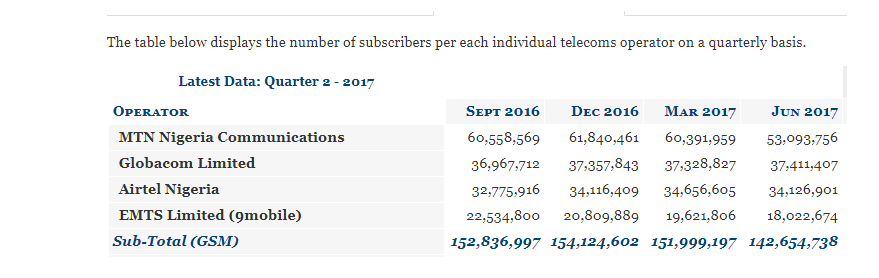
From the NCC data, it seems many Nigerians are even dropping their phones. Except Glo, all the telecom operators lost users between May and June 2017. So, the industry is  experiencing negative growth, implying that you cannot practically expect 9Mobile to magically make money to pay the loans. That is a reality the banks already know.

Earned Value Entrepreneurs, The Value Creators

0

How many times have people told you that you should buy quality things? Many times. There is nothing wrong with that. We all want quality in our lives. The problem is not the quality, but bounding the quality. Why? Quality is an illusion which cannot be left unbounded for it to make sense.

You have a small startup and you want to have the best stationery (yes quality papers) to send your business introductory letters. The imagination is that the best stationery will do the magic. That itself is not the problem. The problem is that you have not figured out that you could save money on the stationery and still get the same value.

Why should you pay for a laptop with 100GB of hard disk, when before you get to 40GB, the laptop has been decommissioned. Technically, you have simply wasted 60GB and the extra money spent for it. You rarely take the old disk into a new one. A new laptop will come with its own disk.

We waste so much money in the world. In the illusion of value, swayed by marketing, we make stupid decisions. The higher the price of wine, the better the taste, even though the makers of the win pour the same liquid and assign different names at different pricing points. We congregate and waste money.

You want to buy prescription glasses where one company controls more than “20 brands”. You happily select the  trendy one, which is always the most expensive. But behind it is the same product priced at different points.

When celebrities do this, it is not a problem. But when entrepreneurs do, I feel bad.

Entrepreneurs Need to Create Value

Creating value is not just in bringing more revenue. It can also come in the way you spend your investors’ money. For all the things Apple plans to do, on display, I know there is a physical limit, on the human eyes, after which improvement in resolution on the smartphone will not have any material impact.

Yes, most human eyes can do a resolution of about 180 dpi at 20-30 inches. So, if someone comes to you with 300 dpi with all the marketing, you need to understand that it makes no practical sense. As they increase the resolution in the smartphones, we all think we can get better value. Have you asked yourself the maximum possible resolution a human retina can resolve?

The fact is this: it is highly unlikely that any human can resolve the difference between 2160p and 4320p in a 4.3 inch smartphone. It is impossible for man to achieve that feat. But we are ready to pay and waste $500 extra for something that adds no practical value.

Yes, I have also heard people that can listen better with a $250 musical system cable. Yes, they are from the outer space. They can hear and listen better with better cables. Nonsense. You see them throw away $230 for something that is naturally indistinguishable by the human cochlear.

Sure, there are improvements but they are MARGINAL for the money we pay for them. Thinking of the Return on Capital Expenditure (ROCE), and  Return on Investments (ROI) must not be far away.

All Together

My point is that quality must not always be associated with price for the best derivable value. If you focus on the price of the item, you will miss the whole point. iPhone will continue to up the specs for years, even when the value is marginal. Yet, we will continue to spend that money. When we go to buy cars, we check at Honda and Toyota even though we know there are Lexus and Mercedes Benz. We want to keep that extra saving to deal with other things in life.

Here, we are thinking of value, bench-marking the money spent to the intrinsic value of that car. But when we come to electronics and IT, we lose that discipline. Marketing is to be blamed. In America, you do not need the fastest speed from Comcast or Verizon in your home because the average speed is just fine. Yet, they keep asking us to upgrade, spending and wasting money on things that offer only marginal value.

Do not fall for the marketing trap: be disciplined on the things that matter. That is one way your startup funding will go a long way. In all practical sense, a $2400 laptop is a waste of money and yet entrepreneurs spend that kind of money when a $700 one will do. That does not mean there is no technical difference, but the saving could have helped you add an intern to support the growth team.

Earning value through saving makes an entrepreneur an earned value entrepreneur, just as free media is earned media.

Jobberman Takes The Job

0

Jobberman pioneered the online recruitment industry in West Africa. It continues to connect employers and job seekers in the region. This is industry of the future because over time recruitment will move completely online. The firm was acquired by One Africa Media many years ago. One Africa Media is now executing an Africa-wide strategy which is very important: they need scale to have opportunities to unlock value.

Hiring the right candidate is important to companies because the ability to find the right skill and talent needed would largely determine the company’s success. To cater to this need, One Africa Media, which owns Jobberman and Brighter Monday, has set up a new company, which is offering cross border recruitment services in Africa.

The new company, known as “The African Talent Company (TATC)”, was set up to focus on Jobberman and Brighter Monday’s clients that were asking for more services across the borders of Africa. This company is offering better-bespoke services in terms of recruiting, consulting, in terms research work, salary surveys and more HR involvement.

Simply, Jobberman is taking the job it has left on the table over the years. Through TATC, among others, the following services will be offered to clients and partners:

  • Recruiting
  • Consulting
  • Research
  • Benchmarking (eg salary, etc)

As I have noted in the past, Jobberman must transmute beyond the direct online recruitment business to offer services which include:

  • Job portal for job seekers
  • Career Advisory Services
  • Recruitment, HR Advisory, Headhunting
  • Placement Services (executive search)
  • E-learning (marketplace)

Through TATC, Jobberman will deliver most of these services at scale, across Africa. This will help it fix some challenges inherent, at the moment, in its business model: patronage of online recruitment in the public sector.

In Nigeria, there is a regulation that stipulates that important government jobs must be advertised. Online was not included. This means that government and its agencies can only advertise for jobs in print newspapers to comply with the regulation. I have noted that when a business cannot provide services to the public sector, in Nigeria, its capacity to grow will be limited. Government remains the largest spender and that is very important for any business and startup. As Jobberman goes Africa-wide, through TATC, it will expand its revenue base. This will help cushion the effects of the lack of major revenue from government.

Nigeria is an employer market as we have more job seekers than available jobs. That has been the reason why Jobberman started charging job seekers fees. The idea was that if there are limited jobs, you need paid access to even apply to them. There is a big problem with that model, which I am not a fan of. Growing the ecosystem and giving employers assurance that the best possible candidates will see their job adverts, irrespective of the candidates’ financial positions, cannot be neglected. You cannot charge job seekers and also at the same time ask employers to pay. That is a faulty business model. It needs to focus on asking employers to pay for services while getting job seekers to join the portal at scale.

In the past, Jobberman had advertised heavily in print newspapers to inform people of its job opportunities. Yes, an online recruitment was spending money on print newspaper. It made sense because the penetration of the web was not good then. But today, Jobberman does not need to do that. It has to find ways to save that money by making sure those corporate entities and high level executives know of its presence. It can have weekly free ad coupons maintained in some major airports. It can still put adverts in print, but not the jobs ads.

Generally, I do think that the future of the company will be finding a way to build a community of learners. This can be branded Jobberman Tech with services offered to companies and governments. If it develops a reputation of preparing post-NYSC graduates, it will essentially redesign the local job market. I envisage something similar to Udacity Nanodegree.

Aggregating The Vision

The Jobberman trio has a great vision as noted during their launch press many years: connect employers and job applicants in Nigeria, seamlessly.

The unacceptable high rate of unemployment got us totally perplexed and we decided to do something about it. We set out with a mission to organize, deliver and manage the largest catalog of jobs in Nigeria. Jobberman started out in the Garage-converted-to-Office of Ayodeji Adewunmi’s Dad in August 2009 and has its root at the Obafemi Awolowo University. The original founders were Opeyemi Awoyemi, Olalekan Olude and Ayodeji Adewunmi. We are proud of our rich history, the past has shaped the present and both will launch the future as we become the premier career destination site for active and passive job seekers in Nigeria.

They have to evolve to stay true to that vision. But as internet penetrates, more employers will be running their online recruitment portals. The implication is that more channels will exist for job seekers to reach companies that have jobs. As that happens, commoditization takes place in the online recruitment business. The winning model becomes who can aggregate all these jobs in one place. I see in the near future, the opportunity will be the company that can aggregate all the available jobs in Nigeria in an easily understandable way. As I have explained many times in the Aggregation Construct, the person that does the aggregation will rule the specific sector. Under the aggregation construct, the companies that control the values are not usually the ones that created them. By building this technology, Jobberman can win big by mopping the available jobs from all sources, before job seekers, monetizing through adverts.

Under the aggregation construct, the companies that control the value are not usually the ones that created them. Google News and Facebook control news distribution in Nigeria than Guardian, ThisDay and others. Because the MNCs tech firms “own” the audience and the customers, the advertisers focus on them, hoping to reach the readers through them. Just like that, the news creators have been systematically sidelined as they earn lesser and lesser from their works. But the aggregators like Facebook and Google smile to the bank. The reason why this happens is because of the abundance which Internet makes possible. Everyone has access to more users but that does not correlate to more revenue because the money goes to people that can help simplify the experiences to the users who will not prefer to be visiting all the news site to get any information they want. They go to Google and search and then Google takes them to the website in Nigeria with the information. Advertisers understand the value created is now with Google which simplifies that process.

All Together

Jobberman continues to redesign itself as it looks for growth, not just in Nigeria but Africa-wide, albeit through its parent company. The parent company needs to find ways to deepen its strength by creating a new unit that works on the premise of aggregation construct. As Internet penetration increases in Africa, more channels will open. Winning the job recruitment competition will now be dependent on the firm that can bring those jobs  in one ecosystem where job seekers can interact with them.The present model of paid service remains, even as the Jobberman parent firm adds the new service. In an employer market, it is always challenging to run a job recruitment business, since there are always more job seekers than available jobs, giving employers so much power.