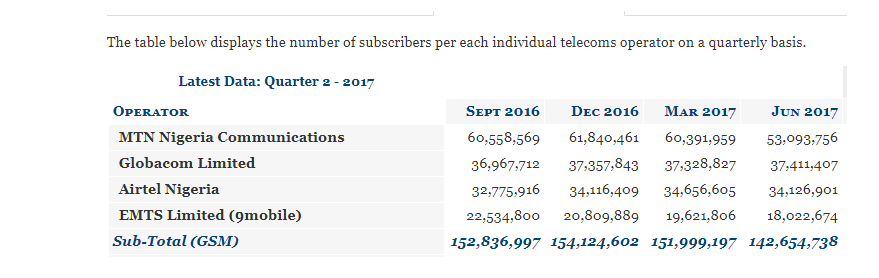
Zenith Bank has made a 30% loan loss provision on its loan exposure to 9Mobile (formerly Etisalat Nigeria). I do think, the next step will be to convert all the loans into equities in 9Mobile. I do not think anyone will expect 9Mobile, as #4 telecom operator in Nigeria, to have the capacity to pay any of the loans in the next five years. That is impossible considering the level of competition in the market. So a 30% loan loss provision is just for the books. There is risk the other 70% could also be provisioned if the issues are not well managed.
Nigeria’s Zenith Bank has made a provision on 30 percent of its loan to 9mobile, the country’s fourth largest telecoms group formerly known as Etisalat Nigeria, the bank’s chief executive said on Monday.
“We have taken about 30 percent … as a provision which we believe is very prudent as the company is undergoing restructuring … to prepare for a new investor,” CEO Peter Amangbo told a conference call.
Nigerian regulators stepped in last month to save Etisalat Nigeria from collapse and prevent lenders placing the country’s fourth biggest telecoms group into receivership, prompting a board, management and name change.
9Mobile had taken out a $1.2 billion loan four years ago from a consortium of banks but struggled to repay it due to a currency crisis and a recession in Nigeria.
Zenith Bank is the largest lender to 9Mobile, one source familiar with the matter said. The bank has declined to disclose its total exposure to the telecoms group.
My recommendation for the telcos will be to convert all their loans into equities, consolidating the total loans within 49% equity and then help 9Mobile to raise new capital at the remaining 51%. That way 9Mobile will have capital to run its operations. By doing that, provided the banks can go long, they can recover the money. If they do not do that, it is possible 9Mobile will struggle since it still needs capital, and having the huge loan exposure in its books will make it extremely challenging to find investors. The loan line has to go, turning it into equity, and then help the telecom operator to raise fresh capital, offering the risk taker the majority ownership at 51%.
We all know that being a #4 telecom operator is not a strong position. Only the top two operators matter. The #3 operator is also there, but #4 is never a factor. So, 9Mobile needs a real risk taker to come and pump capital into it. Only the banks can help to make that possible.
What The Data Shows
From the NCC data, it seems many Nigerians are even dropping their phones. Except Glo, all the telecom operators lost users between May and June 2017. So, the industry is experiencing negative growth, implying that you cannot practically expect 9Mobile to magically make money to pay the loans. That is a reality the banks already know.
How many times have people told you that you should buy quality things? Many times. There is nothing wrong with that. We all want quality in our lives. The problem is not the quality, but bounding the quality. Why? Quality is an illusion which cannot be left unbounded for it to make sense.
You have a small startup and you want to have the best stationery (yes quality papers) to send your business introductory letters. The imagination is that the best stationery will do the magic. That itself is not the problem. The problem is that you have not figured out that you could save money on the stationery and still get the same value.
Why should you pay for a laptop with 100GB of hard disk, when before you get to 40GB, the laptop has been decommissioned. Technically, you have simply wasted 60GB and the extra money spent for it. You rarely take the old disk into a new one. A new laptop will come with its own disk.
We waste so much money in the world. In the illusion of value, swayed by marketing, we make stupid decisions. The higher the price of wine, the better the taste, even though the makers of the win pour the same liquid and assign different names at different pricing points. We congregate and waste money.
You want to buy prescription glasses where one company controls more than “20 brands”. You happily select the trendy one, which is always the most expensive. But behind it is the same product priced at different points.
When celebrities do this, it is not a problem. But when entrepreneurs do, I feel bad.
Entrepreneurs Need to Create Value
Creating value is not just in bringing more revenue. It can also come in the way you spend your investors’ money. For all the things Apple plans to do, on display, I know there is a physical limit, on the human eyes, after which improvement in resolution on the smartphone will not have any material impact.
Yes, most human eyes can do a resolution of about 180 dpi at 20-30 inches. So, if someone comes to you with 300 dpi with all the marketing, you need to understand that it makes no practical sense. As they increase the resolution in the smartphones, we all think we can get better value. Have you asked yourself the maximum possible resolution a human retina can resolve?
The fact is this: it is highly unlikely that any human can resolve the difference between 2160p and 4320p in a 4.3 inch smartphone. It is impossible for man to achieve that feat. But we are ready to pay and waste $500 extra for something that adds no practical value.
Yes, I have also heard people that can listen better with a $250 musical system cable. Yes, they are from the outer space. They can hear and listen better with better cables. Nonsense. You see them throw away $230 for something that is naturally indistinguishable by the human cochlear.
Sure, there are improvements but they are MARGINAL for the money we pay for them. Thinking of the Return on Capital Expenditure (ROCE), and Return on Investments (ROI) must not be far away.
All Together
My point is that quality must not always be associated with price for the best derivable value. If you focus on the price of the item, you will miss the whole point. iPhone will continue to up the specs for years, even when the value is marginal. Yet, we will continue to spend that money. When we go to buy cars, we check at Honda and Toyota even though we know there are Lexus and Mercedes Benz. We want to keep that extra saving to deal with other things in life.
Here, we are thinking of value, bench-marking the money spent to the intrinsic value of that car. But when we come to electronics and IT, we lose that discipline. Marketing is to be blamed. In America, you do not need the fastest speed from Comcast or Verizon in your home because the average speed is just fine. Yet, they keep asking us to upgrade, spending and wasting money on things that offer only marginal value.
Do not fall for the marketing trap: be disciplined on the things that matter. That is one way your startup funding will go a long way. In all practical sense, a $2400 laptop is a waste of money and yet entrepreneurs spend that kind of money when a $700 one will do. That does not mean there is no technical difference, but the saving could have helped you add an intern to support the growth team.
Earning value through saving makes an entrepreneur an earned value entrepreneur, just as free media is earned media.
Jobberman pioneered the online recruitment industry in West Africa. It continues to connect employers and job seekers in the region. This is industry of the future because over time recruitment will move completely online. The firm was acquired by One Africa Media many years ago. One Africa Media is now executing an Africa-wide strategy which is very important: they need scale to have opportunities to unlock value.
Hiring the right candidate is important to companies because the ability to find the right skill and talent needed would largely determine the company’s success. To cater to this need, One Africa Media, which owns Jobberman and Brighter Monday, has set up a new company, which is offering cross border recruitment services in Africa.
The new company, known as “The African Talent Company (TATC)”, was set up to focus on Jobberman and Brighter Monday’s clients that were asking for more services across the borders of Africa. This company is offering better-bespoke services in terms of recruiting, consulting, in terms research work, salary surveys and more HR involvement.
Simply, Jobberman is taking the job it has left on the table over the years. Through TATC, among others, the following services will be offered to clients and partners:
Recruiting
Consulting
Research
Benchmarking (eg salary, etc)
As I have noted in the past, Jobberman must transmute beyond the direct online recruitment business to offer services which include:
Job portal for job seekers
Career Advisory Services
Recruitment, HR Advisory, Headhunting
Placement Services (executive search)
E-learning (marketplace)
Through TATC, Jobberman will deliver most of these services at scale, across Africa. This will help it fix some challenges inherent, at the moment, in its business model: patronage of online recruitment in the public sector.
In Nigeria, there is a regulation that stipulates that important government jobs must be advertised. Online was not included. This means that government and its agencies can only advertise for jobs in print newspapers to comply with the regulation. I have noted that when a business cannot provide services to the public sector, in Nigeria, its capacity to grow will be limited. Government remains the largest spender and that is very important for any business and startup. As Jobberman goes Africa-wide, through TATC, it will expand its revenue base. This will help cushion the effects of the lack of major revenue from government.
Nigeria is an employer market as we have more job seekers than available jobs. That has been the reason why Jobberman started charging job seekers fees. The idea was that if there are limited jobs, you need paid access to even apply to them. There is a big problem with that model, which I am not a fan of. Growing the ecosystem and giving employers assurance that the best possible candidates will see their job adverts, irrespective of the candidates’ financial positions, cannot be neglected. You cannot charge job seekers and also at the same time ask employers to pay. That is a faulty business model. It needs to focus on asking employers to pay for services while getting job seekers to join the portal at scale.
In the past, Jobberman had advertised heavily in print newspapers to inform people of its job opportunities. Yes, an online recruitment was spending money on print newspaper. It made sense because the penetration of the web was not good then. But today, Jobberman does not need to do that. It has to find ways to save that money by making sure those corporate entities and high level executives know of its presence. It can have weekly free ad coupons maintained in some major airports. It can still put adverts in print, but not the jobs ads.
Generally, I do think that the future of the company will be finding a way to build a community of learners. This can be branded Jobberman Tech with services offered to companies and governments. If it develops a reputation of preparing post-NYSC graduates, it will essentially redesign the local job market. I envisage something similar to Udacity Nanodegree.
Aggregating The Vision
The Jobberman trio has a great vision as noted during their launch press many years: connect employers and job applicants in Nigeria, seamlessly.
The unacceptable high rate of unemployment got us totally perplexed and we decided to do something about it. We set out with a mission to organize, deliver and manage the largest catalog of jobs in Nigeria. Jobberman started out in the Garage-converted-to-Office of Ayodeji Adewunmi’s Dad in August 2009 and has its root at the Obafemi Awolowo University. The original founders were Opeyemi Awoyemi, Olalekan Olude and Ayodeji Adewunmi. We are proud of our rich history, the past has shaped the present and both will launch the future as we become the premier career destination site for active and passive job seekers in Nigeria.
They have to evolve to stay true to that vision. But as internet penetrates, more employers will be running their online recruitment portals. The implication is that more channels will exist for job seekers to reach companies that have jobs. As that happens, commoditization takes place in the online recruitment business. The winning model becomes who can aggregate all these jobs in one place. I see in the near future, the opportunity will be the company that can aggregate all the available jobs in Nigeria in an easily understandable way. As I have explained many times in the Aggregation Construct, the person that does the aggregation will rule the specific sector. Under the aggregation construct, the companies that control the values are not usually the ones that created them. By building this technology, Jobberman can win big by mopping the available jobs from all sources, before job seekers, monetizing through adverts.
Under the aggregation construct, the companies that control the value are not usually the ones that created them. Google News and Facebook control news distribution in Nigeria than Guardian, ThisDay and others. Because the MNCs tech firms “own” the audience and the customers, the advertisers focus on them, hoping to reach the readers through them. Just like that, the news creators have been systematically sidelined as they earn lesser and lesser from their works. But the aggregators like Facebook and Google smile to the bank. The reason why this happens is because of the abundance which Internet makes possible. Everyone has access to more users but that does not correlate to more revenue because the money goes to people that can help simplify the experiences to the users who will not prefer to be visiting all the news site to get any information they want. They go to Google and search and then Google takes them to the website in Nigeria with the information. Advertisers understand the value created is now with Google which simplifies that process.
All Together
Jobberman continues to redesign itself as it looks for growth, not just in Nigeria but Africa-wide, albeit through its parent company. The parent company needs to find ways to deepen its strength by creating a new unit that works on the premise of aggregation construct. As Internet penetration increases in Africa, more channels will open. Winning the job recruitment competition will now be dependent on the firm that can bring those jobs in one ecosystem where job seekers can interact with them.The present model of paid service remains, even as the Jobberman parent firm adds the new service. In an employer market, it is always challenging to run a job recruitment business, since there are always more job seekers than available jobs, giving employers so much power.
China is really changing the global order of many things. Africa is part of the ecosystem where the impacts are felt. Now, it is making movies positing itself as the savior to the African populace. According to Quartz, in a new movie, Wolf Warriors 2, China chronicles how Chinese special forces entered an unknown African country to save the local people from white mercenaries who have come to do no good. This movie is the highest grossing movie of all time in China. It is showing the image of China saving Africa from dangerous white people. Simply, the Western world has lost the monopoly of saving the black people! If you have watched the Red Scorpion, on how an American saved the local Africans from the bad Soviet, you will understand. Now, China is doing the same thing: saving Africa.
Indeed, China is not stopping in movies, as it bulldozes itself in the real business world.
First, according to Fortune from a Reuters report, Chinese firms are piling pressure on Ericsson. The equipment giant will cut 25,000 – yes twenty five thousand people – as it battles for a position in the world of Huawei, a Chinese IT equipment giant.
Mobile networks equipment maker Ericsson may slash its workforce by nearly a quarter—some 25,000 jobs in all—in what would be a dramatic expansion of its cost-cutting efforts. The next big investment cycle for mobile carriers, an upgrade to 5G networks, is still years away, and emerging markets—a key prop to growth for many years—are getting tougher due to competition from the likes of Huawei. The company had warned it would cut faster and more deeply after missing expectations in the second quarter. Ericsson has announced 3,000 job cuts already. However, it didn’t confirm the Svenska Dagladet report
Also, another Western company is seeing pressure from Chinese businesses to issue margin warning. China is pushing wind technologies across many African countries and beyond, and Vestas is feeling the heat, competitively.
Shares in Vestas Wind Systems, the world’s biggest maker of wind turbines, fell 8% after it warned of shrinking margins—a reflection of increased price pressure in China. Neither a healthy rise in orders and backlogs nor the announcement that it will buy back nearly 9% of its stock cushioned the fall. The development makes it all the more important to the Danish company that it continues its current run of success in the U.S., where it has nearly half the market and competition from Chinese rivals is less acute—but where it also faces a patent lawsuit from GE, which sued it for improperly using its technology earlier this month
China is not a movie. It is for real. Beyond the movies, Africa is feeling China in business. Huawei is a force, and challenging companies like Cisco. China is winning; Africa needs to learn from China. It has proven that anyone can take up the competitive West. China has shown that it is possible. We need to understand the Chinese secret to compete in the world of technology and commerce.
This also tells another important story. In the age of China, it is a hopeless business model to run a hardware business without platforms. Sooner or later, China will come and attack. In a hardware business, you need a platform to secure your flanks.
There is no hardware business that will survive by itself in this age of Internet without an element of customer post-purchase relationship. You have to find a way to keep customers in your ecosystem. The old model of carry and go will be challenged by cheaper rivals.
It is indeed happening. Everyone wants to get into AI (artificial intelligence) because that is the buzz of the time. AI is cool and fascinating. Across African cities, our entrepreneurs are pushing, just as their counterparts around the world.
Unfortunately, there is one big problem: you cannot just get into AI because you know maths, statistics and algorithms. Succeeding therein demands more. AI is the rocket ship. It needs a fuel. That fuel is data. Without data, AI is simply not going to make sense.
When people write of Google AI advantage, they rightly point out the massive data Google has collected over the years. As Google builds its AI models, it has data to test and validate them. IBM got into that trap also and it has to acquire a healthcare company to get data to support Watson Health, its health AI system.
Watson Health today announced plans to acquire Truven Health Analytics, a leading provider of cloud-based healthcare data, analytics and insights for $2.6 billion. Truven will bring more than 8,500 clients, including U.S. federal and state government agencies, employers, health plans, hospitals, clinicians and life sciences companies to the IBM Watson Health portfolio.
IBM knew that Watson Health will not make any significant market-ready progress without the data. So, it bought the data to help train and improve whatever it has been doing with Watson Health.
Two Cases from Fasmicro Group
When I decided to move into agtech, I knew that AI was going to play a role in whatever we needed to do. So while creating Zenvus, I made sure we also had a roadmap to collect data.That has helped our business because if I had focused on the AI, without the farm data, we would not have made progress. Today, we have the rocket ship and also the fuel. .
As we also unveil a health AI system for Africa in coming weeks, we have also structured the firm to go beyond just the AI. We will collect data to help us serve our clients and partners. Africa does not have quality health datasets and that means the first thing is to think about the fuel, the data, even before we build the rocket ship (the AI).
All Together
As you move into AI, think about the data. Do not put so much effort in any AI business where you do not have the capacity to get data to test and validate the models. While they have datasets online, most times, the datasets are Western and may not really help you in Africa. For instance, most farm datasets online are from large farms, unlike the type of farms we have in Africa. Those are totally irrelevant to the problems we are solving at Zenvus. Models are great, but it is the data that really makes the business. Data, they say, is as important as electricity in this business, and developing a strategy earlier on for data, for your AI startup, will give you an edge.