Bear with us, we are migrating Tekedia to Amazon Web Services (AWS). The current hosting firm, HostGator, has been terrible. Please bear with us. We expect this process to be concluded before Wednesday. Programming continues and please when you see the error, refresh.
The error shows up when we have many visitors on the site. AWS will give us the capacity to grow without concerns on traffic.
Amazon, the ecommerce giant, is causing headache for other big technology companies and consumer facing businesses in America. After its success of taking down malls and physical stores, it has pushed its searchlight to grocery, through its acquisition of Whole Foods, a high-end grocery chain.
But doing all these activities will put Amazon in a position where it will have many enemies. Yes, it will be so exposed that there is hardly anything it does, that it will not be annoying partners. This week, Google and Walmart teamed up to deepen Walmart business; Google will provide a key part of the technology through its voice activated system and the Google Express.
Wal-Mart, the world’s biggest retailer, and Google, the internet’s predominant search engine, are teaming up in an attempt to challenge Amazon’s growing dominance in online shopping.
The venture, announced early Wednesday, marries Google’s hands-free voice activated Google Home program to Wal-Mart’s vast network of US stores to allow customers to order groceries and other items to be home delivered through Google Express.
The initiative is a direct rebuttal to Alexa, Amazon’s popular artificial intelligence program, and comes as the online retailer prepared to swallow Whole Foods Market in a transaction that will exponentially expand Amazon’s presence in brick-and-mortar stores and is expected to lead to home delivery of food through Amazon’s subscription prime program. —–
Scott Kessler, a CFRA analyst who covers Google parent Alphabet, said the announcement made sense for both companies, filling in a gap in Wal-Mart’s technology profile with the addition of voice-ordering capacity and potentially boosting Google’s standing in e-commerce.
There are many things we can learn from this deal:
Walmart has understood that the competition is not just about having the items in the shelves at the lowest possible prices. One needs the technology to have any chance. It thinks it cannot deliver that technology. So, it went with Google
Google itself understands the challenge over the vast empires Amazon is building and how that can affect its own business. Amazon in future can decide to build self-driving cars to help manage its logistics. Google knows that Amazon can come directly to anything it does
Google wants to have presence in grocery, albeit through e-commerce, since that remains where most of the money can be made in America. This partnership with Walmart can help it build a business in that area and later make it available to other retailers. It is very possible that it can provide a vehicle to help others take up Amazon in the retail sector
Yet, I do not think Google has a better voice assistance system compared to Amazon’s Alexa. What is happening here is that Walmart will not willingly arm its competitor by adopting Alexa, since Amazon is a major competitor. So, irrespective of the quality of Google technology, that is always going to be preferable to whatever Alexa has to offer.
Maersk, the global shipping company, noted that it chose Microsoft Azure over Amazon cloud services partly based on the realization that Amazon is also a competitor in the logistics business. This is the same thing that happened in the Google – Walmart deal. Walmart cannot support Amazon by adopting Alexa.
Voice ordering is getting very popular in America. Amazon is leading in that space. This is designed to help Walmart catch-up with Amazon. It will also help Google build new services in this area. Finding that leg into the e-commerce and grocery will be very strategic in its capacity to compete against Amazon in the broad technology arena. Above all, many will buy Google Home, partly because of this deal, and that is good for Google.
Wal-Mart Stores head of e-commerce Marc Lore said the initiative will permit customers to voice order hundreds of thousands of items beginning in late September. Wal-Mart plans to integrate its “easy reorder” service into the program, which allows customers to repeat orders of household staples and other frequent purchases with a few fast clicks.
Voice is a new growth area and if more people begin to talk, over just search, the core business of Google will be challenged. This is why making sure that it is ahead of this curve is something that it has to do.
“We expect voice commerce to become a more important part of Google’s revenue model over the long haul, in particular as more searches migrate to voice platforms, and where transactions may ultimately stand in for advertising,” Sebastian said.
“For Walmart, we believe the partnership with Google helps address risks associated with the ramp (up) in voice commerce, in particular the increasing number of searches and product orders flowing through Amazon’s Alexa voice ecosystem.”
This trajectory will go global because voice is the original way humans have been communicating for ages. Places like Nigeria and Africa must of course deal with some accent and voice issues for the systems to understand them as I have noted in the past. Largely, it is very possible in the next ten years that most things will be done via voice.
What Walmart, Google, Microsoft and Amazon are all doing is setting up the stage for the next battle in computing: voice operating system. Anyone that builds the best will triumph. Think of Google Search supremacy over Microsoft Bing and Yahoo Search, and how Google has come to dominate search. The voice business will not just be for London and New York, the developing world has massive opportunities in the voice space since that is where the highest level of illiteracy exists at the moment. Computing delivered through voice will be more appealing there over the present text-based format. For entrepreneurs with capacity to do voice, this will be highly rewarding in places like Africa.
Opportunities in Voice in Africa
There are many opportunities in the voice assistance space in Africa. In short, if you make it, you will get customers even in the enterprise market. The following are simple examples:
Banks working on agency banking will adopt the technology to reach customers who are largely not literate enough
Insurance firms will also use it to build new solutions, based on voice
Many government services will move from text to voice, solving the illiteracy barrier
Africa’s leading ecommerce companies like Jumia and Konga will come on board. Of course, you must make sure such a technology works with our accents
There is a shift in computing at the consumer level, where people can talk to their phones and the phones get things done. The opportunity will be huge. Now is the time to think of Africa’s voice operating system.
To be an entrepreneur, under most circumstances in Nigeria, is to declare to be visible. To be successful, you cannot hide. If you are an entrepreneur in Lagos, you must hustle. It is not a career that begins at 8am and ends at 4pm. Simply, when you sign-up, it is a 24/7 operation.
One thing that is very important is finding a way to find voice in the crowded space of the business world. You want people you want to hear about you, to hear what you are doing. The communication must be organic, authentic and from the top. It goes beyond press release released by the communication team. The world wants the Founder to speak and be visible.
Why is that necessary? Because tomorrow can bring different moves. As a startup, that is risk. You must navigate that process of moving from one phase to the other. This is not about being gentle. In short, if you think you are special, it is not likely you will be a good entrepreneur in Africa. To do well in this career, you simply have to assume you are nobody. That gives you the humility to wait for a CEO for 7 hours in the waiting room and when he appears, you thank him for the opportunity to be waiting. Yes, you are even lucky to be allowed inside the building. Your degrees, your products or whatever you think you have accomplished should not matter. The challenge before you is this: close the deal and have the papers signed.
Note one more thing: you are respecting that Office and not necessarily the individual. So, it is very important you have that mindset. If you cannot hustle as an entrepreneur in Lagos, forget it. And besides hustling, you must find a space to command. It requires total commitment and dedication for you to succeed..
Now, if you are among the lucky group that has raised capital, that means you even need to do more. One of the challenges in Lagos and indeed Africa is what I call the Sandwich Problem. You have raised money and been doing well, and need more capital, but no one wants to give you money. You are running low on funds and you cannot find new capital. The old investor cannot invest and new ones are not interested. You are sandwiched and that is a very dangerous state. (I have been inspired by the sandwich generation in coining the Sandwich Problem)
a generation of people, typically in their thirties or forties, responsible for bringing up their own children and for the care of their aging parents.
Most times, the reason why that happens, especially in Africa, is that no one knows you are even doing well. And suddenly you need to tell the story but the time is too short before you run out of money. But if you check promising startups like Paystacks, Flutterwave and Jobberman, they do all they can to tell the world how they are doing. That helps them connect with investors passively and when they need help, those people can become believers.
Jobberman was good. They received a huge in-bound investment in the past. They never asked for it, the company wrote them that they wanted to invest. The same thing happened with iROKOtv and many others. But entrepreneurs, who are doing well, but yet invisible, hoping that raising money is a calendar event, are always surprised when nothing happens within the window they have mapped out for fundraising.
You cannot be a sandwich startup. You must find a voice and be bold to tell your story. The world is listening. That can bring in-bound investments and also get investors ready when you need to hit the market. Being an entrepreneur is not a competition for who is the most invisible person. You must have presence to do well. Otherwise, go and get a job, where you can afford not to have a presence. You can be a gentleman or a lady of class. But to run a business, you must overcome all those classy attributes and swim and make noise. Otherwise, no one will know you are in the water. That you hate to speak in the public is a no-no, because being an entrepreneur is like a play except that it involves risking money. Lagos is a tough place to do business and to succeed, you must find a way to hustle.
The usual example is from agriculture where the addition of more fertilizers in a fixed land, will over time, not have material improvement in crop yield. I take that to explain the Freemium internet business and its monetization. You can add more users to downloading that software, but most times, the value obtainable from display ads does not improve the bottom-line significantly. You could have been better if you never have to make it free, focusing on subscription instead. This is the core of the Construct of Diminishing Freemium Monetization.
Yes, the more users have not translated to more revenue. Most blogs and digital systems follow this pattern, limiting the values they can create, as they never cross what I call the Freemium Break-even point, when huge value will be unlocked on Freemium business. That is the point, similar to the Break-even point in business, after which a business can succeed under Freemium model. That means, the business has enough user to do that. Facebook and Google are examples of companies that have significantly exceeded the Freemium Break-even point.
NB: In the videos and images, replace the Freemium with Free, to avoid confusion with the typical use of the word, freemium in tech.
Most entrepreneurs pursue Internet business with the mindset of a Free pricing strategy: offer services for free and earn revenue through advertising. With Google AdSense readily available, you see many websites operating on that business model. It is not just websites – most apps, games and web apps are based on the Free model, with the advertisement support. This differs from Freemium
Freemium is a pricing strategy by which a product or service (typically a digital offering or application such as software, media, games or web services) is provided free of charge, but money (premium) is charged for proprietary features, functionality, or virtual goods.
The Free business model is challenging in the age of ICT juggernauts like Facebook and Google which dominate the web sector. It has one major flaw: the concept that scale will bring more value, monetarily. Pre-internet, a small newspaper could have small number of paying subscribers, and with luck, that would be enough for them to take care of their bills. But today, that small newspaper is a global firm with users that could come from any part of the world. So instead of dealing with say 1,000 print paid customers, it may have more than 100,000 digital customers through its websites. But those digital customers are coming because the content is free on the web.
There is a problem there: the newspaper has grown by 100x but its revenue might have actually dropped. Why? It might have lost the paying 1,000 print customers, who now may be going for the free internet content also. Over time, the newspaper goes all-internet because no one is buying the printed products. Think of U.S. News which I used to subscribe, until the day they told us that they would cease printing the paper. They moved all to web, and in the process cut their workforce.
It is not just newspapers; we do that when we launch products (games, apps) on the web. You are giving out free software which people come to download. The idea is that by bringing the people, you can earn money through advertisement. The goal is to increase customer growth. However, the growth, most times, does not add much value to your bottom line as advertisement, the way it is done on the web, powered mainly by Google does not deliver good returns.
Sure, I understand that most online creators also get advertisements outside Google AdSence. However, only few creators actually enjoy this privilege. Majority of creators just depend on AdSence.
The law of diminishing returns states that in all productive processes, adding more of one factor of production, while holding all others constant, will at some point yield lower incremental per-unit returns.
The usual example is from agriculture where the addition of more fertilizers in a fixed land, will over time, not have material improvement in crop yield. I take that to explain the Free internet business and its monetization. You can add more users to downloading that software, but most times, the value obtainable from display ads does not improve the bottom-line significantly. You could have been better if you never have to make it free, focusing on subscription instead. This is the core of the Construct of Diminishing Free Monetization.
Yes, the more users have not translated to more revenue. Most blogs and digital systems follow this pattern, limiting the values they can create, as they never cross what I call the Free Break-even point, when huge value will be unlocked on Free business. That is the point, similar to the Break-even point in business, after which a business can succeed under Free model. That means, the business has enough user to do that. Facebook and Google are examples of companies that have significantly exceeded the Free Break-even point.
I do understand that not going Free is hard. When the quality of the product is not top-grade, it is very easy to give it away fast and wait for clicks. That is why the quality of products on the web may not be optimal compared to the printed ones where the estate is more at premium. You can have a crappy app which is free. But to ask people to pay, you have to make a great app. So, in a way, people that pursue the Free may be doing it based on their capacities to compete at the phase where payment will not be needed.
Case Study: Netflix and YouTube
Netflix operates on paid subscription while YouTube does not (sure, there is a small part of Youtube that requires subscription). YouTube has more users while Netflix does not. But under direct comparison, Netflix has created more value than YouTube. If Netflix is free, it surely would have had more users but the revenue it is generating today will be significantly lower. Its market cap is around $70 billion. Without Google, a standalone YouTube would not be up to that amount. YouTube competitors like Vimeo are not close to that level. Vimeo’s parent company, IAC/InterActiveCorp, hovers at $8.3 billion. My point is that Netflix has created more value than Vimeo and even YouTube through its closed system despite not having many customers which it could have commanded had it been free.
Free Break-even Coefficient
From the pros, “in accounting, the break-even point refers to the revenues needed to cover a company’s total amount of fixed and variable expenses during a specified period of time. The revenues could be stated in dollars (or other currencies), in units, hours of services provided, etc.” For internet Free business, the “revenue” here should be a factor of visitor traffic, i.e., the more the visitors, the more the advertising revenue.
Because you have no product you are technically “selling”, the usual calculation of break-even point will not apply here.
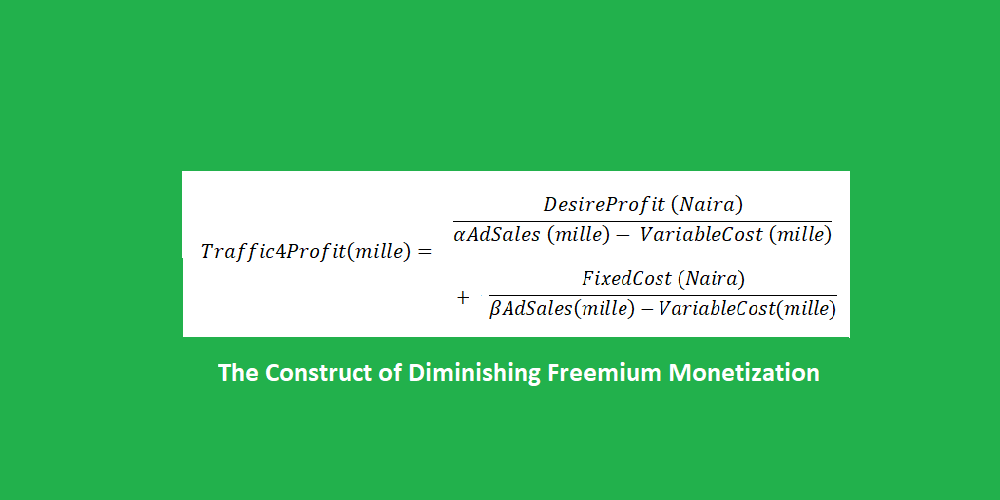
The biggest problem in Free model is that you do not even have control on anything. You do not know how Google prices the traffic and clicks. The king of search is not really transparent as it weighs cost of traffic depending on the location of the IP address. So figuring out the most likely break-even point (in volume of traffic) is hard. More so, traffic does not just mean monetization because many people visiting from Nigeria use Opera which blocks ads. So you can have improved traffic without more revenue. You need a coefficient, the Free break-even coefficient, to capture all the possibilities, if you plan to make the Free a business. That will help you determine what traffic level you need for a break-even in your Free business before you run out of cash. We have the equation thus.
The alpha and beta, the Free Coefficients, depend on many variables: the former has five while the latter has seven. I will leave them here to avoid complicating this piece. The left hand side is the total traffic (in mille, i.e. thousands) required to produce the desire profit. The Coefficients are calibrated for each sector, signifying how much you need to improve.
Free That Works
Free model works when a company has improved its Free coefficients. That means the money it makes through advertisement can cover expenses and then generates profit. The ICT Utilities like Google, Facebook etc have indeed exceeded theirs and that is why they are profitable. But that they have done it does not mean it is easy, for the following reasons:
You need so much scale to have the capacity to command huge revenue. Internet commoditizes value making it harder to easily differentiate. But that is possible, if you find your space. That you have a blog that looks like ThisDay and Punch will not do you so much good.
Your marginal cost must tend to zero since technically in a perfect internet, the marginal cost tends to zero. If that happens, it means that you can easily make profit. Your marginal price is already zero since you are on Free. But if the marginal cost is tending to zero, the small ads can give you profit
ICT utilities like Google and Facebook further puts more pressure in the system through aggregation. You will need a lot of work to differentiate to have a chance to make money.
All Together
I do think that differentiation on the web is important. That helps the ICT Utilities like Google to value your content in their models. But the greatest value is to be so good that you can enjoy subscription. The pursuit of digital growth, most times, does not hold much value because advertising cannot cover most costs unless you have a huge traffic breakout (meaning you have exceeded the Free coefficient). That is the big challenge for those that hope to make careers on the web, as creators. That focus of pursuing subscription from day one with high quality product should be in the central strategy. Becoming a category-king is very important to get people to pay.