Snap, the owner of Snapchat, may not be redeemable. The company seems to lack vision. From Fortune Magazine newsletter, I quote:
Snap’s shares are set to open … after it reported that its quarterly loss nearly quadrupled and said increasing competition from Facebook hit user growth. Revenue rose to $%182 million from $72 million a year earlier, but the net loss hit an eye-watering $443 million, up from $116 million. CEO and co-founder Evan Spiegel tried to cheer investors up by reminding them that slower user growth meant lower Cloud data storage bills in the short term. He didn’t succeed
Essentially, the company is wishing that it does not grow user base so that it can save on computing bills. I mean Snap wishes that it does not add more users to avoid spending on supporting user growth. For an American public company that depends on network effect, possible with huge user base, to execute its business model, this is extremely worrisome. This company has lost its vision.
When you read a portion of a statement credited to Evan, you will wonder if it is not time to be looking for a new CEO for Snap.
A sudden influx of users is “just not appealing at this stage of the business,” Spiegel said. He didn’t say what cloud hosting providers he was referring to in terms of the big bills, but Snap has previously agreed to spend $1 billion over the next five years on Amazon Web Services.
If Snap does not want to be growing users, it simply means that Snap is done. You cannot make up lack of vision any better than this.The statement is illogical, and could put many people wondering if Snap can be saved, even in the midst of competitive onslaught from Facebook.
Just as Fortune noted that Wall Street was not convinced on the argument, I do not buy it also. Snap ended the day down 14%
Over the last few months, a new business model is emerging in Nigeria: free wifi. Companies provide free wifi and then make money via advertisement and other support services. Our university campuses are becoming the first anchor recipients of these bold entrepreneurial pursuits. Don Jazzy started this, at scale, and others like Cyberspace Network are joining the race.
Nigerian universities will be boosted academically with the introduction of free internet access on campus, as Cyberspace Network Limited has made available wifi access for all through its Surwella initiative. …
According to Olusola Bankole, chief marketing officer, Surfwella, the free internet wifi will be launched across the length and breadth of university campuses in Nigeria, starting with the University of Abuja, from today, Wednesday 9, August 2017.
The service will be free, “no payment, no subscription, no data purchase, and no need for modems. Free internet in the most useable form, on wifi,” he stated.
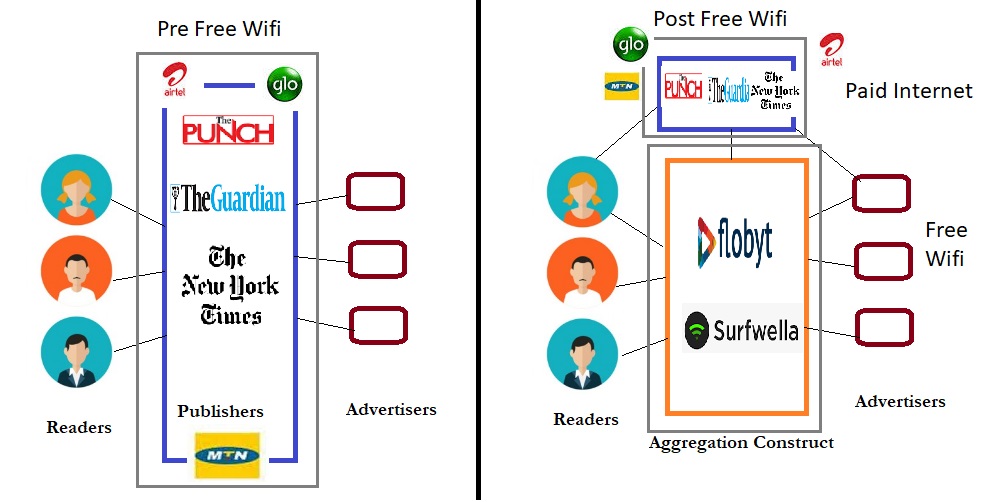
This is exciting for the end users because getting internet free in Nigeria is certainly empowering. The providers are working on the established constructs that scale, through freemium, can deliver huge value down the line. You give the Wifi service free and in that system become an aggregator who controls the ecosystem through which the end users and the publishers get in contact. This is the aggregation construct.
Under the aggregation construct, the companies that control the value are not usually the ones that created them. Google News and Facebook control news distribution in Nigeria than Guardian, ThisDay and others. Because the MNCs tech firms “own” the audience and the customers, the advertises focus on them, hoping to reach the readers through them. Just like that, the news creators have been systematically sidelined as they earn lesser and lesser from their works. But the aggregators like Facebook and Google smile to the bank. The reason why this happens is because of the abundance which Internet makes possible. Everyone has access to more users but that does not correlate to more revenue because the money goes to people that can help simplify the experiences to the users who will not prefer to be visiting all the news site to get any information they want. They go to Google and search and then Google takes them to the website in Nigeria with the information. Advertisers understand the value created is now with Google which simplifies that process.
The Wifi provider manages what passes through its network, assuming a power similar to Google News, as noted in the example of the aggregation construct. Just as Airbnb, and Uber simplify the processes of linking users to houses and vehicles respectively, the Wifi provider can link publishers to the end users effectively. Who cares to advertise via Guardian, Vanguard and ThisDay in Nigeria when you know there is a Wifi provider everyone uses to read the contents. You simply advertise through that Wifi provider expecting that it can organize what it wants its readers to see in its ecosystem. It becomes a key component in the system. That is a very powerful business model, if done at scale.
Core Elements of the Business Model
There are many ways people that deliver free wifi can make money in Nigeria. They include the following:
Advertisement: This is the same model used in many airports around the world. Before you can get on the web, you will need to watch some adverts. This is the key element of the free wifi business model.
Partnership: Just as Facebook helps New York Times to publish its contents on Facebook to reach more audience, ThisDay Nigeria can decide to work with these free wifi entrepreneurs to get people to read their contents in Nigeria. In that case, the entrepreneurs will be compensated. Also, in case governments want people to access contents online and are worried that few can afford to access them, they can partner with these free wifi entrepreneurs to host those contents for them. I expect companies like iflix and other video on demand firms to work with these entrepreneurs under revenue sharing model so that users can use their services to watch movies. This will happen as the wifi companies become stronger with scale.
Unveiling of Flobyt
Mining and Analytics: As data goes through their systems, they can make sense of many elements for partners. From surveys, as seen in some airports, to understanding what users care about in some specific localities, these entrepreneurs can provide insights on so many things. They will mine all the data they are collecting and can make money reselling them. This can help partners to deliver services and solutions at higher quality.
Promotions: You expect the companies doing this to position preferred products in front of the users. Some of those products could be their own products. Just like banks put their services in your view when you use their free wifi services, you expect the entrepreneurs to position their services, from movie to music, ahead of competitors’.Do not expect this to be a neutral internet. In some airports, you get free wifi sponsored by ecommerce companies which provide them to help you buy things from their sites For example, Konga can partner with a free wifi company in Lagos to make its site the landing page.
New Industries: The same manifestos which I have written that telcos need will be useful here. The free wifi or affordable internet business could unlock value in agriculture, as HITCH is doing in Nigeria.
With AgTech IoT (Internet of Things) innovation, companies like MTN, Airtel, 9Mobile and Glo can pipe a lot of agriculture data to farmers, banks, insurers and others, across the food chain. The telcos will aim to improve the connectivity of sensors and other data-capturing devices on farms to help farmers turn data into actionable insights through software platform. The opportunity is huge as this is an untapped market. I am hoping that telcos can come together to seed a new layer of African farming through connectivity. An initiative to connect African farms would be a necessary investment for them to expand beyond where they are today.
Investors See Value
As the free wifi entrepreneurs shake Nigeria, nothing will be the same again. I will not be discussing the impacts to telcos because that will miss the mark. The key thing is that these entrepreneurs can control access to digital contents in the Internet. As aggregators, they will be the winners, not the creators of contents, under the abundance of internet. Investors love such positioning in markets and that is why the money is flowing in..
Tizeti, a Nigerian startup which develops solar powered WiFi towers with its Wifi.com.ng service, today announced it had secured $2.1-million in funding through US-based Y Combinator from several investors.
“Today’s seed announcement allows us to grow aggressively in the Nigerian market, and we will continue to invest in building out our own solar-powered infrastructure, as well as refine and expand our consumer-focused product,” said Kendall Ananyi, the CEO of Tizeti, in a press release.
The round’s investors include Western Technology Investment, Social Capital, Vy Capital, Picus Capital, Ace & Company, Lynett Capital Partners, Zeno Ventures. The round also consists of a handful of angel investors including Y Combinator’s Michael Seibel and Gabriel Hammond.
Sure Tizeti is not free as in Cyberspace Network since it charges from $30 per month, Nevertheless, Tizeti is well positioned to have substantial market opportunity for unlimited Internet service at that price point. This aggregation model does not have to be wholly-free to work, in Nigeria. What I expect to happen is for people to come together and pay for one account and then use the service in turns. For example, three students can pay for that $30 and they will decide who uses the service over the month at what point. Provided that the service is of decent quality, the model will work since the amount is still largely affordable.
The Industry Players
One of the pioneers of this business model is Don Jazzy, the CEO of Mavin Records. With his partners, they unveiled Flobyt Wifi – a free, fast, reliable and easy to use wifi service across partner locations including; eateries, parks, taxis, buses, restaurants, cafés, etc.
Flobyt is a free WiFi service installed across partner locations in Lagos like eateries, parks, taxis, buses, restaurants, cafés and many other businesses. The service is free for patrons of a business who wish to access the internet while in the premises of the patron locations. The internet router itself is a plug-and-play device that, according to the founders, does not require much technical know-how to operate….
There is no charge to use Flobyt WiFi, all it takes is to walk into a partner outlet, patronise them and use the internet without restrictions…
The company plans to take its services to other parts of Nigeria, through West Africa and ultimately throughout Africa giving the public access to free internet while providing value for the business owners.
This is very ambitious indeed and they certainly have a plan. With his celebrity status and contents (he is an entertainer), Don can offer contents and essentially drive what people can access through his Wifi service. Expect his products to be well promoted through this avenue.
Besides Don Jazzy, we have CafeNeo which offers free internet in its stores. Another firm, HITCH, takes it further, delivering value to users by helping them catch contents, to access offline. Users access free service by connecting to HITCH smart WiFi hotspots.
HITCH is a cloud platform that enables curation and access to videos via a HITCH-designed (smart) WiFi hotspot that caches content, and lets users access it offline.
You can add Facebook Free Basics here as it is free to the approved sites.There are also banks like Diamond Bank and Union Bank which allow customers to browse free in their bank premises, provided you are a customer of the bank.
There players will have to expand beyond into other areas for growth and opportunities. A piece by Oluwole Ogunlade noted that free wifi could be very catalytic in the transportation sector. Imagine deploying these services in luxury buses like ABC Transport or Chisco Transport. Any transporter that does this will certainly win customers. The entrepreneurs should explore such partnerships.
What if you could instantly turn those “bored” commuters to your potential market audience by giving them free WiFi while they travel or wait at bus stations? It’s an instant win-win as the BRT becomes more appealing to commuters. And aside BRT services, there are over 16 car hailing services in which a provider can hook up with as distribution partners.
All Together
These services are not really designed for serious work on the web with their less than an hour session caps in some cases. Largely, they expect you to use this to check emails, update Facebook and do nothing of great value. That should be the consolation for the telcos as it will be a tough order to offer great wifi experience free in Nigeria. However, if they find value, they will continue to make free better.
I was in Cape Town last November and noticed that in some parts of the city, one can have good quality free Wifi. Indeed, entrepreneurs across Africa see this as a promising business model. Free wifi is not a business model that should be taken for granted, especially for the telcos. The telcos will have to think what they have to do because if these free wifi entrepreneurs succeed, they will have challenges selling their priced data plans. Giving things for free or nearly free under the aggregation construct is always very contagious. Just like it is hard to compete against Facebook and Google since they offer their services free, free Wifi entrepreneurs can essentially lock out opportunities for many telcos. But these wifi entrepreneurs have a long way to go. Scale will, at the end, become the limiting factor in their business models.
Editor’s Note: This post is published with permission from Wole Ogunlade who originally posted it under this title “These 10 apps will help you practise farming in a modern way (in Nigeria)”
As the wave of “agric-prosperity” is blowing, the new perspective that many of us need to have is that a lot of opportunities exist in agriculture, but we need to unlock it by moving away from cutlass-and-hoes type of subsistence farming to modern way of agriculture. As a side project I recently started farming and I am so excited to see how technology startups are filling a lot of spaces in agriculture for every challenge farmers face. The good new is that while the previous generations depended on cutlass and hoe, today’s innovative farmers can leverage technology to his massive advantage.
I curated my top lists of such modern day tech innovations focused on agriculture in Nigeria.
My curated list of must-have tech innovations and apps for modern-day farmers.
1. Hello Tractor
For farmers that want to practice farming at a commercial scale, getting access to tractors and modern agric tools is one of the biggest problems. Hello Tractor provides a modern, Uber-style way to rent tractor. With a simple SMS booking platform or mobile app, you can join their network of farmers paying for tractor services.
Hello Tractor homepage
2. ProbityFarms
This is a FREE all-in-one farm management and accounting platform to manage your farm operations, book-keeping and connect your goods to a ready-to-buy market. Currently in beta, the platform offers farmer insights about farming activities powered by machine learning at each stage (e.g, alert can tell farmer that they should not apply fertilizer on particular days if the weather forecasts that it could rain).
The platform also incorporate a cooperative farming management and a full suite of business accounting tool. The good new is that there is a forever free plan that you can start with (I encourage you to check it out).
Another notable startup for farm management is AgroInfoTech; a social enterprise with a suite of apps and Zenvus; an enterprise-focused farm management application that is built on top of a hardware IoT. The Zenvus suite consists of farm management apps designed to take the guess work out of farming.
ProbityFarms Homepage
3. FarmCrowdy
Do you want to farm by investing in farming projects? FarmCrowdy helps you to invest in any farming initiative of your choice by sponsoring a farmer. It is Nigeria’s first digital agriculture platform. It recently got accepted to 2017 batch of Techstars Atlanta, a US-based tech accelerator . Farmcrowdy is able to leverage the “wholesale” pricing it can get from its partnership with insurance firms, communities of farmers, as well as fertilizer and other agro-allied companies to give its subscribers up to 50% guaranteed returns. It is noteworthy that Growsel is a similar initiative to farmcrowdy.
Farmcrowdy homepage
4. Releaf.NG
Releaf wants to help you get trusted buyers for your agric products. The company is run by Nigerian-American graduates from the most prestigious schools in US. They recently got funded by Ycombinator. Other notable startups in this space include OgaFarmer, Farmoly and Farmly (owned by AgriHub)
5. Compare-The-Market
This is a simple platform designed to compare the daily market prices of food crops and animals in Nigeria. A key part of their mission is to track, forecast and monitor price trends of agricultural commodities in Nigeria. The site is updated daily with both retail and wholesale prices to ensure that farmers can price their goods at competitive rates. It is owned by Rotimi Williams, the young agric millionaire with the 2nd largest rice plantation in Nigeria.
6. Cellulant.
In Nigeria, Cellulant worked with the Federal Government to launch an e-wallet programme to aid Nigerian farmers directly redeem government subsidized seed and fertilizer vouchers from retail shops and in effect double their income.
While Cellulant is “transforming” itself to a mobile payment company, Agrikore its agric-focused arm monitors the implementation of agricultural schemes where every farmer can have access to financial services, productivity enhancing technologies & best practices, access to markets for Inputs & access to output markets, all enabled via the mobile phone.
In order to make the vision become a reality, Agrikore has created an ecosystem that comprises of Governments, Development Partners, Financial Institutions, Input Suppliers, Farmers and Off-Takers.
Agrikore?—?showing the categories of schemes (Did you notice 14M farmers are integrated in Nigeria alone?)
7. AgroData
Many will agree that there is a huge gap between research institutes like IITA or FIIRO and farmers. This is making it difficult to commercialize agric research initiatives. AgroData is poised to be the link between agricultural research and the farming populace. Farmers can now have at their finger tips new knowledge on farming activities that can improve their yields.
8. WhatsApp
It is worth mentioning that “mobile messaging is the new internet” and platforms like WhatsApp, Line, Telegram and WeChat are leading the pack. Many farmers’ group are leveraging the group chat features of WhatsApp to create informal groups to facilitate discussions and share intelligence about farming practices. I and my partners belong to a few of such group chats on WhatsApp.
9. VoguePay.
Sending and receiving payment is a fundamental part of every business and VoguePay makes it easy for farmers to do so. Instead of asking your buyers to pay to your “hard-to-find, one-branch-per-city bank that might be too difficult to find”, you can send a“request to pay” digital invoice which you can share via simple link on social media or WhatsApp to your customer to get paid.
You can also create full-fledged eCommerce website with VoguePay. Opening an account on VoguePay is free and easy to set up yourself with this guideline.
Alternative payment solutions to VoguePay that farmers can use to sell their products include Paystack, Simplepay and cashenvoy.
10. Other useful tools
In addition to above, other tools which are super useful to the modern farmer is Google (you can always use it to find answers to any question or information). I also use NairaLand Forum, especially the agric section (there is even a whole thread populated with contact details of people interested in agric business)
Conclusion.
It might interest you to know that agric contributes about 22 percent of GDP and over 90 percent of employment, with a potential to add 21 trillion naira to the country’s GDP in 3 years.
There is no better time than now to consider investing in or practicing agriculture as the sector is getting a lot of attention from government, private sector and tech ecosystems. Even ventures capitalists are now funding agric initiatives at scale. Also social entrepreneurship platforms like Tony Elumelu foundation, the British Council and YALI are focusing their grant and mentoring programme towards agric initiatives.
Source: Medium
Wole Ogunlade is a digital and growth marketing strategist for startup. He believes that farming is possibly the new “white collar job”
Through my non-profit, we come in contact with people across our continent. I have visited many universities in Africa. Through this work, I always get people asking for career advice. Largely, no career advice is bullet-proof. You, the recipient, have to make your career work. Even the person giving you advice needs one. I want to move up the ladder, so I talk to people about career, not for job, but business opportunities.
You cannot be running a startup and also be wiring CVs for jobs daily. I understand the concept of hedging. But when you are out there as a startup founder, and at the same time you are looking for a job, you will likely not be at optimum execution. You want money from investors, and yet you’re polishing your CV. That overlap will even make it harder to have traction to raise that money.
The reality is this: if the startup is not a job you think you deserve to have, simply stop it and focus on looking for a job. It is very unlikely you will do well in the startup if that is a second choice. Besides, startup is not something you enter just because you lost a job or have no job, without making up your mind that it is the best job as you transition. That moment of truth must come that the business is the best I can have.
Confidence comes from dignity of labour. You must commit to what you do to thrive in it. Even if you do not like it, you must commit to it. Your job does not necessarily need to be your hobby, in Africa, because jobs are scarce. Like it or not, excellence in it is the only path to the next level.
NB: Startup in this content means going to create something of value with transformational impacts in the market. It is different from small business which could be barbing salon, selling corn along the roads, etc that rarely scales. You do not build such firms without focus.
“A company five years old can still be a startup,” writes Y Combinator accelerator head Paul Graham via email. “Ten [years old] would start to be a stretch.”…
One thing we can all agree on: the key attribute of a startup is its ability to grow. As Graham explains, a startup is a company designed to scale very quickly. It is this focus on growth unconstrained by geography which differentiates startups from small businesses. A restaurant in one town is not a startup, nor is a franchise a startup.