DD
MM
YYYY

PAGES

DD
MM
YYYY

spot_img

PAGES

Home Blog Page 7334

Nigeria’s E-commerce Sector Receives 30% Gift from Government

6

Today, the Nigerian government unveiled the 21 sectors which will enjoy “pioneer status” as it works to accelerate investment into the country, and subsequently diversify the economy from minerals and hydrocarbons. One of those sectors is ecommerce.

The government of Nigeria has released the full list of the 27 key industries and products included in the  ‘pioneer status’ incentives for prospective investors.The benefits include tax relief, mainly for corporate income tax. … Here is the full list of the 27 industries to enjoy the pioneer status….21. E-commerce services;

Nigeria’s corporate income tax (CIT) has averaged 30% over the last few years.

Resident companies are liable to CIT on their worldwide income while non-residents are subject to CIT on their Nigeria-source income.

The CIT rate is 30%, assessed on a preceding year basis (i.e. tax is charged on profits for the accounting year ending in the year preceding assessment).


Simply, CIT is 30% and it is a huge part of the profit. If you are not required to pay this money, the implication is that, you can decide to pass the gain to your customers. This will help the Nigerian ecommerce sector if they decide to pass the gain to customers.

Why This Matters

Just like that, the Nigerian government has made shopping online cheaper. The savings here could be up to 30% of profit provided the ecommerce companies decide to pass the whole gains to customers. This means that if a shoe commands a profit of N1,000, without the pioneer status, an ecommerce company can now sell it for N700 without any material change in its bottom line. This is because the difference of N300 would have been sent to government as tax, without the pioneer status in place. But since government is forgiving that tax, the online seller can sell at N700 without any change in its financials. This assumes that the seller is transferring all the benefits to the buyer.

Depending on how government implements this, selling things online should be cheaper in Nigeria for companies. This mirrors the U.S. model which helped Amazon.com. The ecommerce giant was not collecting local taxes thereby making things artificially cheaper to buyers compared to physical stores which do collect local taxes. So if a product is $100, and the local tax is 7%, buying at Amazon will command only $100 while in the local store, the price will be $107. For Amazon Prime members, the shipping is waived, and that immediately pushes many to shop online as they can save the tax money. That gave online stores a huge edge over their physical store counterparts across America. (By law, the local buyers are expected to self-report the tax; that does not usually happen though).

According to federal law, a retailer does not have to charge sales tax on purchases made in a state where it does not have a presence. And thus the argument has been that online-only retailers — which have only distribution centers instead of a massive fleet of stores dotting every state in the country — have enjoyed an advantage over their brick-and-mortar counterparts because they could effectively beat them on price by not having to charge that tax.

Technically,  we should be seeing items cheaper in Konga and Jumia compared to physical stores and supermarkets once the pioneer status kicks off.  While the challenges of ecommerce remain, in Nigeria, I will not go there today. This is a moment because this is a significant deal.

All Together

The Nigerian ecommerce players will have more room to profitability now they can keep all their profits if they choose. (This assumes they make profits.)  Also, depending on how they plan it, online shoppers will increasingly see products to be more price-competitive compared to brick and mortar stores. As the government rolls out the modalities, more insights will come. This could possibly open more investments in ecommerce sector in Nigeria.
The Frictionless Future And Dislocation In Essence of Firms [SN]

0

This is a Short Note from my LinkedIn update.

Our world is going through a redesign. Technology is restructuring the core elements of our economic systems. The essence of firms, the reduction of the friction that exists between buyer and seller, is challenged. In a friction-less market, the buyer and seller will connect directly without intermediaries (the firms). If savers can find people to lend directly, one of the core pillars of banking will go.

A firm is installing biochip implants in staff making it possible for them to shop and move around in offices seamlessly. That will go mainstream and humans will become nodes, just as we have IP addresses of modern computing and mobility. Add blockchain, the constructs of self-organizing systems will emerge. Even a dislocation in government powers will emerge.

As AI (artificial intelligence) evolves and machines increasingly become more cognitive, bosses will become algorithms. You go to work, you report to AI which will supervise your work. Because the AI can understand more complex systems, at scale, than humans, it has an edge.

The amalgam of brainy machines with humans as nodes under the control of blockchain will reduce the cardinal drivers of firms across sectors. Why do you need school when your brain is an extension of the internet? Unbounded possibilities; it’s ON.

List of 27 Industries to Enjoy Tax Break Under Nigeria’s Pioneer Status Program

0

The government of Nigeria has released the full list of the 27 key industries and products included in the  ‘pioneer status’ incentives for prospective investors.The benefits include tax relief, mainly for corporate income tax. (You could be keeping up to 30% of your profit with this.)

Here is the full list of the 27 industries to enjoy the pioneer status.

  1. Mining and processing of coal;
  2. Processing and preservation of meat/poultry and production of meat/poultry products;
  3. Manufacture of starches and starch products;
  4. Processing of cocoa;
  5. Manufacture of animal feeds;
  6. Tanning and dressing of Leather;
  7. Manufacture of leather footwear, luggage and handbags;
  8. Manufacture of household and personal hygiene paper products;
  9. Manufacture of paints, vanishes and printing ink;
  10. Manufacture of plastic products (builders’ plastic ware) and moulds;
  11. Manufacture of batteries and accumulators;
  12. Manufacture of steam generators;
  13.  Manufacture of railway locomotives, wagons and rolling stock;
  14. Manufacture of metal-forming machinery and machine tools;
  15. Manufacture of machinery for metallurgy;
  16. Manufacture of machinery for food and beverage processing;
  17. Manufacture of machinery for textile, apparel and leather production;
  18. Manufacture of machinery for paper and paperboard production;
  19. Manufacture of plastics and rubber machinery;
  20. Waste treatment, disposal and material recovery;
  21.  E-commerce services;
  22. Software development and publishing;
  23. Motion picture, video and television programme production, distribution, exhibition and photography;
  24. Music production, publishing and distribution;
  25. Real estate investment vehicles under the Investments and Securities Act;
  26.  Mortgage backed securities under the Investments and Securities Act; and
  27. Business process outsourcing.

This is beautiful.

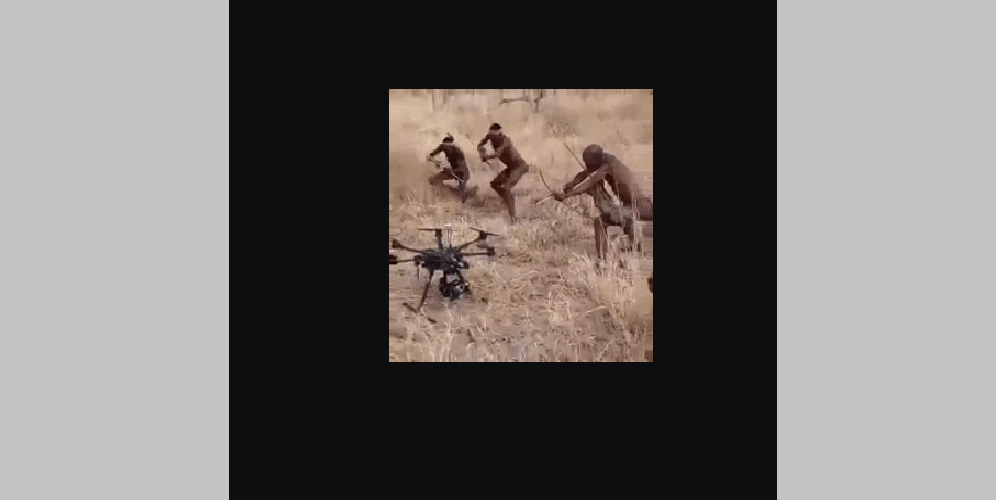
The Villagers Hunted The Drone [GIF]

0

The villagers saw a special breed of “bird” which fell from the sky. They gathered to get it.  They aimed their arrows because even though the bird was already down, it was still moving. Too bad, the animal is a drone.

The bad thing in this video is that the actors are Africans which is a bad stereotype.

Source: I saw this in TechCabal newsletter today

The Technology of Nations: Adam Smith, Isaac Newton and Bill Gates

0

In 1776, Scottish economist and philosopher, Adam Smith, wrote the masterpiece ‘The Wealth of Nations’- actually ‘An Inquiry into the Nature and Causes of the Wealth of Nations”.

By coincidence, the United States Declaration of Independence was adopted the same year, making the American colonies independent and thus no longer a part of the British Empire.

America has since evolved to dominate the old British Empire in virtually every aspect of human endeavors, except perhaps, social welfare. The Americans, figuratively, were discipled by Dr. Smith who believed in the free market and made his argument that ‘capitalism’ will benefit mankind more than any other economic structure. He laid this foundation at the onset of the industrial revolution and provided the basis for modern economics.

Smith made his case about the ‘invisible hand’ and why monopoly and undue and unfettered government regulations or interference in market and industry must be discouraged. He was of the opinion that prudent allocation of resources cannot happen when states dominate and over interfere.

In that old time, American farmers could grow cotton, but would not process it. It has to be sent to England where it would later be imported into the U.S as a finished product. Understanding that this decision was not due to lack of processing ability, you will appreciate Smith’s argument that the market must be free.

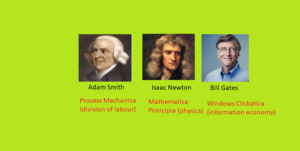
His theses were clear and were very influential; they provided the same level of fulcrum to Economics as Isaac Newton’s Mathematica Prinicipia to Physics. Or in modern times, Bill Gates’ Windows to the information economy.

While reading Smith’s book and understanding the time frame it was written, one cannot but appreciate the intellectual rigor in that piece. Before technology was penetrated in en mass across the regions of the world, he noted that all nations could compete at par in agricultural productivity. The reason was absence of division of labor in any subsistence farming system in the world. A farmer does everything in the farm and is not an expert in most.

Agro productivity has improved over years (source: linkedin)

Discounting fertile land, rain and other factors that could help farmers, all the farmers, from Africa to plantations in Alabama, the level of productivity was similar. Why? No specialization was employed in farming business at the time.

Fast track forward when the industrial revolution set forth. The British Empire became an engine of wealth creation through automation. It was a quintessential period of unrivaled human productivity which resulted to enormous wealth created in the empire. Technology not only helped speed process execution, it helped in division of labor.

Interestingly, Dr Smith had noted that except agriculture where productivity was flat because of lack of division of labor, other industries were doing just fine. And in those industries, there were organized structures which enabled division of labor. For instance in the construction industry, there were bricklayers, carpenters, painters, and so on; but a farmer was a farmer.

As you read through Wealth of Nations and observe the 21st century, it becomes evident that technology was so influential in the last few centuries. It has changed our structures and created a new business adaptation rules like outsourcing which is indeed a new breed of division of labor.

From accumulation of stock and pricing, as explained by Dr. Smith, we see today a world where technology is shaping everything in very fundamental ways for wealth creation. In this era, it has become technology as technology translates to wealth. So, nations that focus on creating, diffusing and penetrating technology will do well.

Why? It is about national technology DNA. The more passionate and innovative nations are triumphing at the global business scene. Give me Japan and I will give you electronics. Talk about United States, I will share biotechnology and pharmaceutical technologies, and indeed every major technology. Give me China, and I will give you green technologies.

So, as nations continue to compete on the technology paradigm, we see at the highest level of success measurement an embodiment captured by technology capability. When nations are understood from the lens of their Technology Readiness Index, Knowledge Economic Index, we see that countries have become technology competing nodes. In some really poor countries with no (effectual) technology, they do not have a node and are unplugged in the sphere of global wealth creation.

Simply, it will be difficult to separate the health of any modern economy from its technology. It goes beyond the wealth of that nation to its survivability. The most advanced nations are the technology juggernauts while the least developing economies barely record any technology penetration impact. For the latter, it is like still living in the pre-industrial age Dr. Smith discussed on agriculture and division of labor where processes were inefficient.

Perhaps, this explains the efficiency in developed world in both the public and private arenas. The more technologies they diffuse, the more productive they become. In other words, show me the technology and I will tell you where the nation stands in the league of countries. Interestingly, the invention of steam engine changed the world and powered the industrial revolution. The invention of transistor transformed the 20th century and is fuelling the new innovation century.

It seems that major scientific breakthroughs bring major great countries. Let me emphasize here that some old kingdoms that ruled the world such as the old Babylon, Roman Empire, and Pharaoh’s Egypt; there have been associated knowledge base that put them ahead. You cannot disassociate good crop production in River Nile to the mastery of Egyptians in inventing some sections of geometry for farming. Some of the old wars had been won by developing constructs that enabled efficient transportation of soldiers to battleground. There was science and nations were winning by using that knowledge.

In conclusion, the world has been living on technology and it is indeed defining our competitive space. As nations compete, it is technology that shapes the world with wealth as the major byproducts, in some cases. I make this case because some of the best technologies had been invented for non-wealth reasons (yes, directly). Examples include Internet and radar technologies which have created wealth and spurred commercial innovations but have military origins.

There could not be any more powerful way of examining national competitiveness than understanding the technology of nations. Yes, wealth has since morphed to technology and all competitions and wealth creation could as well be seen from technology viewpoint. And in this piece, I aptly replace Dr. Smith’s ‘wealth’ with ‘technology’ to have The Technology of Nations. Oh yes, Smith postulated process mechanica, Newton gave us mathematica and Gates pioneered clickatica.