Update: Andela has addressed most of the operational concerns in this piece. You can read updates here and here.
Andela is a fine engineering company. It provides leading global firms and high-growth startups with elite African developers to support their operations.
Andela provides companies with access to the top 1% of global tech talent by identifying high-potential developers on the African continent, shaping them into world-class technical leaders, and pairing them with companies as full-time, distributed team members. This allows Andela’s clients, which range from startups to the Fortune 500, to accelerate their product roadmaps while minimizing time spent interviewing, on-boarding, and training new hires.
Andela is backed by investors including Spark Capital, Google Ventures, Chan Zuckerberg Initiative, Omidyar Network, Susa Ventures, Steve Case, Founder Collective, Rothenberg Ventures, Learn Capital and more.
Its claim that it recruits the “most talented developers” in Africa is debatable; in my alma mater, Federal University of Technology Owerri (FUTO), where oil companies come and hire some brilliant students, before graduation, it is not evident they will forgo Shell and Chevron jobs because of attending Andela training. But there is no doubt that it is making a real contribution in the industry by training and developing young people and offering them opportunities. Also, since these developers are full-time employees of the paired companies, it does mean they are not working for Andela, post-training. Understanding this is important to understand the business model of Andela. How does it make money?
- Option A: The companies, which are hiring Andela trainees, may pay a fee to Andela which is typical to the recruitment sector where companies are compensated for helping clients to fill positions. The only difference here is that Andela is using people from its “school” to fill those positions. So, that fee becomes its revenue. Also, there is also a likelihood that Andela may take besides the fee, a one-off percentage of the first year salary of the developer, paid by the hiring company. This is typical in the industry. We do not know yet because there is no information anywhere on this important part of Andela – are the trainees making money and how much percentage, post training? They are paid about $500 per month with boarding and feeding during training.
- Option B: Another model could be taking a percentage of the developers’ salaries. This one is not interesting since the developer is a “full-time” staff of the paired company. You cannot be a full-time staff in IBM while getting a percentage of your salary going to Andela. So, this does not make sense. However, it is also possible that you can be a full-time staff on “time” but still be a staff of Andela. It is like what happens in the banking sector where OND graduates are employed “full time” in banks despite having the consulting companies that sent them paying them. The banks pay the consulting firms; they pay the OND graduates from there.
- Option C: A hybrid of the Option A and Option B. Andela is paid a fee and continues to get a portion of the developers’ wages. The key part of this is how long are the developers contracted. Are they allowed to resign after training? And how many years are they compelled to remain in Andela network? Knowing the answers to these questions will help decide how Andela makes money. Since they are funding all aspects of the training, it is fair to expect them to have some clauses that demand the developers put some time with them to recover the money. Otherwise, a graduate can depart and source for that job directly.
So, for this analysis, I will focus on the Option C – Andela is paid a fee for facilitating the recruitment of developers into clients’ businesses, and it also takes a percentage salary of the developers, in perpetuity. The core of Andela is to transform bright graduates into elite developers, even those with limited prior-software skills.
Andela has raised about $41 million and one of our fellow citizens, Iyinoluwa Aboyeji, is a co-founder. Iyin now runs Flutterwave, another high-growth company. He is a brilliant mind.
The core of Andela mission is to use African developers to support global firms where there is a shortage of developers. This is a win-win since our citizens get exposed, get nice jobs and the foreign clients get the talent to grow their businesses. It is promoted as an “opportunity to plug the shortage of software developers in Silicon Valley by bringing in technological talents from Africa” .
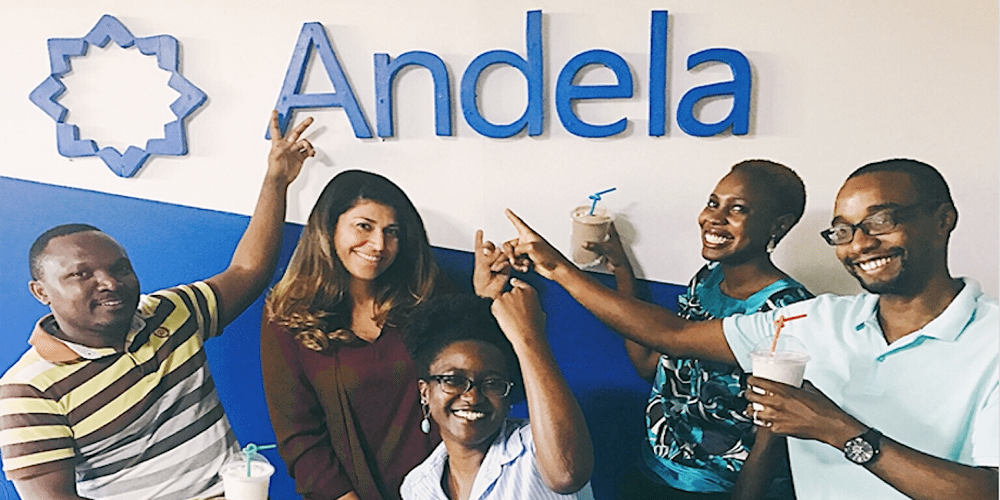
Andela Fellows (credit: iHub)
Making Sense of The Business
For the mission on what Andela is doing, there are many models in the world. Many Indian firms have pioneered that process with dedicated training schools where they prepare people they ship to Western firms. Infosys, Tata and others do this with different flavors. However, for most of those firms, the developer, under most scenarios, remain the staff of the company that sent them. For example, if Infosys puts a developer in IBM, that staff remains a staff of Infosys, and never IBM. The implication is that Infosys continues to earn revenue from that staff throughout the deployment in IBM – it takes a percentage of the salary the staff is paid.
As noted above, I will assume a hybrid – Andela takes initial fees and over time, takes a percentage of the developer’s salary. This makes sense because it provides the office space the developers work from and the developers never paid for the training. In other words, before they are IBM or Microsoft employees, they have to be Andela employees.
(The construct of decoupling from Andela, once hired by the outside firm, post-training, does not make sense. Doing this will mean Andela will only benefit from initial fees paid by the client. This is not really likely, since Andela provides the office spaces where these developers work from, remotely, to provide services to the outside firms. I do not think it is possible they can offer the service without being compensated either by the hiring firm or the developer.)

Andela is radically different from conventional model of education as noted in the table below which compares Andela model for education and the conventional one.
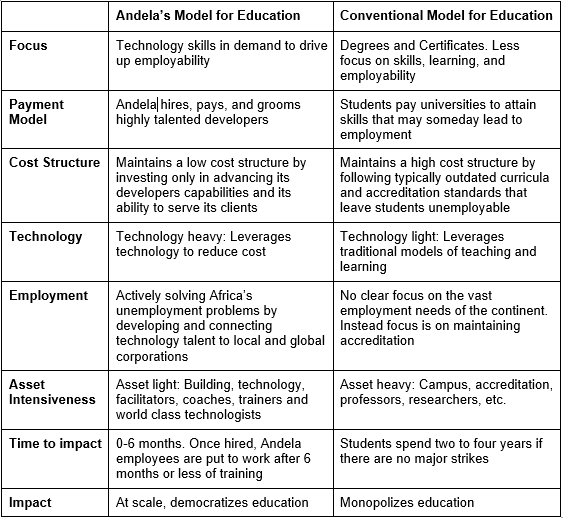
(Table Source: Medium)
The revenue model and how these developers are paid are not provided. This could be a huge difference between the Andela model and conventional education. Understanding that compensation is at the heart of this comparison, but too bad, no one has the data/information to make that call. Do you work for Andela for 4 years? What does the contract say, if you want to depart?
Training Models
Andela trains people. We will examine the processes. There are about four models for doing this:
- You ask people to pay fees to get training/education: In this case you can think of Udacity Nanodegree where you pay to be trained. Or at best, you attend MIT without a scholarship – you pay the school fees. This one requires you invest massively in the program. Udacity is online-based which makes it scalable while MIT is restricted. The key element is making sure you get value in what you are paying for.
- You make the training free: Here, the training is free. Codecademy comes into mind with its solid interactive online training suites which are free. This model scales rapidly because it is free. Quality issues are common in this model.
- You retain people and train: In this model, you become selective, not mass as in Codecademy and you waive the training fee. Not everyone can access that training, you become selective. MEST Ghana has this model. Andela is doing the same. They provide stipends to the trainees. In this model, the revenue is designed where the developers become the products, which are now used to either build companies, or as in Andela case, deployed as employees in other firms. The Y Combinator is also a variant of this, though the focus is building companies.
- NGOs with no sustainability: you offer training to selected developers, pay stipends during training, and when the money runs out, you close. This happens when you cannot find more donors to support the project. In this one, revenue is not a key part of the business. It is more of a community service.
Andela pays stipends, about $500 per month, to the developer-trainees while waving all training fees It has to recoup this investment, provided it is not an NGO. In other words, the investments must be returned.
Andela, a Lagos and New York-based education start-up has brought a brand new approach to education on the African continent. Instead of charging students for a four-year degree before releasing them to a brutal economic environment characterised by high unemployment, Andela recruits intelligent, local talent through a rigorous testing and interview process and then pays each student approximately $500 each month, with benefits, at the start of a four year fellowship designed to transform even the least tech-inclined person into a world-class software developer or project manager. As they progress through the programme and take on greater responsibility, Andela fellows are eligible for pay raises…Andela’s business model centres on training these students to be proficient in software and web development, before making their talent available (while they are still in training) to companies around the world in need of engineering talent.
Essentially, Andela is a talent arbitrage firm which subsidizes the cost of the developer-education through the fees earned from the foreign partners, made possible later by the developer.
The Andela Problem
Andela challenge is scaling. As it opens more offices, its expenses will increase. Because of the level of quality it wants, its growth will correlate heavily with more expenses. Unlike say, it is training on the web and deploying the developers from their homes, it will have to open offices, retain the developers from those offices to support the global clients. Two things happen here:
- Andela is a decentralized school: It has locations in three locations, in Africa now. They are Nigeria, Kenya,and Uganda. It can use the same faculty which it can rotate to cover these locations, or alternatively, it can bring all the classes together to save cost. Alternatively, it is possible most of the training can be done via the web with minimal physical contacts.It is noted that most training is personalized, so it is likely online. Sure, some physical components will still be relevant since they do not just teach technology – they offer programs on communication, leadership and more.
- It runs decentralized employment locations: When it hires and helps IBM to engage a developer, IBM has a record that the person is in Uganda. For Lagos, that person is in Nigeria. It will open many locations. By the time it gets to 100,000 people, it might have many office locations which have to be managed. Think of a company with 100,000 staff.
The business cannot scale outside the blue, because the revenue is the developer, and you cannot mass produce them. There is a space constraint on how many you can have in the offices.Sure – you have more offices, but that also increases cost. For the very fact that these workers remain with Andela, and not leaving, it will quickly run into carry-capacity. But that is a good problem to have in Africa, though.
How? Let us assume, it pairs 200 people in Lagos yearly. Over ten years, it will have 2000 people in Lagos. It means every year, its offices must absorb new 200, assuming old developers did not leave (not clear on the terms for that). Building such a business will mean by the time it gets to 10,000 staff, it will have a huge real-estate like call-center but here developers. Getting to 10,000 is important because the staff is the product where the revenue comes.
Compare this to Infosys model where the developer actually goes to the client office, in some cases. It does not have to expand at that physical scale. But Andela has to invest in accommodation. The students are also housed and provided feeding which mean big expense.
The training process may be difficult, but the payoff is well worth it. Andela pays its fellows from the moment they are accepted, and the company showers them with a multitude of benefits like health care, a MacBook, subsidized housing, and, as is standard for many tech companies, meals every day

Mark Zuckerberg invested through his family foundation (image credit: Newslex)
Andela may become the largest company operating in Africa, if it attains its plan of 100,000 developers in ten years. If it continues the model of accommodating the developers and feeding them, managing that complexity will require that it registers as a real estate firm and also own its own hotel and catering services. So, it is safe to assume that the company will pivot as its capacity grows. This will be the biggest challenge for Andela – you cannot have the 100,000 in your system.
Finding and training people will remain critical in Africa. Compare to the model of Actis, a private equity firm, which runs Honoris United Universities, the difference is clear. Actis is not offering any job placement, though, but it is tapping a network of schools, to train at scale. Both Andela and Actis, are there to make money. Actis is going the old path. Andela offers higher value – it is indeed redesigning the system.
Actis, a leading investor in growth markets, announced today a major pan-African higher education initiative – Honoris United Universities
Honoris United Universities is the first African private higher education network bringing together the leading tertiary education institutions in North and Southern Africa for the first time. Honoris United Universities will harness the collaborative intelligence and the pioneering efforts of these institutions to educate Africa’s next generations of leaders and professionals.
Looking At Revenue
From the heart of Andela program, it looks like a charity, but it is not. Everything depends on what the developers get when they begin work and what Andela makes from them, as they are paired in companies.
Andela’s training and education program unites qualified African students, regardless of age or income, with leading developers who teach them to code. The four-year training program, which pays its students, is highly selective. Jeremy Johnson, the company’s CEO, has said that in Nigeria its recruitment rate was around 0.7% of the 15,000 applicants it had received to that point. Within six months of starting the program, those students who have been accepted start to be placed at technology companies that partner with Andela, and receive continual training and professional development. Andela has partnered with Microsoft, IBM, 2U, Udacity, and others.
Andela pays the students and trains them for four years. This is like an undergraduate education. Though the training is four years, the developers start working from the 6th month. This means they could be working for 3.5 years which at the end, they become on their own. (This is not clear) In all its materials, it emphasis training so you do not know what happens past the four years, if these developers, will remain in their networks. It plans to train more than 100,000 in ten years
Komolafe is just one of many Andela students who are betting on this young education start-up company, which intends to train 100,000 software engineers over the next 10 years.
At acceptance rate of say 1%, it means that Andela will be in contact, physically or online, with at least 10 million young Africans. Of course some of the processes are automated, but it is still a huge number. The cost of operation will also increase as this firm advances:
Finding these bright minds is an extensive process. Over its two years, Andela has seen applications from approximately 40,000 candidates. Those applicants are filtered out through automated aptitude tests. Top scorers are then invited in for in-person tests, and after that, the top 2 percent of candidates are invited back for the final round of the application process, a two-week boot camp. Only about a third of those individuals make the final cut, hence Andela’s razor-thin 0.7 percent acceptance rate….Accepted fellows move into Andela’s campuses and begin their personalized training right away, which is a process that typically takes about five or six months to complete.
At its peak, Andela could be making real money. I cannot put a figure without knowing what happens after training for the developers. How many years are they required to “work” for Andela?
Rounding Up
There is no question that Andela is pioneering a new model of talent development in Africa. It is going to seed a new generation of African tech leaders in coming years. Its vision is sweet and Africa will forever be better for it. However, depending on its contract with the developers, it may struggle to make money; its cost will scale massively with growth by operating real estates, accommodation and catering. If it gets to the 100,000 developers it hopes to train in ten years, on assumption that it can remotely have the developers work from its facilities, it will become one of the largest companies in Africa. Its products are the developers. By controlling all aspects of the developer experience as it wants to house, feed and keep them, it may very soon become a real estate and catering company because handling that will become a huge part of its business. But if it graduates them after four years, with the developers free to depart, after the training and pairing/mentoring, it could be seen as the most important social empowerment program in modern Africa. The story of this company is just starting – we need to know more how it plans to handle the future of the developers as it recruits very brilliant people with super-size ambitions in life. Andela problem is that humans are its products. That is always hard to control.