DD
MM
YYYY

PAGES

DD
MM
YYYY

spot_img

PAGES

Home Blog Page 7409

Simple ways to secure your Android phones from hackers

0

The Android platform has recently exploded in popularity, and hackers and thieves have taken notice. They’ve used the open-source operating system’s shortcomings to steal information from users, or to steal cash directly in the form of premium text fees. But the basic steps toward proper Android security are neither expensive nor difficult. Following these five simple steps will provide a solid foundation for protecting yourself as you merge your life, information and finances with your mobile device.

Take Precautions when Using Apps

Applications are the most common way for malware to get onto your Android device. Google scans all the apps available through Google Play for malware, so if you are going to download something, make sure you do it through Google. Installing third-party apps may be tempting, especially because those apps are often free, but it opens up your device to a whole host of issues. If nothing else, Google will offer to scan any app downloaded from outside of Google Play, so at least run the scan when prompted.

Additionally, pay attention to what permissions each app requests when you install it. For example, a navigation app will certainly need permission to use your location, but a note-taking app doesn’t. Likewise, a game application probably doesn’t need access to your contact list. Check the list of permissions that appears before you install any application, and if something doesn’t look right, find a similar app that doesn’t ask for access to unnecessary information.

Stay Updated

The modern threat landscape is a little bit like the old whack-a-mole game. Hackers find flaws in the software and exploit them, then developers repair the hole, only to have hackers move to another vulnerability. While Google can’t always prevent these exploits, it’s pretty good about keeping Android updated to fix the issues it does discover.

However, this won’t do you any good if you don’t keep your software updated. Running your Android device on outdated software is an easy way to get infected with malware, because exploits become better-known with time, and hackers know that plenty of users won’t have updated their devices. Likewise, Google is constantly adding security measures to Android. For example, the 3.0 version of the Android software introduced device encryption, which makes stealing data off of it very difficult. Those users choosing to stay with an older software version lose out on these protections.

Avoid Unsecure Connections

Free, public Wi-Fi can be a tempting way to save time and keep your mobile data usage to a minimum, but it’s not always safe. Hackers can easily set up man-in-the-middle situations using these connections, where you actually connect to the hacker’s device or computer, allowing him or her to see all the information that flows from your device to the Internet. Hackers can also exploit the connection process to install malware directly onto your smartphone or tablet.

If you have to use one of these networks, take some precautions to keep yourself safe. First, ensure the business you are in does have free Wi-Fi, to avoid connecting to a fake Wi-Fi hotspot. Then, only use apps and websites that encrypt information, which makes it very difficult for hackers to see what you are doing. Finally, if possible, connect using a VPN, like the kind many businesses have set up for their employees.

Lock Your Device

This tip may seem a bit simple, but locking your device is an important step in keeping it safe. If you lose your Android smartphone or tablet, the lock screen may be enough to keep whoever finds it from looking through your personal information. More importantly, it can take a thief just a few seconds with your unlocked device, perhaps while your attention is diverted, to download and install an Android virus, malware or spyware. A simple lock screen can prevent this.

Get a Mobile Security Solution

All of these tips are a good start, but the biggest step you have to take is finding and installing a professional Android security solution. The best solutions offer a combination of antivirus protection, anti-theft protection, dangerous SMS filtering, Web protection and privacy protection to ensure that your device remains as secure as possible.

There are free anti-malware options out there, but that low price point comes with some hidden costs. It’s almost impossible to tell the true free solutions, which are still limited at best, from Trojan horses that infect your device rather than keep it safe. If you’re looking to save some money, the best option is a trusted security name that offers a free Internet Security trial period, so you can see the solution in action before making a purchase. Industry leaders also offer complete mobility solutions, so you can protect several devices at the same time.

The extent of Android malware, viruses and spyware may make you think twice about how much you use your device, but it doesn’t have to. Hackers almost always look for the easy targets, and by following these tips you can avoid the vast majority of malware and stop anything that does get through before it gets access to your information. Only through tight Android security precautions, paired with a robust security solution, can you truly feel safe.

Take a Short Course

You can learn more about Android security by taking Facyber certificate courses .
Mines of Knowledge

13

This is my general response to those that have asked me to explain what I mean by “Mines of Knowledge” as posted on my feed. This is a fast feedback which could not be posted on comment section because of space limitation.

Hello,

Thanks for the kind comments. Mines of Knowledge is not really that complicated. The construct is that we can invest in education and seed deep knowledge base which can be mined for human progress. The latent creativity and ingenuity of our people remains the best mines, across Africa, over the ones of platinum, gold and crude oil.

Mines of Knowledge could show through top class universities, excellent primary/secondary schools, good technology ecosystems and making sure that Africa’s finest minds stay home. The world competes on Knowledge and anyone that figures the best way to create knowledge dominates.

During the golden era of Egypt when Pharaohs controlled some of the best thinkers, Egypt ruled the world. In short, when Moses appeared before the Israelites, according to Bible and Torah, they marveled that he had studied under the Pharaohs. Recall Joseph, son of Jacob, who interpreted the dreams of Pharaoh. He saved the world from famines as Egypt was the only country that stored grains, during abundance, for the famine period. The best thinkers, then, lived in Egypt.

The best moment of Greece was the era of unprecedented knowledge generation. The finest philosophers like Socrates, Aristotle lived therein. They had their moments. Greece blossomed and the world was on the feet of the Greeks. Take a big example: When the world was debating the material component of the universe, it was like a family affair in Greece; Thales said water, Heraclitus said fire, Pythagoras said numbers, etc. The world just watched them because the best ideas were emanating from Greece. Hipparchus had perfected Trigonometry in Greece and Euclid of Alexandria, a Greek mathematician, had invented Geometry. They owned knowledge and helped to shape the designs of some of the best ports off the coast of the Mediterranean.

When General Titus and Vespasian destroyed Jerusalem circa AD 67 – 70, the Romans were the best fighters. They had the best knowledge and the best technologies. They destroyed the  rebuilt Temple of circa 408 BC and made Jerusalem desolate (the temple was originally built by Solomon in 10th century BC),. They dominated the world and imposed their vision of the world, just as America is doing today. No one could challenge Rome because Rome is power. From Apostle James, the brother of Jesus and the first Bishop of Jerusalem (who was martyred in AD 69) to Bishop Polycarp, through Apostle Peter, Rome controlled some of the best thought-leaders. By the time Apostle Peter was crucified upside down, the finest lawyers, philosophers were under the control of Rome. Subsequently, Catholicism was formed, and Vatican was consecrated as the Holiest spot on earth and existed undisputed before the birth of Prophet Mohammed (born 570 AD), the Father of Islam.

From the Babylonian Empire to the American empire of today, when you win on Knowledge you win on economy and human development. Babylon (today’s Iraq) used to be an intellectual domain. When Islam was founded in the 7th century, there were many intellectuals that actually helped. Abu Ja’far al-Khwarizmi, the Father of Algebra, lived in Baghdad and was known to travel to Mecca to help fix mathematical puzzles. He postulated and built the foundations of modern Algebra. There was relative prosperity as Islam had thinkers and they actually made enormous progress. The first University in the world, created in Morocco, was renowned for its ability to create knowledge creators and thinkers. Some men went to Mecca just to meet Khwarizmi solve their business problems disguised as mathematics. He was a pioneer in the beautiful science of numbers we have come to admire and he made many merchants better through application of numbers in their businesses.

The Great Britain ran great ideas during the Industrial Revolution and they ruled the world. They built mines of knowledge in science. In such, then, the rulers of Britain were inspired by science and technology. Michael Faraday was an icon, and in the Houses (Lords and Commons), doctors, engineers, pharmacists were everywhere. Britain later chose Law, Logic and Philosophy, over sciences, and they crumbled in sustaining knowledge.  They lost the steam of the Industrial Revolution.

The beauty of America today is not the Mother of All Bombs but the finest mines where they create knowledge. If the top 10 universities in US close, within two decades, America will lag in military, economic development and political power. The monies some American universities control eclipse the GDPs of most countries. They invest in knowledge creation and dissemination.

Hard Evidence on How Knowledge Builds Nations

There is hard evidence that when nations build mines of knowledge, they prosper. Over the last 500 years, productivity increase has driven GDP (gross domestic product) growths across nations. When nations improve their productivity capabilities, they always experience expansion in GDPs. And when GDPs expand, the results have correlated with higher standard of living. Higher standard of living is better living welfare for citizens.

Technology penetration or diffusion has been a catalyst to this global economic redesign. Technology anchors innovation which typically drives productivity gain.

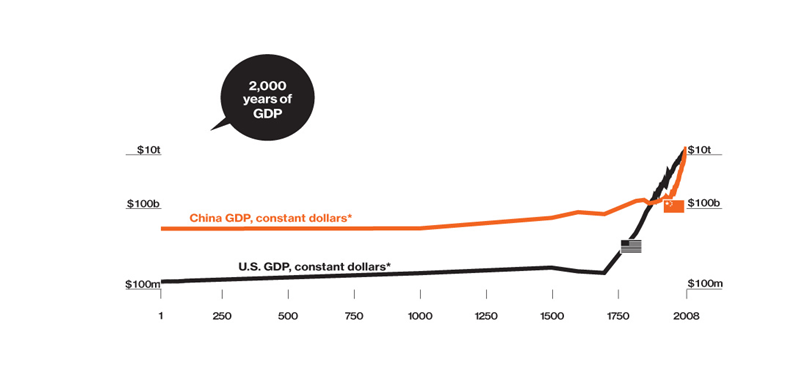
For more than 15 centuries, neither China nor USA improved productivity. Consequently, the GDPs were on stasis.

As shown in the plot above, using the two most dominant economies today, the gross world product (GWP) started expanding around 1700. Around that time, many efforts were made around the world on Intellectual Property Rights. They created a system to enable nations build mines of knowledge and own rights to some ideas that emanate from them. U.S. awarded the first patent to Samuel Hopkins on July 31, 1790. The impact was huge because men could now take risks on ideas, commercialize them and own the exclusivity to the monetization processes. That triggered a virtuoso circle that pushed capitalism to pursue lofty goals where Pfizer can invest billions of dollars to find cures to diseases knowing that if it succeeds, it will have time to recoup the invested money. Without that structure, they would not take that risk. This also explains that making knowledge to work requires strong legal systems.

Conclusion

My vision of Africa is that we can build Mines of Knowledge where young people can have their minds liberated from norms and dogmas. And the ones that will help find solutions to our problems in our own ways. I am so pained that after decades, Nigeria does not have regular electricity. There is nothing that says it must be imported or provided by GE technologies. The problem is that we have been nurturing the wrong mines of crude oil which has made it impossible to develop one that can help Nigerians to build the one that will give us light.

I have worked in America and Nigeria – the reality is that everyone is smart. The difference is preparation. Before I made it to U.S., I did not know how to wire a simple diode. But after going through the knowledge creation system of America, I filed a patent on making microchip that controls surgical robots. I have my circuits in the iPhone as I helped to design a critical interface for the MEMS accelerometer (in Analog Devices Corp) which was shipped to Apple. It is not that I am now brighter. Rather, it is just that I have found myself in a system that supports anyone that makes efforts to flourish on knowledge creation – they have these companies that create campuses which focus on innovation over mere invention. The progress of my team on Zenvus tells me that companies like Apple, Google and Facebook could be African if we begin to build mines of Knowledge, at scale.

Across history, from the Babylonians during Nebuchadnezzar in 605 BC to the Roman Empire, to the British, and the present America, knowledge has always ruled humans. Anyone that builds the best knowledge mine wins. The cure to cancer and AIDs will not come through political rallies, but through support those rallies give to technical minds to find miracles. Creating Mines of Knowledge remains the most competitive weapon available for defining the wealth of nations.

If I lay hands on the videos, I will share but this is a big summary of what I mean by Mines of Knowledge.

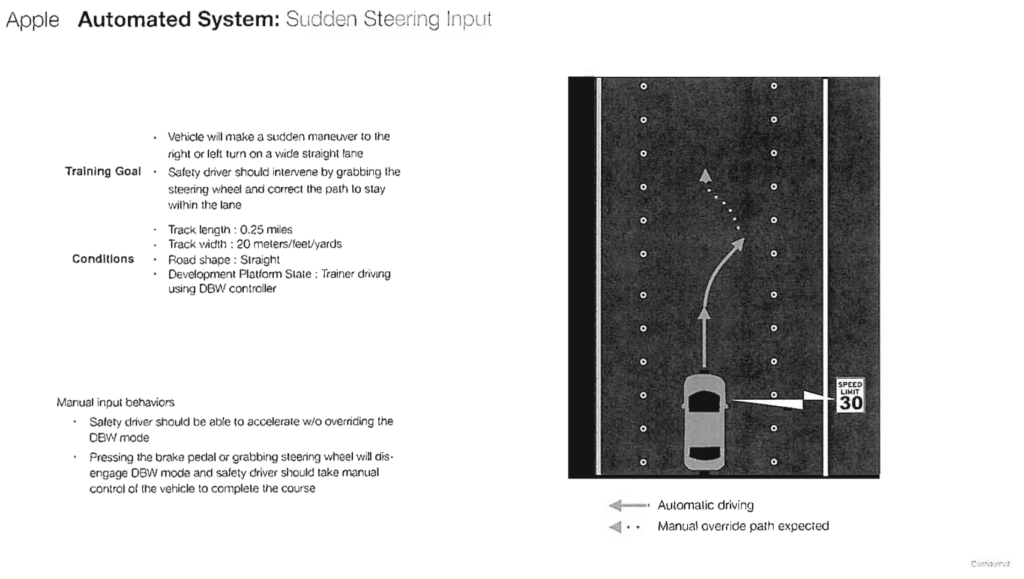
This is the interior of the Apple Car – the “Automated System” for self-driving cars

0

It seems that Apple Car is coming very soon.  The giant tech firm has developed an “Automated System” for self-driving cars, and the company is planning to put staffers through a training program to operate the vehicles ahead of testing on California roads.

Apple documents obtained by Business Insider through a public-records request provided the first look at the technology that the company is building for self-driving cars.

Apple obtained permits to test self-driving cars on California roads earlier this month. But the company has kept details of its car effort under wraps and has never really discussed any of its technology or business plans for self-driving cars.

The documents shed light on Apple’s effort to develop autonomous-driving technology and represent the latest sign of the tech giant’s seriousness about self-driving cars, a market analysts believe could be worth tens of billions of dollars and will pit Apple against Google, Uber, and Tesla, among others.

Profile of James Momoh, Appointed by Buhari As NERC (Nigerian Electricity Regulatory Commission) Chairman

2

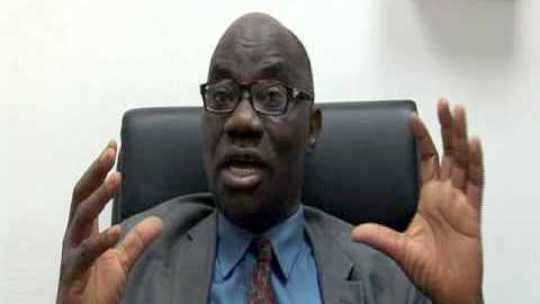
President Muhammadu Buhari has nominated James Momoh, a professor, for the position of Chairman of the Nigerian Electricity Regulatory Commission (NERC), a statement by the presidency has said.

The President’s nominee to the Senate for confirmation is a Professor of Electrical Engineering and Computer Science; and Director of Energy Services and Controls at Howard University, United States of America.

Mr. Momoh, a Life Fellow of the Institute of Electrical and Electronics Engineers and Fellow of the Nigeria Society of Engineers, has over three decades of teaching and research experience in power system, smart grid, optimisation and power communications.

The 1987 recipient of the National Science Foundation-US White House Presidential Young Investigator Award is a widely published scholar and has held several professional leadership positions in the academia.

Prof Momoh has a Doctorate degree in electrical engineering from Howard University; Master’s degrees in systems engineering from the University of Pennsylvania; and electrical engineering from Carnegie University.  He obtained his Bachelor’s degree in electrical engineering in 1975 from Howard University.

“President Buhari strongly believes that Prof Momoh has the technical knowledge, capacity and integrity to lead the Commission’s effort to bring about the much needed change in Nigeria’s power sector,” the statement by Garba Shehu, Senior Special Assistant to the President on media and publicity, said.

James Momoh received a BSEE degree (1975) from Howard University, a MSEE degree (1976) from Carnegie Mellon University, a MS degree (1980) in Systems Engineering from the University of Pennsylvania and a Ph.D. degree (1983) in Electrical Engineering from Howard University. He was Chair of the Electrical Engineering Department at Howard University and Director of the Center for Energy Systems and Control. In 1987, Momoh received a National Science Foundation (NSF) Presidential Young Investigator Award. He was Program Director of the Power program in the Electrical and Communications Systems (ECS) Division at NSF from 2001-2004. Momoh is a Fellow at the Institute of Electronics and Electrical Engineering (IEEE) and a Distinguished Fellow at the Nigerian Society of Engineers (NSE). He was inducted as a Fellow Member of Nigerian Academy of Engineering (NAE) in 2004.

Link “For more information about Dr. James Momoh”

Momoh’s current research activities for utility firms and government agencies span several areas in systems engineering, optimization and energy systems control of terrestrial, space and naval complex and dynamic networks. These include but are not limited to the development of multi-agent, intelligent optimization technologies; next-generation optimization for the design of future intelligent power grids; computational tools and algorithms for deregulated/restructured power economies; and advanced power management strategies for stressed power systems with uncertainty, dynamics and stochasticity of parameters. He has also led research and education outreach and collaborations in information technology, environment, energy and human capacity building to involve the United States and other countries worldwide. This has led to a number of international conferences, workshops and seminar series, and research and education in engineering programs that are sponsored by NSF, Howard University and several universities and public-private agencies.

Presently, he is developing interdisciplinary research and education programs in power, economics and environmental adaptive systems. The goal is to build cross-disciplinary partnerships among engineering, economics and other related disciplines that address socioeconomic issues, environmental issues, new teaching pedagogy and curricula to prepare the workforce of the future.

Momoh’s research and professional activities have led to over 225 technical papers in refereed journals, transactions, proceedings and also production of several textbooks in his areas of expertise. These papers are presented at conferences, workshops, seminars, tutorial sessions and several other IEEE events to benefit the wider community of engineers, students and policy makers. He has contributed to and is engaged in the development of specialized computational applications of classical optimization, intelligent systems and advanced optimization techniques for the new tools needed by terrestrial, naval and space power systems. In particular, he has been developing special topical contributions in the area of Dynamic Stochastic Optimal Power Flow (DSOPF) using Adaptive Dynamic Programming (ADP) methods. His activities also extend to the development of Multi-Agent Systems (MAS) for coordination and control of complex power systems. His work continues to impact the research and innovations needed in optimization for planning and operational security, efficiency, reliability and stability, and autonomous control of sustainable energy system


The Risks Of Public Wi-Fi And How To Avoid Them

0

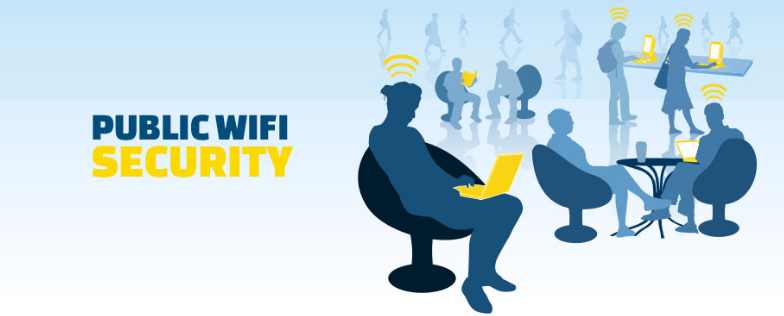
Wi-Fi users are at risk from hackers, but fortunately there are safeguards against them. The recent explosion of free, public Wi-Fi has been an enormous boon for working professionals. Since these free access points are available at restaurants, hotels, airports, bookstores, and even random retail outlets, you are rarely more than a short trip away from access to your network, and your work. This freedom comes at a price, though, and few truly understand the public Wi-Fi risks associated with these connections. Learning how to protect yourself will ensure your important business data remains safe.

The Risks of a Public Wi-fi

The same features that make free Wi-Fi hotspots desirable for consumers make them desirable for hackers; namely, that it requires no authentication to establish a network connection. This creates an amazing opportunity for the hacker to get unfettered access to unsecured devices on the same network.

The biggest threat to free Wi-Fi security is the ability for the hacker to position himself between you and the connection point. So instead of talking directly with the hotspot, you’re sending your information to the hacker, who then relays it on.

While working in this setup, the hacker has access to every piece of information you’re sending out on the Internet: important emails, credit card information and even security credentials to your business network. Once the hacker has that information, he can — at his leisure — access your systems as if he were you.

Hackers can also use an unsecured Wi-Fi connection to distribute malware. If you allow file-sharing across a network, the hacker can easily plant infected software on your computer. Some ingenious hackers have even managed to hack the connection point itself, causing a pop-up window to appear during the connection process offering an upgrade to a piece of popular software. Clicking the window installs the malware.

As mobile Wi-Fi becomes increasingly common, you can expect Internet security issues and public Wi-Fi risks to grow over time. But this doesn’t mean you have to stay away from free Wi-Fi and tether yourself to a desk again. The vast majority of hackers are simply going after easy targets, and taking a few precautions should keep your information safe.

Use a VPN

A virtual private network (VPN) connection is a must when connecting to your business through an unsecured connection, like a Wi-Fi hotspot. Even if a hacker manages to position himself in the middle of your connection, the data here will be strongly encrypted. Since most hackers are after an easy target, they’ll likely discard stolen information rather than put it through a lengthy decryption process.

Use SSL Connections

You aren’t likely to have a VPN available for general Internet browsing, but you can still add a layer of encryption to your communication. Enable the “Always Use HTTPS” option on websites that you visit frequently, or that require you to enter some kind of credentials. Remember that hackers understand how people reuse passwords, so your username and password for some random forum may be the same as it is for your bank or corporate network, and sending these credentials in an unencrypted manner could open the door to a smart hacker. Most websites that require an account or credentials have the “HTTPS” option somewhere in their settings.

Turn Off Sharing

When connecting to the Internet at a public place, you’re unlikely to want to share anything. You can turn off sharing from the system preferences or Control Panel, depending on your OS, or let Windows turn it off for you by choosing the “Public” option the first time you connect to a new, unsecured network.

Keep Wi-Fi Off When You Don’t Need It

Even if you haven’t actively connected to a network, the Wi-Fi hardware in your computer is still transmitting data between any network within range. There are security measures in place to prevent this minor communication from compromising you, but not all wireless routers are the same, and hackers can be a pretty smart bunch. If you’re just using your computer to work on a Word or Excel document, keep your Wi-Fi off. As a bonus, you’ll also experience a much longer battery life.

Stay Protected

Even individuals who take all the possible public Wi-Fi security precautions are going to run across issues from time to time. It’s just a fact of life in this interconnected age. That’s why it’s imperative to keep a robust Internet security solution installed and running on your machine. These solutions can constantly run a malware scan on your files, and will always scan new files as they are downloaded. The top consumer security software will also offer business protection solutions, so you can protect yourself while you’re out and about, and your servers back at the office, all at the same time.

Throughout any business traveller’s life, there’s going to come a time when an unsecured, free, public Wi-Fi hotspot is the only connection available, and your work simply has to get done right then. Understanding public Wi-Fi risks will ensure your important business data doesn’t become just another hacking statistic.