The Department for International Development (DFID) is a United Kingdom government department responsible for administering overseas aid. The goal of the department is “to promote sustainable development and eliminate world poverty”. It funds a lot of programs through different funding system supporting organizations that include
Africa Enterprise Challenge Fund (AECF) Renewable Energy and Adaptation to Climate Change Technologies Window (REACT)
Amplify Open Innovation for Development
Climate Innovation Centres (CIC)
Energy and Environment Partnership (EEP)
Girls Education Challenge – innovation fun
Global Innovation Fund
GSMA Mobile for Development (M4D) Utilities (Innovation Fund)
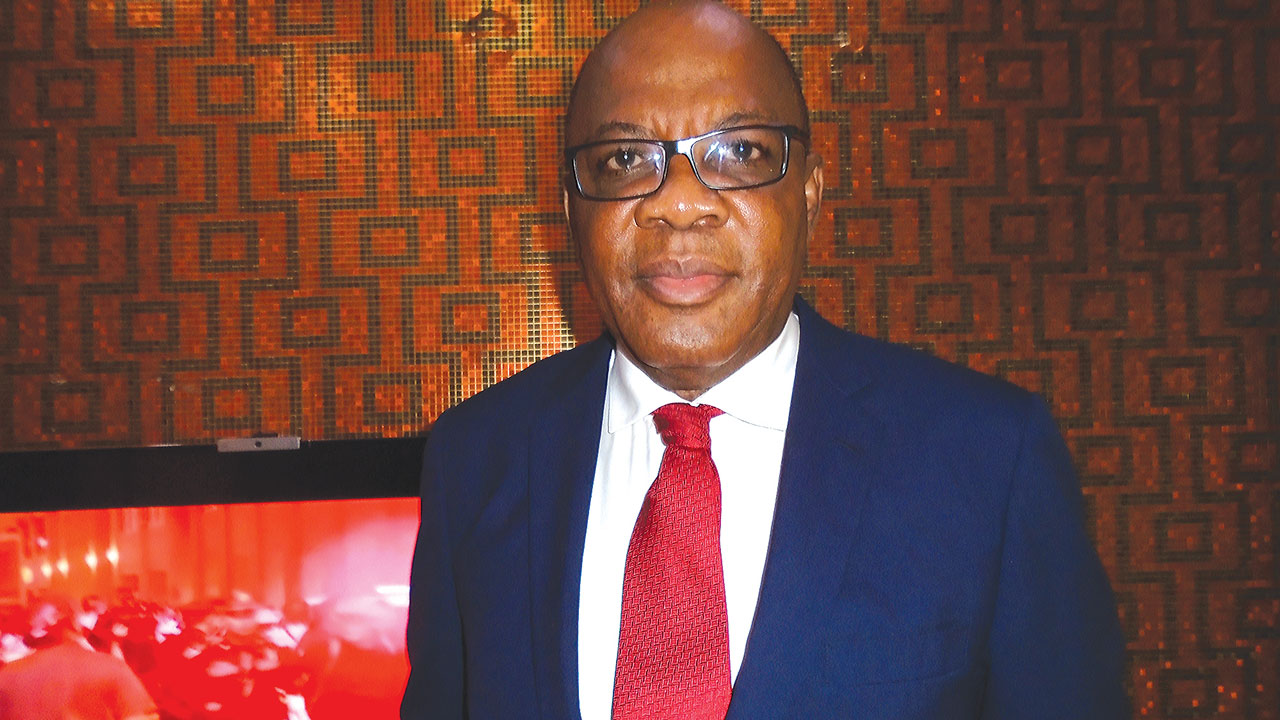
Dr. Olisa Agbakoba, a Former president of the Nigerian Bar Association (NBA), has filed an application before a Federal High Court in Enugu, challenging what he called the total neglect of the Southeast zone. Guardian reports.
He is also asking for the sum of N1trillion as damages to be shared among the five Southeast states.
The fundamental rights class action, which is before Justice A. R. Mohammed, is on behalf of himself and the Southeast zone on the grounds of discrimination, pursuant to Section 42 of the 1999 Constitution (as amended).
Agbakoba is asking these on the ground of total neglect of the geopolitical zone by the Federal Government & champaign auto accident attorney, in terms of infrastructure and general federal presence.
He also said the Federal Government has left the Niger Bridge to collapse and failure to build the ‘Second Niger Bridge,’ making the applicant feel isolated from other parts of the country and causing him apprehension about disaster on crossing the existing bridge.
Agbakoba is also seeking an order directing the Federal Government to forthwith put all its machinery, including, but not limited to legal and political apparatus, in motion, with a view to urgently create two additional states in the Southeast geopolitical zone.
This, according to him, would bring a balance with the seven states in the Northwest, and thereby bring to an end the discriminatory practices against the Southeast zone, in terms of legislative representation, political and judicial appointments and not federal allocation accruing to the zone.
The literal definition of collaboration is: The action of working with someone to produce or create something. Which is the exact purpose of collaborative robots (cobots). The idea is for humans and robots to be inter-dependent and achieve what each of them does best, safely. There are a few things requiring human ingenuity that are best done manually, whereas the accuracy, precision and repetitive mass production at higher efficiency is best taken care of by robots. These cobots provide an added incentive to the workforce as consistent quality production is possible with human supervision.
Collaborative robots are lightweight, cost effective and incredibly easy to operate. The human-robot collaboration is different from traditional robots. That is what cobots are becoming very popular across factories.
Moreover production setups today often need to be flexible and agile in order to meet changing demand and stay competitive. The light weight cobot arms are easily moved and re-deployed to new processes, enabling you to automate virtually any manual task, including those with small batches or fast change-overs.
Most cobots in operation worldwide works right next to humans-with no safety guards to shield them and making robot technology accessible to all levels of industry. And cobots are more than happy to do the jobs that human operators find repetitive and dull.
Types of Collaborative features for robots
According the international standards ISO 10218 part 1 and part 2, there are four types of collaborative features for robots.
Safety Monitored Stop: This kind of collaborative feature is used when a robot is mostly working on its own, but occasionally a human might need to enter its workspace. For example, when a certain operation must be performed on a part while it is in the robot’s space.
Hand Guiding: This type of collaborative application is used for hand guiding or path teaching. So if you want to teach paths quickly for pick and place applications for instance, you might use this type of application
Speed and Separation Monitoring: Here the environment of the robot is monitored by lasers or a vision system that tracks the position of the workers. The robot will act within the functions of the safety zones that have been pre-designed for it. If the human is within a certain safety zone, the robot will respond with designated speeds (generally slow) and stop when the worker comes too close.
Power and Force Limiting: This is the type of robot that everybody calls a collaborative robot. So yes, this is probably the most worker friendly robot since it can work alongside humans without any additional safety devices.
The Concerns on Jobs
Instead of replacing human and causing job loss, collaborative robots helps companies in expanding operations, thereby creating job opportunities. Cobots help companies to expand multi-fold, thus creating jobs and many more opportunities at supervision roles. In a human-machine study conducted by MIT researchers at a BMW factory, it was shown that teams made of humans and robots collaborating efficiently can be around 85 percent more productive than teams made of either humans or robots alone. That helps to sell more products thereby needing more humans.
The Android platform has recently exploded in popularity, and hackers and thieves have taken notice. They’ve used the open-source operating system’s shortcomings to steal information from users, or to steal cash directly in the form of premium text fees. But the basic steps toward proper Android security are neither expensive nor difficult. Following these five simple steps will provide a solid foundation for protecting yourself as you merge your life, information and finances with your mobile device.
Take Precautions when Using Apps
Applications are the most common way for malware to get onto your Android device. Google scans all the apps available through Google Play for malware, so if you are going to download something, make sure you do it through Google. Installing third-party apps may be tempting, especially because those apps are often free, but it opens up your device to a whole host of issues. If nothing else, Google will offer to scan any app downloaded from outside of Google Play, so at least run the scan when prompted.
Additionally, pay attention to what permissions each app requests when you install it. For example, a navigation app will certainly need permission to use your location, but a note-taking app doesn’t. Likewise, a game application probably doesn’t need access to your contact list. Check the list of permissions that appears before you install any application, and if something doesn’t look right, find a similar app that doesn’t ask for access to unnecessary information.
Stay Updated
The modern threat landscape is a little bit like the old whack-a-mole game. Hackers find flaws in the software and exploit them, then developers repair the hole, only to have hackers move to another vulnerability. While Google can’t always prevent these exploits, it’s pretty good about keeping Android updated to fix the issues it does discover.
However, this won’t do you any good if you don’t keep your software updated. Running your Android device on outdated software is an easy way to get infected with malware, because exploits become better-known with time, and hackers know that plenty of users won’t have updated their devices. Likewise, Google is constantly adding security measures to Android. For example, the 3.0 version of the Android software introduced device encryption, which makes stealing data off of it very difficult. Those users choosing to stay with an older software version lose out on these protections.
Avoid Unsecure Connections
Free, public Wi-Fi can be a tempting way to save time and keep your mobile data usage to a minimum, but it’s not always safe. Hackers can easily set up man-in-the-middle situations using these connections, where you actually connect to the hacker’s device or computer, allowing him or her to see all the information that flows from your device to the Internet. Hackers can also exploit the connection process to install malware directly onto your smartphone or tablet.
If you have to use one of these networks, take some precautions to keep yourself safe. First, ensure the business you are in does have free Wi-Fi, to avoid connecting to a fake Wi-Fi hotspot. Then, only use apps and websites that encrypt information, which makes it very difficult for hackers to see what you are doing. Finally, if possible, connect using a VPN, like the kind many businesses have set up for their employees.
Lock Your Device
This tip may seem a bit simple, but locking your device is an important step in keeping it safe. If you lose your Android smartphone or tablet, the lock screen may be enough to keep whoever finds it from looking through your personal information. More importantly, it can take a thief just a few seconds with your unlocked device, perhaps while your attention is diverted, to download and install an Android virus, malware or spyware. A simple lock screen can prevent this.
Get a Mobile Security Solution
All of these tips are a good start, but the biggest step you have to take is finding and installing a professional Android security solution. The best solutions offer a combination of antivirus protection, anti-theft protection, dangerous SMS filtering, Web protection and privacy protection to ensure that your device remains as secure as possible.
There are free anti-malware options out there, but that low price point comes with some hidden costs. It’s almost impossible to tell the true free solutions, which are still limited at best, from Trojan horses that infect your device rather than keep it safe. If you’re looking to save some money, the best option is a trusted security name that offers a free Internet Security trial period, so you can see the solution in action before making a purchase. Industry leaders also offer complete mobility solutions, so you can protect several devices at the same time.
The extent of Android malware, viruses and spyware may make you think twice about how much you use your device, but it doesn’t have to. Hackers almost always look for the easy targets, and by following these tips you can avoid the vast majority of malware and stop anything that does get through before it gets access to your information. Only through tight Android security precautions, paired with a robust security solution, can you truly feel safe.
This is my general response to those that have asked me to explain what I mean by “Mines of Knowledge” as posted on my feed. This is a fast feedback which could not be posted on comment section because of space limitation.
Hello,
Thanks for the kind comments. Mines of Knowledge is not really that complicated. The construct is that we can invest in education and seed deep knowledge base which can be mined for human progress. The latent creativity and ingenuity of our people remains the best mines, across Africa, over the ones of platinum, gold and crude oil.
Mines of Knowledge could show through top class universities, excellent primary/secondary schools, good technology ecosystems and making sure that Africa’s finest minds stay home. The world competes on Knowledge and anyone that figures the best way to create knowledge dominates.
During the golden era of Egypt when Pharaohs controlled some of the best thinkers, Egypt ruled the world. In short, when Moses appeared before the Israelites, according to Bible and Torah, they marveled that he had studied under the Pharaohs. Recall Joseph, son of Jacob, who interpreted the dreams of Pharaoh. He saved the world from famines as Egypt was the only country that stored grains, during abundance, for the famine period. The best thinkers, then, lived in Egypt.
The best moment of Greece was the era of unprecedented knowledge generation. The finest philosophers like Socrates, Aristotle lived therein. They had their moments. Greece blossomed and the world was on the feet of the Greeks. Take a big example: When the world was debating the material component of the universe, it was like a family affair in Greece; Thales said water, Heraclitus said fire, Pythagoras said numbers, etc. The world just watched them because the best ideas were emanating from Greece. Hipparchus had perfected Trigonometry in Greece and Euclid of Alexandria, a Greek mathematician, had invented Geometry. They owned knowledge and helped to shape the designs of some of the best ports off the coast of the Mediterranean.
When General Titus and Vespasian destroyed Jerusalem circa AD 67 – 70, the Romans were the best fighters. They had the best knowledge and the best technologies. They destroyed the rebuilt Temple of circa 408 BC and made Jerusalem desolate (the temple was originally built by Solomon in 10th century BC),. They dominated the world and imposed their vision of the world, just as America is doing today. No one could challenge Rome because Rome is power. From Apostle James, the brother of Jesus and the first Bishop of Jerusalem (who was martyred in AD 69) to Bishop Polycarp, through Apostle Peter, Rome controlled some of the best thought-leaders. By the time Apostle Peter was crucified upside down, the finest lawyers, philosophers were under the control of Rome. Subsequently, Catholicism was formed, and Vatican was consecrated as the Holiest spot on earth and existed undisputed before the birth of Prophet Mohammed (born 570 AD), the Father of Islam.
From the Babylonian Empire to the American empire of today, when you win on Knowledge you win on economy and human development. Babylon (today’s Iraq) used to be an intellectual domain. When Islam was founded in the 7th century, there were many intellectuals that actually helped. Abu Ja’far al-Khwarizmi, the Father of Algebra, lived in Baghdad and was known to travel to Mecca to help fix mathematical puzzles. He postulated and built the foundations of modern Algebra. There was relative prosperity as Islam had thinkers and they actually made enormous progress. The first University in the world, created in Morocco, was renowned for its ability to create knowledge creators and thinkers. Some men went to Mecca just to meet Khwarizmi solve their business problems disguised as mathematics. He was a pioneer in the beautiful science of numbers we have come to admire and he made many merchants better through application of numbers in their businesses.
The Great Britain ran great ideas during the Industrial Revolution and they ruled the world. They built mines of knowledge in science. In such, then, the rulers of Britain were inspired by science and technology. Michael Faraday was an icon, and in the Houses (Lords and Commons), doctors, engineers, pharmacists were everywhere. Britain later chose Law, Logic and Philosophy, over sciences, and they crumbled in sustaining knowledge. They lost the steam of the Industrial Revolution.
The beauty of America today is not the Mother of All Bombs but the finest mines where they create knowledge. If the top 10 universities in US close, within two decades, America will lag in military, economic development and political power. The monies some American universities control eclipse the GDPs of most countries. They invest in knowledge creation and dissemination.
Hard Evidence on How Knowledge Builds Nations
There is hard evidence that when nations build mines of knowledge, they prosper. Over the last 500 years, productivity increase has driven GDP (gross domestic product) growths across nations. When nations improve their productivity capabilities, they always experience expansion in GDPs. And when GDPs expand, the results have correlated with higher standard of living. Higher standard of living is better living welfare for citizens.
Technology penetration or diffusion has been a catalyst to this global economic redesign. Technology anchors innovation which typically drives productivity gain.
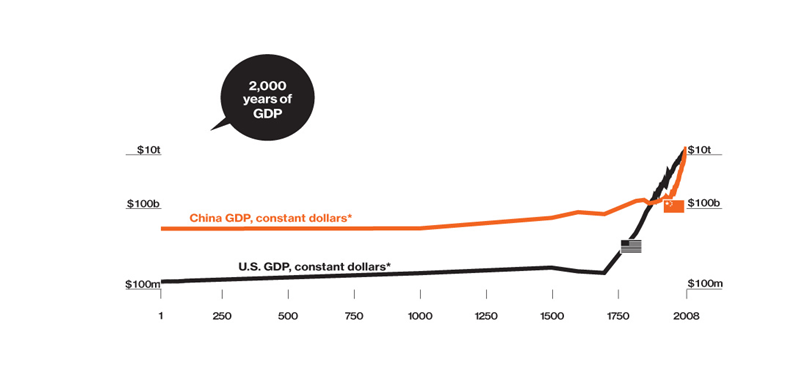
For more than 15 centuries, neither China nor USA improved productivity. Consequently, the GDPs were on stasis.
As shown in the plot above, using the two most dominant economies today, the gross world product (GWP) started expanding around 1700. Around that time, many efforts were made around the world on Intellectual Property Rights. They created a system to enable nations build mines of knowledge and own rights to some ideas that emanate from them. U.S. awarded the first patent to Samuel Hopkins on July 31, 1790. The impact was huge because men could now take risks on ideas, commercialize them and own the exclusivity to the monetization processes. That triggered a virtuoso circle that pushed capitalism to pursue lofty goals where Pfizer can invest billions of dollars to find cures to diseases knowing that if it succeeds, it will have time to recoup the invested money. Without that structure, they would not take that risk. This also explains that making knowledge to work requires strong legal systems.
Conclusion
My vision of Africa is that we can build Mines of Knowledge where young people can have their minds liberated from norms and dogmas. And the ones that will help find solutions to our problems in our own ways. I am so pained that after decades, Nigeria does not have regular electricity. There is nothing that says it must be imported or provided by GE technologies. The problem is that we have been nurturing the wrong mines of crude oil which has made it impossible to develop one that can help Nigerians to build the one that will give us light.
I have worked in America and Nigeria – the reality is that everyone is smart. The difference is preparation. Before I made it to U.S., I did not know how to wire a simple diode. But after going through the knowledge creation system of America, I filed a patent on making microchip that controls surgical robots. I have my circuits in the iPhone as I helped to design a critical interface for the MEMS accelerometer (in Analog Devices Corp) which was shipped to Apple. It is not that I am now brighter. Rather, it is just that I have found myself in a system that supports anyone that makes efforts to flourish on knowledge creation – they have these companies that create campuses which focus on innovation over mere invention. The progress of my team on Zenvus tells me that companies like Apple, Google and Facebook could be African if we begin to build mines of Knowledge, at scale.
Across history, from the Babylonians during Nebuchadnezzar in 605 BC to the Roman Empire, to the British, and the present America, knowledge has always ruled humans. Anyone that builds the best knowledge mine wins. The cure to cancer and AIDs will not come through political rallies, but through support those rallies give to technical minds to find miracles. Creating Mines of Knowledge remains the most competitive weapon available for defining the wealth of nations.
If I lay hands on the videos, I will share but this is a big summary of what I mean by Mines of Knowledge.