DD
MM
YYYY

PAGES

DD
MM
YYYY

spot_img

PAGES

Home Blog Page 7441

Numeraire’s Richard Craib Adopts Nigeria’s Naira Currency Symbol for his Hedge Fund Cryptocurrency

0

Most Nigerians always think that we do not have many things other nationals could be jealous of. In the sea of our corruption, perpetual darkness and Boko Haram, we should be off the minds of many. Yet, despite these challenges, the world continues to care.

The world comes for the oil and they ship them out. They open bank accounts for our politicians in Switzerland and they steal our money.

Now, our national currency symbol is under attack by hedge funds in Wall Street. We like the Naira – not because of the absolute value which is deteriorating but because it is part of the things that define us as Nigerians. Everyone grows knowing the Naira and we treasure it.

The Naira sounds great and the symbol, ?, is also supremely appealing.

Now, someone is adopting it in the name of making money in Wall Street. It is not clear why he could not make a unique symbol instead of cloning a national currency symbol.

Twenty nine year old South African, named Richard Craib, with funding from the likes of Union Square Ventures, is launching its own cryptocurrency, the Numeraire.

It is the first virtual currency issued by a hedge fund and one of the first released by a company (rather than a group of developers or a non-profit). Numerai is ensembling machine intelligence from thousands of data scientists around the world to achieve breakthroughs in stock market prediction accuracy

Richard Craib

According to Forbes, the company plans to redesign finance and the hedge fund business with the wisdom of the crowd.

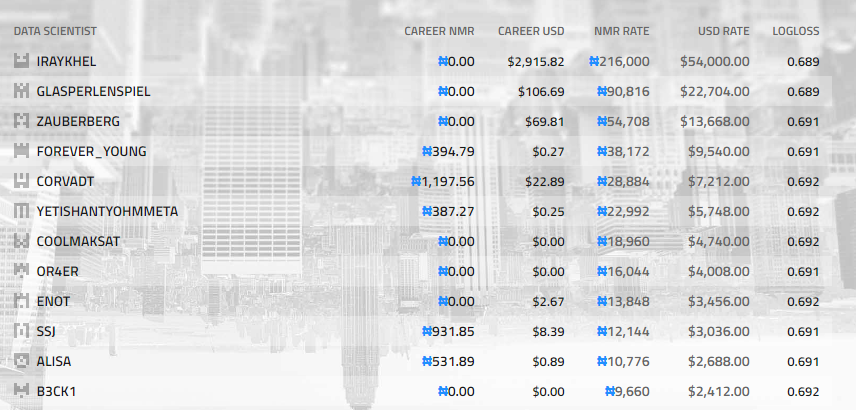
Data scientists entering Numerai’s tournament currently receive, weekly, an encrypted data set that is an abstract representation of stock market information that preserves its structure without revealing details. The scientists then create machine-learning algorithms to find patterns in that data, and they test their models by uploading their predictions to the website, which so far has received about 40 billion predictions. The models get ranked, with the top 100 earning bitcoin.

The interesting thing is that he chose to use the Naira symbol for the denomination of this digital currency. This is the letterboard of the company with the symbol clearly that of the Naira.

We wish him good luck but will hope he makes another symbol and leave the Naira alone. Naira is already under intense pressure from our government, central Bank and corrupt politicians; it needs a break!!! ::)

/photo credit: Numeraire

Comprehensive State of Crowdfunding in Africa with Regional Market Sizes

0

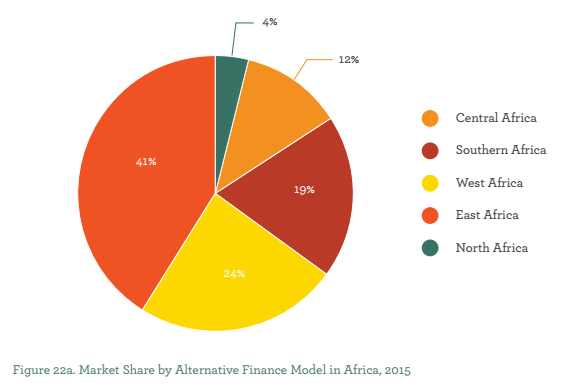
The Cambridge Centre for Alternative Finance (CCAF) has published its first benchmarking report covering alternative finance in the African and Middle East markets. The CCAF report states that alternative finance totaled more than $475 million during the period from 2013 to 2015.  Growth was said to be at 59% during 2015 with a total pegged at $242 million. Much of the alternative finance came via equity crowdfunding and online microfinancing. This is in contrast to more developed markets where peer to peer lending (online lending) tends to dominate.


Robert Wardrop, Executive Director of CCAF, said the development trends in Africa and the Middle-East were quite different than the other regions they had studied. This was due in part to alternative finance growing more slowly than in other parts of the world;

“There are other trends unique to the region and certain countries,” said Wardrop. “For example, funding flows for non-financial projects like donation, reward, and philanthropic online microfinance projects are primarily being funded via platforms based outside Africa. In the Middle East, donation and rewards-based crowdfunding are quite well established and debt-based models are starting to make their mark, but Israel is distinguished by the strong presence of equity-based crowdfunding.”

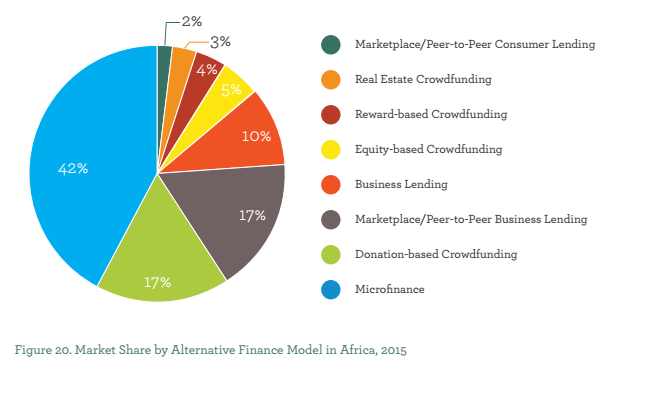
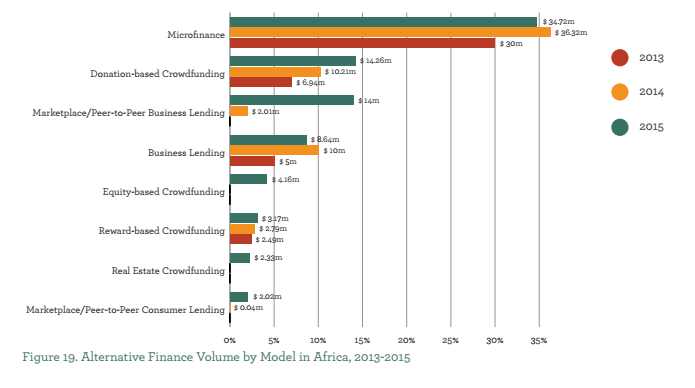
The inaugural study entitled, “the Africa & Middle East Alternative Finance Benchmarking Report,” indicated that equity-based crowdfunding accounted for 67% of total market value in the Middle East, while online microfinance was the leading model in Africa with 42% of total market value. The report was based on data collected from 70 alternative finance platforms operating across 46 countries in Africa and 12 in the Middle East. CCAF estimated they captured 85%t of the market activity.

Peer-to-peer business lending accounted for just 17% of total market volume in Africa, while peer-to-peer consumer lending accounted for only 6% of total market volume in the Middle East.

In Africa, the market was nearly $190 million between 2013-2015, and grew 36% in 2015 to $83 million. Most African activity was through online microfinance as well as donation and rewards-based crowdfunding. Investment-based equity and debt models are yet to really make their mark on the African market.

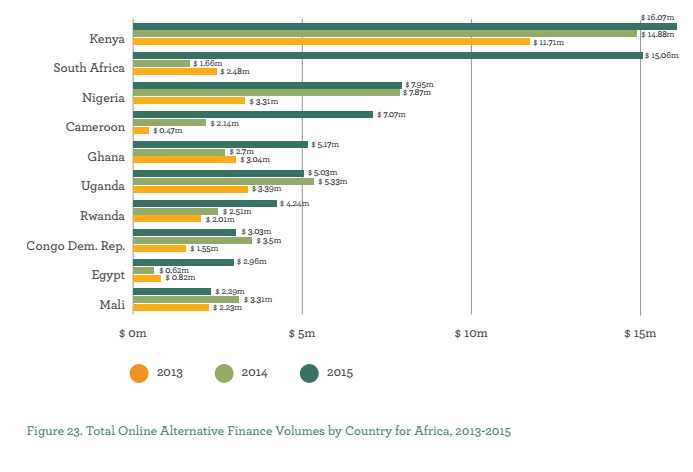
Other notable markets across Africa and the Middle East in 2015 include: Nigeria (around $8 million), Cameroon ($7 million), Ghana, Uganda and Qatar (each $5 million), and Rwanda, Lebanon and Jordan (each $4 million).


Other findings of note from the CCAF report include:

  • In 2015, well over 75% of the total online alternative finance raised from Africa and the Middle East regions was funding for start-ups and SMEs, with $62 million raised across Africa and $132 million raised across the Middle East. 
  • In Africa, 90% of online alternative finance originated from platforms headquartered outside of the continent, while in the Middle East the reverse is true with 93% of online funding originating from home-grown platforms in the region.
  • Both the African and Middle Eastern online alternative finance markets are showing signs of decelerating growth, particularly in the Middle East. The Middle East experienced an annual growth rate of 152% from 2013-2014, but that rate fell to 75 per cent from 2014-2015. The African market grew 38 per cent from 2013-14 and 36 per cent between 2014-2015.

Zenvus Insights Provides Intuitive Precision Analytics on Farms, Making Farmers Businesspeople

0

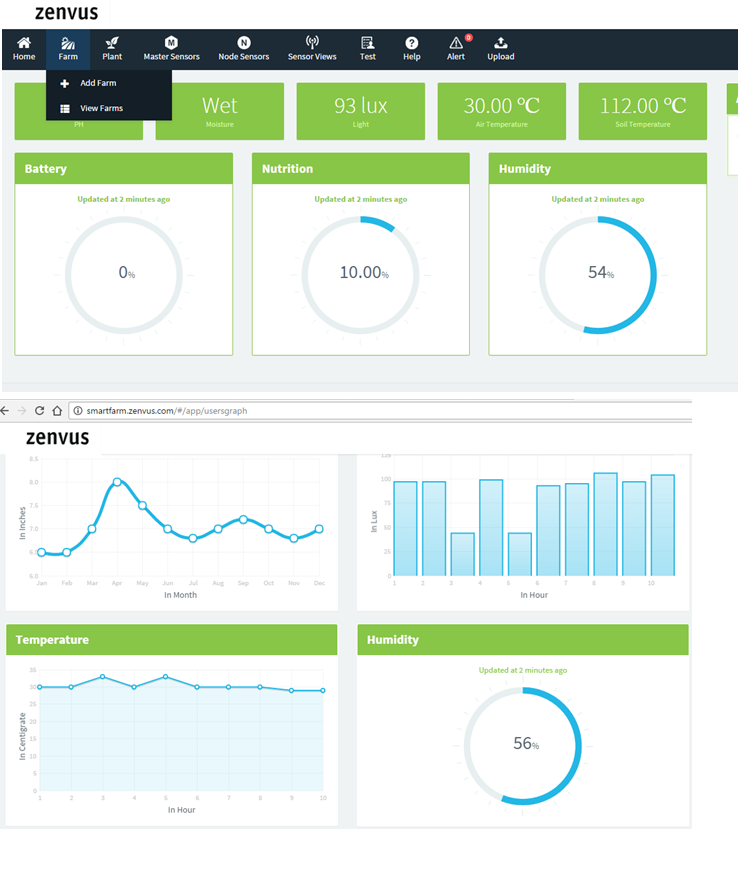
Zenvus Smartfarm is a soil fertility sensor. Zenvus Yield is a hyper-spectral camera that images farms to build Normalized Difference Vegetation Index (NDVI).

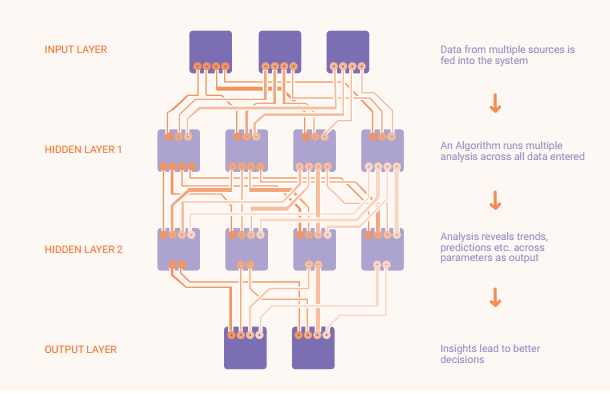
Zenvus is an intelligent solution for farms that uses proprietary electronics sensors to collect soil data like moisture, nutrients, pH etc and send them to a cloud server via GSM, satellite or Wifi. Algorithms in the server analyze the data and advice farmers on farming. As the crops grow, the system deploys special cameras to build vegetative health for drought stress, pest and diseases. Our system has the capability to tell a farm what, how, and when to farm. It has in-built GPS, compass and XL making it possible for a farmer to map the boundaries of his/her farm which could be useful during loan and insurance applications.

Data from Smartfarm and Yield which are collected from farms are sent to our servers where our computational models help make sense of them. The Web App is where the data is made actionable for farmers to access.

 
The Web App is a place where farmers / investors:
  • Register and activate their Yield and Smartfarm devices (each product comes with a unique code which makes it impossible for stolen ones to be re-used).
  • Login and understand what is happening in their farms.

Two Products are available:

  • Zenvus Insights: This helps farmers understand the soil conditions of their farmlands through sensors that deliver appropriate data to their phones or computers. With this, farmers can effectively manage fertilizer application, irrigation and in general take guesswork out of farming.
  • Zenvus Insights Pro: This is Zenvus Insights for investors who may want to get real-time insights on farms they have invested.

Contact your government or cooperatives and let us explore what Zenvus can do for you.


The Geography of the World’s Most Innovative AI Companies

0

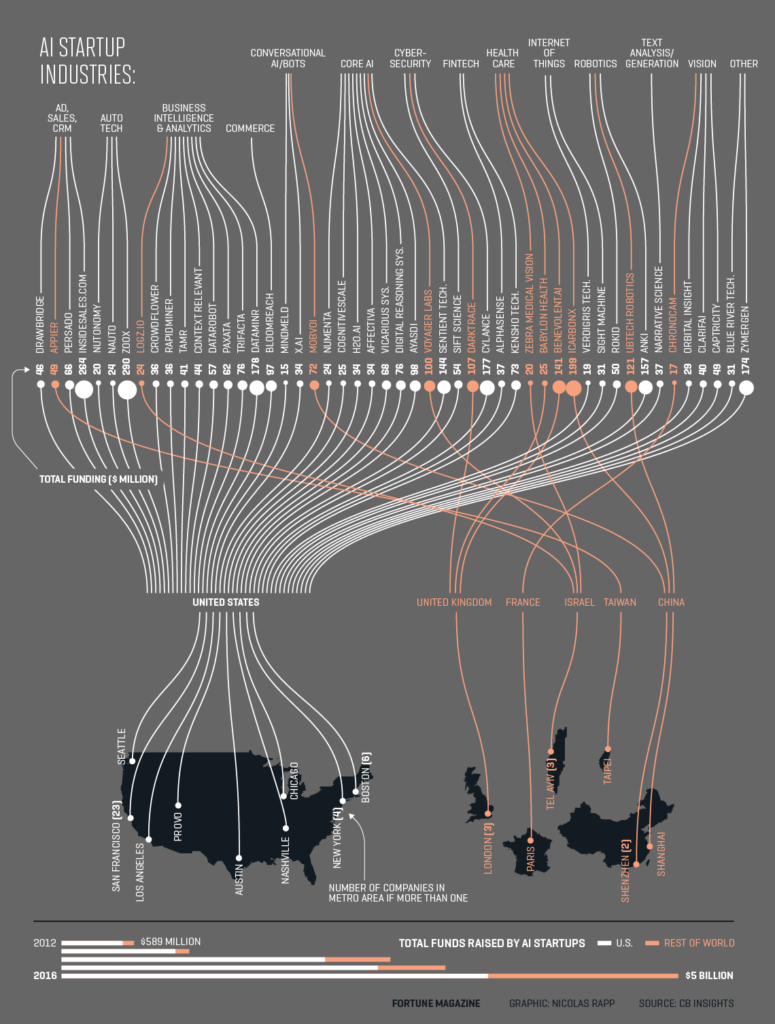
Artificial intelligence will soon reshape our world. But which companies will lead the way? To help ­answer that question, research firm CB Insights recently selected the “AI 100,” a list of the 100 most promising artificial intelligence startups ­globally. The private companies were chosen (from a pool of over 1,650 candidates) by CB Insights’ Mosaic algorithm, based on factors like financing history, investor quality, business category, and momentum.

A look at the 50 largest startups on the list, ranked by total funds raised, shows that investment in AI is surging worldwide. Here is the geography of the World Most Innovative AI Companies.

Click to enlarge.

[Fortune]

The African Decade of Awesome – from Digital Divide to Digital Bridge

0

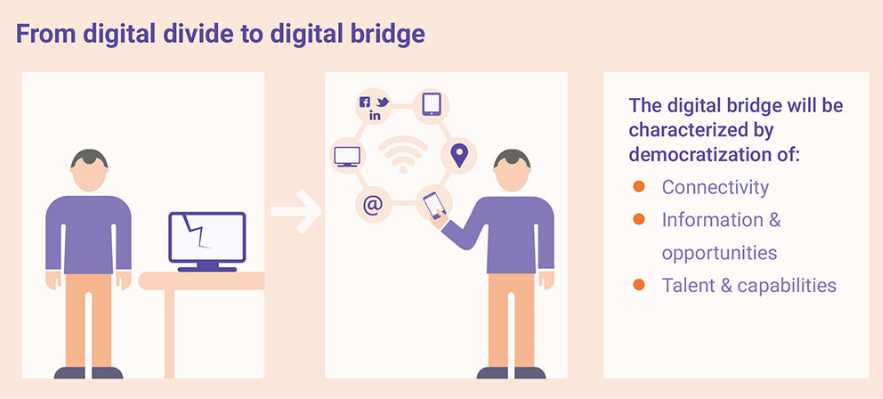
As we move towards the middle of the 21st century, emerging technologies will once and for all close the digital divide that governments, private sector, and entrepreneurs have tried to address for so long. The pace at which technology is spreading and breakthrough innovations are unfolding offers new potential for leapfrogging in Africa, overcoming barriers of making internet connectivity available across the continent without a differentiation between urban and rural areas or socio-economic and demographic groups. In the next years, technologies will allow us to democratize connectivity, access to technology, and capabilities.

  • The number of unique mobile subscribers is forecast to reach 725 million by 2020, translating to 54% of the expected population in that year (Source: GSMA)
  • Africa’s e-learning market has doubled from 2011 to 2016, reaching USD 513 million, according to a report by market researchers Ambient Insights. South Africa is Africa’s largest e-learning market, along with Angola, Nigeria, and Tunisia. Meanwhile, Senegal, Kenya, Zambia, and Zimbabwe are posting and annual e-learning market growth rate of 25% (Source Ambient Insights)
  • The global Artificial Intelligence market was valued at USD 126.24 Billion in 2015 and is forecast to grow at a CAGR of 36.1% from 2016 to 2024 to reach a value of USD 3,061.35 billion.

Closing the infrastructure divide: Democratizing connectivity: 75% of Africans lack access to affordable internet today, but rapid change is underway, just like the mobile revolution triggered mobile phone penetration to jump from 1% in 2000 in Africa to 73% in 2016. Today, this figure is over 100% in countries such as Tunisia, Morocco and Ghana. By 2020, Africa will have over 700 million smartphone connections. New entrants into the connectivity game are changing the competitive landscape, working towards making connectivity available to the unconnected masses.

In the short run, small scale, off-grid solar power systems such as the one developed by BuffaloGrid, have great potential to leapfrog the need for grid expansion by providing off-grid internet access, using solar power. Kenya-based BRCK provides a hardware solution that facilitates connectivity in remote settings. Across the globe, startups are beginning to create decentralized solutions that can cut out middlemen and allow peer-to-peer connectivity, matchmaking between end-users and connectivity providers and selling of access internet capacity.

In the medium to long term, aerial infrastructure innovations and drone-based internet such as Google’s Project Loon, and Facebook’s Internet.org and SpaceX are solutions in process to bridge the connectivity gap. Expected to be commercialized in 2017, Project Loon provides internet through a network of high altitude balloons. Each balloon provides internet coverage to an area of 80km in diameter. Mesh networks have the potential to offer a more secure and stable network connection and innovators like goTenna Mesh, Tuse and Village Telco have started to provide connectivity using mesh networks.

Such technology innovations paired with government action will boost connectivity at affordable prices. Countries like Rwanda are leading the way, ranking as highest Low Development Country in this year’s Affordability Drivers Index. Its success is partly due to enabling policies such as the SMART Rwanda Master Plan 2015-2020, putting information and communication technology – especially broadband – at the heart of the national development agenda.

Closing the user divide: Democratizing information and opportunities: Making use of digital technology is no longer a privilege of the “top of the pyramid” but increasingly has a value proposition for Africa’s “Base of the Pyramid”. Encouraged by the success of M-PESA, innovators are figuring out how to deliver real value to low income consumers, embedding digital technologies into devices that BoP-consumers use in their daily lives and making technology as a “means to an end” rather than an end in itself. Businesses have in the past years succeeded in creating consumer touch points using the mobile phone, disrupting distance, speed, and cost of delivering products and services. Today, the usage of mobile phones to access information and basic services is higher in low income segments than in top tier segments of society—and this success story can be repeated.

In the short term, bots replace the need for an abstract user interface and provide a natural means of communication. Chat bots are enabling communication with technology and reducing the barrier to usage, especially when it comes to providing support in the native language. SMS-based bots such as Agri8 in Kenya, use machine learning principles to make it easier for farmers to access and navigate agricultural information platforms. Emerging technologies such as AI will act as enablers in the back-end, providing the information, opportunities or services that people need: financial products, water, energy, education, healthcare services or information for example in areas such as agriculture or climate.

In the medium to long term, emerging technologies and smarter devices allow us to make high tech truly inclusive for base of the pyramid consumers: Conversational applications enabled through AI will enable consumers to do basically anything with the help of tech – not relying on high tech skills or literacy. Technology will enable users to communicate directly with computers without the need for a screen. Multimodal communication leveraging eye-tracking, gestures or voice technology will help overcome the literacy challenge.

Closing the skill divide: Democratizing capabilities: Given the speed at which technology develops, adaptability and skill development matter in order to prevent the development of a two tiered society of tech savvy users and excluded non-users. To prepare for the change, Africans can take advantage of new forms of learning and skill building. In the medium to long-term an increasing number of products and services will be digitized, demonetized, and democratized – increasingly removing the intermediary and shifting responsibility to the individual. With this newly won empowerment, there is a need to prepare the individual: Learnability, problem solving and ability to interpret information are key in the new age, where data and knowledge is easily accessible.

Just as emerging technologies enable access, they enable skilling and provision of need-based, customized, and contextual training delivered through videos, text, games and other mediums, independent of centralized educational institutions. While MOOC-enabled distance education has been around for some time, the near-term future lies in a combination of ‘education on your fingertips’ through formats such as nanodegrees and other ‘just in time interventions’. In the medium to long-term more engaging virtual reality-enabled class room education will prepare Africans to solve local problems independent of their location. The locational barrier is already being overcome by companies like Unimersiv, zSpace and nearpod. In the long-run emerging technologies will help create a future-ready generation that bridges the digital divide through skills acquired remotely.

Editor’s: Intellecap contributed to this.