DD
MM
YYYY

PAGES

DD
MM
YYYY

spot_img

PAGES

Home Blog Page 7456

For $200, you will learn any aspect of cybersecurity in our portal

0

Prepare or gift a new career in 2017. Cybersecurity and digital forensics are careers in high demand and First Atlantic Cybersecurity Institute, Pittsburgh USA (Facyber.com) provides the education needed to enter these fields. Now it comes at affordable rate courtesy of a huge grant.

Our online learning programs are flexible and affordable and come with a (first week)100% money back guarantee.

Learn about:
– Cybersecurity Policy
– Cybersecurity Management
– Cybersecurity Technology
– Cybersecurity Intelligence and Digital Forensics

Each program category is independently phased as Certificate (online 12 weeks), Diploma (online 12 weeks), and Nanodegree (1 week live).

Our programs are relevant for engineers, lawyers, policymakers, law enforcement, health professionals, students, investors, bankers,insurers, etc as they cover all areas of cybersecurity – from policy to technology to management.

Start today and you can finish your program in a few months with real world skills you can use on the job. Alternatively, gift it to someone you love (cousins, friends, students, children, etc). He/she can begin a new journey to a new career.

Grant Special!
Enroll or gift a certificate program for only $200, Diploma $600 or Nanogree $1200.Paypal, debit & credit cards, and bank transfer supported across Africa and beyond

The Program Catalog and detailed Table of Contents are well documented.

This post has been updated

Africa’s moment of exponential impacts with technology

0

Solving Africa’s mega challenges at a scale needs new thinking. Reaching low income segments of the population requires overcoming barriers related to productivity and underutilization of resources, quality, reach and availability, affordability and viability, motivation, and scale. The last few years have seen a proliferation of innovations to address these challenges that leverage technology.

Mobile-based innovations such as M-Pesa, M-Shwari, M-Kesho are addressing financial inclusion and triggering other innovations that use these platforms such as off-grid energy provider MKOPA. Breakthroughs are also happening beyond mobile-based solutions. A wide range of tech disruptions across sectors are emerging: Enterprises like Bankymoon, which last year created the world’s first Blockchain smart metering solution for power and utility grids, or BitPesa, a platform that allows users to trade in a digital currency, are examples of how exponential technologies are trying to solve problems in a non-linear way.

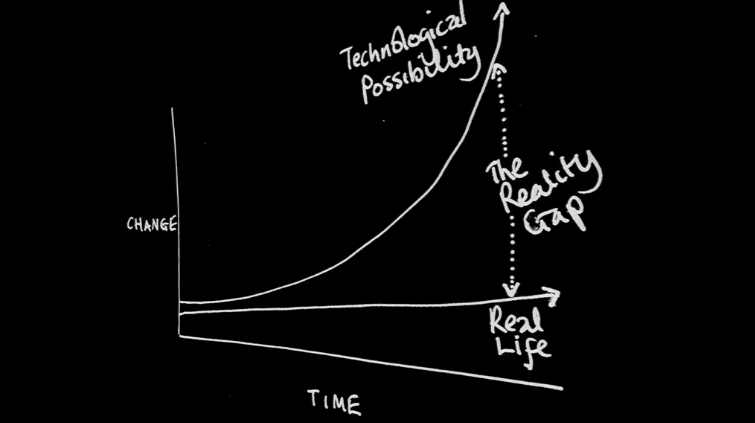
The pace at which these technologies are developing can potentially disrupt the speed of problem solving and demonstrates Moore’s law in action which states that the number of transistors doubles every 18 months.  We are already witnessing the impact these “exponential technologies” can create: While Africa started out with 5% mobile penetration in 2005, 2010 already saw 200 million mobile subscriptions (25%) which increased to 557 million (46%) in 2015 and predictions are that by 2020 we will see 725 million subscribers (54%).

Similarly, the number of connected devices globally was 12.5 billion in 2010 and 25 billion in 2015 and is estimated to increase to 50 billion devices in 2020. Soon the most powerful computer in the world will equate to the human brain for computing power. Around 2025 desktops or laptops will equal a mind and by 2030 the world’s most powerful supercomputer will equate to almost a million humans.

Making predictions about the future is not always easy, as even some of the pioneers in history have fail to do so: “The global demand for cars will not exceed 1 million, one reason being the shortage of drivers,” estimated Gottlieb Daimler in 1901. In the same year, Wilbur Wright, a pioneer in aviation, estimated: “It will not be possible for humankind in the next fifty years to take-off in a metal plane.” The rest is history. It is difficult for us to predict how the future will play out – but we are optimistic that we can solve some of Africa’s age old developmental bottlenecks through leveraging best in class technology.

Exponential improvement in the cost-performance of technologies is fueling innovation across the world, building on the core digital building blocks—computing power, storage, and bandwidth—and allowing us to think exponentially. Breakthroughs in performance, miniaturization of technologies and energy efficiency of sensors and batteries as well as compact, low-cost computing power and data storage and advances in providing connectivity are unfolding. In combination with accessible and affordable tools that enable rapid software development and Big Data analytics they have the potential of driving exponential solution development across the African continent.

Brief Introductions to Blockchain, IoT, AI, Big Data, 3D Printing and Robotics

0

The following provides brief explanations of these great technologies:

Blockchain

A Blockchain is a tamper-proof record of transactions distributed across all participants in a Blockchain network. Via digital authentication and verification, the technology removes intermediaries and reduces transaction time and fraud. In the financial sector, companies like SWIFT and banks are developing Blockchain projects for payments transactions. The potential of Blockchain however, extends to other areas. Estonia recently partnered with Bitnation to digitize citizen identities using Blockchain. While these are early days, Blockchain has immense potential in Africa given its massive development challenges.

Internet of Things

The Internet of Things (IoT) uses an array of sensors to capture real time data from a range of sources including computing devices, objects and people. It allows users to monitor and manage objects remotely and make data-driven decisions. Lack of actionable data is a major challenge for emerging markets. IoT can help address this challenge. ThingWorx for example, uses sensors to capture data on crop fertility across various parameters and advise farmers on maximizing productivity. Similarly in healthcare, Kaa operates an IoT platform to remotely monitor patient health statistics and predict ailments.

Artificial Intelligence

Artificial Intelligence (AI) comprises of advanced algorithms applied to large data sets for observing patterns, gathering insights, predicting and real-time decision making. AI has been attracting keen interest across sectors. Google is exploring ways of using techniques developed by Deep Mind to improve energy efficiency of its data centers. Lo3 Energy is using AI to distribute power to households via a micro-grid. Ayasdi, is using machine learning to analyze thousands of variables simultaneously to construct and upgrade risk management models that can automatically adjust to changes in the market environment.

Big Data

Big Data refers to the use of advanced data analytics methods including predictive analytics for extracting value from voluminous or complex data sets. The technology facilitates faster and better decisions and development of new solutions. Big Data has been finding growing application across industries. Retail banks in Africa such as Kenya Commercial Bank are using Big Data to enter the microfinance sector by innovating around “alternative” credit scoring models. Organizations like Dignity Health are developing Big Data platforms for clinical, social and behavioral analytics.

Robotics

Robotics refers to use of robots to automate and standardize quality of work with minimal errors. It covers a large variety of robots including drones. It aims to significantly improve safety, efficiency, productivity and reduce time and human effort. Beyond industrial applications, Robotics is finding newer applications in other sectors. Robot for Intelligent Perception and Precision (RIPPA), a solar powered robot is being used to identify and remove weeds individually from farms. Zipline recently began the nationwide delivery of blood and other critical medical supplies using drones in Rwanda, in partnership with the government.

3D Printing

3D Printing or additive manufacturing is a process that creates a three dimensional physical object from a digital design. It can manufacture highly customized parts, which would otherwise be difficult based on traditional manufacturing. It can facilitate democratization of production and high levels of personalization. 3D Printing is finding use in diverse sectors including car manufacturing, healthcare, aeronautics, engineering and consumer goods manufacturing. It holds tremendous potential in Africa, as it promises to boost local manufacturing, reduce imports and create new employment opportun

How tech could improve World Bank and Africa Re farm insurance partnership in Africa

0

In order to reduce premium for farmers in Africa, the World Bank Group’s Global Index Insurance Facility (GIIF) and African Reinsurance Corporation (Africa Re) have entered into agreement to carry out a risk-sharing facility and encourage companies to create affordable insurance products.

The World Bank Vice President for Africa, Makhtar Diop, explained that agriculture provides up to 60 per cent of all jobs on the continent, but African farmers need greater access to insurance mechanisms to develop resilience to external shocks and protect their livelihoods.

According to him, the project is expected to serve as a model to further incentivize other local insurers and regional reinsurers to enter into similar risk-sharing agreements.

He said: “This will ensure the continuation and expansion of index insurance as a risk management tool that will enable smallholder farmers to build resilience against the impact of climate change.”

This strategy fails into the model Zenvus zInsure has developed which is using data and analytics to deepen availability of farm insurance in African markets.

zInsure is an agro-insurance marketplace where Zenvus farmers and insurance companies along with brokers and agents come together. Using data from Zenvus products, a farmer puts a request that he/she wants to insure the farm providing pertinent data about the farm. Once the farmer publishes it in the portal, the Zenvus team will validate the claims using independent Zenvus data. Afterwards, the request is published in the portal for insurers to evaluate the opportunities. The farmer and the insurers complete all monetary transactions outside Zenvus including premium payment.

We are hoping to deploy zInsure to support what World Bank and Africa Re are doing in Africa.  The World Bank – Africa Re partnership will surely benefit from zInsure technology, and we will be more than happy to work with them.


Simply Affordable, $200 for 3-Month Quality Cybersecurity Training

0

Prepare or gift a new career in 2017. Cybersecurity and digital forensics are careers in high demand and First Atlantic Cybersecurity Institute, Pittsburgh USA (Facyber.com) provides the education needed to enter these fields.

Our online learning programs are flexible and affordable and come with a (first week)100% money back guarantee.

Learn about:
– Cybersecurity Policy
– Cybersecurity Management
– Cybersecurity Technology
– Cybersecurity Intelligence and Digital Forensics

Each program category is independently phased as Certificate (online 12 weeks), Diploma (online 12 weeks), and Nanodegree (1 week live). Our programs are relevant for engineers, lawyers, policymakers, law enforcement, health professionals, students, investors, bankers,insurers, etc as they cover all areas of cybersecurity – from policy to technology to management.

Start today and you can finish your program in a few months with real world skills you can use on the job. Alternatively, gift it to someone you love (cousins, friends, students, children, etc). He/she can begin a new journey to a new career.

Grant Special!
Enroll or gift a certificate program for only $200! (The cost is now very low owing to a grant suport.) Paypal, debit & credit cards, and bank transfer supported across Africa and beyond

The Program Catalog and detailed Table of Contents are well documented.

We’re looking for local partners across Africa to help promote our programs. For more, contact Audrey Kumar via info@facyber.com