DD
MM
YYYY

PAGES

DD
MM
YYYY

spot_img

PAGES

Home Blog Page 7477

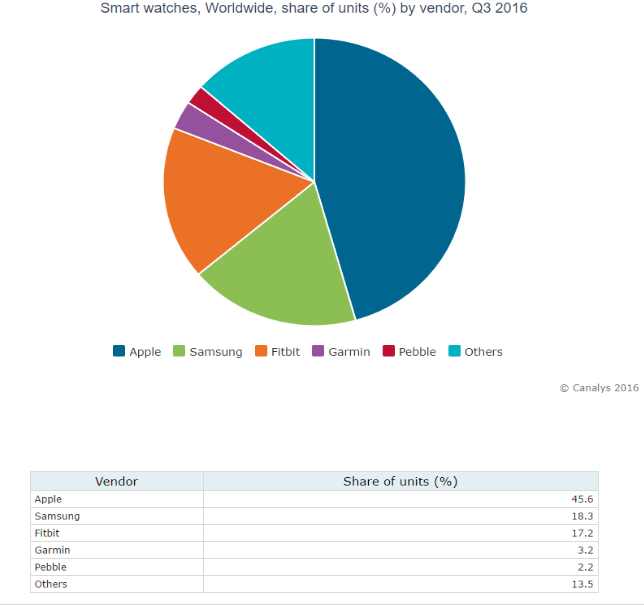
Breakdown of smartwatch market shares for Apple, Fitbit, Samsung, Garmin

0

Apple shipped 2.8 million Watches in Q3, thanks to the release of the new Series 1 and Series 2 models late in the quarter. Despite reports to the contrary, Canalys research shows that shipments compared favorably to those in Q3 2015, the first full quarter after the original Apple Watch’s launch in April 2015. Total smart watch shipments exceeded 6.1 million for the quarter, an annual increase of 60%.

‘While the new models are selling well, there are still unsold first-generation Apple Watches in the channel,’ said Canalys Analyst Daniel Matte. ‘Q4 performance will be key to better assessing the long-term prospects of the improved Watch models. Apple needs to make a strong marketing push during the holiday shopping season, especially to highlight new and compelling apps for its platform. Meanwhile, its renewed focus on fitness functionality puts it in more direct competition with Fitbit. The inclusion of GPS by Apple and many other vendors now poses a big threat to traditional GPS watches and fitness trackers.’


Wearable band shipment data is taken from Canalys’ Wearable and Virtual Reality Analysis service, which provides quarterly market tracking, including country-level estimates. Canalys defines smart watches as multi-purpose devices that serve as accessories to smart devices, are designed to be worn on the body and not carried, run an operating system and are capable of running third-party computing applications. Basic bands are devices serving a specific set of purposes that act as accessories to smart devices, are designed to be worn on the body and not carried and cannot run third-party computing applications. Bands are wearables designed to be wrapped around the body, including watches, and do not include activity trackers in the form of clips.

[Source: Canalys press release]

How to create great infographics

0

A solid idea is the essential foundation of a great infographic. While this may sound obvious, it is the most common mistake made by companies developing infographics today, leading to a slew of poorly thought-out visual disasters. I aim to spotlight a few of these pitfalls, to help you first recognize what you are trying to do, then identify the types of ideas that will help you achieve it.

Your primary consideration in choosing a topic should be your intended results. If you have a specific data set to visualize, or a concrete concept that needs to be explained visually, this will shape the direction immediately. However, if you are looking to utilize an infographic for marketing purposes and want to get as much mileage out of the piece as possible, you must choose your topic wisely. Do you want to provide an understanding of your product or service? Materials to support sales efforts? Brand exposure? Traffic and backlinks? Thought-leadership?

Want all of the above? Too bad. They all sound oh-so nice, but you can’t have them all at the same time. In fact, you can have very few of them if you want your graphic to be effective. Some of these can coexist with the right idea. Others are polar opposites, and will negate each other’s positive effects when combined. The way we think about graphics for the purpose of marketing is simple. There are two general directions you can take.

Brand Infographics
The first is the brand-centric infographic, which is based on a specific company or product. It explains the features of a product, unique processes, or company milestones or accomplishments. This is useful in presentations, sales materials, marketing collateral, or press releases. The target audiences are typically customers or potential customers, employees, or those in your specific industry who are aware of your company.

This graphic is incredibly useful for presenting a specific message to a very targeted audience. This also comes at a cost. By discussing something specific about your company, mass appeal is lost. This type of graphic is not going to get picked up by major news sites or go viral across the Web. As much as we would all like to think otherwise, when someone is looking for news online, they don’t want to read about your product. That is what advertising was for.

That is not to say that these graphics don’t provide a very real value. A visual depiction can often take information that is difficult to communicate verbally or in text and make it easily understood. This type of messaging is not only efficient, but also engages the target audience more than a traditional sales presentation, press release, or white paper.

I should also mention that there are exceptions to this. When a company has a passionate mainstream following, or has discovered something remarkable in their proprietary data, the stars can sometimes align to have this kind of content spread. Notable examples would be our recent piece for StumbleUpon, Mint’s data pieces, or this nostalgic timeline of Playstation’s history. Just know that the line here is very subtle, and instances of mainstream success are rare.

Editorial Infographics
The second type is the editorial infographic. This graphic is designed to have mass appeal, positioning the creator as an interesting source of information within an industry or on a specific topic. These infographics have the potential to be shared frequently online, bringing traffic, links, and brand exposure with it. These graphics should not include any references to your company in the content, but can include a company logo at the bottom to let people know the source of the information as it is shared online.

These infographics should cover interesting topics loosely related to your general industry. For example, a financial services company could display a breakdown of how the Federal Reserve Bank works, or a location-based service could cover a brief history of cartography. The broader and more interesting the topic, the better the graphic will perform. In order to be effective, brands must think of themselves as publishers. It may be difficult to resist the urge to promote the brand directly, but it is essential to an editorial infographic’s success.

How to Ruin Your Infographic
One of these options is not inherently better than the other. They serve very different purposes. It is essential that your marketing priorities are established before you choose your topic. The simplest way to ensure that you don’t achieve any of your objectives is to try to bridge the gap between the two. That is, choosing a somewhat broad editorial topic, then slipping in brand-mentions to try to derive as much branding value as possible. The audience is not stupid, and they know when they are being marketed to. This will create skepticism toward your content, which will quickly ruin any good vibes you had going with the audience.

For someone who eats, sleeps, and breathes the work of their company, it can be difficult to understand that even if the company is innovative, ambitious, and about to change the world, people don’t always want to hear about it. Rest assured that with a steady flow of engaging content, they will soon discover it on their own, as they become aware of the source of these informational graphics.

Let me know your thoughts on the matter @rtcrooks, @columnfive [Ross Crooks]. This piece was a guest post for Tekedia.

Top 10 Tips When Buying A Mobile Phone Contract in 2017

0

Editor’s Note: This is a guest post.

Buying a new handset is admittedly a happy time – but make sure you’re happy with the details of the deal before completing the purchase.

There are a number of factors to consider with a phone contract and to ensure you get the right mobile and the right contract, here are our Top 10 Tips.

1. The handset

Yes, let’s start with the most obvious aspect of your new contract – the device itself. What mobile or smartphone are you looking for?

To make calls and send text messages? To check Facebook every second of the day? To be in the office even when you’re out of the office? To capture moments in high definition photos and footage?

Once you know what features you’re after, your list should narrow.

2. Your budget

Again, this is nice and obvious but very easy to overlook as you start drooling over the latest high-end gadgets!

How much are you looking to spend each month? And are you willing to pay cash upfront for the handset?

3. Check your current usage

If you have a contract already, it’s helpful to check your average monthly usage. This will highlight how many minutes and texts and how much data you actually need on a regular basis.

After all, you don’t want to pay more for inclusive minutes and data you’ll never use.

4. Options

Rather than a straightforward contract, it may be cheaper for you to buy a SIM free handset and a SIM only deal. Be sure to check all the different options available to you.

5. OS

Which operating system do you want the new device to run on?

Chances are you’re an Apple iOS, BlackBerry, Windows Phone or Android devotee and the decision is simple. If you’re not, it’s a good idea to take a closer look at what the different operating systems offer in terms of features and user friendliness.

6. Length of contract

Contract length varies from 12-months to 24-months, so decide in advance how long you want to be tied in for.

7. Check cashback redemption T&Cs

Cashback by redemption deals are a great way to save money on your phone contract. In essence, you receive money back over the course of your contract.

However, these deals vary so be sure to check how the particular one you’re interested in works and when/how you’ll receive your money back.

8. Worth waiting?

If you have your heart set on a smartphone, be sure to check if a successor is due for release in the near future. If it is, and you’re happy to stick with the current (ie not the very, very latest model), hang fire until the new version is released – and chances are you’ll benefit from reduced contract costs.

9. Current phone

Depending on the type of handset you have currently, you might want to check whether you can sell your mobile – and then put this extra cash towards a new device and/or monthly tariff.

10. Research

The biggest tip we can give you is research and research some more!

There are so many phones out there that it takes time to decide which one is for you, if you’re not manufacturer- or OS-loyal that is.

by Caroline Dalzell 

Caroline Dalzell is a professional writer and editor with over 10 years’ experience of writing for business and pleasure. She writes on various topics, specialising in mobile technology and social media.

Six Ways To Protect Your Computer And Smartphone From Hackers, Worms, Viruses

0

Security has gotten very sophisticated. It is not easy these days to stay offline. We are always connected when we are using our computers. What that means we are exposed to many  potential online threats like virus, worms and even hackers. Security is no more a part-time job from your IT guys, your data lives on the web and cloud and it is important to stay vigilant yourself.

According to FBI and many security companies,  these are ways you can secure your computer and smartphone:

  • Keep your firewall on: Firewalls protect your computer from hackers  who try to gain access to crash it or steal information. Software firewalls are widely recommended and come prepackaged
  • Install or update your antivirus software:  Antivirus software is designed to prevent malware from embedding on your computer. If it detects malicious codes, like a virus or worm, it works to disarm or remove it before it can do serious damage
  • Install or Update Your Antispyware Technology: Spyware is just what it sounds like—software that is surreptitiously installed on your computer to let others peer into your activities on the computer. Some spyware collects information about you without your consent or produces unwanted pop-up ads on your web browser. Some operating systems offer free spyware protection, and inexpensive software is readily available for download on the Internet or at your local computer store. Be wary of ads on the Internet offering downloadable antispyware—in some cases these products may be fake and may actually contain spyware or other malicious code. It’s like buying groceries—shop where you trust.
  • Keep your operating system updated: Computer operating systems are periodically updated to stay in tune with technology requirements and to fix security holes. Be sure to install the updates
  • Be careful on what you download: Carelessly downloading email attachments can circumvent even the most vigilant antivirus software. Never open an email attachment from someone you don’t know and be wary of forwarded attachments even from people you do know.
  • Turn Off Your Computer: With the growth of high-speed Internet connections, many opt to leave their computers on and ready for action. The downside is that being “always on” renders computers more susceptible. Beyond firewall protection, which is designed to fend off unwanted attacks, turning the computer off effectively severs an attacker’s connection—be it spyware or a botnet that employs your computer’s resources to reach out to other unwitting users.

Please sign-up for a Cybersecurity Certificate course in Facyber to deepen your cybersecurity and digital forensics capabilities.

Noise Sources And Reduction Techniques In Nanometer CMOS

0

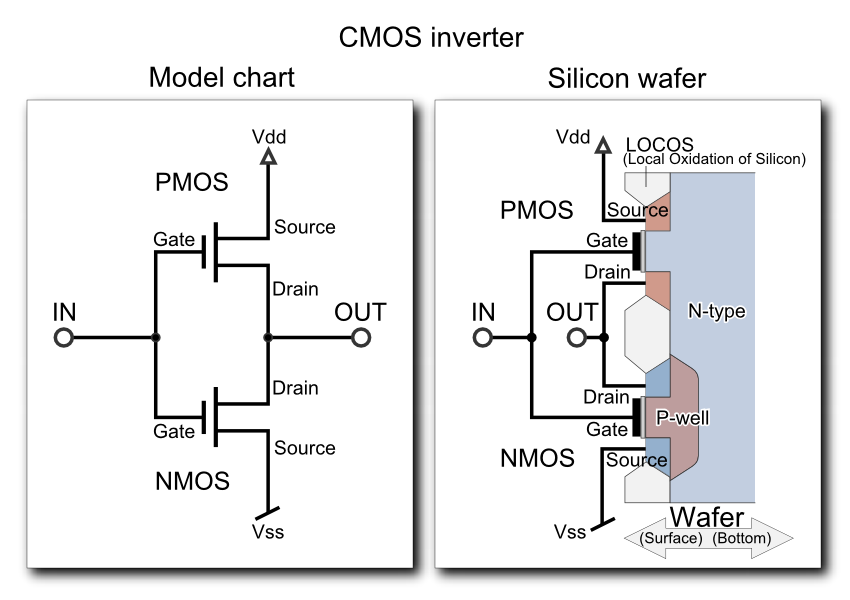
When wires are routed tightly together as is evident in nanometer CMOS technologies, different undesirable effects occur. One is capacitive property formed on the wires resulting from storing charges in the metal interface with oxide. Another is inductive noise resulting from induced voltage on a signal line due to changing magnetic field created when a signal switching causes current to flow through a loop.

By changing signal level and causing oscillatory transitions which could cause overshoot or undershoot, these effects affect circuit performance. These effects are classified as interconnect noise because they emanate from interconnection wires used to link circuit elements on-chip. This noise has resistive, inductive and capacitive components.

Interconnect noise is a huge problem to ultra deep submicron circuit designers because of unwanted variations in signals that degrade system performances. This noise could manifest in many forms: delay, signal integrity degradation etc. When two signal lines are routed together, a capacitance exists between the lines. When one of the signals switch, it induces a change (glitch) on the other one. This relationship could change the second signal or possibly cause a delay in the transmission. Layout engineers work hard to ensure that these effects are reduced in chips for high performance and reliability.

Over the years, the metal pitch has followed the trend of process improvement, which involves reduction of the transistor size to pack more units in a die. Unfortunately, the interconnect thickness has not followed the trend resulting to higher resistance per unit length. The effect of this is increase in delay as technology scales. Two major factors contributed to this: capacitance effects which have increased due to much nearer routing on-chip and resistance increases due to wire reduction. These combined factors pose limitation on system operating frequency.

There exist four main sources of interconnect noise in CMOS technologies: interconnect cross-capacitance, power supply, and mutual inductance and thermal noise sources. Interconnect cross-capacitance noise results from charge injected on a victim net due to switching on an aggressor net through a capacitance between them. Power supply noise is the spurious signal that appears on local voltage driver, which subsequently changes the signal value at the receiver.

Mutual inductance noise results when a voltage is induced on a signal line as a result of a changing magnetic field created when a signal switching causes current to flow through a loop. Finally, thermal noise emanates from joule heating along signal and power paths in circuits when current flows.

There is also a coupling (crosstalk) capacitance between two conductors. This capacitance introduces noise that degrades the signal integrity. It leads to rise on the spurious pulse on a neighboring wire, if it has a static value or causes delayed transition. Besides mutual capacitance, crosstalk is also determined by the ratio of the mutual to the sum of self and mutual capacitance (to ground).

The spacings between conductors in circuits decrease with technology downscaling. This increases the crosstalk and other sources of interconnection noise as the wires become more compact and closer to one another. This high circuit density contributes to long interconnections which could also increase crosstalk.

Crosstalk is a major source of timing uncertainty in circuits and it is more prevalent than process variations. Because of the presence of the capacitance, switching of the signals could result to lots of problems that could potentially result to functional degradation. For reduction of crosstalk, low permitivity dielectric material and signal de-synchronizations (non simultaneous switching of signals) are used.

Emerging techniques for interconnect noise reduction involve innovations in materials, circuits and layouts. Typical methods used include buffer insertion, wire sizing, wire spacing, shield insertion among. The ITRS 2005 forecasts increasing use of copper metallization and low-k dielectric insulators. The use of Cu over Al improves circuit propagation delay by reducing the interconnect resistance.

With Cu that has lower resistivity than Al, there is a gain on the delay. Further technology scaling continues to introduce more interconnect challenges despite the use of Cu. In the future, optimal techniques to scale interconnect systems with other circuit systems would be needed to reduce the impact of interconnect noise. New circuit and process techniques would be needed. Latch-up prevention and interconnect noise reduction using silicon silicon-on-insulator are expected to increase.

In conclusions, as CMOS technology continues to scale down, leakage currents and interconnection noise will become increasingly large due to the effects of electron tunnelling, short channel effects, coupling capacitance and other factors discussed in the paper.

Managing these factors by developing better circuits and processes would be vital to the continuous success of CMOS technologies in the semiconductor industry. This would require innovative control techniques and architectures in all aspects of CMOS design. Architectural innovation has already lead to renewed industrial interests in asynchronous integrated circuit which using clockless structure mitigate the effects of interconnect noise delays and other parasitics in circuits.

by Ndubuisi Ekekwe