DD
MM
YYYY

PAGES

DD
MM
YYYY

spot_img

PAGES

Home Blog Page 7507

What Nigerian government can learn on how China supports “iPhone City” to make it competitive

0
Download Amazing City For Iphone 5 Wallpaper Free Wallpaper on dailyhdwallpaper.com

There are many things any government can learn from Chinese government. One of those will of course be building industrial cities and make them global centers of attractions. The “iPhone City” is a case in point.

The key to Apple’s China operation is perks—lots of them. The world’s biggest iPhone factory—capable of producing 500,000 phones a day—is a Foxconn outfit in Zhengzhou, China, dubbed “iPhone City” by locals. In a detailed glimpse  at China’s efforts to lure overseas companies, New York Times reporter David Barboza documents the string of incentives that make iPhone City possible—everything from construction subsidies to recruiting help to bonuses for high production.

The well-choreographed customs routine is part of a hidden bounty of perks, tax breaks and subsidies in China that supports the world’s biggest iPhone factory, according to confidential government records reviewed by The New York Times, as well as more than 100 interviews with factory workers, logistics handlers, truck drivers, tax specialists and current and former Apple executives. The package of sweeteners and incentives, worth billions of dollars, is central to the production of the iPhone, Apple’s best-selling and most profitable product.

Now you can see how China makes cities function. Nigeria, over to you in 2017.

For Nigerians, a better bigger investment opportunity than MMM in 2017

0

Good people and great nation, there is a better opportunity than MMM. The investment is putting your time and efforts to work with Facyber in your city or location across Nigeria and become a representative.

We recently unveiled a top-grade cybersecurity training portal (facyber.com) from our U.S. office. Using the experiences we have gathered from running Milonics Analytics, my IBM PartnerWorld business, we created this portal to help governments, organizations and individuals deepen their cybersecurity capabilities. All the programs are here.

The programs are structured around Policy, Management, Technology and Digital Forensics making sure that anyone in any field will find value therein. Lawyers, law enforcement etc may be interested in policy while the techies have the technology component. More details of programs are available here.

We want to  channel the energy of Nigerians from MMM to something far better. We offer generous revenue sharing with partners.

Let us know the possibility of working with you. Our platform offers better deals than MMM – get people through your social media, let them use a code we will give and just like that, you are up and earning.

Facyber offers money-back guarantee within a week of enrollment. So it does not cost anyone you bring any risk.

Regards,


Facyber Team

Consumer Reports will not change its review outcome on Apple’s MacBook Pro

0

Apple  is certainly not happy for the outcome of Consumer Reports testing of its MacBook Pro.

The nonprofit organization is standing by its initial verdict in which it did not give the MacBook Pro (2016) its “recommended” rating. The organization has now said it doesn’t think re-running the tests will change anything.

“In this case, we don’t believe re-running the tests are warranted for several reasons. First, as we point out in our original article, experiencing very high battery life on MacBooks is not unusual for us – in fact we had a model in our comparative tests that got 19 hours,”

Apple has challenged the findings but Consumer Reports does not plan to change the outcome – MacBook Pro is not Recommended.

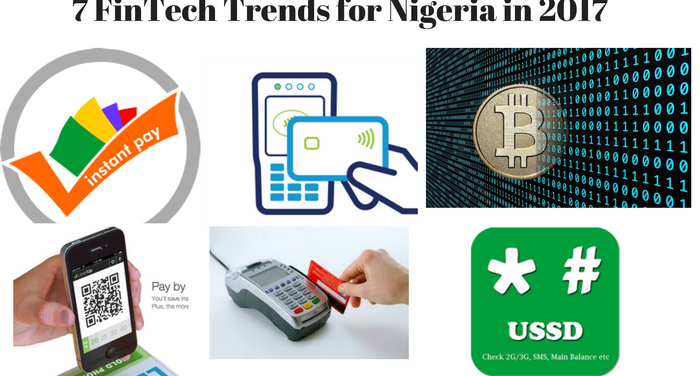
Seven FinTech Trends for Nigeria in 2017: QR Code Payment, USSD and More

0

by SOLA FANAWOPO

With the end of the year approaching, the amount of forecasts for 2017 is steadily increasing. How will the local FinTech industry develop and what will be the next big thing?

One can foresee the next Fintech trends more realistically by looking at the current developments. Exactly, they will determine the course for the next year. Seven areas are of special interest.

1.   QR Code Payments

QR code payments will effectively take off in Nigeria’s financial market in 2017. In 2016, the market witnessed the entrant of Access Bank’s PayByCapture and MasterCard’s Masterpass with minimal impact. VISA will definitely join the fray early in 2017 while local biggies –Interswitch and Remita – are working very hard to fight for market share. This market will be very interesting. However, interoperability and standardization may be the biggest challenge for fast adoption.

2.    USSD

The success of GTBank X737x USSD powered payment system in 2016 will encourage a lot of innovation on the platform in 2017 and beyond.

USSD (Unstructured Supplementary Service Data) is a Global System for Mobile (GSM) communication technology that is used to send text between a mobile phone and an application program in the network.

The NIBSS-powered micro cash (mCash) platform is layered on USSD. Even most QR code payments integrate the USSD option to target the G2 customers. Remita may also layer some of its payment and collection solutions on bank’s USSD platforms.

The Nigerian Communications Commission (NCC) has also promised to put in place a friendly USSD’s tariff regime in 2017 to encourage financial inclusion project of the federal government.

3.   Contactless

With the increasing consumers’ trust of the payment networks, contactless may likely sneak into the payment market in 2017.

4.   Hyper competition in POS business

With the eventual take off of the deregulated Merchant Service Charge (MSC) in 2017, I foresee a cut-throat competition among the banks in the troubled POS market. With the new regime, the banks are empowered to determine the MSC with their merchants.

Most banks are likely to adopt zero MSC charge to gain market share as deposits still make up the highest percentage of fund sources for the banks.

5.   T+1 may become history

With most payment platforms like USSD and QR code adopting instant payment settlement for the merchants, T+1 will be gradually phased-out from the market in 2017. If your acquiring solutions cannot give instant payments and settlements for your merchants, you may have to start re-working your process now as the market will be hostile to you in 2017. Even cheque truncation will likely embrace instant clearance in 2017.

6.   Flexible regulations

In order to promote financial inclusion, I foresee CBN becoming more flexible in most of its pro-bank regulations in 2017. The regulator having granted no objection to MasterCard and VISA on Person to Person (P2P) payments in the country, the big wall is already falling; I see some of the pro-banking regulation being discarded in 2017.

I foresee CBN toying with an idea of e-money regulation in 2017.

7.   Digital Currency

In response to the popularity of unregulated ponzi scheme like, Mavrodi Mudial Moneybox, MMM, I foresee CBN and Nigeria Deposit Insurance Commission (NDIC) adopting a digital currency regulation in 2017. This is the only way such scheme can be regulated.

[LinkedIn]

Five Things Every Modern Entrepreneur Needs

0

Editor’s Note: This was contributed by Brian Greenberg.

1. Transparency.  Operating with transparency used to be a luxury versus a necessity but, now, it’s quite mandatory. Millennials in particular, who wield a tremendous amount of influence and purchasing power, make buying decisions based largely on the provenance, manufacturing processes and overall business practices of a particular company. Because millennials are now the largest population in the U.S., to say that transparency will drive how businesses are perceived is an understatement at best. However, the good news is that establishing and maintaining transparency doesn’t have to be difficult. Simply communicating regularly with honesty and unequivocally holding yourself, your staff and your company accountable will go a long way toward fostering good will with not only consumers and prospects, but also with vendors, strategic partners and your industry at large.

2. Loyalty.  It used to be that only airlines had “loyalty” programs. Now, everybody from giant corporations like Pepsi Co. to mom and pop corner coffee shops have some sort of loyalty program. And, rightfully so. Every industry faces new competition on a daily basis and customers are understandably price sensitive, often buying from whoever has the best sale or perks. However, what loyalty programs really come down to is creating that coveted repeat customer. For instance, airlines offering free first class upgrades or hotels upgrading size of the room for elite travelers often creates an allegiance that trumps price point.  This principle can be applied in every business.  If you’re a service company and a client is at the end of their agreement, offer a specific service at a discount or another deliverable with a high perceived value. Those who do business online can easily build an awards program that fosters a faithful following.

3. Crowdfunding. The ugly truth is if you need a loan, chances are extremely high you won’t be able to get one. In fact, the recent small business study also revealed that the majority—a full 61%–of those who tried to get a favorable loan were unable to do so. Venture capital and private equity funding is equally difficult to come by, if not more. While some types of capital are actually easier to procure, the interest rates are usually more aggressive, often prohibitively so. Instead, focus on crowdfunding and non-traditional lenders such as Bond Street, Kabbage and Deal Struck. According to Massolution’s 2015CF–Crowdfunding Industry Report, global crowdfunding was anticipated to be over $34 billion. A revenue source of that size is simply too big to ignore and not tap into.

4. Pay-for-Play Social Media. Facebook was among the first to implement the “pay-for-play” model by removing organic reach and focusing on paid advertisement.  Since being acquired by Facebook, Instagram is destined to follow.  Pinterest and Twitter are also both currently growing into their pay-for-play systems and will likely make it difficult for pure organic reach as well.  Unfortunately, this means entrepreneurs will need to increase their social media budget. However, Facebook’s paid ads have been shown to reach a significantly greater percentage of users than organic posts, making paid ads well worth the investment. However, social media shouldn’t only be leveraged as a form of advertising. Rather, social media is an ideal way to handle customer service in such a way that not only improves marketplace loyalty but also your company’s transparency endeavor.

5. Instant Gratification.  Simply put, if you don’t offer some form of instant gratification your prospective customer will likely go somewhere that does. This truth is particularly problematic for businesses that require information from customers, such as insurance or financial services. Having prospects fill out contact request forms to be contacted later on for products or services is becoming less and less effective in the “Age of Impatience.” To be competitive, you need to deliver to the customer instantaneously in some way, whether that be with the provision of information they are seeking or other deliverable that will satiate them in the moment and keep them interested for a longer term.  Even just offering quicker and more efficient processes in dealing or transacting with your company is certainly a form of instant gratification. At every available touchpoint, strive to impress the customer—an incredibly effective way of evoking that gratified feeling.

No matter what industry you’re in or the type of business you run, you can still make a profit no matter what the current economic outlook happens to be. That begins with giving customers what they want, how they want it and in a way that’s more sensitive to marketplace vs. company needs. The above tools will put your business well on its way to doing exactly that, possibly making 2016 your most successful year yet.

Brian Greenberg is a multi-faceted entrepreneur who has founded and currently spearheads an assortment of successful online businesses. He currently co-owns and operates multiple entrepreneurial companies with his father