DD
MM
YYYY

PAGES

DD
MM
YYYY

spot_img

PAGES

Home Blog Page 7524

The Cost of Cybercrime in Nigeria is …. And Learn What a Company is Doing To Reduce It

0

The federal government has said the estimated annual cost of cybercrime to Nigeria is 0.08 per cent of the country’s Gross Domestic Products (GDP), which represents about N127 billion (about $635 million).

The National Security Adviser (NSA), Maj-Gen. Babagana Munguno (rtd), stated this monday during the inauguration of the Cybercrime Advisory Council, at the Office of NSA (ONSA), Abuja.

Munguno who is the Chairman of the 31-member Council, lamented that the cost of to the nation is quite significant, saying that the “activities of hackers and cyber criminals in recent times have threatened government presence, economic activities and security of Nigerians and vital infrastructure connected to the internet. “

He said: “The 2014 Annual report of the Nigeria Deposit Insurance Corporation (NDIC), shows that, between year 2013 and 2014, fraud on e-payment platform of the Nigerian banking sector increased by 183 per cent. Also, a report published in 2014 by the Centre for Strategic and International Studies, UK, estimated the annual cost of cybercrime to Nigeria at about 0.08 per cent of our GDP, representing about N127 billion.

“Global tracking of cyber-attacks indicate that Nigeria is among countries with high cases of software piracy, intellectual property theft and malware attacks. The situation is a serious challenge to our resolve to take advantage of the enormous opportunities that Internet brings, while balancing and managing its associated risks.”

According to him, the situation was made possible due to lack of awareness of cyber-security and poor enforcement of guidelines and minimum standards for security of government websites, particularly those hosting sensitive databases of Nigerians.

The NSA, emphasised the need to take serious action to protect our national cyberspace as a national security requirement.

Munguno added that the importance of serious action to protect the nation’s cyberspace, increased tremendously with growth in number of Nigerians connected to the internet, from less than a million in 2003 to over 80 million in November 2015.

He warned that “any serious attack or interference to the operation of Nigerian cyberspace will have negative impact on national economy as well as on public health and safety”, adding that “our national cyberspace has become a critical information infrastructure and protecting it, is a matter of importance”.

Munguno listed some of the common cyber-crimes in Nigeria to include: computer virus and malware infections, identity theft and privacy invasion, fraudulent electronic transaction, and theft of intellectual property.
Other are: radicalisation and violent extremism, terrorism perpetrated through the cyberspace, website hacking and defacement; and distributed denial of service attack, amongst others.

Because of these challenges, U.S. based First Atlantic Cybersecurity Institute has launched to assist Nigerian professionals, governments and companies to develop the necessary skills they need to combat cybercrime. ENROLL here today.


How AI Intellectual Monopoly Will Affect Africa

0

This piece by the Economist explains why the Western world will rule the 21st century. Even the promise of China is muted when you know the West is creating another world entirely. For us in Africa, we can be happy to connect as usual buyers until technical education is  made a priority in the continent.

Sometimes it is perceived as a figment of the far future. But artificial intelligence (AI) is today’s great obsession in Silicon Valley. Last year technology companies spent $8.5 billion on deals and investments in artificial intelligence, four times more than in 2010. Nearly all of the world’s technology giants, including Google, Microsoft, Facebook, Amazon and Baidu, are competing fiercely to hire the best AI experts, snap up start-ups and pour money into research. What accounts for the tech elite’s sudden AI-phoria?

The technology has not always been so popular. The field was largely ignored and underfunded during the “AI winter” of the 1980s and 1990s. At that time AI research conducted at universities proved to be disappointingly slow and irrelevant to companies’ bottom lines. Now, however, the chill is gone. Progress in AI is accelerating. Recently Google generated lots of headlines when DeepMind, a start-up it acquired in 2014, helped train a computer to repeatedly beat the world champion at Go, a board game. This has sparked both fear and hope for the future of AI: hope for fat profits and improving people’s lives through technology; fear about how society will cope with the dislocation AI could bring.

AI is already starting to generate big financial gains for companies, which helps explain firms’ growing investment in developing AI capabilities. Machine-learning, in which computers become smarter by processing large data-sets, currently has many profitable consumer-facing applications, including image recognition in photographs, spam filtering and those that help to better target advertisements to web surfers. Many of tech firms’ most ambitious projects, including building self-driving cars and designing virtual personal assistants that can understand and execute complex tasks, also rely on artificial intelligence, especially machine-learning and robotics. This has prompted tech firms to try to hire up as much of the top talent as they can from universities, where the best AI experts research and teach. Some worry about the potential of a brain drain from academia into the private sector.

The biggest concern, however, is that one firm corners the majority of the talent in artificial intelligence, creating an intellectual monopoly of sorts. Google looks best positioned to do this: between its Google Brain project and its acquisition of DeepMind, it has some of the brightest human brains working on AI. Because superior AI systems are able to learn and improve more quickly, the firms that develop an early edge in artificial intelligence may reap the greatest rewards and erect barriers to entry that smaller firms will find hard to overcome. In December Elon Musk and several other tech leaders pledged $1 billion to help fund OpenAI, a research lab that will make public all of its findings, to ensure there is an entity that is working on developing AI on behalf of the public good and not just its own profits. Today AI is the domain of tech geeks, but its future matters to everyone.

From our end here in Tekedia, Africa must work to deepen its own research so that it can compete in this A.I. evolving age. Anything less, we will simply facilitate consumerism for the Western World.

How Business Digitization Will Destroy These Jobs In Nigeria

0

This is bold and really bold. You better ask your friends and families to plan accordingly on their careers.

By 2025, jobs which were common place in 2015 will no longer exist. Students graduating in 2016, will have obsolete qualifications for which there will no longer be a profession by 2025.

  • Front-line military personnel will be replaced with robots
  • Private bankers and wealth managers will be replaced with algorithms
  • Telemarketers, data entry capturers, tax preparers, lawyers, accountants, actuaries, statisticians and consulting engineers will be replaced with Artificial Intelligence (AI).

New business models, like those of Uber and Alibaba, are already industry-shaping disruptors, and each day, new Digital innovators are emerging to cause disintermediation and disruption across every industry imaginable.

Traditional enterprises, whilst presently successful by today’s standards, are scrambling to make sense of Business Digitisation in order to stay relevant in the Digital future. Many are attempting to create new Digital business models which will eventually cannibalise their traditional business, rather than capitulating to new disruptive Digital start-ups. Companies are also digitising their products and services, along with operational processes and customer channels. Over 70% of top fortune 500 companies have plans to offer their products as a Digital service by 2020.  Presently, the 10 most valuable start-ups globally are estimated to have a value of $172.7 billion – all embracing Digital platform based business models. Around 90% of the business models in 2020 will be driven by the cloud.

Globally, the number of connected devices will nearly quadruple by 2025, significantly altering the skills employers hold most valuable. Increasing connectivity will change how employees choose to work (for example: remotely, part-time, independently, or dispersed), and provide employers with a spectrum of hiring options.

Millennials, most of whom are Digital Natives, will comprise an estimated 48.3% of the global labour force in 2025, while those aged 60 and older will comprise 9.9% (compared with 7.9% in 2015).

The line between what has traditionally been business and IT is becoming more and more blurred. Largely due to the early adoption and impact of Digital marketing, The Chief Marketing Officer or CMO, now controls a bigger “IT” budget and influence than the CIO. This is only set to increase and expand across the organisation, as Digital Natives become future business leaders.

What new skills and expertise will be required to lead and manage the Digital enterprise of the future?

As robots, AI and Digital algorithms continue to replace many jobs and professions; new and emerging professions by 2025 will focus more on human interaction, augmented through Digital mechanisms. Jobs requiring uniquely human characteristics, such as cultural deftness, caretaking, or empathy, and creative thinking, are those least threatened by automation.

The ability to work anywhere, anytime is fuelling the Digital nomad trend, which is highly appealing to millennials, but will also blur political and economic boundaries, and test national labour codes.

Artificial Intelligence, its subfields, and automation will create some specific reflecting trends associated with new and emerging technology advances. Career gains from AI and automation include:

  • Artificial Intelligence technology and automation salesperson
  • Specialist programmers
  • Cybersecurity experts
  • Engineering psychologists
  • Robot and automation technology manufacturer, distributor, servicer, and refurbisher
  • Technology-specific trainer
  • Neuro-implant technicians
  • Virtual health care specialist
  • Virtual reality experience designer

Conclusion:

Digital transformation cannot be ignored without becoming irrelevant, and an adaptive Digital strategy is imperative. 

The Digital workforce will be largely millennial, and significantly different from today in terms of culture, leadership style and skills. Artificial Intelligence, robots and Digital algorithms will automate many professions, but jobs requiring uniquely human characteristics – or are critical to the development of Digital solutions – will be in great demand by 2025.

A holistic Digital transformation strategy, which considers the Digital workforce along with the business model, process and customer channel dimensions, will be imperative for organisations wishing to remain relevant in the next 10 years.

Africa needs to plan and invent for the digital workforce era. Nigeria has to plan also.

Since Naira Floated, No Foreign Investor Had Made Money in Nigeria if Invested Before the Float

0

It is indeed a tough economy that we are all experiencing in Nigeria. The exchange rate is collapsing and any investor that puts money in Nigeria now will have to run the numbers: how can you grow faster than the loses coming from the currency deterioration. That is the black swan – you have to grow faster than any borrowing interest rate, faster than the currency loses and then grow to make profit. There is no way that is possible and that is why we say that no investor had exited profitability, for those that invested before, since Nigeria floated its currency.

Analysis from Punch shows a really troubling pattern:

The naira is seen depreciating further and may hit the 500 mark to the United States dollar at the parallel market next week as the greenback scarcity persists and the Central Bank of Nigeria cuts supply to foreign exchange operators.

The local currency was trading around N495 to the dollar on the black market on Thursday, compared to 485 per dollar last week due to dollar shortages, traders said.

The naira was quoted at 310.5 to the dollar on the official interbank window on Thursday by commercial lenders.

The BDC operators are now getting $8,000 each per week from Travelex against the usual $15,000 each per week.

The naira had tumbled against the dollar to 490 on Monday from 487 last Friday, as acute shortage of the greenback continued to batter the economy and the country’s foreign exchange markets.

Before falling to 487 last Friday, the local currency had consecutively closed flat at 485 for four days in the previous week.

The severe shortage of the dollar has put the naira under persistent pressure at both the official and parallel forex markets.

The global crash in the prices of crude oil, Nigeria’s main forex earner, has brought untold hardships on Nigerians.

Economic and financial experts said unless the lingering dollar supply problem abated, the volatility in the exchange rate and the consequent economic challenges might continue.

Economic and financial experts expect the naira to weaken further against the dollar as the Christmas holiday begins this week.

They also argued that the crackdown on the parallel market forex traders and the persistent scarcity of the greenback would make further weakening of the local currency inevitable.

A few weeks ago, the naira closed flat at 470 against the greenback over a period of over a week.

The naira had plunged to 470, down from 455 on the back of a fresh dollar shortage at the official and parallel forex markets.

Dollar shortages have caused many companies to halt operations and lay off workers, compounding an economic crisis exacerbated by the fall in global prices of oil, which accounts for over 70 per cent of Nigeria’s budget revenue.

The CBN has struggled to support the naira as the country’s external reserves continue to fall.

[Punch]

How to Grow Food from Microchips and Data Analytics [Photo]

0

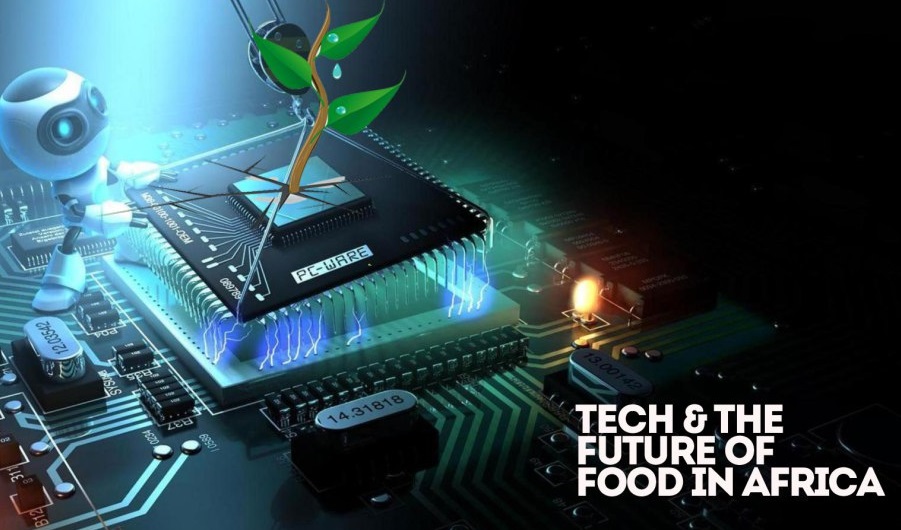
This photo shows it all – it tells you how to grow good food from microchops and data analytics.

Do you know one company that is leading the push in Africa? It is Zenvus.

Zenvus is an intelligent solution for farms that uses proprietary electronics sensors to collect soil data like moisture, nutrients, pH etc and send them to a cloud server via GSM, satellite or Wifi. Algorithms in the server analyze the data and advice farmers on farming. As the crops grow, the system deploys special cameras to build vegetative health to help detection of drought stress, pests and diseases. The data generated is aggregated, anonymized and made available via subscription for agro-lending, agro-insurance, commodity  trading to banks, insurers and investors.