DD
MM
YYYY

PAGES

DD
MM
YYYY

spot_img

PAGES

Home Blog Page 7546

The Geography of Crowdfunding Ecosystem in Africa

0

Africa is now home to over 57 active crowdfunding platforms with projects raising over $126.9 million in 2015, reveals the Afrikstart Crowdfunding in Africa report.

Crowdfunding took the world by storm in 2007 when Indiegogo started connecting, online, aspiring project creators to individual funders worldwide. Nearly ten years later, project creators now raise millions of dollars for their campaigns on prominent crowdfunding platforms, as shown by the success of the Pebble smartwatch campaign that reached over $20 million on Kickstarter in 2015.

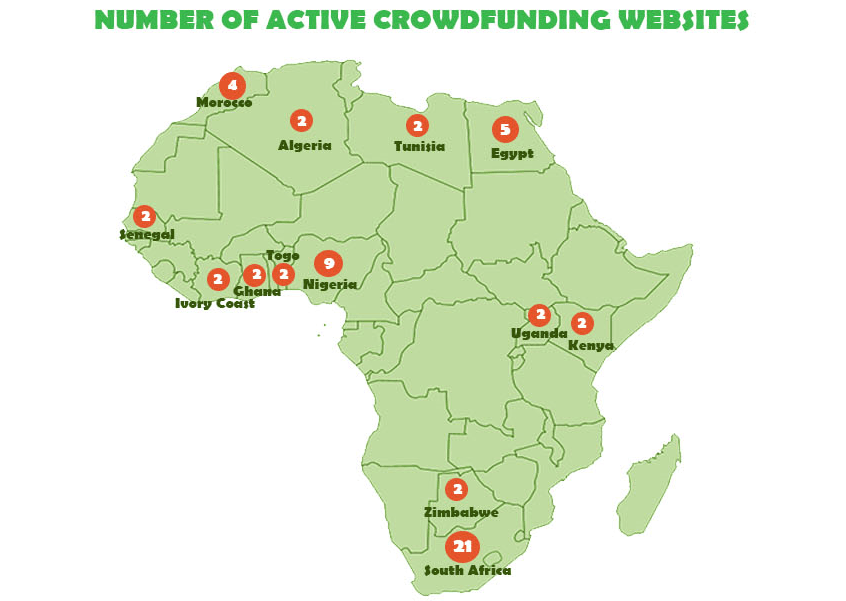
Community-based financial solidarity and fundraising are an integral part of the African culture and traditions. Across Africa, communities are accustomed to pooling funds to support various charity-focused, social and economic local projects. It was only a matter of time for Africans to seize the opportunity to translate the fundraising process online, and to jump on the crowdfunding bandwagon. By 2012, 9 crowdfunding platforms were founded in Africa, in the likes of Slicebiz, M-Changa, Starme, Shekra or Jumpstarter. In 2015, 57 crowdfunding platforms were operating across Africa. South Africa lead the way in African crowdfunding with 21 active platforms, and Nigeria was catching up with 9 operational platforms.

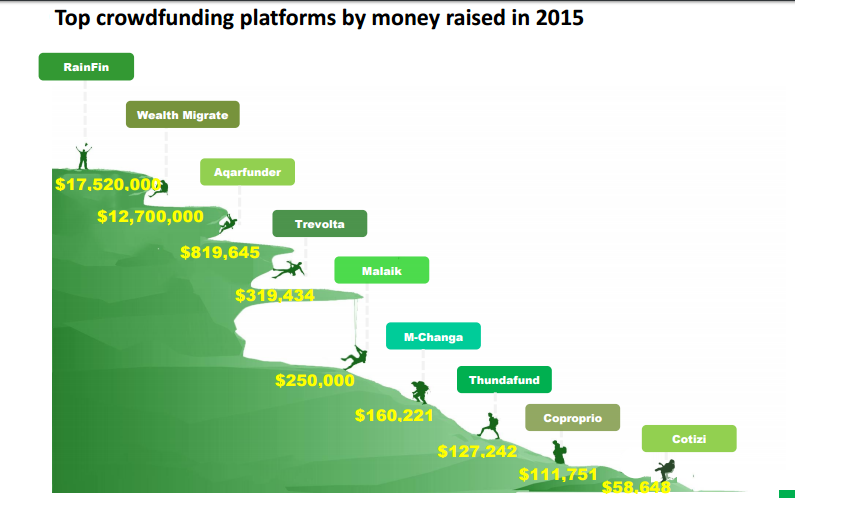
While operating in a business environment with low Internet penetration, low social media usage, and limited funds transfer and payments solutions, Africa-based crowdfunding platforms succeeded to raise an estimated $32.3 million in 2015. Money raised was mainly directed to fund startups and SMEs ($17.7 million), real estate crowd invested projects ($13.6 million), travel crowdfunded trips ($319,434), and to donate to social causes and charity projects ($307,860).

Africa-based crowdfunding platforms show their capacity to attract backers to support multimillion projects. Wealth Migrate, a South-African real estate platform, launched the most funded project in 2015, and raised $12,700,000 to acquire 4 medical buildings in the USA. The equity crowdfunding platform Malaik succeeded to collect $250,000 for the Nigerian startup i-drop. RainFin, a peer-to-peer lending platform based in South Africa, launched thousands of projects to provide loans of up to ZAR 750 000 to small businesses and individuals. Trevolta, specialised in funding trips, launched a massive crowdfunding campaign ‘‘Rhinos without Borders’’ that raised $292,170 in 2015 to save rhinos from the poaching crisis, by relocating them to Botswana.

Foreign crowdfunding platforms also strive to fund projects in Africa. They poured an additional $94.6 million in 2015 to local initiatives, with an appeal for impact-focused projects geared to help children, to empower women and girls, or to promote education. Kenya was the top recipient of funds, with $21.7 million collected.

Crowdfunding projects in Africa received an estimated $126.9 million in 2015.
Africa is home to over 50 crowdfunding platforms which raised $32.3 million.
Foreign crowdfunding platforms poured an additional $94.6 million to fund African projects.

Crowdfunding is deemed to be a viable and scalable alternative source of funding for startups and small businesses, charities and other project creators in Africa. Crowdfunding is at a relatively nascent phase in Africa but it has the potential to reach 2.5 billion by 2025, as estimated by the World Bank. The Afrikstart Crowdfunding in Africa report gives a detailed insight into the performance of over 50 Africa-based crowdfunding platforms by country, by project categories, by crowdfunding model; and the total number of projects and their success rate. It also outlines the financial contributions of foreign crowdfunding platforms that fund projects in Africa. Are also mentioned in the report the top successful crowdfunding campaigns.
data-on-crowdfunding

The Afrikstart Crowdfunding in Africa report is free and available here.

Adapted here

NITDA to Unveil ICT Tools for “Change Begins with Me’’ campaign

0

The National Information Technology Development Agency (NITDA) has pledged to support the “Change Begins with Me’’ campaign with corruption-eliminating Information and Communication Technology (ICT) tools.

The pledge was made by NITDA’s Acting Director-General, Dr Vincent Olatunji, at a two-day sensitisation workshop for management staff of the agency.

A statement issued by Mrs Hadiza Umar, NITDA’s Head of Corporate Affairs Department, quoted Olatunji as saying that “NITDA as an Information Technology (IT) agency will look inward for ICT tools that can be used to help prevent or better still eliminate corrupt practices in the country.’

The News Agency of Nigeria (NAN) recalls that President Muhammadu Buhari recently launched the “Change Begins with Me’’ campaign in Abuja.

The campaign seeks the support of every Nigerian in eliminating indiscipline in every sphere of life.

Why Nigeria needs Digital Finance

0

In developing nations,  two billion people don’t have access to basic financial services such as savings accounts and credit. That’s almost half of the developing world’s adult population. Giving most of these people access to those services using mobile phones and the internet would increase the GDP of emerging economies by $3.7 trillion by 2025, according to a study by the McKinsey Global Institute. That’s a 6% boost.

The report by McKinsey argues that the benefits of digital finance go beyond unlocking another market for the financial industry. Access to these basic services would reduce inequality, poverty and even government corruption. It would also create 95 million new jobs.

Digital finance can provide access to financial services for 1.6 billion people—880 million of them women—in emerging economies for the first time, McKinsey said. This is within reach because the infrastructure already exists. In 2014, 80% of adults in developing nations had mobile subscriptions. By 2020, 90% of these adults will own a mobile phone.

Nigeria needs a clear strategy to improve its digital finance sector to help improve people’s lives.

data

Yahoo continues the fast death – 500 million user accounts stolen

0
CHINA - DECEMBER 01: Different Yahoo! services including Yahoo! Messenger are pictured on a computer, in Hong Kong, China, on Thursday, December 1, 2005. Almost 80 percent of trading in South Korea's 218 trillion won ($210 billion) government market is executed over the counter on Yahoo! Inc.'s instant messaging service, traders say. (Photo by Lucas Schifres/Bloomberg via Getty Images)

This company needs to just go away. It continues to surprise no one with the endless bad news.

Yahoo said on Thursday information associated with at least 500 million user accounts was stolen from its network in 2014 by what it believed was a “state-sponsored actor.”

The data stolen may have included names, email addresses, telephone numbers, dates of birth, and hashed passwords but may not have included unprotected passwords, payment card data, or bank account information, the company said.

Foreign debts of Nigerian Governments by State

0

Nigeria is owing real money to foreign investors. In a new article by Punch, Lagos, Kaduna and Edo, with a combined foreign debt profile of $1.84bn, are the most indebted states of the federation as far as subnational foreign debts are concerned.

Statistics obtained from the Debt Management Office in Abuja on Wednesday showed that the 36 states of the federation and the Federal Capital Territory owe $3.65bn in foreign debts as against the $7.61bn owed by the Federal Government as of June 30, 2016; bringing the country’s total foreign debt to $11.26bn.

Lagos, which has the biggest economy in the country, retained its topmost position as the most indebted state of the federation with a total of $1.43bn in foreign debts. Thus, the state holds 39.17 per cent of the country’s total subnational foreign debts.

Kaduna State, with total foreign debt of $225.28m, comes in the second position. It holds 6.16 per cent of the subnational foreign debts.

Edo State, with a total of $179.52m as of June 30, holds 4.91 per cent of the country’s subnational foreign debts.

The highest owing states in the subnational foreign debts include Cross River, $141.47m or 3.87 per cent; and Ogun, $103.55m or 2.83 per cent.

Others are Bauchi, with $97.23m or 2.66 per cent; Osun, $78.93m or 2.16 per cent; Adamawa, $77.14m or 2.11 per cent; Enugu, $74.46m or 2.04 per cent; Katsina, $68.99m or 1.89 per cent; and Oyo, $67.56m or 1.85 per cent.

Some of the least indebted states of the federation are Borno, $21.89m; Taraba, $23.01m; Plateau, $29.24m; Yobe, $29.28m; Jigawa, $32.62m; Kogi, $33.56m; Benue, $34.26; FCT, $34.8m; Zamfara, $35.07m; and Delta, $42.21m.

Our correspondent reported that the 36 states of the federation and the FCT grew their external debts by $1.37bn in five years.

The external indebtedness of the subnational governments as of December 31, 2010 stood at $2bn. However, by December 2015, it had risen to $3.3bn.

This shows that the subnational governments grew their external debts by 68.44 per cent within the five-year period.

Some states, over the period, maintained their top positions in the borrowers’ club, while others jumped onto the list in the period.

With an external debt of $41.19m in 2010, Edo State, for instance, was not among the most indebted states in the country.

However, by the end of December 2015, the state’s external debt profile had leapt to $168.19m, showing a difference of $127m. This means that the state’s external debt rose by 308.34 per cent in five years.