DD
MM
YYYY

PAGES

DD
MM
YYYY

spot_img

PAGES

Home Blog Page 7601

The PSIPSE Seeks to Grow its $50 Million Secondary Education Investment in Developing Countries

0

A partnership of private donors and foundations announced today an $8 million call for proposals seeking new ideas and innovative solutions to address critical issues that impair secondary education learning for marginalized populations.

Through the Partnership to Strengthen Innovation and Practice in Secondary Education (PSIPSE), Dubai Cares, Echidna Giving, the John D. and Catherine T. MacArthur Foundation, The MasterCard Foundation, and an anonymous donor announced the fourth PSIPSE call for proposals with a geographic focus on Kenya, Malawi, Tanzania and Uganda.

The call for proposals announced today will lead to funding in 2017 in support of projects that pilot innovations, expand and adapt successful models, inspire collaborations and research critical questions about how to improve quality in secondary education while aiming to create systemic change in this sector at the local or national level. Projects are expected to apply innovative approaches that enable teachers to better act as facilitators of learning, improve adolescents’ learning outcomes, and promote 21st century employment-relevant skills.

“The world has made impressive strides in providing primary education to children Worldide. However, without opportunities for secondary education, children have little chance to improve their livelihoods, and the progress made at primary level could be jeopardized. Through this call for proposals by PSIPSE, we aspire to foster novel approaches to gain ground in the quest for quality secondary education”.
-Tareq Al Gura, Chief Executive Officer at Dubai Cares

The PSIPSE was formed in 2012 on the proven premise that quality secondary school education is measurably associated with positive effects on health, well-being and productivity of youth. Yet secondary education and quality relevant learning experiences for secondary school aged youth remain scarce in the developing world, particularly for marginalized girls.
Since the 2015 announcement of grants, the PSIPSE has focused on an overarching Monitoring, Evaluation, and Learning framework that will help the PSIPSE better understand the impact of its interventions and ensure that its future grantmaking builds on evidence from the portfolio of 58 projects in 8 countries for which PSIPSE has provided of over $50 million in funding to date.
To accelerate learning and sharing, the PSIPSE convened a meeting of grantees in Dar es Salaam, Tanzania in June, 2016. This was the second convening of PSIPSE grantees in East Africa, the first taking place in Nairobi, Kenya in 2014. The meeting aimed to give grantees an opportunity to share successes, challenges and lessons learned in the implementation of their PSIPSE funded projects in the representative countries; to build relationships and network with key stakeholders who are involved in implementing secondary education programs in the region; and to explore opportunities for collaboration and peer-to-peer networking among PSIPSE grantees. The convening also provided a space to engage with policy makers from PSIPSE focus countries and participate in technical workshops on communication, scaling-up and monitoring and evaluation.

Nigeria plans to invest $550 million in new satellites

0

With over N144 billion ($362 million) spent on its building and more on the construction of ground station infrastructure, the country’s communications satellite is still idle in the ongoing switchover from analogue to Digital Terrestrial Television (DTT) broadcasting.

The reason: there is no backup to switch to, if the satellite, for any reason, packs up, prompting a warning by experts that the entire DDT broadcasting could hit the rocks in the event of a system failure.

Information and Culture Minister, Lai Mohammed, was, however, quoted recently as saying: “The process of digitalisation is unstoppable and irreversible; it’s not a matter of choice. If we do not follow the world to digitalise and meet the June 2017 target, it means our telephones, televisions and radios would not be free from interference.

Mohammed confirmed to The Guardian: “When the White Paper on utilisation came out, the Nigerian Broadcasting Commission (NBC), the digital team set up by government, paid a visit to Nigeria Communication Satellite Limited (NIGCOMSAT) and explained to them how ready they were to patronise them. But unfortunately, as we speak today, NIGCOMSAT has no redundancy. In other words, they have no backup. If we sign with them and for any reason the satellite goes down, it means we cannot transmit.”

He stated, however, that as soon as NIGCOMSAT scaled the hurdle, the Federal Government would have no choice but resort to the main local player.

Mohammed’s position corroborates that of his Communications counterpart, Adebayo Shittu. At the end of the National Council on Communication Technology (NCCT) in Kaduna, last week, Shittu highlighted the fears of investors and users about losing data to an unreliable satellite.

He disclosed government’s plans to procure two backups for NIGCOMSAT at the cost of $550 million. “Once that is done, we can beat our chest and say, ‘nobody should take Nigerian money outside for the purpose of storing data’. I am confident that with the Federal Government’s approval, we will get what we want.”

Register for FACyber Nanodegree Programs in Cybersecurity Policy, Management, Technology, Digital Forensics

0

fAt First Atlantic Cybersecurity Institute (facyber.com), we  offer nanodegree programs in the following areas:

  • Nanodegree in Cybersecurity Policy (NCYP)
  • Nanodegree in Cybersecurity Technology (NCYT)
  • Nanodegree in Cybersecurity Management (NCYM)
  • Nanodegree in Cybersecurity Intelligence & Digital Forensics (NCDF)

The duration is 7 days and requires successful completion of equivalent diploma program (see below). Each program stream costs $2900.  It requires attending one week live (physical) training in Lagos. This live program is available twice per year and is run by FACyber team.


  • Certificate in Cybersecurity Policy (CCYP): Certificate in Cybersecurity Policy deals with the policy analysis and implementation aspects of cybersecurity. It presents theory and topical issues, at government and enterprise levels, with both technical and managerial components in the fields of information systems security. The program helps learners develop skills on the policy, ethical, and legal issues associated with cybersecurity and information security.

Diploma in Cybersecurity Policy (DCYP) Capstone: This is a practical-oriented program where learners are tasked with developing solutions for a theoretical or real case cybersecurity policy issue with the guidance of a mentor. A project report is required at the end of the program.


  • Certificate in Cybersecurity Technology (CCYT): The Certificate in Cybersecurity Technology is designed to provide learners with skills to analyze multi-faceted complex cybersecurity issues, develop capabilities to make strategic decisions to protect organizations from threats and become competent cybersecurity professionals.

Diploma in Cybersecurity Technology (DCYT) Capstone: This is a practical-oriented program where learners are tasked with developing capabilities in the core technical aspect of cybersecurity. Learners will have access to some tools and equipment to work throughout this program. A project report is required at the end of the program.


  • Certificate in Cybersecurity Management (CCYM): The Certificate in Cybersecurity Management equips and prepares learners with modern skills to become effective managers across the broad nexus of cybersecurity and intrusion preventions in organizations. The central core is developing capacity to prevent anticipated cyber intrusions, using experiences to mitigate future threats, and formulating and implementing enterprise-level cybersecurity roadmaps. The program also explores the roles of regulation, policy developments, legal instruments and civil liberties.

 Diploma in Cybersecurity Management (DCYM) Capstone: This is a practical-oriented program where learners are tasked with developing cybersecurity project management capabilities with the guidance of a mentor. Here, learners develop cybersecurity implementation frameworks. A project report is required at the end of the program.


  • Certificate in Cybersecurity Intelligence & Digital Forensics (CCDF): The Certificate in Cybersecurity Intelligence & Digital Forensics is structured to provide modern skills to those interested in digital forensics, digital intelligence and uncovering digital evidence. The program equips learners with broad analytical frameworks and prepares them to become competent cyber investigators.

Diploma in Cybersecurity Intelligence & Digital Forensics (DCDF) Capstone: This is a practical-oriented program where learners are tasked with developing capabilities in digital forensics, digital evidence and digital intelligence. Learners will have access to some tools and equipment to work throughout this program. A project report is required at the end of the program.

facyber@fasmicro.com

The paradox of human longevity escape velocity

0

In 1900, the average American lived for less than 50 years. Over the last century, improvements in medicine and public health have contributed to a steady increase in life expectancy. Life expectancy at birth is now 76 for men and 81 for women.

The increase in longevity has been so consistent that it’s permeated actuarial science for life insurance and annuities. The Society of Actuaries has for many years incorporated an assumption that longevity will keep improving over time.

Data over the last five years, however, indicates that this trend may be decelerating, and 2016 saw a rare decrease in life expectancy. Talented entrepreneurs seem undaunted! The fact that the U.S. life insurance industry collected $151.4B in premiums in 2015 has a number of them (including SoFi) extremely focused!

Finally, some futurists such as Aubrey de Grey believe that we don’t need coverage, we will continue chipping away at the aging process until we reach “longevity escape velocity” and live to 1,000. Aubrey does, however, fail to point out how to deal with the dodgy Salmon Mousse you might get served at a holiday dinner party.

Zenvus is presented to Nigeria’s Federal Ministry of Agriculture and Rural Development

0

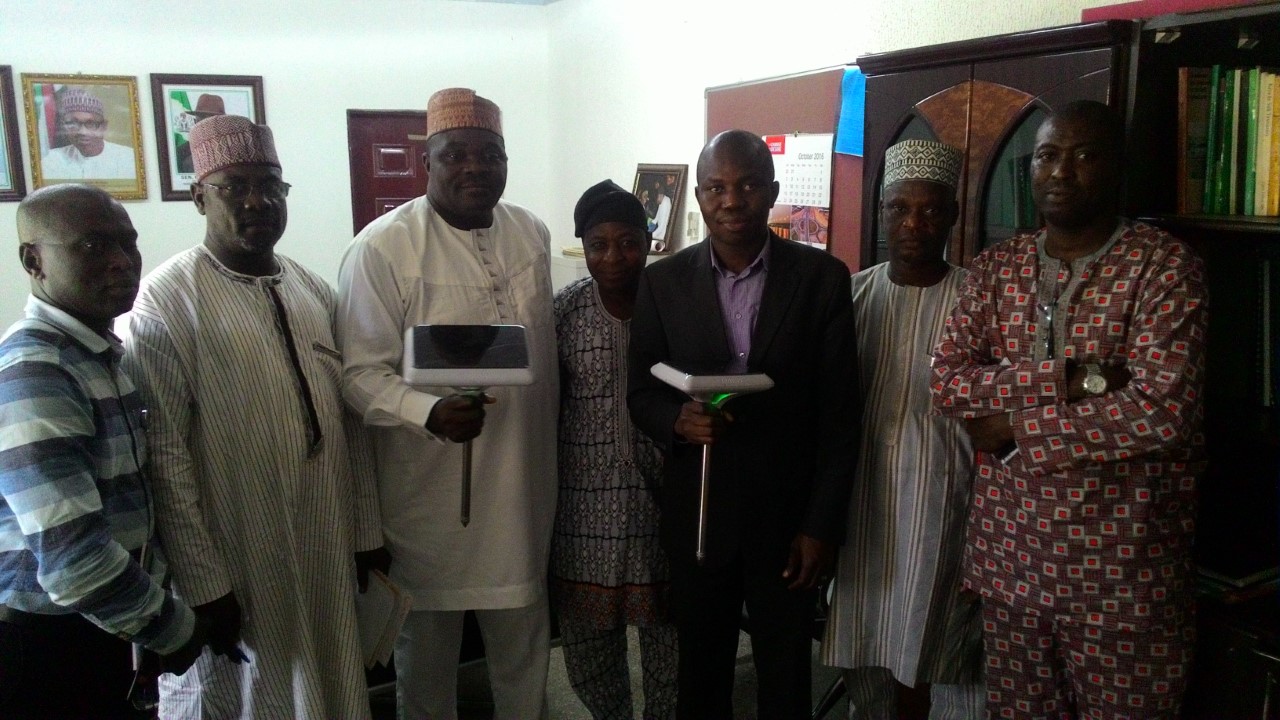
Zenvus has been presented to Nigeria’s Federal Ministry of Agriculture and Rural Development. The Director of Soil Fertility in the ministry received Zenvus and the ministry is adopting the sensor for its farm fertility activity across Nigeria. Zenvus has a GPS engine which makes it easy to know the exact location where the sample is taken.

Zenvus is an intelligent solution for farms that uses proprietary electronic sensors to collect soil data like moisture, nutrients, temperature, pH etc. It subsequently sends the data to a cloud server via GSM, satellite or Wifi. Algorithms in the server analyze the data and advise farmers on what, how and when to farm. As the crops grow, the system deploys hyper- spectral cameras to build crop normalized difference vegetative index which is helpful in detecting drought stress, pests and diseases on crops. The data generated is aggregated, anonymized and made available via subscription for agro-lending, agro-insurance, commodity trading to banks, insurers and investors. Zenvus also has a mapping feature which can help a farmer map the farm boundary with ease.

The mission of Zenvus is to eliminate extreme poverty in emerging world especially Africa by improving crop yield and overall farming productivity. It brings the fusion of electronics and analytics to empower farmers.