DD
MM
YYYY

PAGES

DD
MM
YYYY

spot_img

PAGES

Home Blog Page 7604

Yahoo continues the fast death – 500 million user accounts stolen

0
CHINA - DECEMBER 01: Different Yahoo! services including Yahoo! Messenger are pictured on a computer, in Hong Kong, China, on Thursday, December 1, 2005. Almost 80 percent of trading in South Korea's 218 trillion won ($210 billion) government market is executed over the counter on Yahoo! Inc.'s instant messaging service, traders say. (Photo by Lucas Schifres/Bloomberg via Getty Images)

This company needs to just go away. It continues to surprise no one with the endless bad news.

Yahoo said on Thursday information associated with at least 500 million user accounts was stolen from its network in 2014 by what it believed was a “state-sponsored actor.”

The data stolen may have included names, email addresses, telephone numbers, dates of birth, and hashed passwords but may not have included unprotected passwords, payment card data, or bank account information, the company said.

Foreign debts of Nigerian Governments by State

0

Nigeria is owing real money to foreign investors. In a new article by Punch, Lagos, Kaduna and Edo, with a combined foreign debt profile of $1.84bn, are the most indebted states of the federation as far as subnational foreign debts are concerned.

Statistics obtained from the Debt Management Office in Abuja on Wednesday showed that the 36 states of the federation and the Federal Capital Territory owe $3.65bn in foreign debts as against the $7.61bn owed by the Federal Government as of June 30, 2016; bringing the country’s total foreign debt to $11.26bn.

Lagos, which has the biggest economy in the country, retained its topmost position as the most indebted state of the federation with a total of $1.43bn in foreign debts. Thus, the state holds 39.17 per cent of the country’s total subnational foreign debts.

Kaduna State, with total foreign debt of $225.28m, comes in the second position. It holds 6.16 per cent of the subnational foreign debts.

Edo State, with a total of $179.52m as of June 30, holds 4.91 per cent of the country’s subnational foreign debts.

The highest owing states in the subnational foreign debts include Cross River, $141.47m or 3.87 per cent; and Ogun, $103.55m or 2.83 per cent.

Others are Bauchi, with $97.23m or 2.66 per cent; Osun, $78.93m or 2.16 per cent; Adamawa, $77.14m or 2.11 per cent; Enugu, $74.46m or 2.04 per cent; Katsina, $68.99m or 1.89 per cent; and Oyo, $67.56m or 1.85 per cent.

Some of the least indebted states of the federation are Borno, $21.89m; Taraba, $23.01m; Plateau, $29.24m; Yobe, $29.28m; Jigawa, $32.62m; Kogi, $33.56m; Benue, $34.26; FCT, $34.8m; Zamfara, $35.07m; and Delta, $42.21m.

Our correspondent reported that the 36 states of the federation and the FCT grew their external debts by $1.37bn in five years.

The external indebtedness of the subnational governments as of December 31, 2010 stood at $2bn. However, by December 2015, it had risen to $3.3bn.

This shows that the subnational governments grew their external debts by 68.44 per cent within the five-year period.

Some states, over the period, maintained their top positions in the borrowers’ club, while others jumped onto the list in the period.

With an external debt of $41.19m in 2010, Edo State, for instance, was not among the most indebted states in the country.

However, by the end of December 2015, the state’s external debt profile had leapt to $168.19m, showing a difference of $127m. This means that the state’s external debt rose by 308.34 per cent in five years.

Crises in Jumia as Revenue drops 72% and 57% on Q2-2015/2016 and H1-2015/2016

0

Jumia is really struggling. It seems the challenges of Konga are not an isolated case. People are not shopping.

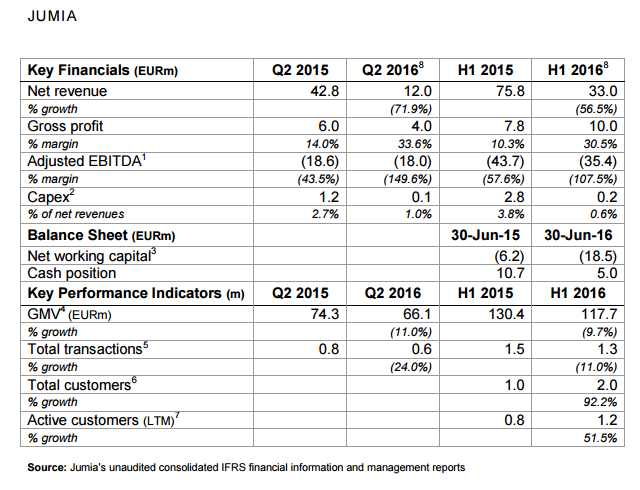
The Rocket Internet’s eCommerce group in Nigeria and Africa has just released its 2016 half year consolidated result showing the company recorded a net loss of EUR35.4 million within the period.

When compared to its net loss recorded in last year, the company has managed to reduce its loss by 19%. In the first half of 2015, the company recorded a net loss of EUR43.7 million.

Also on the topline, Jumia’s revenue also fell by 56%. With the first half of this year, net revenue was EUR33.0 million compared to last year when it recorded EUR75.8 million f0r the first half of 2015.

The table below is from Jumia interim un-audited statement.  It does not look nice

jumia

Notes: (1) Adjusted EBITDA is calculated as (i) operating profit or loss (Q2 2015: loss of EUR 20.9m; Q2 2016: profit of EUR 19.3m; H1 2015: loss of EUR 48.4m; H1 2016: loss of EUR 39.0m) plus (ii) depreciation of property, plant and equipment and amortization of intangible assets (Q2 2015: EUR 0.6m; Q2 2016: EUR 0.6m; H1 2015: EUR 0.8m; H1 2016: EUR 1.0m). Adjusted EBITDA excludes share based compensation expenses that amounted to EUR 1.7m in Q2 2015, EUR 0.7m in Q2 2016, EUR 3.9m in H1 2015 and EUR 2.6m in H1 2016.

(2) Capital expenditure is calculated as (i) purchase of property, plant and equipment (Q2 2015: EUR 1.2m; Q2 2016: EUR 0.1m; H1 2015: EUR 2.8m; H1 2016: EUR 0.2m) plus (ii) acquisition of intangible assets (Q2 2015: EUR 0.003m; Q2 2016: EUR 0.001m; H1 2015: EUR 0.003m; H1 2016: EUR 0.004m).

(3) Net working capital is calculated as (i) inventories (June 30, 2015: EUR 12.4m; June 30, 2016: EUR 3.1m) plus (ii) trade and other receivables (June 30, 2015: EUR 14.9m; June 30, 2016: EUR 6.0m) plus (iii) prepaid expenses (June 30, 2015: EUR 2.6m; June 30, 2016: EUR 1.3m) minus (iv) trade and other payables (June 30, 2015: EUR 36.1m; June 30, 2016: EUR 28.9m).

(4) The total value of “total transactions” sold in period, including taxes, including shipping costs.

(5) Total number of valid (i.e. not failed or declined) orders starting the fulfilment process less cancelled orders (before rejected and returned orders), i.e. total number of orders shipped in the period (eCommerce and marketplace).

(6) Number of customers that have made at least one transaction as defined in “total transactions” at any time before end of period.

(7) Number of customers having made at least one transaction as defined in “total transactions” within the last 12 months before end of period. (8) The improvement in gross margin, including decrease in net revenue and cost of goods sold respectively, is predominantly explained by a continued shift from retail sales towards a marketplace business model.

Source: Rocket Internet

Five key shifts Transforming the Entertainment and Media sector in Nigeria

0

The following are the five dimensions of the entertainment and media landscape, according to PwC analysts: demography, competition, consumption, geography, and business models. Simultaneous and interrelated, these five shifts influence and play off one another. They should serve as a serious call to action for both industry incumbents and new entrants to seek out growth opportunities in markets worldwide.

Shift 1. Demography: Youth will be served

Our analysis of national entertainment and media markets globally reveals an almost perfect correlation between the relative size of the under-35 population and growth in entertainment and media spending—confirming that younger consumers are now the primary drivers of global growth. Our analysis of total entertainment and media revenue growth in the world’s 10 youngest and 10 oldest markets in demographic terms reveals that, on average, entertainment and media spending in the 10 youngest markets is growing three times as rapidly as in the 10 oldest markets.

Shift 2. Competition: Content is still king

In a world where Netflix can launch in 130 new countries in a single day, it’s easy to assume that content is becoming more globally homogeneous. But the reality is that content is being redefined by forces of globalisation and localisation simultaneously—and that while much of the industry is growing more global, content tastes and cultures remain steadfastly local.

Shift 3. Consumption: The joy of bundles

The ability for consumers to design and curate their own media diet has been one of the most powerful trends to emerge in the industry. But the bundle is far from dead, with video and cable incumbents—which were initially slow off the mark—now fighting back by offering their content on an integrated omnichannel basis, on TV, laptop, tablet, and smartphone. As take-up of these new-style bundles grows, we believe the bulk of digital OTT mass-market services will gradually be reabsorbed into aggregated offerings that will echo the traditional analogue-style bundle, but that will be more flexibly priced and available on a full range of devices. When this happens, the competitive battle may move up a notch, as cable, technology, and telecom players fight over gaining access to distribution.

Shift 4. Geography: Growth Markets

Generally, entertainment and media companies had one set of expectations about developed markets (slow growth, low regulation, easier to access) and another about developing markets (rapid growth, high regulation, harder to access). But the dynamics are shifting rapidly as disruption pushes markets to develop in different ways, meaning “opportunity” economies—even within the same region—can display significantly varied growth patterns.

Shift 5. Business models: Transforming with trust

Today’s entertainment and media market includes technology companies racing to become hybrid content companies, and traditional publishers evolving the other way to emerge as hybrid technology companies. This underlines how the growth of technology and digitisation is acting as a centrifugal force—breaking up existing relationships; pushing large, generalist entities to give way to smaller specialists; and allowing smaller, nimble competitors to beat out incumbents. For incumbent advertising agencies, this opens up an opportunity to reorient themselves to become invaluable to markets, by bringing together programmatic capabilities, analytics, data aggregation, and native content to create the new “super” agency.

Entertainment and Media Sector of Nigeria to grow 11% CAGR from current $3.8 billion over 5 years

0

The Internet, video games, television, and filmed entertainment segments of sub-Saharan Africa’s entertainment and media industry are projected to continue to grow in the following years but the publishing industry is having to work very hard to make any headway, according to PwC’s  Entertainment and media outlook: 2016 – 2020 report (South Africa – Nigeria – Kenya)released today. Despite a relative slower growth projection for the industry, the Outlook forecasts that South Africa’s entertainment and media industry is expected to grow from R125.7 billion in 2015 to R173.3 billion in 2020, at a compound annual growth rate (CAGR) of 6.6%.

Digital spend is expected to drive the overall growth. South Africa’s Internet access market will rise from R39.4 billion in 2015 to R68.5 billion in 2020, as broadband – both fixed and mobile – becomes an essential utility.

The Outlook presents annual historical data for 2011 – 2015 and provides annual forecasts for 2016 – 2020 in 11 entertainment and media segments for South Africa, Nigeria, and Kenya: the Internet, television, filmed entertainment, video games, business-to-business publishing, recorded music, newspaper publishing, recorded music, magazine publishing, book publishing, out-of-home-advertising and radio.

South Africa has the largest TV market in Africa and continues to grow strongly, with pay-TV subscription revenues expected to expand by a 5.0% CAGR to reach R25.2 billion in 2020. The video game market is also performing well and revenue is forecast to grow at a CAGR of 5.6% to reach R3.7 billion in 2020, up from R2.8 billion in 2015. Social/casual gaming revenue overtook traditional game revenue for the first time in 2015 and is expected to be the key growth area over the next five years, exceeding R2 billion by 2020.

Alongside video providers, the B2B market will be a strong source of revenue for South Africa’s entertainment and media industry over the next five years. The amount of data that businesses are using for decision-making is increasing, and the tools used to access the information are increasingly cloud-based with more and more users gaining access via mobile handsets. The market is forecast to grow at a 4% CAGR to reach just under R11.6 billion in 2020.

By contrast, the newspaper market in South Africa is expected to be R1 billion smaller than in 2015. In 2015 total newspaper revenue was worth R9.1 billion, but this figure will drop to R8.1 billion in 2020.  Circulation figures are also forecast to start declining, as price rises are unable to compensate for the declining numbers of copies sold.

By the same note, South Africa’s consumer’s magazine market is also forecast to see a decline in later years. A growing number of South Africans are accessing magazine content and websites via their smart devices, but the boom in smartphone and tablet ownership will be the biggest driver for digital magazine revenue growth over the forecast period.

Although physical music continues on its downward trajectory, it is streaming revenue that will be responsible for keeping recorded music revenue from large falls. Digital music streaming revenue is forecast to rise from R74 million in 2015 to R437 million in 2020.

The report shows that South Africa’s total entertainment and media advertising revenue is expected to rise from R43.4 billion in 2015 to R53 billion in 2020, a CAGR of 4.1%, with only newspaper advertising revenue forecast to take a downward turn. TV advertising continues to dominate the market, but Internet advertising is combining scale with a great pace of expansion, and will become the second-largest contributor to revenue by 2020.

Nigeria

Nigeria has one of the fastest-growing markets in the entertainment and media industry. In 2015 it saw 15.7% growth to reach US$3.8 billion, and with all segments forecast to rise over the forecast period, an 11% CAGR is anticipated. Internet advertising will see the fastest growth over the forecast period, and will come predominantly in formats designed for mobiles, in keeping with the prevailing method of Internet access in the country. TV advertising is also benefitting from strong economic growth and an emerging middle class with a higher disposable income.

Kenya

Kenya’s total entertainment and media industry was worth US$2.2 billion in 2015 and is expected to be worth US$3.3 billion by 2020. Internet access again will be the main contributor, if not as dominant in Kenya as in Nigeria, accounting for 43% of the total market in 2020.