 What is Biometrics?
Biometrics refers to the automatic identification or identity verification of living persons using their enduring physical or behavioral characteristics. Many body parts, personal characteristics and imaging methods have been suggested and used for biometric systems: fingers, hands, feet, faces, eyes, ears, teeth, veins, voices, signatures, typing styles, gaits and odors. This means that biometrics is the automated approach to authenticate the identity of a person using individual’s unique physiological or behavioral characteristics. Since it is based on a unique trait which is part of you, you do not have to worry about forgetting it, losing it or leaving it at some place. Since it is unique to you, it is more difficult for others to copy, duplicate or steal it. Thus in general, biometrics offers a more secure and friendly way of identity authentication
There are several Biometric Technologies in use today, with many more being developed and investigated as many challenges on Biometric emerges regularly all over the world. There are three common features of the biometric that are very important namely:
- Acquiring Biometric Data,
- Processing :-Registration Extract features and generate template
- Matching: Registration of allowed users and allowed users.
In acquiring a biometric data a sensor is used to achieve this and the data will then be processed by a processor which could be part of an embedded system or a PC. The data acquired is transformed into different domain with different digital techniques to introduce complex features to ensure that the data is unique and also to introduce security elements.
The processing involves enhancing the data, removing noise and segmenting out the crucial data. From such conditioned data, the unique features are then extracted and a template is then generated to represent the biometric data. This template will be the basis from which the uniqueness of the data is associated with the identity of the user. If it is the first time the user is using the biometric system, the template will be stored for future references. Other information associated with the user may be included as well to increase security and for easy identification.
The final process and execution is in the matching which involves comparing the generated template against the Reference of allowed user(s). If the matching is made against a claimed identity, the matching process will be a one to one comparison between the generated template and the stored reference template. Such a matching process is called a verification process.
There are many ways the user can claim an identity, such as by entering date of birth, mother’s maiden name, name, telephone number, PIN or password and using token such as smart card or contactless card. Other possible mode of matching is to compare the generated template against a list of reference templates of legitimate users. Such a process involves one to many comparisons and the matching process is called an identification process. The type of matching process used in a biometric system will depend on the nature of application and the owners choice where the biometric system is used and the biometric technology involved.,
Common and conventional Biometric Technology.
1. Face
In a face Biometric Technology, an image can be acquired using a normal camera such as an off-the-shelf desktop camera or any Digital camera. The face is the most natural biometric for identity authentication. Users can be identified by this solution in using facial recognition techniques which may be global approach or feature based. Feature based means using the unique features of several users which is only peculiar to them to identify and recognize each individual when the matching process is applied.
2. Fingerprint
The use of Fingerprint is the oldest method of identity authentication and has been in used for criminal identification. The fingertips have corrugated skin with line like ridges flowing from one side of the finger to another. The flow of the ridges is non-continuous and forms a pattern. The discontinuity in the ridge flow gives rise to feature points, called minutiae, while the pattern of flow give rise to classification pattern such as arch or curves or hollow and spiral and other features of the finger. These are the basis of fingerprint recognition due to mainly the differences in Individual’s minutia matching and pattern matching.
3.Iris
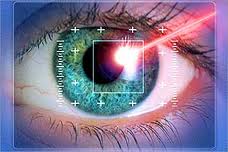
The Iris is another Biometric feature that is very unique to an individual, it is the coloured part of the eye, is composed of a type of tissue called trabecular meshwork which gives the appearance of layered radial lines or mesh when the iris is examined closely.
The visible mesh consists of characteristics such as striations, rings, crypts, furrows etc. giving the iris a unique pattern. The iris pattern is stable throughout the lifespan of an individual and is different for twins as well since the pattern is independent of genetic makeup. With this feature of the Iris there are no two individual that have the same characteristics even “Identical twins!”
5. Hand Geometry
The hand image is obtained using a digital camera looking from the top when the user placed his or her hand at a specified surface. This specified surface is very essential when applying the recognition and matching technique. The hand can be aligned using pegs or reference marks. Two views are usually taken in a single image, the top view and the side view. The side view is usually taken by the top camera as well using a side mirror. From the hand image, the fingers are located and the length, width, thickness, curvatures and their relative geometry measured.
6. Voice
Voice authentication or speaker recognition uses a microphone to record the voice of a person. The recorded voice is digitized and then used for authentication. The speech can be acquired from the user enunciating a known text (text dependent) or speaking (text independent). Age, illness and environment may affect the effectiveness of voice recognition, these features or conditions are put into consideration when proffering Biometric Technology solution using Voice.
However, not all biometric Technology is suitable for identification.
There are other Biometric Technologies including Signature, Retinal Scan, DNA, Typing, Vein Pattern (such as within the Wrist, Palm or Dorsal surfaces of the hand), Thermal pattern of the Face keystroke Dynamics, Gait (Walk, Step, Pace) Pattern, Body Odour and Ear shape.
In proffering a Biometric Technology, we recommend adopting more than one solution, a multi-modal system which combines several Biometric Technologies to increase the likelihood of finding a match will be increasingly feasible as hardware and system cost decreases to an attractive level. Each solution is designed and implemented according to the clients need and challenge.
Factors to consider before deployment
These factors are considered- The Issues, Potential and Challenges faced by Biometric Technology. In selecting a specific biometric technology and solution to clients the following must be considered:-
1. Size and type of user group.
2. Place of use and the nature of use (such as needs for mobility and location)
3. Ease of use, and user training required and transfer of knowledge where necessary
4. Error incidence such as due to age, environment and health condition.
5. Security and accuracy requirement needed.
6. User acceptance level, privacy and anonymity.
7. Long term stability including technology maturity, standard, interoperability and technical support.
8. Cost.
There are numerous applications for Biometric systems. Most applications currently concentrate on Security related, physical and logical Access Control and many more enhancements are underway. These include the following areas:
- Immigration such as border control, frequent travelers, air ports,
- Banking/Financial Services such as ATMs, Payment Terminals, Cashless Payment, Automated Cheque Cashing, etc.
- Computer & IT Security such as Internet Transactions, PC login etc.
- Healthcare such as privacy concern, patient information control, drug control etc.
- Law and Order such as public ID card, voting, gun control, prison, parole etc.
- Gatekeeper/Door Access Control such as secure installations, military, hotel building management etc.
- Telecommunication such as telephony, mobile phone, subscription fraud, call center, games etc.
- Time and Attendance such as school and company attendance
- Welfare, including health care services
- Consumer Products such as automated service machines, vault, lock-set, PDA, etc.